Banner | Promotion
This article is submitted by the author team (research group).
In today’s world, where information is rapidly developing, LCDs have become an indispensable part of daily life and work as the main carrier of information presentation and the fundamental window for human-computer interaction. With the improvement of living standards and socio-economic conditions, the demand for LCDs with excellent color rendering and color reproduction has surged. Perovskite quantum dot glass, due to its combination of the outstanding optical properties of quantum dots (high color purity, high photoluminescence quantum efficiency, tunable emission colors, etc.) and the excellent physical/chemical stability of inorganic glass, is considered an ideal alternative to traditional phosphor conversion layers in backlit displays, showing broad application prospects in the display industry.
Recently, Professor Chen Daqin and his team from Fujian Normal University published a review article titled “Applications of Perovskite Quantum Dot Glass Backlighting” in the column of “Quantum Dot LCD Application Technology” in the journal Liquid Crystal and Display (ESCI, Scopus, core Chinese journal) 2023, Issue 3. This article introduces the application methods of perovskite quantum dot glass backlight structures and summarizes the current research status and challenges faced in the development of perovskite quantum dot glass in backlight applications, finally providing an outlook on its future in backlight applications.
Encapsulation Methods for Perovskite Quantum Dot Glass BacklightingCurrently, there are three main configurations for LCD backlight systems, categorized based on the placement of quantum dot materials: “On Chip,” “On Edge,” and “On Surface.”
• “On Chip” Encapsulation
The “On Chip” encapsulation directly places the perovskite quantum dot glass on the surface of the blue LED chip’s light-emitting layer, achieving white light through coupling (Figure 1a). However, in practical applications, the stability of quantum dot glass is required to be very high. This is because the junction temperature during normal operation of the blue LED chip can be between 85-120 °C, and the perovskite quantum dot glass also releases some heat during the light conversion process, necessitating that the quantum dot glass maintain long-term luminescent stability at 150 °C. In addition, a 1W blue LED chip has a radiation power density of approximately 60W/cm², so the perovskite quantum dot glass must not only have excellent thermal stability but also outstanding optical stability, which is still a significant challenge for current perovskite quantum dot glass.
• “On Edge” Encapsulation
The “On Edge” encapsulation prepares quantum dot glass powder into a conversion strip installed on the side edge of the light guide plate where the blue LED light bar enters, coupling it into the light guide plate. This structure effectively reduces the impact of heat and light radiation from the blue LED chip on the luminescent materials of the quantum dot glass, and the amount of raw material used is relatively small, about one percent of that used in the “On Surface” method. However, due to the difficulty in assembly and encapsulation of this structure, research on perovskite quantum dot glass in the “On Edge” encapsulation is still in its infancy.
• “On Surface” Encapsulation
The “On Surface” encapsulation involves applying a perovskite quantum dot glass film to the blue light guide plate for light conversion and diffusion, forming a white light backlight source (Figure 1c). This structure does not directly contact the light-emitting layer and allows for uniform diffusion of blue light through the light guide plate, resulting in minimal heat and light radiation affecting the quantum dot glass conversion film, thus adequately meeting application requirements. However, this structure requires a larger amount of quantum dot glass raw material, and as the size of the display increases, the cost also gradually rises. In terms of film preparation, the perovskite quantum dot glass conversion film has not yet achieved industrial production, and related research is relatively limited. Therefore, how to effectively prepare low-cost, high-brightness perovskite quantum dot glass optical conversion films is a major challenge hindering its practical application.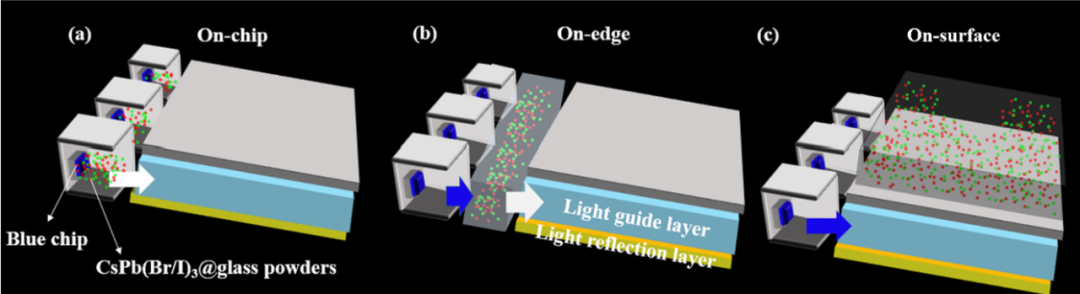
Figure 1: (a) On Chip, (b) On Edge, (c) On Surface
Source: Chemical Engineering Journal, 2020, 398: 125616.
Current Development Status of Perovskite Quantum Dot Glass Backlighting• Development Status of Perovskite Quantum Dot Glass Chip Encapsulation in Backlight ApplicationsSince Wang et al. first precipitated CsPbBr₃ quantum dots in phosphate glass in 2016, many researchers have focused their attention on perovskite quantum dot glass and its application studies, with the research on chip applications of perovskite quantum dot glass being a hotspot. For example, Liu et al. demonstrated strong luminescence and excellent luminous efficiency in light-emitting devices made from perovskite quantum dot glass, with green LED devices achieving a maximum luminous efficiency of ~120 lm/W, and external quantum efficiency reaching ~30%. White LED devices showed a luminous efficiency of 50-60 lm/W and an external quantum efficiency of 20-25% (Figure 2). Additionally, thanks to the protection of inorganic glass, CsPbX₃ perovskite quantum dots exhibited excellent light and water resistance, and after 20 cycles of heating and cooling from 20 °C to 200 °C, the luminous intensity showed almost no decrease, demonstrating excellent thermal reversibility. Similarly, Guo et al. prepared CsPbX₃@glass with outstanding stability and thermal reversibility in borosilicate glass, where CsPbBr₃@glass maintained 98.7% of its initial luminous intensity after 10 cycles of thermal cycling at 300-400K, and after 60 days of exposure to 150W UV light, the luminous intensity decreased by less than 5%. By coupling a blue LED chip with the CsPbX₃@glass conversion layer, a white LED device with a wide color gamut was produced, achieving a color gamut of 121.9% of the NTSC display color gamut and 91.1% of the Rec.2020 display color gamut.
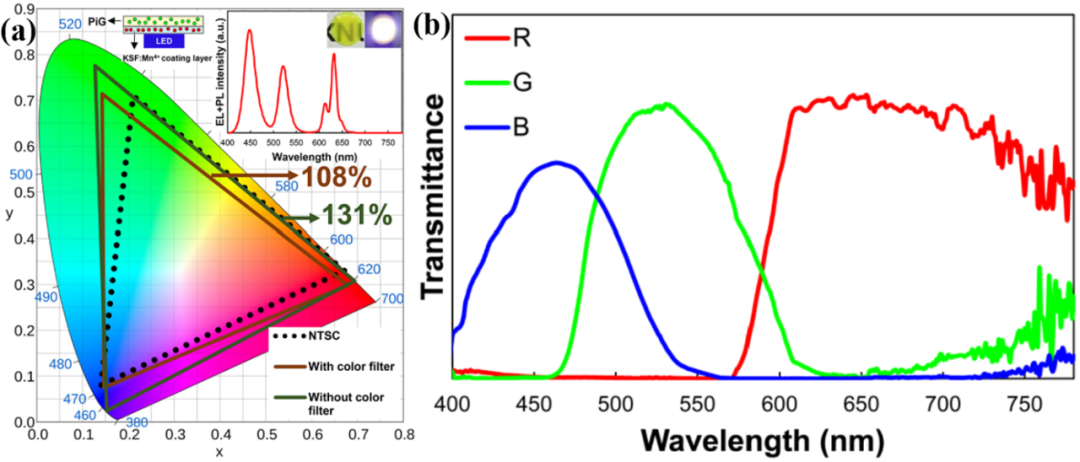
Figure 2: (a) CsPbBr₃@glass, (b) CsPb(Br/I)₃@glass, (c) CsPbBr₃@glass + CsPb(Br/I)₃@glass sheets for green, red, and white LED devices; (d) luminous efficiency and external quantum efficiency of LED devices constructed from CsPbBr₃@glass and CsPb(Br/I)₃@glass; (f) relationship between luminous chromaticity coordinates of green and red LED devices and forward bias current.Source: Advanced Optical Materials, 2019, 7(9): 1801663.It is worth noting that the color gamut of white LEDs does not represent the range of colors that LCDs can display, as LCDs achieve color display through white light sources combined with color filters. Therefore, the final color display effect is constrained by both the luminous characteristics of the white backlight source and the spectral transmission of the color filters. For instance, Im et al. used CsPbBr₃@glass PIG sheets and KSF:Mn⁴⁺ coating layers coupled with blue light chips to produce white LEDs, and after the action of color filters, the color gamut dropped from 131% of the NTSC display color gamut to 108% (Figure 3a), which also proves that color filters greatly influence the display characteristics of LCDs. However, the current filtering effects of color filters are quite limited, as red, green, and blue color filters can only filter out certain wavelength ranges of light, while still allowing a wide band of light to pass through within their respective emission bands (Figure 3b). Thus, the luminous characteristics of the white backlight source play a crucial role in the color display capability of the display. Furthermore, perovskite quantum dot glass generally suffers from high-temperature thermal quenching, with luminous intensity dropping to about 20% of the initial value around 100 °C. This result also demonstrates that perovskite quantum dot glass cannot maintain long-term luminous stability during normal operation of blue LEDs. Therefore, alternative configuration methods are needed to realize the application of perovskite quantum dot glass in backlighting.
Figure 3: (a) The color reproduction range of white LEDs made with CsPbBr₃ quantum dot glass PIG sheets and KSF:Mn⁴⁺ coating layers with and without color filter; the inset shows the luminescent images of the white LEDs and PL spectra. (b) Transmission spectra of red, green, and blue (R, G, B) color filters.
Source: ACS Applied Nano Materials, 2021, 4(7): 7072-7078.
• Development Status of Perovskite Quantum Dot Glass Chip Encapsulation in Backlight ApplicationsThe “On Surface” encapsulation, due to not directly contacting the light-emitting layer and allowing blue light to diffuse uniformly through the light guide plate, results in minimal heat and light radiation affecting the optical conversion film, making the application of perovskite quantum dot glass optical conversion films in backlit displays feasible. In fact, perovskite quantum dot optical conversion films have already been successfully developed. In 2016, Zhong et al. successfully prepared perovskite quantum dot optical conversion films with high transparency (>85%) and high luminous quantum efficiency (>90%) and integrated this optical conversion film into the “On Surface” backlight structure. As shown in Figure 4g-h, the LCD prototypes based on the perovskite quantum dot optical film exhibited more saturated and vivid colors compared to commercial LCD screens (after filtering, the color gamut was 105% of NTSC). Unfortunately, this film lost almost all its luminous intensity in less than five days under accelerated aging conditions (70 °C/85% RH) due to the decomposition and failure of the perovskite quantum dots when exposed to external environments (such as light, heat, and air). Therefore, achieving commercial applications of wide color gamut backlit flat displays with perovskite quantum dot optical conversion films still faces many urgent issues, especially the stability of the quantum dot optical films. It is worth mentioning that the currently produced perovskite quantum dot optical films, even when encapsulated with barrier films, can only meet partial commercial aging requirements (60°C, 90% RH aging) and cannot pass more stringent industrial aging test standards like double 85. This is because the barrier film encapsulation still cannot completely prevent the infiltration of water and oxygen into the optical film. Therefore, improving stability and reducing costs are critical bottleneck issues that need to be addressed for the application of perovskite quantum dot optical films in backlit displays.In recent years, perovskite quantum dot glass, due to its seamless encapsulation by the dense network structure of inorganic glass, can effectively isolate quantum dots from the external environment, providing a promising new approach to completely solve its stability issues. For example, Chen et al. prepared optical conversion films with excellent optical performance and stability by blending perovskite quantum dot glass powder with silicone gel to form films (Figure 4a-d). By adjusting the weight ratio of [CsPbBr₃@glass]/PDMS, the quantum yield of the conversion film can reach ~100%, and it maintains over 80% quantum yield under 365-480 nm light excitation (Figure 4a-b). These findings confirm their suitability as conversion layers in backlighting excited by blue light chips. Meanwhile, display devices constructed based on quantum dot glass/polymer films for white backlighting achieved a wide color gamut, reaching 152% of the commercial LCD display color gamut and 103% of the NTSC display color gamut (after filtering), exhibiting more saturated and vivid colors compared to commercial LCDs (Figure 4e-f). Xiang et al. mixed quantum dot glass powder with UV-curable glue, then coated it between two layers of PET films to obtain perovskite quantum dot glass film conversion layers. The display devices assembled with this conversion layer demonstrated a wide color gamut, reaching 126.27% NTSC and 93.9% Rec.2020 display color gamuts (without filtering), and due to the dual protection of the PET film and glass substrate, this composite film exhibited good water and thermal resistance. After soaking in water at 80 °C or exposing to blue light at 460 nm for 96 hours, the luminous intensity showed no significant change. After continuous operation of the assembled display for 60 hours, the performance and output image quality remained unchanged. These results indicate that perovskite quantum dot glass has broad application prospects in wide color gamut LCDs.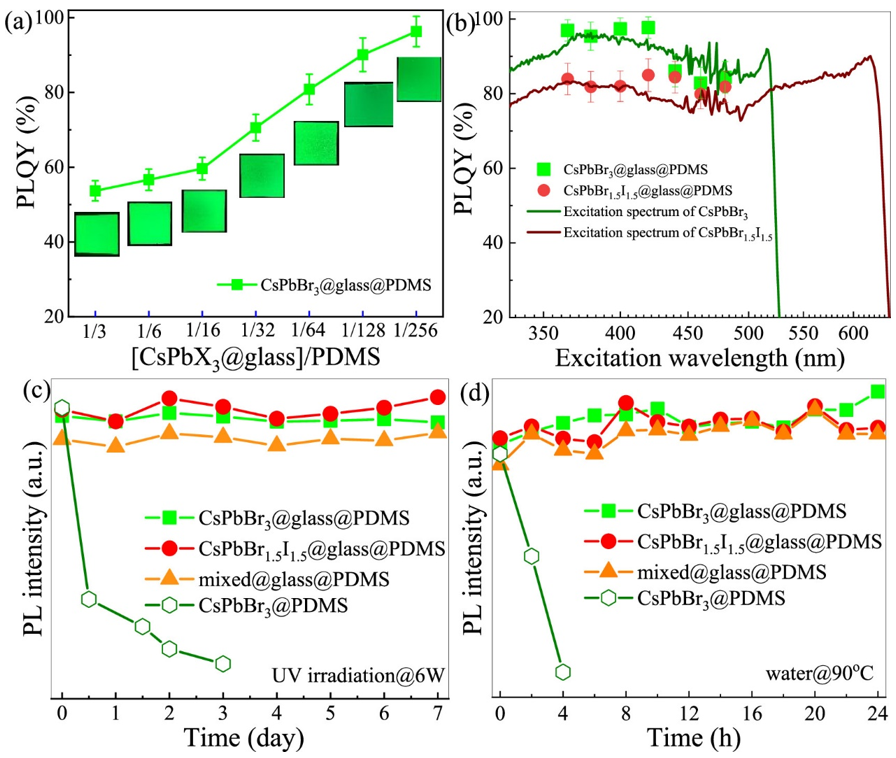
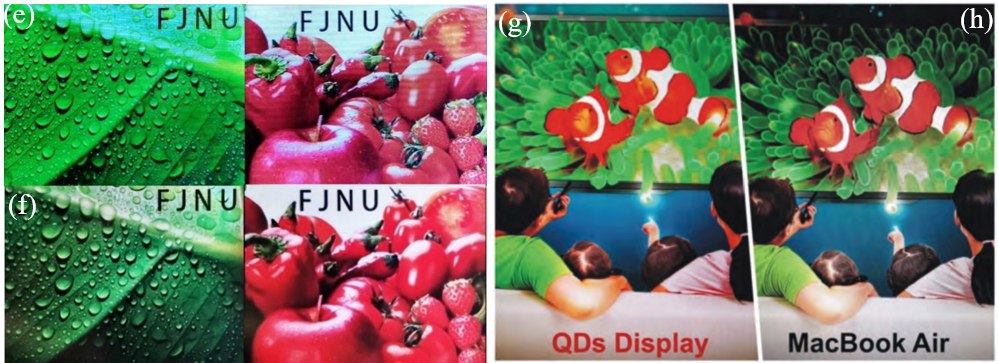
Figure 4: (a) Quantum yield of CsPbBr3@glass@PDMS films with different [CsPbBr3@glass]/PDMS weight ratios; the inset shows a physical photo of the luminescent film; (b) Quantum yields of CsPbBr3@glass@PDMS and CsPbBr1.5I1.5@glass@PDMS films as a function of incident excitation light wavelength; (c) Photostability testing under UV light (6W) for 7 days; (d) CsPbX3@glass@PDMS film immersed in 90 °C water for 24 hours during accelerated aging tests. For comparison, data for colloidal CsPbBr3@PDMS films are also provided in (c, d). The display effect of prototypes integrated with perovskite quantum dot glass optical films (f) compared to commercial displays (e); (g) and (h) compare the display effects of prototypes integrated with colloidal perovskite quantum dot optical films and Apple laptop displays.
Sources for Figure 4 a-f: ACS Energy Letters, 2021, 6(2): 519–528.
Sources for Figure 4 g-h: Chinese Optics, 2017, 10(5): 666-680.
Challenges Faced in Perovskite Quantum Dot Glass Backlighting ApplicationsDespite the stability of perovskite quantum dot glass being sufficient to meet application demands, there are still some urgent issues to be addressed for backlighting applications. These issues can be divided into two categories.
One category involves optical performance issues inherent to perovskite quantum dot glass:
1. The luminous efficiency still needs to be further improved compared to colloidal quantum dots, especially for red-emitting quantum dots;
2. The full width at half maximum of the emission needs to be further narrowed;
3. Optical performance tends to drop sharply during emission wavelength tuning.
The other category involves issues during application:
1. Perovskite quantum dot glass is prone to thermal quenching at high temperatures, making it unable to maintain long-term stable luminescence during normal operation of the chip;
2. The preparation process of perovskite quantum dot glass conversion films is not yet mature, remaining at the experimental stage and unable to achieve large-scale industrial production.These scientific challenges present new obstacles for the application of perovskite quantum dot glass in backlit displays.Summary and OutlookFor the display industry, enhancing the color reproduction and rendering effects of screens has become an inevitable trend, and perovskite quantum dot glass, due to its excellent optical performance and stability, shows strong competitiveness in backlighting applications. The dense network structure of glass effectively isolates perovskite quantum dots from water and oxygen without the need for barrier films, significantly improving the stability of perovskite quantum dots. However, several issues still need to be resolved for industrial applications, such as the high cost of PDMS, long film formation cycles, and challenges in producing large-area films. Therefore, it is urgent to select suitable polymer carriers (e.g., PMMA, PC, PS, PP, etc.) and develop low-cost, high-stability, and optically excellent perovskite quantum dot glass/polymer composite materials that meet industrial production demands, ultimately achieving backlit displays. It is believed that in the near future, perovskite quantum dot glass will play a more important role in backlighting displays. Paper Information Lin Jidong, Chen Daqin. Applications of Perovskite Quantum Dot Glass Backlighting [J]. Liquid Crystal and Display, 2023, 38(3):342-355.https://cjlcd.lightpublishing.cn/thesisDetails#10.37188/CJLCD.2022-0223
Corresponding Author Introduction

Chen Daqin, Professor at Fujian Normal University, PhD supervisor, and high-level talent introduced to Fujian Province (Class B). He obtained his bachelor’s and master’s degrees from Central South University in 2001 and 2004, and his PhD from the Fujian Institute of Material Structure Research, Chinese Academy of Sciences in 2008. He is engaged in the research and development of luminescent materials and devices. He has led one national key research and development project and one sub-project, five projects from the National Natural Science Foundation, as well as the Fujian/Zhejiang Provincial Outstanding Youth and Fujian Provincial Natural Science Key Fund. He has published over 200 SCI papers as the first or corresponding author in journals such as Chem. Soc. Rev., AM, AFM, JACS, Light Sci. Appl., ACS Energy Lett., and Nano. Energy, with over 15,000 citations and more than 30 papers cited over 100 times, an H-index of 75, and over 30 ESI hot/highly cited papers. He holds more than 20 authorized Chinese invention patents, has written three book chapters, and translated a monograph titled Introduction to Materials Science and Engineering.
Supervised by: Zhang Ying, Zhao YangEdited by: Zhao Wei Banner Promotion
Welcome to submit promotional articles from research groups.
Please scan the QR code to contact the on-duty editor.

Some readers say they often do not receive push articles from the public account.
Finally, I found a secret!
It turns out, if you do not “star”⭐️, you won’t see me!
Currently, there is an effective solution: click on the public account name “Chinese Optics” at the top of the article to enter an interface, click the “···” icon in the top right corner, a new interface will pop up, and click “Set as Star” (as shown in the figure below).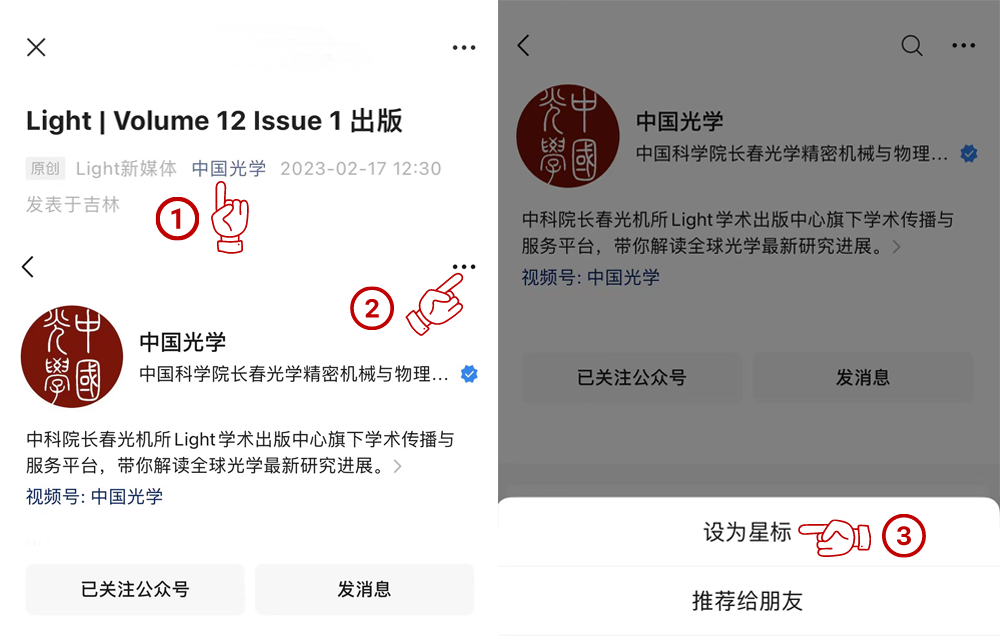
Click here 👇 to follow me
Light up the “Like” and “Looking” buttons, so you won’t miss article updates.