1. Application of UAV Operations in Recent Conflicts
In recent years, the use of unmanned aerial vehicles (UAVs) in actual combat has become increasingly frequent, with their roles becoming more prominent, drawing significant attention from countries around the world towards UAV combat applications. Especially during the Russia-Ukraine conflict that erupted in 2022, both sides extensively deployed UAVs, fully utilizing the “asymmetric” advantages of UAVs to construct a comprehensive airstrike system integrating battlefield reconnaissance, fire guidance, ground strikes, and effect assessment, becoming a “force multiplier” on the battlefield.
(1) Initial Deployment – Syrian War
On January 5, 2018, the Syrian opposition launched the first-ever cluster drone attack in the history of warfare. The Russian air defense system detected a total of 13 UAVs, of which 10 were targeting the Khmeimim Air Base, and 3 were aimed at a logistics facility at Tartus Naval Base.
Both captured UAVs were fixed-wing designs, navigated using GPS and altimeters; powered by small internal combustion engines, their wings were made of polystyrene reinforced with wooden strips; each wing carried 3 releaseable improvised bombs, and each UAV could carry 6. Although the UAVs used in this attack were relatively crude, with lower technical levels and poor guidance accuracy, they demonstrated the enormous potential of cluster UAV tactics.
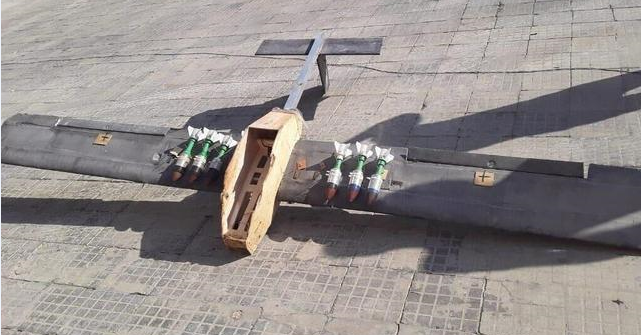
Figure 1: Self-made UAVs by the Syrian opposition
(Source: Phoenix News Global Network)
(2) Formation of Combat Capability – Attack on Saudi Oil Company
In the early hours of September 14, 2019, several UAVs attacked a Saudi oil company, causing paralysis to two oil facilities. A total of 18 UAVs were involved in the operation, utilizing 3 different types of UAVs: Kassef-3, Samad-3, and an undisclosed model. During the attack, the three types of UAVs took off from different locations in Yemen, with one UAV equipped with electronic warfare equipment providing protection for the entire operation. Cruise missiles coordinated with UAVs to attack from multiple directions.
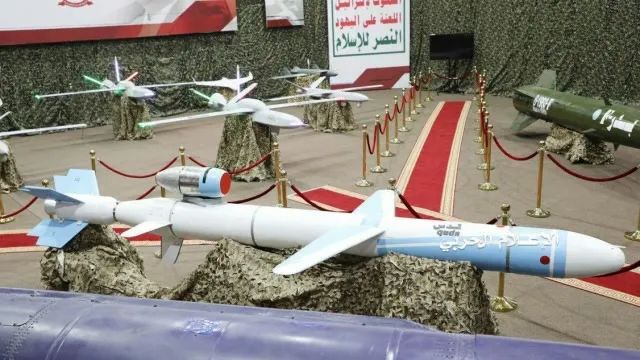
Figure 2: UAVs showcased by the Houthis
(Source: Zhihu)
(3) Becoming Main Battle Equipment – Nagorno-Karabakh Conflict
On September 27, 2020, fierce clashes erupted between Azerbaijan and Armenia in the Nagorno-Karabakh region. In the early stages of the war, the Azerbaijani army was at a disadvantage. With support from Turkey and Israel, the Azerbaijani forces extensively utilized Turkey’s TB2 armed reconnaissance UAV, domestically improved An-1 UAVs, and Israel’s Hermes 900 UAVs to deliver devastating strikes against Armenia’s air defense systems, T-70 tanks, and artillery positions, turning the tide of the battle. In this conflict, UAVs were first used as main battle equipment, playing a crucial role and drawing significant global attention to UAV combat applications.
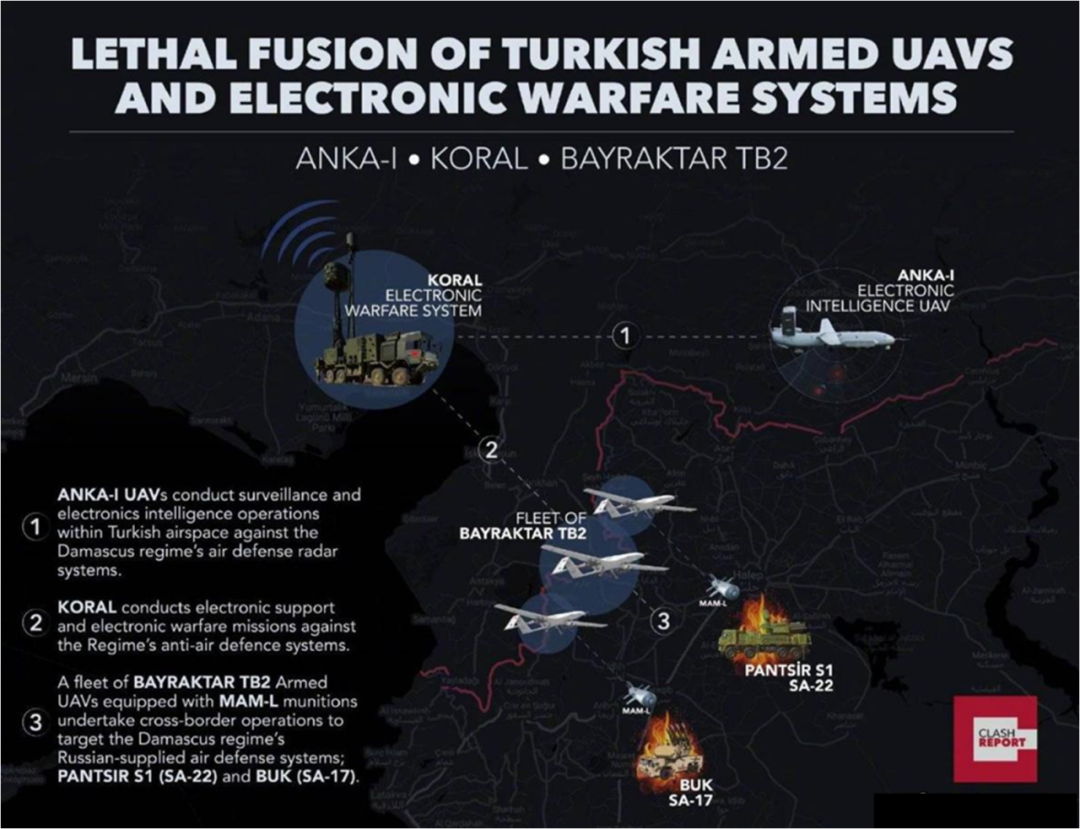
Figure 3: TB2 striking the Pantsir-S1
(Source: Clash Report)
(4) Mature Combat Applications – Russia-Ukraine War
Since 2022, UAV equipment on the Russia-Ukraine battlefield has demonstrated significant effects in reconnaissance, target indication, precision strikes, electronic warfare, cognitive warfare, and information warfare.
High-altitude/Close Reconnaissance: During the battle for Snake Island, Ukrainian forces dispatched an RQ-4 UAV for high-altitude reconnaissance of Russian military deployments on Snake Island, completing a strategic reconnaissance mission; additionally, an RQ-4 UAV was sent from the Sigonella base in Italy directly to the Donbas region in eastern Ukraine and the international airspace over the Black Sea for aerial reconnaissance of Russia.
On the Russian side, the “Outpost” UAV was used for close reconnaissance, battlefield monitoring, target indication, and artillery correction. The “Outpost” UAV provided support and reconnaissance against Ukrainian frequent armed attacks for Russian ground convoys.
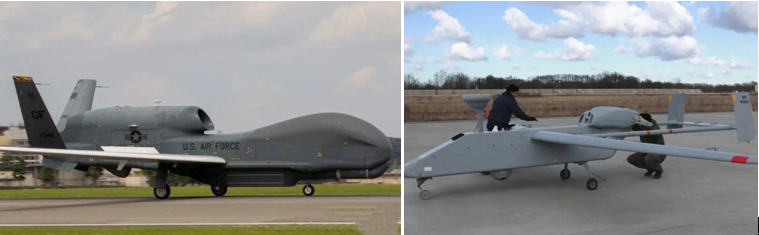
Figure 4: RQ-4 UAV (Ukraine) and “Outpost-R” UAV (Russia)
(Source: Tencent News)
Strike/Reconnaissance: In the early stages, the Ukrainian military seized the opportunity presented by the rapid advance of Russian forces and the lack of air cover, deploying multiple batches of TB2 UAVs to strike key weak points in Russian supply lines and logistics convoys, destroying 6 Russian armored vehicles, 10 air defense missile systems (launchers, transport vehicles, guidance vehicles), 2 command posts, 1 communication station, and 9 helicopters.
On the Russian side, the “Orion” strike UAV was used to strike Ukrainian ground targets, successfully hitting a command post of the Ukrainian “Aidar Battalion” with a 9M133FM-3 missile.
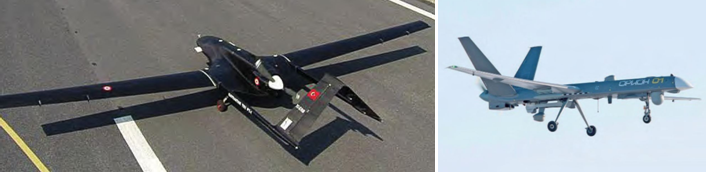
Figure 5: TB2 UAV (Ukraine) and “Orion” UAV (Russia)
(Source: “China Military Transition to Civilian” and “Tactical Missile Technology”)
Fire Guidance: In May 2022, during the defense of the Siverskyi Donets River, the Ukrainian army utilized multiple small UAVs provided by NATO to relay reconnaissance of Russian river crossing operations and located Russian crossing points, guiding rear long-range artillery to cover fire, destroying dozens of Russian vehicles and two floating bridges, forcing the Russian crossing operation to halt.
The Russian side dispatched a “Sea Eagle-10” UAV for continuous tracking and monitoring of the Ukrainian forces, subsequently discovering the Ukrainian pre-set artillery positions, guiding fire support to eliminate remaining combat personnel according to the fire strike process.
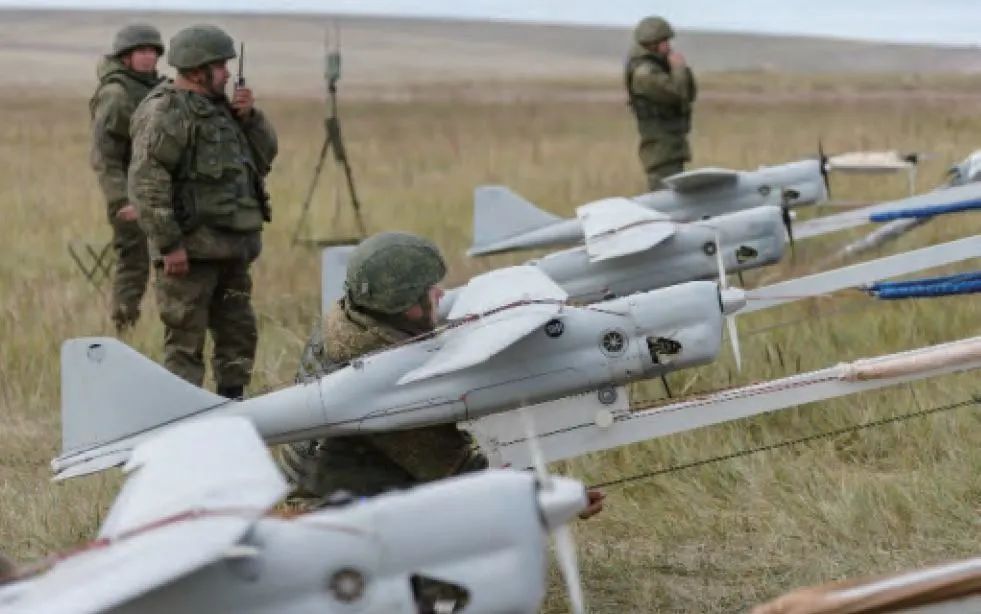
Figure 6: Russian “Sea Eagle-10” UAV launch scene
(Source: “Tactical Missile Technology”)
Suicide Strike: Recently, two Ukrainian suicide UAVs attacked the Kremlin in Russia. After timely action by the Russian military and special forces using radar warfare systems, the two UAVs’ actions were thwarted, failing to achieve their attack objectives. However, debris from the downed UAVs fell on the Kremlin’s dome, leaving explosion marks.

Figure 7: Attack on the Kremlin by UAVs
(Source: Tencent News)
The Russian side has focused on using the highly destructive “Geranium-2”, capable of launching 5-7 UAVs in succession, with its piston engine located at the rear of the fuselage, utilizing a propeller for propulsion. Under the suicide strike of the “Geranium-2”, 30%-40% of Ukraine’s national power infrastructure has been attacked, with over half of thermal power facilities being targeted.
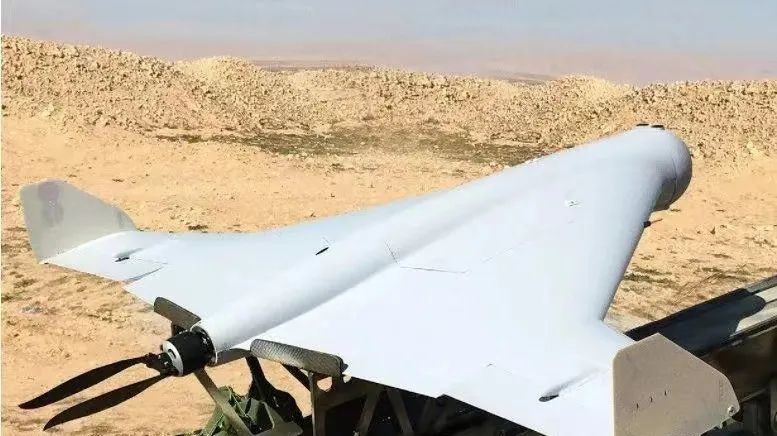
Figure 8: “Geranium-2” UAV
(Source: Sohu News)
Micro UAV Grenade Projection: The Ukrainian army has conducted weapon projection strikes against Russian soldiers using self-developed quadcopter UAVs, achieving precise strikes and damage against Russian personnel in trenches and BMD-4M tracked vehicles.
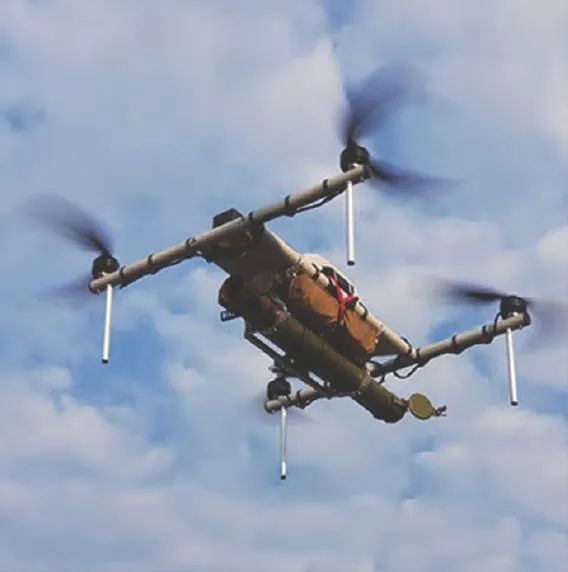
Figure 9: Ukrainian self-developed quadcopter UAV with weapon payload
(Source: “Tanks and Armored Vehicles”)
The Russian military has used the “Mugin-4” UAV to project bombs, causing damage. The Russian military has previously used this UAV to drop grenades on Ukrainian positions, resulting in casualties among Ukrainian soldiers.
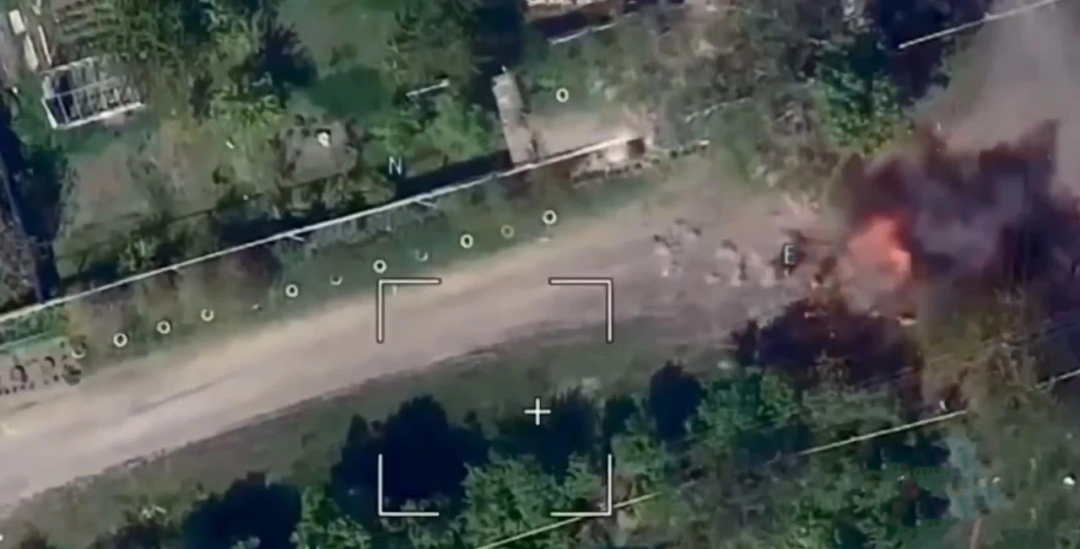
Figure 10: Quadrotor UAV dropping grenades on ground vehicles
(Source: Tencent News)
2. Analysis and Summary of Foreign UAV Combat Styles and Characteristics
Based on the UAV combat applications in recent conflicts, we analyze and summarize the combat styles of five typical UAV categories, along with their characteristics and operational parameters.
(1) High-altitude/Close Reconnaissance Mode
Utilizing high-altitude long-endurance UAVs and advanced stealth UAVs for long-distance reconnaissance of enemy coastal ports and positions, providing intelligence information for command decision-making and target indication for long-range strike weapons while assessing damage effects.
Taking the typical type 5 UAV “Global Hawk” as an example, its operational style profile is shown in Figure 11.
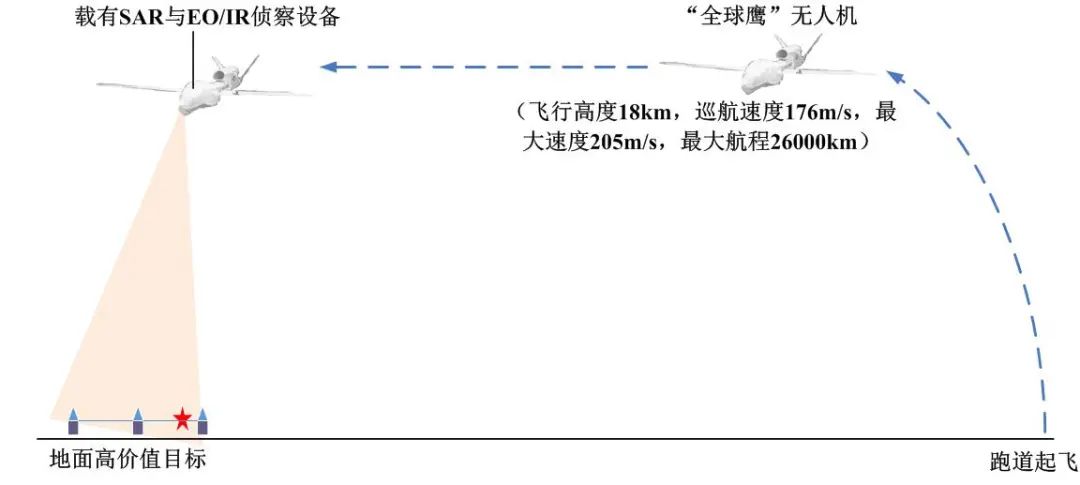
Figure 11: High-altitude/Close reconnaissance operational style profile of the “Global Hawk” UAV
(2) Strike/Reconnaissance Mode
This mode generally employs medium or small UAVs, primarily for early-warning reconnaissance of ground and surface targets in key areas, providing intelligence information for command decision-making in the early stages of combat, and providing target indication for long-range strike weapons in the later stages while utilizing onboard strike weapons to engage ground and surface targets.
Taking the typical type 4 UAV “TB2” as an example, its operational style profile is shown in Figure 12.
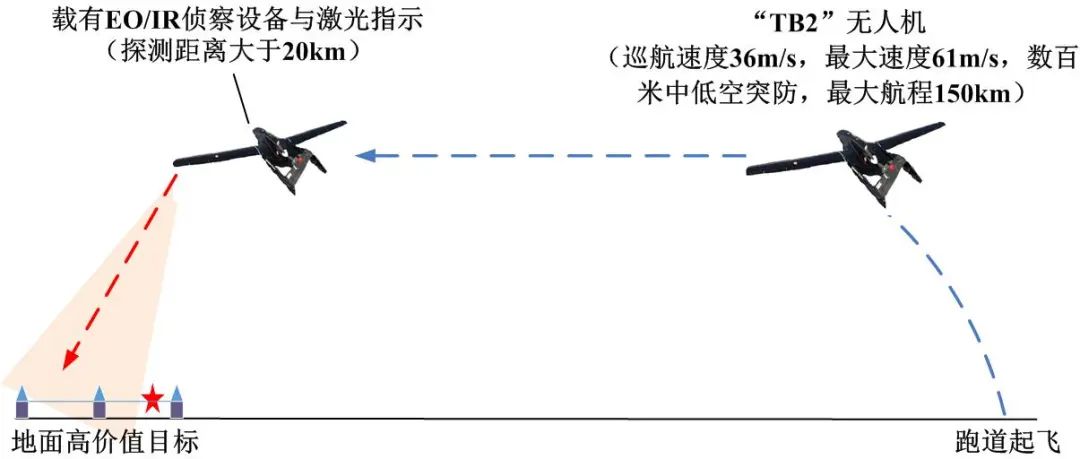
Figure 12: Strike/Reconnaissance operational style profile of the “TB2” UAV
(3) Suicide Strike Mode
Utilizing medium and small UAVs/loitering munitions, conducting multi-directional flight and low-altitude penetration to perform point-to-point suicide attacks on command stations, vessels, armored vehicles, and personnel in the later stages of combat.
Taking the typical type 2 UAV “Spring Knife 600” as an example, its operational style profile is shown in Figure 13.
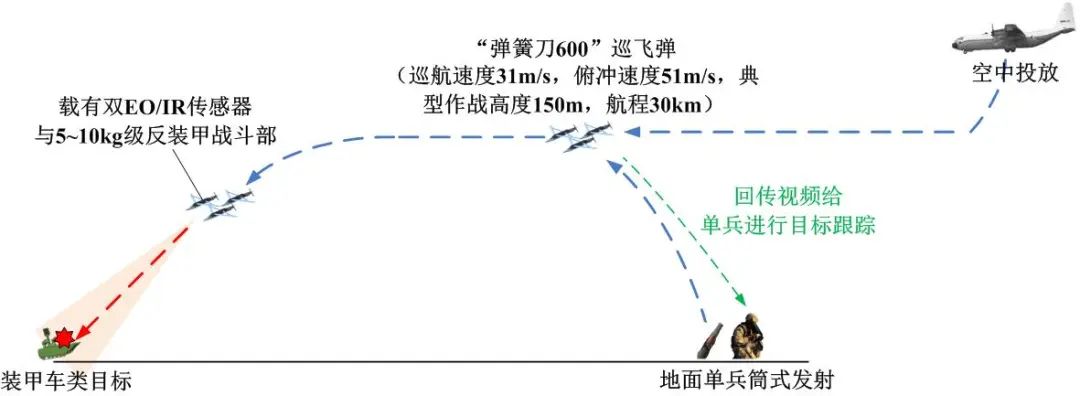
Figure 13: Suicide attack operational style profile of the “Spring Knife 600” loitering munition
(4) Guided Cruise Missiles/Artillery Collaborative Attack Mode
Utilizing medium and small UAVs for low-altitude penetration, conducting multi-directional feints against naval formations, consuming their air defense firepower, while launching cruise missiles and anti-ship missiles to strike land/sea targets; utilizing medium and small UAVs to reconnoiter land/sea target locations, providing precise target indication, guiding rockets/artillery for long-range strikes in the early stages of combat to achieve area coverage killing and conducting damage effect assessments.
Taking the typical type 3 UAV “Little Elf” as an example, its operational style profile is shown in Figure 14.
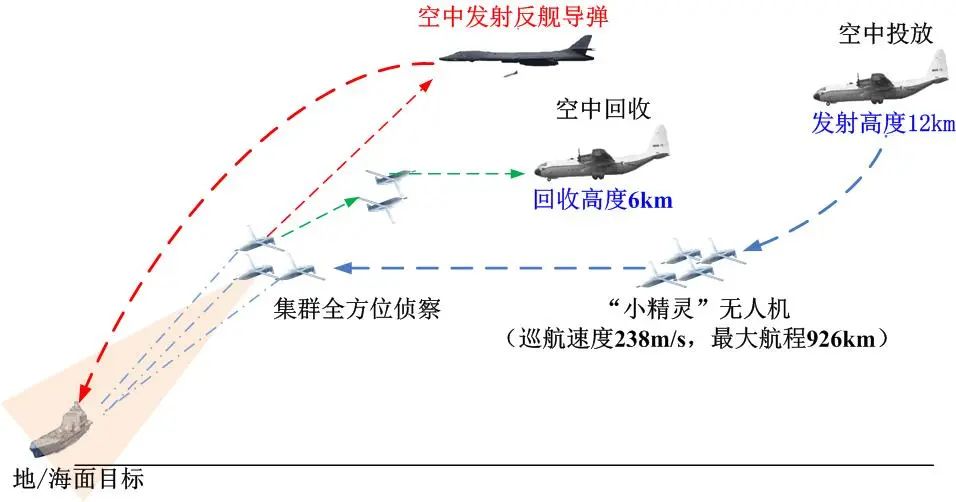
Figure 14: Fire guidance operational style profile of the “Little Elf” UAV
(5) Grenade Projection Mode
Utilizing micro UAVs, such as quadcopters and quadrotors, leveraging terrain and tree cover to approach combat personnel and deploying grenades in the vicinity of combat personnel.
Taking a typical civil type quadcopter UAV as an example, its operational style profile is shown in Figure 15.
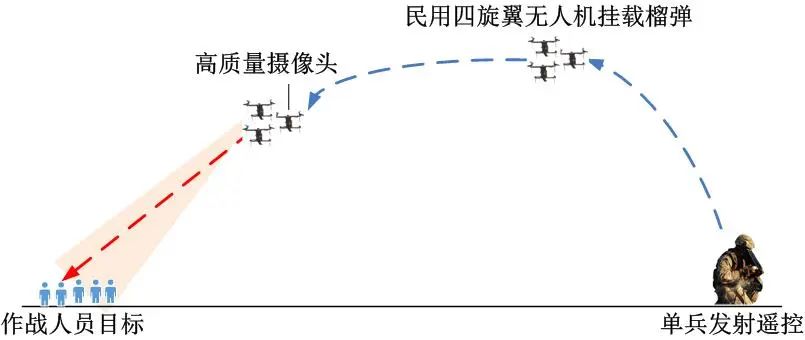
Figure 15: Civil quadcopter UAV deploying grenades
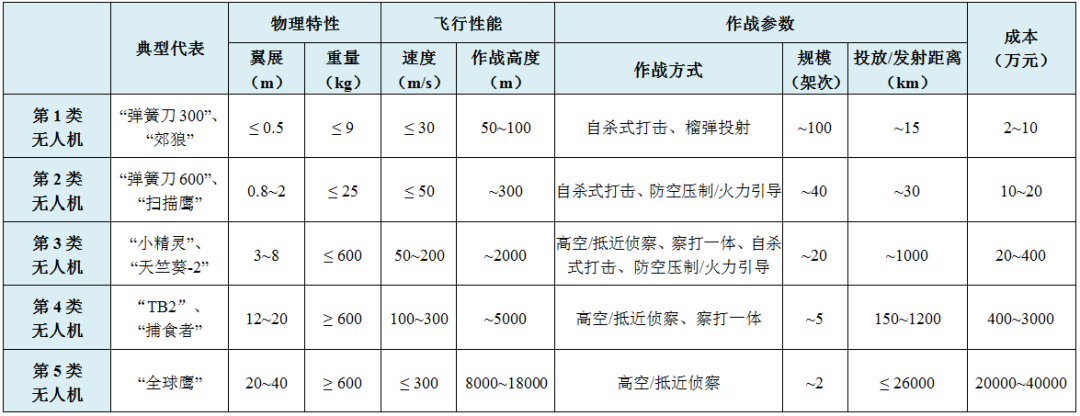
Based on the characteristics and typical styles of UAVs from categories 1 to 5, we summarize the target characteristics and specific operational parameters of each UAV type, as shown in Table 1.
Table 1: Characteristics and Operational Parameters of 5 UAV Types
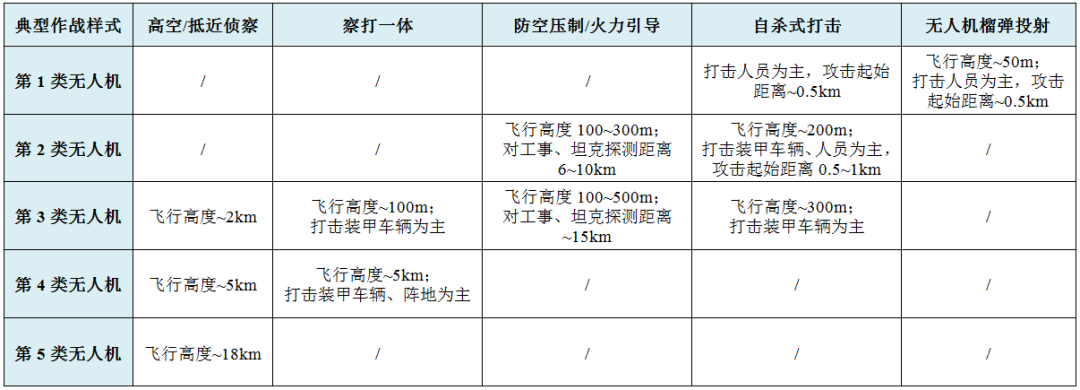
We have summarized and organized the typical operational styles of UAVs in various recent local wars and conflicts, as shown in Table 2.
Table 2: Typical Operational Characteristics and Styles of 5 UAV Types
3. Conclusion
From the global local conflicts that have erupted since 2018, it is evident that UAVs (and swarms) possess characteristics such as strong autonomy, high cost-effectiveness, and high levels of intelligence compared to traditional weaponry in various combat scenarios. With the development of artificial intelligence technology and the expansion of practical applications on the battlefield, countries are accelerating their exploration and research into new UAV (and swarm) combat styles. Constructing or developing new, high-efficiency, and highly intelligent anti-UAV (and swarm) weaponry will be an important direction for future air defense development.
Author: Liao Xin, Gu Yifan
Editor: Zhou Pinwu
Introduction to “Aerospace Defense”
“Aerospace Defense” was founded in 2018, supervised by China Aerospace Science and Technology Corporation, and co-hosted by Shanghai Institute of Mechanical and Electrical Engineering and Shanghai Jiao Tong University Press. It is an academic journal publicly issued in the field of aerospace defense. The journal adheres to the purpose of “publishing new theories, new technologies, and new achievements in the field of integrated aerospace defense, promoting academic exchanges, advancing military-civilian integration and achievement transformation, improving China’s aerospace defense weaponry level, and serving the modernization of China’s national defense and military construction,” and collects nationwide contributions on aerospace defense strategy research, system verification and research, military-civilian integration technologies, and new concept defense technologies, discussing and promoting technological innovation, ideological innovation, theoretical innovation, and application of achievements. We sincerely welcome your submissions!
Contact Information:
Website: www.qk.sjtu.edu.cn/ktfy
Email: [email protected]
Mailing Address: Editorial Office of “Aerospace Defense”, No. 1333-1 Zhongchun Road, Minhang District, Shanghai, Zip Code: 201109
Contact Number: (021) 24185113, 24185376