Data is valuable; research reduces worries
Dig deep, look far, find patterns
Take notes, practice trading skills, summarize often

★★★★★Creating original content is not easy; my articles do not require rewards or paid knowledge, and you can learn tips for free. If you like it, please like, bookmark, share, and pin it. Thank you from the little red bull.★★★★★
Deepseek’s five-step stock review method is generally recognized!!
Deepseek’s bull market operation strategy and risk management
The harsh reality and survival strategies for retail investors in the stock market
Historical bull market sector rotation patterns in A-shares
Analysis of the computing power sector’s industry chain
Analysis of the chip industry chain structure and its subdivisions
Analysis of the satellite industry chain’s subdivisions and applications
Analysis of the automotive industry chain’s subdivisions and development trends
The structure of the Internet of Things (IoT) industry chain is clear and can be summarized into four core layers: “Perception Layer – Network Layer – Platform Layer – Application Layer”, with security assurance running throughout. The following diagram clearly illustrates this structure and the core components of each layer:
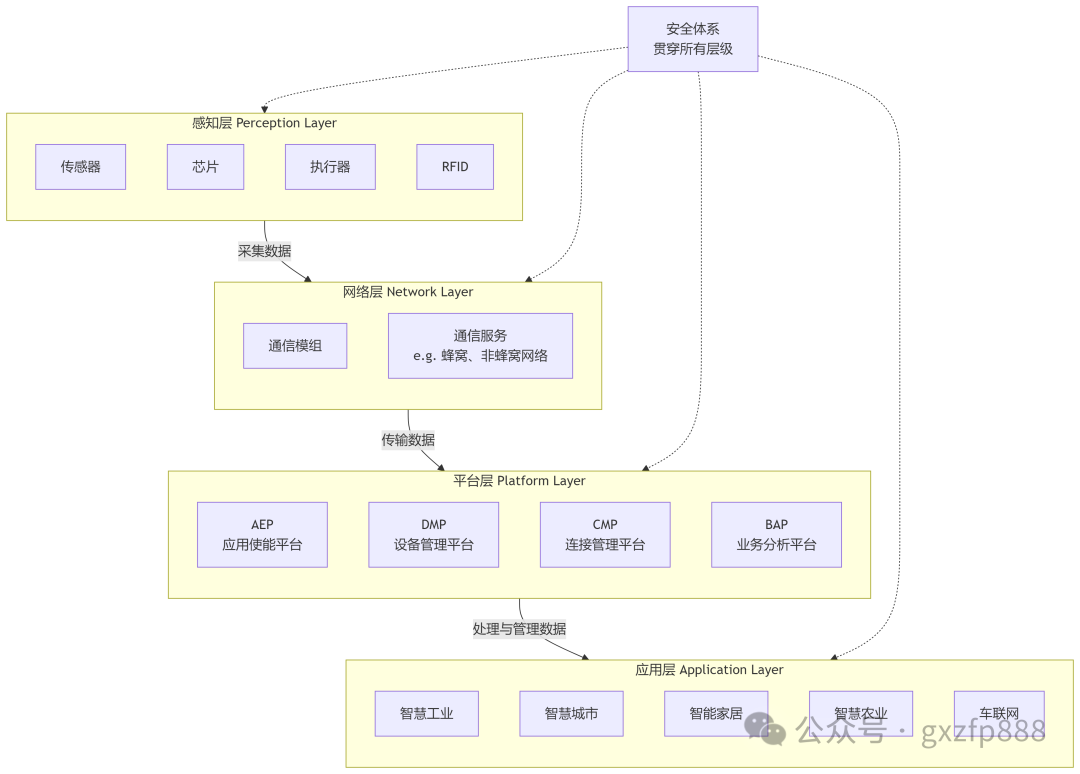 First Layer: Perception Layer (Data from the Physical World): This is the “nerve endings” and “senses” of the IoT, responsible for identifying objects and collecting data.1.1. Sensors: The core of the core, used to collect various physical, chemical, and biological quantities.Types: Temperature sensors, humidity sensors, pressure sensors, light sensors, accelerometers, gyroscopes, gas sensors, image sensors (cameras), etc.Manufacturers: Bosch, Texas Instruments, STMicroelectronics, Honeywell, AAC Technologies, etc.1.2. Chips: The “brain” of the device.MCU (Microcontroller Unit): Responsible for core control and computation of the device.Communication chips: Responsible for wireless or wired communication (Wi-Fi, Bluetooth, NB-IoT, etc.).Security chips: Provide hardware-level security protection for devices.Manufacturers: Qualcomm, Intel, MediaTek, Espressif (ESP8266/32), GigaDevice, etc.1.3. Actuators: The “hands and feet” of the IoT, responsible for receiving commands and executing operations. For example: smart switches to turn on lights, motors to control curtain movement, valves to control water flow.1.4. RFID (Radio Frequency Identification):Tags: Attached to objects for identity recognition and information storage.Readers: Read and write tag information.Applications: Product anti-counterfeiting, warehousing logistics, access control systems.Others: QR codes/barcodes, GPS/Beidou positioning modules, etc.
 Second Layer: Network Layer (Data Transmission Channel): Responsible for reliably and securely transmitting data collected from the perception layer to the platform layer, acting as the “highway” of information.2.1. Communication Modules: Integrated chips, memory, amplifiers, etc., providing standardized interfaces to enable terminal devices to connect to the network.Manufacturers: Fibocom, Quectel, Ruijie Networks, Telit, Sierra Wireless, etc.2.2. Connectivity Services: Provide network access and operational services.Cellular Networks:2G/3G: Gradually being phased out.4G Cat.1: A main network with balanced cost and performance for medium to low speeds.NB-IoT (Narrowband IoT): Low power, wide coverage, and large connections, suitable for static scenarios like meter reading and smoke detection.5G RedCap: Lightweight 5G, balancing performance, power consumption, and cost, suitable for industrial IoT and wearable devices.Non-cellular Networks:Short-range: Wi-Fi, Bluetooth, Zigbee, Z-Wave, etc., mainly used for smart homes and wearable devices.Long-range (LPWAN): LoRa (requires self-built networks), Sigfox, etc.Network Equipment and Operations: Base stations, routers, switches, and other infrastructure are provided by telecom operators (China Mobile, China Telecom, China Unicom, Verizon, Vodafone, etc.) and equipment manufacturers (Huawei, ZTE, Ericsson, Nokia, etc.).Third Layer: Platform Layer (Data Management and Processing Hub): The “brain” of the IoT, responsible for device management, data storage, analysis, visualization, and providing development tools for upper-layer applications.Device Management Platform (DMP): Responsible for device registration, authentication, monitoring, remote debugging, firmware upgrades (OTA), and troubleshooting.Connectivity Management Platform (CMP): Mainly for cellular networks, managing SIM cards, data traffic, plans, network status, and billing.Application Enablement Platform (AEP): Provides development tools, API interfaces, and data analysis services to help developers quickly build and deploy IoT applications. This is the core value of the platform layer.Business Analytics Platform (BAP): Utilizes big data and AI technologies to analyze, mine, and visualize massive device data, generating business insights to support decision-making.Typical manufacturers:Cloud service giants: AWS IoT, Alibaba Cloud IoT, Huawei Cloud IoT, Microsoft Azure IoT, Tencent Cloud IoT (providing one-stop services from IaaS to PaaS).Vertical software vendors: PTC (ThingWorx), Siemens (MindSphere), GE (Predix).Operators: China Mobile OneNET, China Telecom CTWing.Fourth Layer: Application Layer (Value Realization and Solutions): Combines the capabilities of the previous three layers with specific industry scenarios to form implementable solutions that directly create value for users.ToB (Business/Government):Smart Industry/Industrial Internet (IIoT): Predictive maintenance, smart manufacturing, energy consumption management, digital twins.Smart Cities: Intelligent transportation, smart security, smart lamp posts, smart environmental monitoring (water/air quality monitoring).Smart Energy: Smart grids, smart oil fields, photovoltaic power station monitoring.Smart Retail: Unmanned convenience stores, smart vending machines, supply chain management.Smart Agriculture: Precision irrigation, environmental monitoring, livestock tracking.Smart Logistics: Asset tracking, cold chain monitoring, smart warehousing.ToC (Consumers):Smart Homes: Smart speakers, smart appliances, smart security systems.Wearable Devices: Smartwatches, health bands.Vehicle-to-Everything (V2X): In-vehicle entertainment, vehicle status monitoring, smart navigation, autonomous driving.Throughout: Security Layer, security is the lifeline of the IoT, permeating every level.Perception Layer Security: Physical security of devices, chip security, sensor tamper-proofing.Network Layer Security: Communication encryption (e.g., TLS/SSL), VPN, protection against cyber attacks.Platform Layer Security: Data storage encryption, access control, API security, privacy protection.Application Layer Security: Application vulnerability protection, identity authentication, security auditing.Security vendors: Qihoo 360, Sangfor, Check Point, Palo Alto Networks, and the security teams of various platform vendors.Conclusion: The IoT industry chain is long and complex, with a high degree of integration, requiring collaboration among hardware manufacturers, chip vendors, communication operators, platform providers, software developers, system integrators, and security service providers to ultimately provide complete solutions for various industries. For entrepreneurs or investors, it is often more realistic to choose one or several sub-sectors to focus on.
Warm Reminder: The stock market has risks; investment requires caution. The content written in this article is for reference only and represents personal research opinions. Stock friends should think and analyze the stock market themselves.
-!! End, thank you for watching!!-
——-★★Collection of Historical Articles★★—––
Stock Software Longhu List Little Red Bull Analysis System Large Capital System
Tongdaxin Main and Auxiliary Chart Indicator Stock Selection Tool Tongdaxin Custom Data System
Custom Data Other Stock Software Ex System Daily Closing Data
Tongdaxin Tips tdx Indicator Writing Tutorial Tdx Indicator Formula
Longhu List Tutorial Speculative Capital Profit and Loss Data Upstream and Downstream of the Industry Chain Stock Academy
Quantitative Tutorial Indicator Backtesting Python My Stock Notes