
(1) Overview of Biochemical Diagnostic Instruments
A biochemical analyzer, also known as a biochemical instrument, is a device that uses photometric colorimetry and biochemical analysis methods to measure specific chemical components in body fluids. Due to its fast measurement speed, high accuracy, and low reagent consumption, it has been widely used in hospitals, epidemic prevention stations, and family planning service stations at all levels.
The fully automated biochemical analyzer is one of the most commonly used and important analytical instruments in clinical testing, primarily used to determine various biochemical indicators in serum, plasma, or other body fluids, such as glucose, albumin, total protein, cholesterol, transaminases, etc. It plays a significant role in auxiliary diagnosis, efficacy detection, health checks, and drug abuse detection, making it an essential clinical testing device in medical and disease control units at all levels, as well as a commonly used instrument in epidemic prevention, quarantine, and biological research. Its clinical application scope is expanding, making it one of the fastest-growing fields in today’s medical device industry.
Biochemical analysis is one of the important means of modern medical clinical diagnosis and disease prevention. Automatic biochemical analyzers can continuously monitor various reaction types for analysis. Besides general biochemical project determinations, they can also determine hormones, immunoglobulins, blood drug concentrations, and other special compounds. By combining biochemical analysis results of blood and other body fluids with other clinical data for comprehensive analysis, they provide a basis for diagnosing diseases and evaluating organ functions, while also identifying complicating factors and determining future treatment baselines and measures.
In contemporary hospitals, automatic biochemical analyzers are one of the most basic and indispensable medical devices for disease diagnosis, condition monitoring, efficacy observation, prognosis judgment, and prevention. Diagnosing acute pancreatitis, diabetic ketoacidosis, myocardial infarction, uremia, acid-base balance disorders, and electrolyte imbalances caused by dehydration or edema in emergencies relies heavily on biochemical analyzers. Tests for liver function, kidney function, protein balance, lipid metabolism, glucose metabolism, potassium, sodium, chlorine, calcium, phosphorus, magnesium, and trace elements are all performed by biochemical analyzers. The results obtained from biochemical analyzers directly affect the medical quality of the entire hospital and are critical to patient safety.
(2) Principles of Biochemical Diagnostic Instruments
Automatic biochemical analyzers are high-tech products that integrate optics, mechanics, electronics, and fluids, generally divided into four parts: sample introduction system, optical system, control system, and data processing system. The sample introduction system is a prerequisite for analysis, the optical system is the core of the entire instrument, the control system ensures analysis, and the data processing system extends functionality. Currently, the vast majority of biochemical analyzers work based on the principle of photometric colorimetry, and their structure can be roughly seen as composed of a photometric colorimeter or spectrophotometer and a microcomputer.
Based on structural composition, biochemical analyzers consist of a sample holder, sampling device, reaction chamber or reaction pipeline, heater, detector, microprocessor, printer, and functional monitor. The specific working principle is as follows: a monochromatic light beam illuminates the colored liquid in the colorimetric cell, and the absorption of light energy by the sample being tested is detected. The detector converts the light signal into the corresponding electrical signal, which is then amplified, rectified, and converted into a digital signal sent to the computer. Meanwhile, the computer controls the drive power to drive the filter wheel and sample tray, and processes, calculates, analyzes, and saves the measurement data according to the user’s selected working mode. The printer simultaneously prints out the corresponding results, and finally, after measuring each group of samples, the colorimetric cell is cleaned.
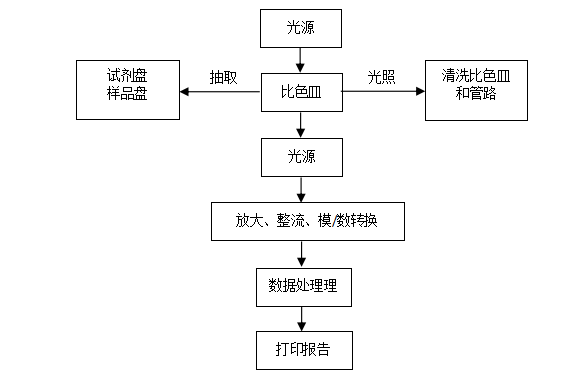
Working Principle of Biochemical Analyzers
(3) Classification of Biochemical Diagnostic Instruments
Since Technicon in the United States successfully produced the world’s first fully automatic biochemical analyzer in 1957, various models and functions of fully automatic biochemical analyzers have emerged, marking a significant step towards automation in clinical biochemical testing in hospitals. To date, the development of biochemical analyzers has been rapid, with diverse classification methods generally categorized as follows.
01
Classification by Degree of Automation
(1) Semi-Automatic Biochemical Analyzers
In the analysis process, some operations need to be performed manually (such as sample addition, heating, colorimetric aspiration, result recording, etc.), while other operations can be completed automatically by the instrument. These instruments are referred to as semi-automatic biochemical analyzers. Their characteristics include small size, simple structure, high flexibility, and low cost.
(2) Fully Automatic Biochemical Analyzers
The entire process from sample addition to outputting test results is completely automated, requiring the operator only to place the sample in a specific position on the analyzer and start the instrument with a selected program to receive the test report without manual intervention. Because there are no manual operation steps in the analysis, subjective errors are minimal, and since these instruments typically have functions for automatically reporting abnormal conditions and self-correcting their operational status, systematic errors are also small.
02
Classification by Structure and Principle
(1) Continuous Flow (Pipeline) Systems
Continuous flow analyzers refer to instruments where the chemical reactions of the same testing items for various samples are completed as they flow through the same pipeline mixed with reagents. Such instruments can generally be divided into air-segmented systems and non-segmented systems. Air-segmented systems use small segments of air between each sample, reagent, and mixed reaction liquid, while non-segmented systems use reagent blanks or buffer solutions to separate the reaction liquids of each sample. Among pipeline analyzers, air-segmented systems are the most common.
(2) Discrete Systems
Discrete analyzers are programmed based on manual operation methods, with rhythmic mechanical operations replacing manual ones, and each step connected by transfer belts operating sequentially. The chemical reactions of each sample mixed with reagents are completed in their respective reaction cups.
(3) Centrifugal Systems
Centrifugal analyzers refer to instruments where each sample is mixed with reagents under the influence of centrifugal force in their respective reaction chambers, completing chemical reactions and measurements almost simultaneously, resulting in higher analytical efficiency.
(4) Dry Chemistry Systems
Dry chemistry analyzers refer to instruments where reagents are solidified on carriers such as films or filter paper, with each sample droplet placed on the corresponding test strip for reaction and measurement. Their advantages include quick operation and portability, currently widely used in emergencies and field tests.
(5) Bag Systems
Bag analyzers use reagent bags instead of reaction cups and colorimetric cells, with each sample reacting and measuring in their respective reagent bags.
03
Classification by Reagent and Instrument Compatibility
(1) Closed Systems
Instruments and reagents are sold and used together, generally with specified reagent brands by the instrument manufacturer, prohibiting the use of reagents from other manufacturers.
(2) Open Systems
Instruments and reagents are sold and used separately, with no specified reagent brands by the instrument manufacturer, allowing users to choose freely.
04
Classification by International Testing Practices
(1) Small Instruments
Small instruments are generally single-channel and have slower testing speeds.
(2) Medium Instruments
Medium instruments are generally multi-channel, capable of testing 2 to 10 items simultaneously, with some instruments allowing arbitrary selection of test items while others do not.
(3) Large Instruments
Large instruments are generally multi-channel instruments capable of testing more than 10 items simultaneously, with free selection of analysis items.
05
Classification by Testing Channels
(1) Single-Channel Biochemical Analyzers
Single-channel biochemical analyzers can only test one item at a time, but the items can be changed, resulting in slower testing speeds.
(2) Multi-Channel Biochemical Analyzers
Multi-channel biochemical analyzers can test multiple items simultaneously.
(4) Development History of Biochemical Diagnostic Instruments
Biochemical analyzers have evolved from the earliest spectrophotometers to semi-automatic biochemical analyzers, and now to the widely used fully automatic biochemical analyzers, undergoing three stages of development.
First Generation: The spectrophotometer, which uses ultraviolet, visible, infrared light, and laser to determine the absorption spectrum of substances, is a method for qualitative and quantitative analysis of substances based on this absorption spectrum, known as spectrophotometry. The instrument used is called a spectrophotometer. The advantages of spectrophotometer detection include direct reading of absorbance, simple operation, and low cost; however, the disadvantages include the inability to directly calculate concentration values, large errors, and few detectable items.
Second Generation: Semi-automatic biochemical analyzers, which require some operations (such as sample addition, heating, colorimetric aspiration, result recording, etc.) to be performed manually during the analysis process, while other operations can be completed automatically by the instrument. These instruments are characterized by small size, simple structure, and high flexibility, allowing them to be used separately or in conjunction with other instruments, and are inexpensive.
Third Generation: Fully automatic analyzers, where the entire process from sample addition to outputting results is completely automated. The operator only needs to place the sample in a specific position on the analyzer and start the instrument with a selected program to receive the test report. Fully automatic biochemical analyzers have more reagent and sample positions than semi-automatic ones, with faster testing speeds and no manual addition of reagents, eliminating errors due to different manual reagent addition techniques, resulting in better accuracy and repeatability.
01
International Development History of Biochemical Analyzers
In the early 19th century, the most primitive manual methods were used to complete a small number of biochemical indicator tests. During this stage, the loading methods for samples, reagents, and other liquids primarily relied on pipettes, resulting in extremely low work efficiency and significant errors. In the 1950s, with the emergence of automatic diluters, the loading of liquids became automated or semi-automated, and semi-automatic colorimeters were gradually applied, utilizing fixed-flow colorimetric cups for sample colorimetric determinations.
In 1957, Technicon in the United States manufactured the world’s first biochemical analyzer based on Professor Skeggs’ design, leading to a rapid emergence of various models and functions of fully automatic biochemical analyzers. In 1965, the discrete automatic analyzer was born, with a working principle similar to manual operation, where samples are processed in separate reaction cups.
The 1970s introduced reflective optical analyzers paired with dry chemical reagents, improving the accuracy, precision, multifunctionality, and analysis speed of biochemical analysis. The application of various analytical technologies such as spectrophotometry, centrifugation, chromatography, electrophoresis, radioactive nuclides, and immunology technologies significantly propelled the rapid development of various clinical biochemical testing instruments. In the early 1980s, TECHNICON in the United States invented instruments capable of overcoming cross-contamination between samples, raising the level of automatic biochemical analyzers to a new height. In the late 1980s, dry chemical analyzers using solid-phase enzymes, ion-specific electrodes, and multi-layer membranes were developed. Since the 1990s, with technological advancements, biochemical analyzers have evolved toward more functional perfection, with an increasing number of detectable items and higher accuracy and precision, better meeting the diverse requirements in laboratory management.
02
Development History of Biochemical Analyzers in China
Starting in the mid-1970s, institutions such as the Shanghai Medical Device Research Institute, Beijing Medical Instrument Research Institute, Beijing Analytical Instrument Factory, and Beijing Biochemical Instrument Factory developed continuous flow, discrete, and centrifugal biochemical analyzers. Although domestic biochemical analyzers with independent intellectual property rights were developed at that time, their quality was poor and unsatisfactory. Even those that had prototypes did not become market products, leading to reliance on imports for most such instruments in China.
In 1972, the Italian embassy in China donated a continuous flow automatic biochemical analyzer to Peking Union Medical College Hospital; in 1975, Tianjin Medical University Second Hospital introduced a two-channel continuous flow automatic biochemical analyzer from the Italian company Carlo Erba. Based on the study of these two instruments, the Beijing Biochemical Instrument Factory launched a three-channel continuous flow automatic biochemical analyzer, which won the National Science and Technology Conference Award in 1978, but unfortunately did not see market effects.
During the widespread use of automatic biochemical analyzers in Chinese clinical chemistry laboratories, a significant impact was made in around 1986 when the Netherlands’ Vital Company introduced the MicroLab semi-automatic biochemical analyzer, with thousands of units introduced. To narrow the gap in automation between domestic clinical laboratories and developed countries, the development of fully automatic biochemical analyzers became the primary research topic in domestic laboratory medicine.
Since the 1990s, through persistent efforts, various models of semi-automatic and fully automatic biochemical analyzers have been independently developed in China. The development of automation in clinical chemistry testing in China can be summarized into seven periods, as shown in the diagram below.
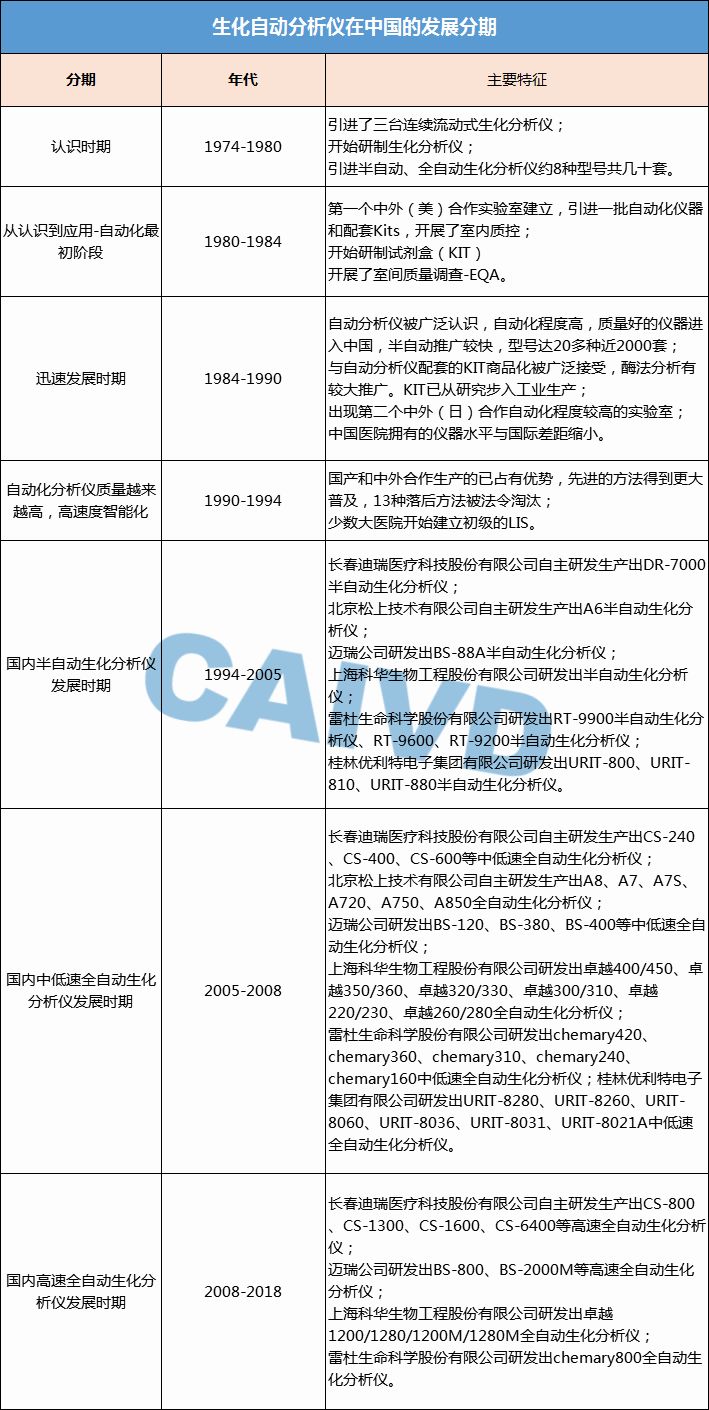
(5) Main Products in the Biochemical Diagnostic Instrument Market
With the continuous development of fully automatic biochemical analyzers and the increasing testing speeds, we classify fully automatic biochemical analyzers according to their testing speeds, with the following categories: ≤300T/H, 300-400T/H, 400-600T/H, 600-800T/H, and >800 T/H.
(6) Market Capacity of Biochemical Diagnostic Instruments
According to industry data and market sales data from various segmented companies, the biochemical market capacity was approximately 10.3 billion RMB in 2016 and approximately 11.3 billion RMB in 2017, with a growth rate of about 9%. In the domestic IVD segmented field, the traditional biochemical market share is gradually declining, and the growth rate is decreasing. As domestic biochemical testing matures and stabilizes, subsequent market growth is expected to slow down. Imported brands are mainly dominated by Roche and Beckman, accounting for about one-quarter of the market, while most others are domestic brands. The biochemical field is expected to grow by around 10% in 2017, and the entire market has become a blue ocean market, with most brands experiencing sluggish growth for various reasons.
Looking at the domestic market, the domestic replacement rate of biochemical products is close to 50%, with numerous manufacturers. According to NMPA registration statistics, more than 200 companies related to clinical biochemistry have emerged in the domestic market. However, imported manufacturers still dominate high-quality clients such as large tertiary hospitals. Most fully automatic biochemical analyzers in tertiary hospitals are monopolized by foreign companies, mainly due to the complex technology involved in optics, mechanics, electronics, software, fluid paths, temperature control, and biochemical analysis, requiring strict control over system structure, timing requirements, and high reliability and precision. With the successful development of domestic biochemical diagnostic reagents and instruments, domestic biochemical analyzers have rapidly penetrated hospitals below the tertiary level. Currently, some quality domestic biochemical manufacturers have gradually entered the high-end domestic market, such as Mindray, Kehua, and Dirui.
Foreign fully automatic biochemical analyzers have matured technologically after years of development, with companies such as Roche, Beckman, Abbott, Siemens, Johnson & Johnson, and Hitachi launching high-performance, high-speed, modular analyzers that can be linked with immunoassays. Domestic biochemical analyzers started later and have a weak technical foundation. Currently, domestic companies represented by Mindray, Kehua, and Dirui have successfully produced biochemical instruments that can compete with foreign companies, mainly targeting the mid-to-low-end market, while domestic companies such as InnoCare, Jinrui, Pukang, and Tekang focus on the low-end market. From the market situation, large hospitals and laboratories generally prioritize foreign brands for fully automatic biochemical analyzers due to their high requirements for technical parameters, performance, and brand. Meanwhile, small and medium-sized hospitals, given their smaller sample volumes and cost considerations, generally opt for medium and small biochemical analyzers. Hence, it is evident that the high-end market in China is still dominated by foreign brands. As foreign brand product lines penetrate deeper, competition in the small and medium-sized hospital market will become increasingly fierce.
–END–
Source: CAIVD, “Blue Book on the Development of China’s In Vitro Diagnostics Industry”Editor:As Su | Proofreader:Ryan | Chief Editor: Ye Pianpian

Recommended Reading
–Summary of 209 Industry Standards for China’s In Vitro Diagnostic Products–NMPA | 2020 Latest Q&A Compilation Related to In Vitro Diagnostics–431 Items of In Vitro Diagnostic Reagents Exempt from Clinical Trials–Song Haibo: Current Status and Thoughts on Key Raw Materials for China’s In Vitro Diagnostics–Directory of 1427 In Vitro Diagnostic Production and Service Enterprises–Multiple IVD Companies Targeting the Veterinary Diagnostic Market–64 In Vitro Diagnostic Companies Assisting in AIDS Testing!–The Advancing Molecular Diagnostics, PCR Industry Welcomes a New Opportunity Period–Chemiluminescence Immunoassay Technology and Clinical Significance of Common Projects in Testing Departments
Exhibition Dynamics
–CACLP · CISCE 2021 Chongqing Station: Exhibiting Company Booth Numbers Announced
–CACLP · CISCE 2021 Chongqing Station: Recommended Construction Company List
–CACLP · CISCE 2021 Chongqing Station: Recommended Hotels
Statement: ① Articles published by this public account are original. Any individual, media, or website wishing to reprint must indicate “Reprinted from ‘CACLP In Vitro Diagnostic Information'” at the beginning of the article and credit the author. ② The content published by this public account with specified sources is owned by the original source, and does not represent the position of this public account. If there is any infringement, please contact WeChat [826699172].