According to a report from Electronic Enthusiasts Network (by Mo Tingting), the Bluetooth chip design industry is entering a new growth cycle in the first half of 2025. Recently, several publicly listed Bluetooth chip companies have announced their performance for the first half of the year. Statistics from Electronic Enthusiasts Network show that five companies, including Hengxuan Technology, Jieli Technology, Zhongke Lanxun, Tailin Microelectronics, and Juchip Technology, have reported a general recovery in performance, accelerated technological iteration, and AI and edge computing power becoming the core driving forces of the industry. Most companies have achieved both revenue and profit growth in the first half of this year.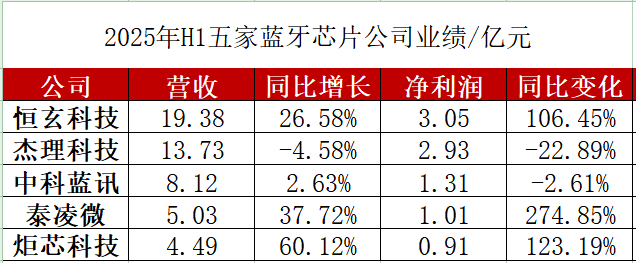 Hengxuan Technology leads in revenue and profit scale, being the only company with revenue exceeding 1.9 billion yuan and a net profit of over 300 million yuan, firmly maintaining its industry leader position. Tailin Microelectronics has shown remarkable profit growth, with a year-on-year increase of 274.58% in net profit attributable to the parent company, and a staggering net profit growth rate of 278.87%, becoming the fastest-growing enterprise.The growth of Hengxuan Technology’s performance mainly comes from the continuous rapid growth in the smartwatch market, expanding new clients such as Xiaotiancai and Songtuo; the ramp-up of new products like BES2800 has also improved the overall chip ASP. Additionally, the company has expanded into new markets beyond wearables, including wireless microphones, smart glasses, and Wi-Fi.Juchip Technology has maintained steady growth, with revenue and profit growth rates exceeding 20%, showing balanced performance. Zhongke Lanxun’s revenue growth rate is only 2.63%, with a net profit decline of 2.61%, reflecting its growth bottleneck in the mid-to-low-end market. Meanwhile, Jieli Technology has experienced “reverse growth,” with both revenue and profit declining.The performance growth of Juchip Technology is attributed to the industrialization of AI technology. Tailin Microelectronics stated that its performance growth is due to increased customer demand, new client expansion, and new products starting to ship in volume, with revenue increases across all product lines, particularly in the multimode and audio product lines, while the BLE product line also saw significant revenue growth.Jieli Technology expects a year-on-year change in net profit attributable to the parent company from January to September 2025 to be between -19.93% and -29.61%. The third round of inquiries in the application documents for listing on the Beijing Stock Exchange mentioned that Jieli Technology’s performance decline is mainly affected by competition in the consumer electronics market, fluctuations in customer procurement demand, and a decline in sales amounts in the mid-to-low-end market.
AI Becomes the Core Battlefield
With the explosion of AI and edge computing power, Bluetooth chip companies are positioning AI technology as a core strategy, launching chips that support NPU, in-memory computing, and other technologies to meet terminal manufacturers’ demands for new features such as intelligent noise reduction, voice recognition, and AI calling.Tailin Microelectronics pointed out in its financial report that the development of wireless IoT chips and edge AI has shown the following new characteristics: first, the continuous advancement of chip manufacturing processes, with advanced processes emerging that significantly enhance chip performance and reduce power consumption; second, the reshaping of the global chip industry chain, with international trade frictions and geopolitical factors leading to increased diversification of the supply chain, promoting the diversification and autonomy of related industries; third, the integration of artificial intelligence and machine learning technologies presents new challenges and opportunities for chip design, requiring chips to possess stronger computing capabilities and higher energy efficiency ratios to meet the real-time data processing needs of smart devices.In terms of AI computing power, Hengxuan Technology, Zhongke Lanxun, and Juchip have significantly enhanced edge AI processing capabilities through the integration of NPU or in-memory computing architectures. For example, Hengxuan Technology’s next-generation smart wearable chip BES2800 is widely used in customer TWS earphones, smartwatches, smart glasses, and other terminal products. The BES2800 adopts a 6nm FinFET process, integrating multi-core CPU/GPU, NPU, large-capacity storage, low-power Wi-Fi, and dual-mode Bluetooth on a single chip, significantly improving performance, power consumption, and technological innovation.Juchip Technology’s edge AI audio chip ATS323X series, based on first-generation in-memory computing technology, has entered the project phase with several leading brands, with customer terminal products aimed at low-latency private wireless audio being the first to achieve mass production, driving rapid ramp-up of new products. Additionally, the edge AI processor chip ATS362X series has also been successfully introduced into leading audio brands, applied in their high-end speakers, Party speakers, and other products.Juchip Technology continues to advance its AI + audio strategy, with its smart IoT AIoT edge low-power computing chip platform providing ample AI computing power for various practical application scenarios, such as voiceprint recognition, intelligent noise reduction, sound field positioning, directional sound pickup, multi-track separation, voice enhancement, semantic analysis, AI beautification, AI voice changing, and AI sound effects, which can be widely applied in professional audio equipment such as Party speakers and sound cards.In the edge AI field, Zhongke Lanxun continues to strengthen its efforts in the AI headphone market. Zhongke Lanxun’s Xunlong third-generation chip adopts a multi-core architecture of CPU + DSP + NPU, capable of meeting the application development of various AI algorithms in audio, combined with dual-mode Bluetooth data transmission to utilize cloud-based large model AI capabilities. The company’s Xunlong third-generation BT896X series chips have been used in Baidu’s Xiaodu Tiantian AI tablet robot’s smart speaker.Tailin Microelectronics combines edge AI with low-power wireless IoT chips, launching multiple series of chips and software development tools that support edge AI technology, further deepening and expanding the company’s business towards AI. The newly launched edge AI chips have entered the mass production stage, with sales in the second quarter already reaching a scale of tens of millions.Tailin Microelectronics has launched the machine learning and artificial intelligence development platform TLEdgeAI-DK, which will support mainstream local AI models, such as Google’s LiteRT, TVM, and other open-source models. The company’s TL721X series chip products are also currently the world’s lowest power wireless smart IoT connection protocol platform, particularly suitable for use in various battery-powered products.Jieli Technology’s second-generation “Wutong” series chip AC791N supports lightweight AI neural networks, allowing for the embedding of more complex AI algorithms, with an integrated matrix-vector accelerator, supporting Wi-Fi + classic Bluetooth 2.1 + Bluetooth BLE5.0 tri-mode coexistence, suitable for use in AI toys.
Comprehensive Expansion from Audio to AIoT
All companies have transformed from single audio chip providers to comprehensive AIoT solution providers. For example, Zhongke Lanxun is focusing on AI toys + Wi-Fi chips, while Tailin Microelectronics is comprehensively laying out multi-protocol IoT chips (Bluetooth, Zigbee, Matter, Wi-Fi). In the first half of this year, Zhongke Lanxun launched its first Wi-Fi + BT + audio three-in-one AB6003G chip, which can be used in various fields such as smart homes, smart wearables, industrial IoT, and smart cities. This technological breakthrough significantly broadens the company’s business landscape, further enriching the company’s implementation scenarios. Zhongke Lanxun has successively launched solutions for AI smart toys, Wi-Fi smart speakers, and other products. Zhongke Lanxun pointed out that the company is actively laying out the AI toy industry ecosystem centered around its self-developed AB6003G Wi-Fi chip.Although a latecomer, Zhongke Lanxun has already formed its own technological advantages in Wi-Fi chip technology. Zhongke Lanxun has developed a new generation of Wi-Fi + Bluetooth Combo RF and ePTA coexistence technology, as well as new generation Wi-Fi modem and baseband processing technology.Tailin Microelectronics continues to lay out Bluetooth, Zigbee, low-power multi-mode IoT RF transceiver technology, multi-mode IoT protocol stack, and Mesh networking protocol stack technology, low-power system-on-chip power management technology, ultra-low latency and multi-mode wireless audio technology, low-power wireless high-precision positioning technology, automotive digital key technology, heterogeneous multi-core system-on-chip technology, and RISC-V instruction set-based MCU. In terms of Mesh, Tailin Microelectronics combines edge AI technology with multi-mode IoT protocol stack and Mesh networking protocol stack technology, supporting the operation of edge AI on Mesh nodes. Currently, the company’s AI algorithms and low-power Bluetooth, Matter, and other technologies have been integrated, further accelerating the application of AI technology in low-power networking.Chip companies are continuously expanding their application scenarios, extending downstream, such as AI smart glasses. Hengxuan Technology is developing AI ISP technology, and Juchip Technology’s smart Bluetooth wearable SoC chip series has also landed in the AI smart glasses market. The ISP of smart glasses differs from past IPC applications, with differences in static and dynamic scene requirements and performance specifications. Hengxuan Technology’s advantage lies in its deep cooperation with brand customers, which can accelerate rapid product iteration.Hengxuan Technology pointed out that the core of AI glasses single-chip design lies in adopting advanced processes; otherwise, the significance of a single chip is limited. The advantages of a single chip include: first, significantly reduced power consumption for inter-chip transmission; second, a substantial reduction in chip size, making it more suitable for devices with extreme size requirements such as smartwatches and smart glasses, especially under advanced process support, achieving smaller sizes while further reducing overall power consumption through wireless technology, which is very advantageous.With the optimization of product structure, penetration from low-end to mid-to-high-end has increased, and the proportion of high-margin products has risen, directly driving profit growth. Hengxuan Technology’s comprehensive gross margin in the first half of the year was 39.3%, an increase of 6.1 percentage points year-on-year. Tailin Microelectronics stated that benefiting from the increased sales proportion of high-margin products, optimized product sales structure, and cost advantages brought by expanded sales scale, the company’s gross margin has risen to a high level, reaching 50.61%.

Statement: This article is original from Electronic Enthusiasts Network, please indicate the source above when reprinting. For group communication, please add WeChat elecfans999, for submission, exposure, and interview requests, please send an email to [email protected].
More Hot Articles to Read
-
11 Semiconductor Equipment Companies H1: Etching Equipment Sold for 5 Billion, Highest Net Profit Soared by 73%
-
Alibaba Unveils: Self-Developed AI Chip 100% Domestic, No Need for TSMC Foundry
-
Xiaomi Enters the Market, Another Storage Boom!
-
Labubu Sparks! Consumer-Level 3D Printing Industry Chain Takes Off
-
Ministry of Industry and Information Technology: Over 10 Million Satellite Communication Users by 2030! Industry Chain Takes Off?
Click to Follow and Star Us
Set us as a star to not miss any updates!