The Explosion of AI Agents: From Technological Frenzy to Industrial Deepening
In the past two years, large models have demonstrated astonishing creativity but have fallen into the awkward situation of being “able to talk but unable to act”.:
Strong reasoning but weak execution: Even models like DeepSeek that solve complex logical problems still lack the ability to call tools.
Interaction is cumbersome and efficiency is low: Users need to repeatedly converse to debug results, unable to “let AI work on its own”.
The essential breakthrough of AI Agents lies in endowing large models with three core capabilities
Task Planning: Traditional large models can only generate text suggestions, while AI Agents can actively decompose abstract goals into executable sub-tasks and dynamically adjust paths.
Tool Invocation: Breaking the boundaries of text generation, achieving proactive operation of physical and digital tools, forming a “sensory-action” closed loop.
Dynamic Evolution: Endowing AI with the ability to dynamically accumulate knowledge and optimize strategies, rather than static responses.
According to the latest IDC report, the market size of AI Agent software in China will exceed 5 billion yuan in 2024, with a growth rate exceeding 60% over the next four years.By 2025, the Chinese AI Agent market is expected to surge to 3.3 trillion yuan with a compound annual growth rate of over 100%, shifting its development logic from “demonstrating general capabilities” to “tackling vertical scenarios”. The technical layers are becoming increasingly clear—L0 to L3 level agents focus on automated task execution, while L4 level agents like DeepYuan AI’s MasterAgent can achieve multi-agent cluster collaboration and fully autonomous decision-making, boosting manufacturing efficiency by 100%. This explosion is no coincidence, but a necessary path for AI to transform from a “toy” to “productivity”.
In this process, “local deployment” has become a key turning point: by 2025, the adoption rate among enterprises will exceed 23%, and it is expected to reach 90% by 2028.. Driven by data security and compliance needs, the integration of domestic computing power and industry knowledge graphs is giving rise to specialized AI solutions in finance, healthcare, law, and industry.
Vertical Applications of AI Agents in Legal Scenarios
Pain Points of Traditional Legal Work Models
Repetitive labor consumes professional time: Junior lawyers spend 60% of their working hours on basic document processing.
Knowledge updates lagging behind pose risks: When new judicial interpretations are issued, manual searches inevitably miss information.
Data security is precarious: Deploying on third-party platforms can lead to the leakage of sensitive client information.
General AI’s immediate stability: Online services struggle to support high-frequency legal searches and document generation needs.
Currently, the legal technology field is undergoing a transformation from digitization to intelligence, with companies inclined to rapidly enhance efficiency through the deployment of general AI integrated machines. However, due to the inherent high professional barriers, strict logical systems, complex knowledge structures, and the extremely high requirements for the accuracy of decision-making results in the legal industry, its intelligent transformation is far from simply introducing general technologies or stacking computing power. Simply deploying general integrated machines is still insufficient—what the legal scenario needs is vertical empowerment, not just computing power stacking.
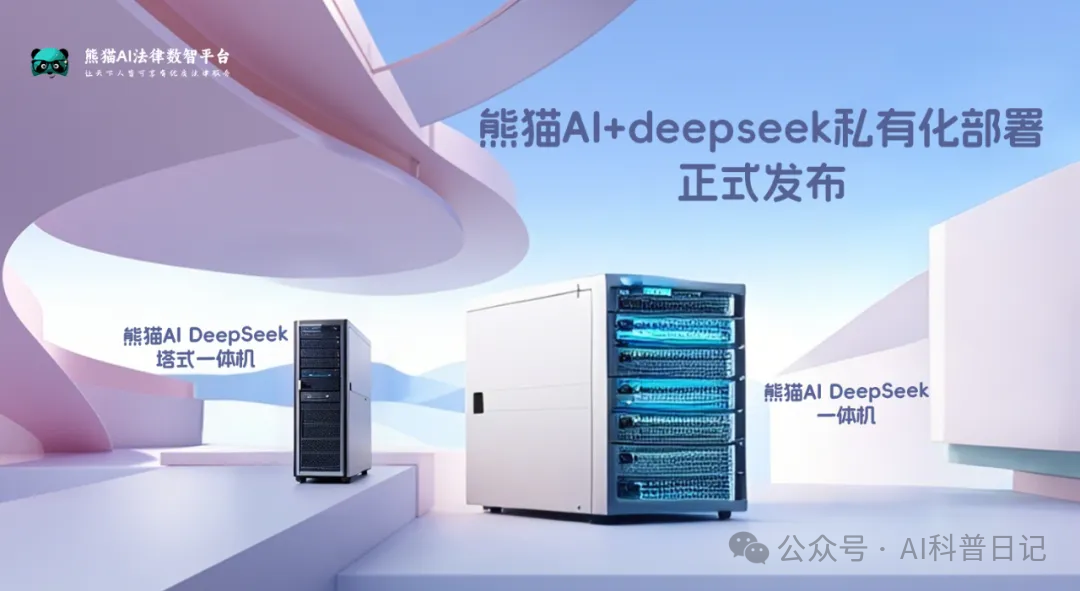
Panda AI × DeepSeek Tower Integrated Machine: A “Full-Stack Intelligent Workbench” for Legal Professionals
Security and controllability are the baseline, while precise empowerment is the ultimate goal. As the first deeply integrated solution in the legal vertical field, the Panda AI + DeepSeek tower integrated machine redefines the “law firm AI agent”:
-
Secure Foundation: Strengthening Compliance Defenses: Domestic chips + local deployment ensure physical isolation of sensitive data such as contracts and case files. Complies with financial-grade trusted certification (5th level standard from the China Academy of Information and Communications Technology), meeting audit requirements for state-owned enterprise clients.
-
Authoritative Knowledge Graph and Hybrid Model Architecture: The first legal data asset certification in China: The platform builds a self-owned intellectual property legal knowledge graph, covering over 4.7 million dynamic regulations and over 180 million judicial cases, with a data update frequency reaching daily, ensuring the timeliness and authority of legal bases. Eliminating “legal clause illusion”: using a triple hybrid model of BERT + GPT + MOE, through dual verification of logical reasoning and probabilistic statistics, preventing the fabrication of legal clauses and erroneous citations, producing outputs equivalent to those of a lawyer with 10 years of experience.
-
Integrating Panda AI’s “Contract Six Laws” Knowledge Engine: Covering 242 types of contracts and 360,000 clause variants, capable of outputting review suggestions based on the differences in positions of “strong party/weak party”.
-
Embedding DeepSeek’s Multimodal Understanding Capabilities: Achieving deep functions such as automatic summarization of case files, evidence chain verification, and extraction of dispute focal points.
-
Intelligent Contract Review: Relying on a library of over 1,000 risk point rules, automatically outputting clean/revised reports and quadruple review documents (including validity judgments and clause replacement suggestions), improving work efficiency by 300%.
High-quality, warm legal services: from “tools” to “partners”
Supporting psychological comfort and emotional guidance (e.g., Shenzhen Futian Women’s Federation’s “Sister Fu” intelligent legal robot);
24/7 response to consultations on marriage and family, workplace discrimination, etc., making law “accessible warmth”.
Chinese legal AI is undergoing an evolution from single-point tools to full-stack platforms to ecological empowerment. When technology can eliminate 60% of repetitive labor (such as contract proofreading and document generation), the creativity of legal professionals will be directed towards more valuable areas: strategy formulation, humanized negotiation, and judicial innovation.
The era of legal intelligent agents has begun. Scan to consult the “Panda AI + DeepSeek Tower Integrated Machine” for your exclusive solution.