Hello everyone! This is a channel focused on cutting-edge AI and agents~
Following the releases of Deep Research by Google, OpenAI, and Perplexity, the University of Oxford has published a paper titled “Agentic Reasoning: Reasoning LLMs with Tools for the Deep Research” and has open-sourced the code. Today, let’s take a detailed look at their approach to deep research~
This framework not only surpasses existing RAG systems and closed-source large models in PhD-level scientific reasoning tests (GPQA) but also outperforms Google’s Gemini Deep Research in deep research tasks across fields such as finance, healthcare, and law!
How Is This Possible?
Ordinary reasoning models can only rely on their own knowledge or context knowledge from the internet to think and reason for extended periods before responding. However, if a reasoning model can call upon tools to assist in reasoning, it can be much more efficient.
Agentic Reasoning has arrived, mimicking how humans solve complex problems. It collects information from the internet, performs quantitative analysis using computational tools, and organizes thoughts on a whiteboard.
Therefore, they have customized three core agents:
- Web Search Agent: Responsible for obtaining information from the internet
- Code Agent: Performs computational analysis using Python
- Mind Map Memory Agent: Constructs a knowledge graph based on reasoning context (trick, detailed later)
The tool-assisted reasoning process for complex problems can seamlessly integrate with the reasoning process of large models!
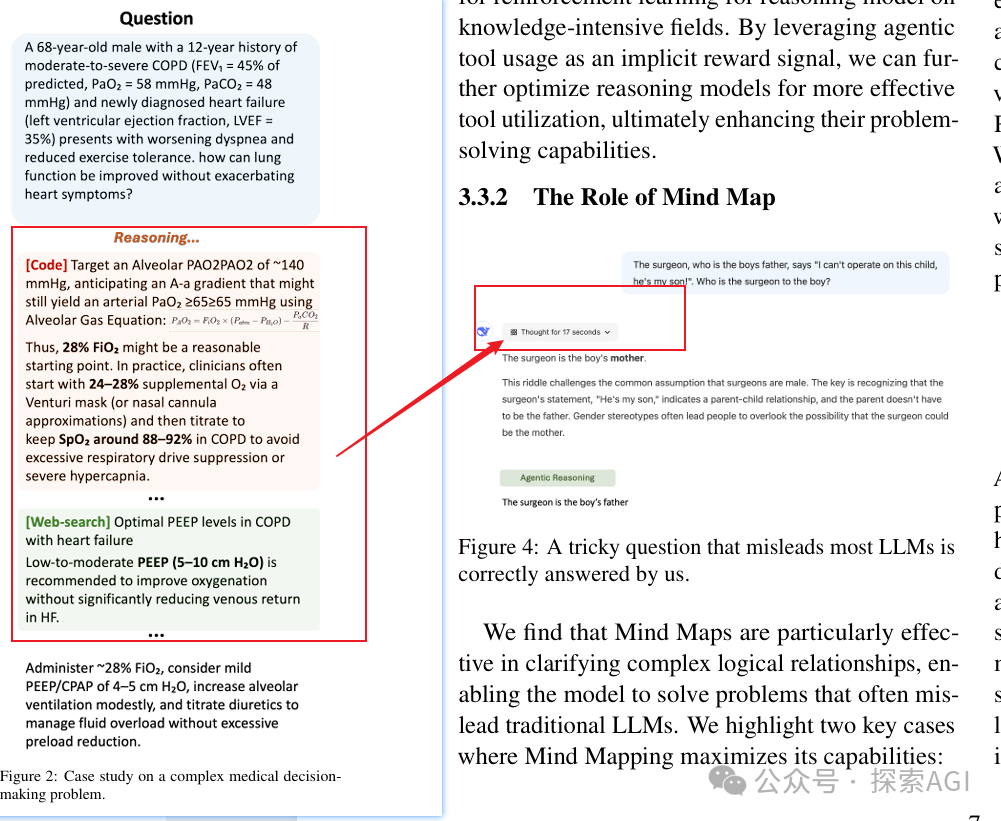
The large reasoning model performs normal reasoning and decides in real-time whether it needs additional information based on task requirements (just generate the corresponding token; once the tool is called, the results can be integrated back into the reasoning chain).
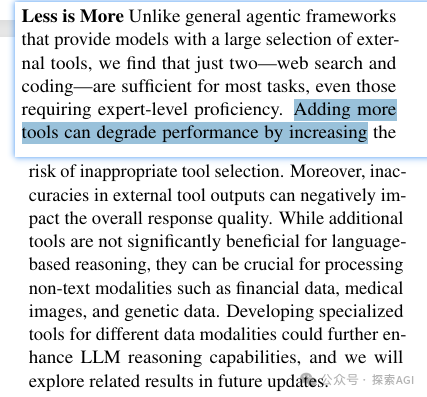
After a long reasoning chain + external knowledge (web, code), the reasoning chain may become quite chaotic, so this framework introduces a Mind Map agent. This agent can transform the original reasoning chain into a structured knowledge graph (this work directly adopts graphrag, entity extraction -> community construction -> abstract community summary).
Some Findings!
Importance of Division of Labor
Allowing different LLMs to focus on their respective tasks (e.g., DeepSeek-R1 for reasoning, Claude-Sonnet for programming) can significantly enhance overall performance.
Less Is More
Using only a few agent tools can yield the best results. Adding more tools may increase the risk of making incorrect choices.
Tool Usage and Accuracy
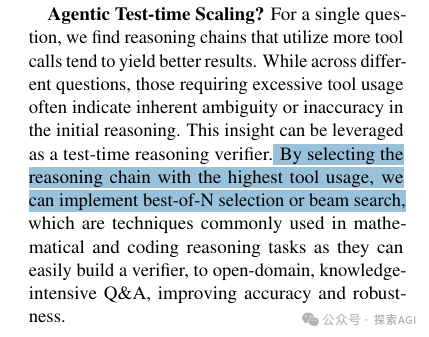
For individual questions, using more tools can often lead to better reasoning results. However, if tools need to be frequently called across questions, it may indicate flaws in the initial reasoning trajectory.
Project open-source address: https://github.com/theworldofagents/Agentic-Reasoning
The framework’s performance significantly surpasses Google Deep Research in several areas. It even outperforms human experts in various fields. It also excels in deep research problems that require over 20 minutes.
Alright, that’s all I wanted to share today. If you’re interested in building AI agents, don’t forget to like and follow~ 😉