Assembly language and C language are both commonly used programming languages in microcontroller programming, and they are among the earliest and most widely used languages. Especially in embedded programming like microcontrollers, assembly language has the advantages of being simple, efficient, and quick to learn. However, it also has many disadvantages. Below is a comparison of the advantages and disadvantages of both:
The advantages and disadvantages of assembly language are as follows:
1) Assembly language instructions directly manipulate the computer’s hardware, such as registers and memory addresses, or have instructions that operate on register bits. Therefore, when writing hardware drivers and BIOS programs, which are closely related to hardware, it can precisely control the working state of the hardware, achieving efficient utilization of hardware resources.
2) High execution efficiency: The instructions of assembly language correspond to the machine instructions of the microcontroller, with simple and direct syntax, compact code, and high execution efficiency. In scenarios with extremely high performance requirements, such as real-time control systems and encryption algorithms, assembly language can improve program execution efficiency by optimizing instruction sequences.
3) Poor portability of assembly language programs: They are not very readable and require high skill from programmers. Different microcontrollers (CPU processors) have significant differences in their instructions and registers. Even different models of the same brand and series of CPU have differences in registers. Therefore, once a program is written for one microcontroller (CPU processor) and the microcontroller is changed, some adjustments to the program are required. Given that there are also differences in registers or assembly instructions, this can be quite difficult. Moreover, assembly instructions require a lot of memorization, and programmers must be very familiar with the differences between these two processors to complete the program migration work.
The advantages and disadvantages of C language are as follows:
1) C language is considered a high-level programming language, with the advantage of high programming efficiency. This is because C language has rich data types, operators, and control structures, such as arrays, structures, pointers, loops, and conditional statements. These high-level language features allow programmers to express complex algorithms and logic in a more concise and intuitive manner, greatly improving programming efficiency.
2) Good portability: C language compilers can be used on different operating systems and hardware platforms. By using standard C libraries and adhering to the ANSI C standard, programs written in C can be compiled and run on different platforms with little or no modification required. Advanced programmers often make basic preparations for better program portability when building program frameworks, so migrating such programs usually only requires modifying one or two files, making it very simple.
3) C language has standard library functions that provide convenient tools for programmers, allowing direct usage, avoiding repetitive development, reducing workload, and improving development efficiency. There are even many third-party libraries available, further expanding the functionality of C language. This is one of the reasons why C language is widely used in embedded software development.
4) For the same functional function, programs written in C language, after being compiled by the compiler, output executable files that are not as efficient as those written in assembly language and are larger in size. However, this disadvantage is not a major concern anymore, as the main frequency of microcontrollers is increasing and storage space is becoming larger.
The following image shows a software development example for a chip, which contains an assembly function file fully written in assembly language, with functions available for other files to call.
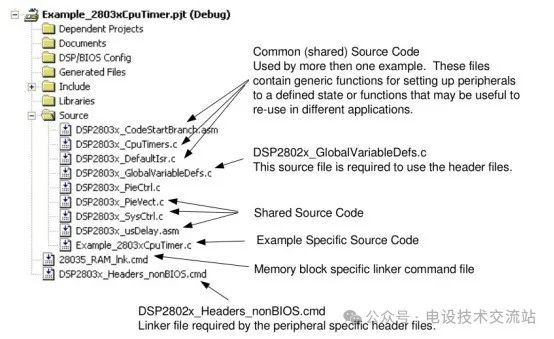
Figure 1: Assembly Development Example
In summary, both of these languages have their own advantages as well as their shortcomings, and it depends on how you apply them. Nowadays, programming experts, in order to achieve high program execution efficiency, fast control speed, enhance the efficiency of complex algorithms, or to keep certain algorithms confidential, write these functional programs in assembly language as functions, forming their own function libraries for C language to call. This not only achieves speed and efficiency but also protects the algorithm, allowing the advantages of assembly language to be utilized to realize specific functions while fully leveraging the high-level features of C language for overall program design. This is the pinnacle of design for programming experts.
Have you become an expert in embedded software development yet?
Welcome to leave a message for discussion.