Article Highlights

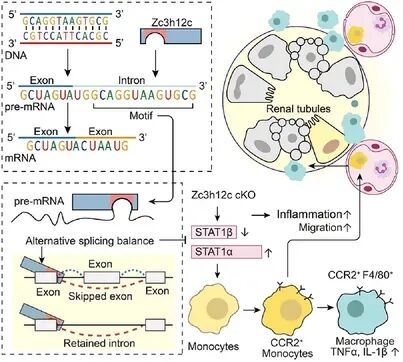
RNA-binding proteins regulate post-transcriptional gene translation, but the macrophage-specific role of Zc3h12c remains unclear. Here, we characterized the role of Zc3h12c in macrophages using Tnfrsf11aCre-Zc3h12cflox/flox mice. Both Tnfrsf11a and Zc3h12c are highly expressed in renal tissues of patients with chronic kidney disease and are positively correlated with interstitial fibrosis scores. Single-cell RNA sequencing revealed that Tnfrsf11a is abundantly expressed in renal macrophages of mice, associated with chemokine induction, macrophage phagocytosis, and renal injury activation. In various models of renal injury, Tnfrsf11aCre-Zc3h12cflox/flox mice suffered more damage and inflammation in the kidneys, characterized by increased infiltration of Ccr2-positive leukocytes. Mechanistic studies in vitro indicated that Zc3h12c inhibits the activation of macrophages towards a pro-inflammatory phenotype, regulating macrophage survival, migration, and phagocytosis. Both computational and in vitro analyses demonstrated that Zc3h12c regulates the expression of pro-inflammatory cytokines/chemokines and chemokine receptors, and modulates the alternative splicing of precursor mRNA STAT1. Therefore, macrophage-derived Zc3h12c may limit tissue inflammation and injury through alternative splicing of precursor mRNA.
Innovations1. This study reveals for the first time the renal protective role of Zc3h12c in a macrophage-specific conditional knockout model, clarifying its new function in negatively regulating inflammatory responses and tissue fibrosis in chronic kidney disease.2. By combining clinical sample analysis with single-cell sequencing technology, we discovered the co-expression characteristics of Tnfrsf11a and Zc3h12c in renal macrophages and their positive correlation with disease severity, providing a basis for clinical target screening.3. The study elucidates the mechanism of action of Zc3h12c from the perspective of post-transcriptional regulation, demonstrating that it can influence the polarization state and functional performance of macrophages by regulating the splicing of precursor mRNAs of key signaling molecules such as STAT1.Research Insights1. This research highlights the importance of studying cell type-specific gene functions, especially in highly heterogeneous immune cells (such as macrophages), where conditional gene knockout models can effectively reveal context-dependent gene functions.2. The research strategy combining clinical cohorts with single-cell transcriptomic data aids the transition from correlation analysis to mechanistic studies, particularly suitable for investigating immune-stroma cell interactions in complex diseases.3. The mechanisms by which RNA-binding proteins influence immune cell functions through the regulation of alternative splicing have not been fully explored; this study provides a paradigm for this emerging field, suggesting that other RNA-binding proteins may also possess undiscovered immune regulatory functions.Future Directions1. Further exploration of whether Zc3h12c exerts protective effects in other organ fibrosis models (such as liver fibrosis, lung fibrosis) is warranted to determine its tissue-specific or universal functions.2. In-depth studies on the specific molecular mechanisms by which Zc3h12c regulates STAT1 splicing, such as whether it interacts with specific RNA sequences or splice factors, will provide a basis for developing therapeutic strategies targeting the splicing process.3. Expanding to other immune cell types, such as dendritic cells or neutrophils, to investigate whether Zc3h12c has similar or unique regulatory functions in these cells.Similar Research Approaches1. Investigating the specific functions of other RNA-binding proteins (such as ZFP36, ELAVL1) in macrophages or other immune cells using cell type-specific knockout models combined with disease-related phenotype analysis.2. Screening differentially expressed RNA-binding proteins in fibrosis disease models and validating their regulatory mechanisms on tissue inflammation and fibrosis through gain/loss-of-function experiments.3. Utilizing single-cell multi-omics technologies to analyze the dynamic expression of RNA-binding proteins in immune cells under disease conditions and their correlation with alternative splicing events.
Original Link
Macrophage Zc3h12c Limits Tissue Inflammation and Injury via Alternative Splicing of Pre-mRNAAdvanced Science ( IF 14.1 )Pub Date : 2025-08-20DOI: 10.1002/advs.202506707Chenyu Li, Julian Aurelio Marschner, Yoshihiro Kusunoki, Ningxin Zhang, Xiaoxin Li, Hao Deng, Zhibo Zhao, Kanako Watanabe‐Kusunoki, Zhihui Zhu, Yan Xu, Stefanie Steiger, Maciej Lech, Katalin Susztak, Christian Schulz, Hans‐Joachim Anders
Join the Discussion
We have established an “Academic Exchange Group” focusing on the field of nanomedicine research.
Scan the QR code below to add the editor on WeChat to join the discussion~