Acoustic feedback is one of the most troublesome issues in live sound amplification. It can cause regenerated reverberation, severely affecting speech clarity, limiting the improvement of system gain, and causing distortion in sound. When feedback becomes severe, it can lead to self-oscillation, making the entire system unable to function properly and even damaging the speakers (especially the high-frequency drivers). Therefore, current amplification systems often use a “feedback suppressor” to mitigate acoustic feedback.
1 Traditional Acoustic Feedback Suppression Methods
1.1Band-Stop Filter Using Parametric Equalizers
The traditional method of acoustic feedback suppression mainly utilizes a band-stop filter, also known as a notch filter, constructed from parametric equalizers. This type of feedback suppressor has multiple (usually 12 to 24) notch filters, with some set as fixed filters. During system debugging, when a feedback signal at a certain frequency is detected, a corresponding filter is activated at that frequency, reducing the gain at that frequency, thereby suppressing feedback at that frequency. This allows for attenuation of some major feedback frequencies in the sound field. Another part of the notch filters is set as active filters to suppress potential feedback that may occur during system use.
However, this approach has certain limitations. The most obvious problem is that it sometimes cannot identify certain feedback signals, because this method is essentially still an equalizer. Frequency equalization is composed of filters, and different equalization levels at different frequencies inevitably cause phase errors between them.
In dual-channel or multi-channel systems, different equalization levels in different channels can also cause phase errors between channels, which can affect sound quality and sound image positioning to a certain extent, resulting in undesirable outcomes. Additionally, the acoustic environment in amplification settings often changes with various external conditions, especially the number of audience members and changes in clothing during different seasons, which can significantly affect the frequencies of feedback points. Although there are active filters to cope with this, they often cannot be activated timely and accurately for suppression. Therefore, this method often requires high standards for architectural acoustics, electroacoustic devices, and system operation, but if properly tuned in a specific acoustic environment, it can still achieve good suppression effects. The most famous companies producing such products include Sabine, dbx, Shure, etc.
1.2Frequency Shifting Method
Another method of acoustic feedback suppression is the frequency shifting method. This type of feedback suppressor continuously changes the frequency of the input audio signal by 3 Hz to 6 Hz, resulting in a difference between the output signal frequency (the frequency of the signal played by the speaker) and the input signal frequency, thus breaking the feedback condition and suppressing acoustic feedback. This frequency change is not a big problem for the speech frequency range and is not easily perceptible to listeners, but it is difficult to accept for lower frequency audio signals. At the same time, the frequency shifting method can produce noticeable frequency modulation effects at critical feedback, causing sound to tremble; thus, it can only be used in situations where sound quality requirements are not high. It is reported that there is a frequency shifting feedback suppression method that does not shift the entire frequency band but only shifts the frequencies of feedback points to suppress feedback, but the author has not yet used it.
2 Adaptive Acoustic Feedback Suppression
Adaptive acoustic feedback suppression is a method that employs adaptive control technology. In recent years, advanced adaptive acoustic feedback cancellation technology has been proposed based on modern signal processing theory, effectively overcoming the limitations of traditional acoustic feedback suppression, with advantages such as simple operation, minimal sound distortion, and significant improvement in transmission gain.
2.1Adaptive Control
In daily life, the term adaptive refers to the characteristic of organisms to change their habits to adapt to new environments. Therefore, adaptive control should be a control method that can correct its characteristics to adapt to the dynamic characteristics of the object.
The research object of adaptive control is systems with a certain degree of uncertainty. Here, the term “uncertainty” refers to the fact that the mathematical model describing the controlled object and its environment is not completely certain, containing some unknown and random factors. Every practical system has varying degrees of uncertainty, which sometimes manifests internally within the system and sometimes externally.
Internally, the structure and parameters of the mathematical model describing the controlled object may not be accurately known to the designer in advance; as for the external environment’s influence on the system, it can be equivalently represented by many disturbances that are usually unpredictable. Additionally, there are also some uncertainties generated during measurement that enter the system. Faced with these various objective uncertainties, how to design appropriate control actions to achieve and maintain a specified performance index optimally or near-optimally is the problem that adaptive control aims to solve.
Adaptive control, like conventional feedback control and optimal control, is also a control method based on mathematical models. The difference is that adaptive control relies on less prior knowledge about the model and disturbances, needing to continuously extract information about the model during the system’s operation to gradually improve the model. Specifically, it can identify model parameters based on the input-output data of the object, a process known as online identification of the system. As this process continues, through online identification, the model becomes increasingly accurate and closer to reality. Since the model is continuously improved, the control actions derived from this model will also be continuously improved. In this sense, the control system has a certain adaptability. For example, when the system is in the design phase, due to the lack of initial information about the object’s characteristics, the system’s performance may not be ideal when it first starts running. However, after a period of operation, through online identification and control, the control system gradually adapts and ultimately adjusts itself to a satisfactory working state. Similarly, for certain control objects, their characteristics may undergo significant changes during operation, but through online identification and changing controller parameters, the system can also gradually adapt (excerpted from the book “Adaptive Control” published by Beijing Institute of Technology Press in 2009). Conventional control systems have a certain ability to suppress the influence of changes in internal characteristics and external disturbances, but because the controller parameters are fixed, when the internal characteristics of the system change or the range of external disturbances is large, the system’s performance often declines significantly, even becoming unstable. Adaptive control is “change to control change”; therefore, it is very suitable for systems where the characteristics of the object or the disturbance range change significantly while also requiring high-performance metrics to be maintained frequently, which is precisely the requirement for live sound amplification systems. Thus, it is evident that adaptive control technology is quite ideal for use in the acoustic feedback suppression of live sound amplification systems.
2.2Adaptive Acoustic Feedback Suppression Systems and Their Working Principles
Adaptive acoustic feedback suppression is based on digital signal processing (DSP), integrating digital signal analysis, signal detection, digital filtering, adaptive filtering, nonlinear processing, and subband technology to achieve full-band feedback suppression.
The adaptive acoustic feedback suppression system is an adaptive filter with two input terminals. It takes the output signal from the local microphone as a reference signal and the output signal from the local speaker as a reference signal. The adaptive filter is different from general filters with fixed parameters; it consists of a filter and an adaptive algorithm that adjusts the filter structure. It can pick up changing signals in real-time and automatically adjust filter parameters through the adaptive algorithm to achieve optimal filtering effects. After adaptive interference cancellation processing, the feedback from the local microphone output to the microphone through the indoor sound field can be effectively suppressed, thus achieving adaptive acoustic feedback suppression.The basic working principle of the adaptive acoustic feedback suppression system is shown in Figure 1.
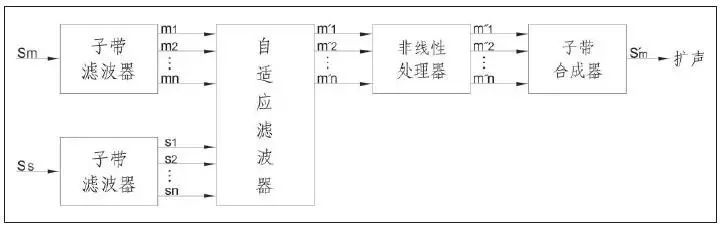
Figure 1 The Basic Working Principle of the Adaptive Acoustic Feedback Suppression System
The input signal Sm from the local microphone is filtered through a subband (separation) filter to obtain the subband components of the microphone input signalm1⋯⋯mn, which is sent to the subband adaptive filter. The output signal from the local speaker, which serves as the reference signal Ss, is also filtered through a subband (separation) filter to obtain the subband components of the speaker’s output signals1⋯⋯sn, which is also sent to the subband adaptive filter. These two signals undergo subband feedback cancellation in the adaptive filter to yield the residual signalm’1⋯⋯m’n.
Under ideal conditions, the estimated feedback signal should be consistent with the actual feedback signal input to the microphone, so that after feedback cancellation processing, the residual feedback should be zero. However, the actual situation is not so; due to environmental noise, even if the estimated feedback signal is consistent with the actual feedback signal input to the microphone, the residual feedback after cancellation is not zero, as environmental noise still exists. The feedback filter obtained using this residual feedback will deviate from the actual feedback impulse response, and due to the influence of the local speaker on the feedback filter parameters, residual feedback always exists. Therefore, nonlinear processing is needed to further reduce feedback.
After processing by the nonlinear processor, the subband signalm”1⋯⋯m”n is sent to the subband synthesis filter, where the subband signals are synthesized back into the full-band audio signalS’m, which is then sent to the amplification system. The characteristics and impulse response of the subband synthesis filter are determined by the characteristics and impulse response of the subband (separation) filters. In principle, the signal should be restored to the original signal after passing through these two sets of filters. However, in practical applications, due to the limitations of perfect restoration filter design and the impact of feedback cancellation processing and nonlinear processing, there are often some discrepancies between the restored signal and the original signal, but the influence can be controlled to a certain extent during the design of the filter group.
The feedback suppressor is connected in series in the amplification loop and does not directly obtain the reference signal from the speaker end. So, where does this reference signal come from? In fact, this reference signal comes from the speaker’s acoustic feedback signal received by the microphone, which the system automatically identifies as the feedback signal to serve as the reference signal.
2.3Applications of Adaptive Feedback Suppression
From the working principle of adaptive feedback suppression, its greatest feature is the automatic adaptation to the acoustic environment on-site, requiring no tuning, making it simple and reliable, and can improve transmission gain by 6 dB to 12 dB. In future long-term use, regardless of what changes occur in the acoustic environment, it can automatically adapt to the new acoustic environment for feedback suppression.
Adaptive filtering technology is not only used for acoustic feedback suppression (AFC) but also for echo cancellation (AEC), ambient noise cancellation (ANC), and automatic sound field equalization (AEQ).
3 Current Research Status of Adaptive Feedback Suppression
Currently, there are many companies researching adaptive filtering technology both domestically and internationally, but very few have actually developed products. Internationally, there are mainly companies like Polycom, ClearOne, and Biamp, but their products are generally comprehensive digital audio processors, where adaptive feedback suppression is often just one of the features.
Domestically, the main companies conducting independent research on adaptive filtering technology include Shanghai Longoo Electronics Technology Co., Ltd. (Longoo), Chengdu Hpdtech Technology Co., Ltd. (Hpdtech), and Guangzhou Guangxin Electronics Technology Co., Ltd. It is reported that the Sanjiyin Audio Group and Mianyang Kechuang Park Haotian Electronics Technology Co., Ltd. have also begun to engage in this technology. In the working principle of adaptive feedback suppression, one of the most important steps is to continuously and accurately track and collect the reference signal at high speed. The core algorithm of digital signal processing is how to accurately calculate the reverse cancellation or filtering signal to the maximum extent. This is not difficult for researchers engaged in digital signal processing applications, but the choice of algorithm to achieve the best effect can vary significantly, hence the core secret of each company lies in the DSP algorithm.
Many specialized adaptive feedback suppressor products have emerged domestically. In addition to companies that possess core technology having their own products, some manufacturers have launched their adaptive feedback suppressor products by using the branded products or functional modules of the aforementioned companies. The following introduces several such products from domestic companies.
3.1HD Series Feedback Suppressors
Longoo once produced a dedicated feedback suppressor product HD1014, which, in addition to feedback suppression functionality, also features automatic noise suppression and automatic gain control. Its basic application is dual-channel balanced 0 dB level input and output, and it can also be set to microphone level (with phantom power) and intelligent mixing.
HD1014 has been discontinued; currently, the main standardized products include HD1033, HD1040, and HD1057. The first two are 4-in-4-out, but HD1033 has echo suppression functionality to meet the needs of video conferencing. These products can accept microphone level (with phantom power) or line level inputs, and feature intelligent mixing with automatic sound field equalization. HD1057 is based on HD1040 but adds 12 channels of intelligent mixing to accommodate more microphone inputs. Its panel also includes knobs for adjusting microphone, line, and recording levels, as shown in Figure 2. These products, when connected to microphones, power amplifiers, and speakers, can form a well-performing small conference amplification system or amplification systems for special needs (such as courtrooms). The functionality and parameters of each input and output channel can be set via a USB interface connected to a computer using accompanying software. Longoo can also customize various modules and products with adaptive processing functionality according to customer requirements.

Figure 2 HD Series Feedback Suppressors
3.2CP-530 Intelligent Mixing Audio Processor
Hpdtech does not have a dedicated feedback suppressor product with balanced input and output; the original CP-520, which had 3 microphone inputs (2 balanced with phantom power, 1 unbalanced) and 1 unbalanced dual-channel line input with 3 outputs (1 balanced and 1 unbalanced dual-channel), has been discontinued. Currently, they have the CP-530 with 10 channels of intelligent mixing input, which can output intelligent mixing switched microphone information to control cameras, etc. It can also connect to a computer for setting the functionality and parameters of each input and output channel via accompanying software. In addition, they offer several teaching audio host products with adaptive processing. Hpdtech also provides adaptive processing modules.
3.3AFC-6 Adaptive Feedback Suppression Module
Guangzhou Guangxin Electronics Technology Co., Ltd. mainly supplies adaptive feedback suppression modules, such as AFC-6.
3.4Others
There are also some companies that have launched adaptive feedback suppression products by branding or using functional modules from the above companies. For example, Shenzhen Dongwei Intelligent Technology Co., Ltd. (Dongwei) once had an adaptive feedback suppressor product AFC6-4, with dual-channel balanced 0 dB level input and output, featuring automatic noise suppression, with necessary settings done via a dip switch on the rear panel. Other products include the A-7230 from Guangdong Meilai Electronics Factory, AEC-2020 from Guangzhou Aiso Electronics Co., Ltd., and M2000AII from Foshan Damaike Electronics Technology Co., Ltd., which are also adaptive feedback suppressors. Additionally, Enping Hengli Electronics Co., Ltd. (Maxson) has an intelligent mixer with adaptive feedback suppression functionality.
4 Application Experience
The author has used products from Longoo and Dongwei, both of which performed well. Longoo’s products have more comprehensive features, and during critical feedback, the metallic sound tailing is smaller compared to Dongwei’s products, possibly due to their digital signal processing algorithm tracking the reference signal relatively quickly and accurately; while Dongwei’s products do not require computer connections for setup, making them more convenient. The author has also used other brands (not listed above) of similar products and found their performance unsatisfactory, indicating that even similar types of products can vary significantly in quality.
Although adaptive feedback suppressors have good full-band frequency characteristics, they should still be used similarly to general feedback suppressors, ideally only connected in the microphone loop. For example, they can be connected in series between an intelligent mixer or a “hand-in-hand” conference system host and the mixing console, or connected to the output of the microphone grouping on the mixing console. If using an adaptive feedback suppressor with intelligent mixing and multiple inputs, settings via accompanying software should ensure that feedback suppression and intelligent mixing functionalities are used only for the microphone channels.
Lastly, it is important to note that there are some products referred to as “automatic feedback suppressors” that are entirely different from adaptive feedback suppression. Some of these are classic notch-type feedback suppressors that simply use an automatic tuning method, which slowly increases gain to produce feedback and suppress it one by one by pressing a button. While this method avoids the need for manual adjustment of each notch filter, it is often not as ideal as traditional manual tuning. Others are simply frequency-shifting types, yet the manufacturers still call them “adaptive.” Some manufacturers have feedback suppressor products that incorporate notch, frequency-shifting, and adaptive filtering methods, making it easier to confuse them. Therefore, when choosing products, it is essential to clarify whether it is genuinely an adaptive filtering method feedback suppressor.
Selected from “Performing Arts Technology” 2017 Issue 7, Xiong Jian “Adaptive Acoustic Feedback Suppression Technology and Its Applications”, please indicate the source: Performing Arts Technology Media.
Order “Performing Arts Technology” Magazine

Submissions, Reprints, Collaboration
QQ: 2761859395
WeChat: muenennpl
Magazine Office
Tel: 010-64097040
010-64037167