According to a report by Electronic Fan Network (by Zhou Kaiyang), the rapid increase in the number of MCUs within a single vehicle has provided a new opportunity for IC design companies. Many MCU manufacturers that previously focused on consumer electronics are now pivoting towards automotive electronics.However, for any automotive chip manufacturer, truly entering the automotive market and establishing a foothold requires overcoming the barrier of automotive certification.In addition to tests like AEC-Q100 that focus on IC reliability, the ISO26262 functional safety certification of CPU IP is also indispensable during the design phase.
Moreover, merely adhering to the ISO26262 design process specifications is not enough; obtaining certification from various third-party independent functional safety certification bodies is the ultimate goal, such as Germany’s TUV, Switzerland’s SGS, and America’s Exida. Therefore, whether for cockpit, gateway, or ADAS chips, already verified automotive IP must be selected at the initial design stage. This approach can significantly shorten the automotive certification time for chips and accelerate their market launch.
Arm: A Complete Automotive IP Ecosystem from Functional Safety to Performance
As a veteran IP supplier in the automotive field, Arm has established a complete automotive product matrix, covering various processor IP products from the Cortex-M series to the Cortex-R series and the Cortex-A series, addressing common automotive applications such as sensors, SoC management, ADAS, and IVI. According to Dennis Laudick, Vice President of Global Market at Arm Automotive Division, over 85% of IVI/cockpit processors and over 50% of ADAS application processors globally are based on Arm.
Taking the Cortex-M series as an example, automotive MCU products based on M series processor IP undoubtedly have the highest shipment volumes. Currently, the mainstream automotive MCUs using Cortex-M IP range from low to high performance with Cortex-M0+, Cortex-M4, and Cortex-M7. The first two are mostly used in ASIL-B level MCU designs, while the dual-core lockstep configuration of Cortex-M7 is frequently used in ASIL-D level MCU designs.
For instance, the commonly used Cortex-M4 processor IP adds DSP instructions based on the M3, making it very suitable for applications requiring some digital signal processing. The Cortex-M4F, which has a built-in FPU, has become the first choice for many MCU manufacturers. Products based on this core include NXP’s S32K14x, Infineon’s CYT2B9, Guokun Technology’s N32A455, and Qichip Microelectronics’ Raptor series, all of which are widely used in basic applications such as body control and intelligent cockpits.
Also popular in such applications is the Cortex-M33, which has been specially optimized for cost- and power-sensitive MCUs and mixed-signal applications, and it also integrates Arm’s TrustZone security technology, enhancing security against external attacks. For example, GigaDevice’s first MCU GD32A503 and Yuntai Semiconductor’s YTM32B1ME are both developed based on this processor IP.
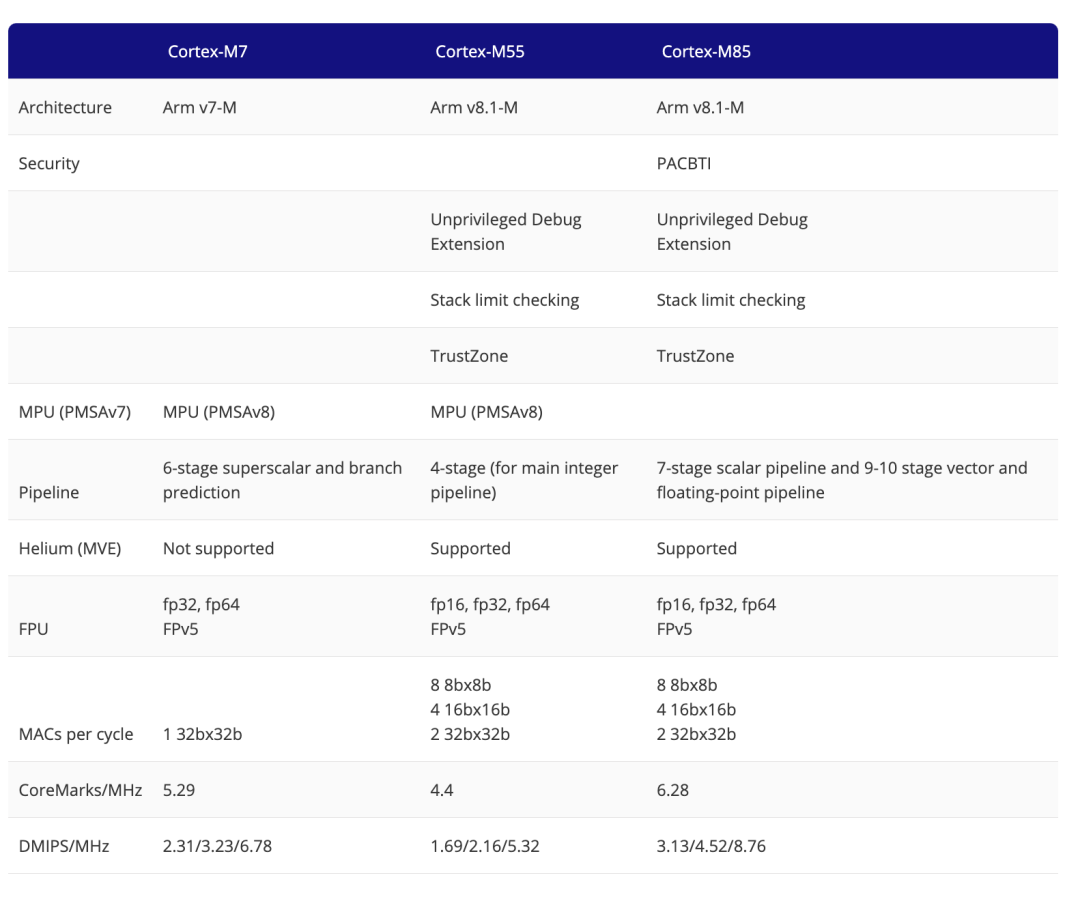
Cortex-M7, M55, and M85 Comparison / Renesas
Of course, with the increasing demand for ASIL-D level automotive functional safety certification and higher performance, Arm has also launched the higher-performance Cortex-M85 processor IP that supports ASIL-D level, providing manufacturers of high-performance automotive MCUs with a general-purpose computing performance option that exceeds M7, as well as offering better performance for ML/DSP applications.Compared to the M7 with a 6-stage superscalar design, the M85 uses a 7-stage scalar pipeline and a 9 to 10-stage vector and floating-point pipeline design, achieving 6.28 CoreMarks/MHz and several times the ML/DSP performance of the M7.
In terms of functional safety, the Cortex-M85 can adopt a dual-core lockstep design, making it suitable for high-safety-level body control applications, such as high-torque traction motors. Renesas Electronics also showcased the first MCU prototype based on Cortex-M85 last year. With Arm having achieved third-party ASIL-D safety certification for several processor IPs like M23, M33, and M55, it is believed that M85 will soon receive this certification, joining M33 and M55 as a new mainstream automotive MCU IP.
Additionally, it is worth noting that during the adaptation to new complex automotive architectures, with increasing performance requirements, the Cortex-R series of processor IPs have also begun to appear in some automotive MCUs. For example, STMicroelectronics’ Stellar integrated MCU incorporates six Cortex-R52 cores.
The Stellar P series is specifically designed to meet the integration requirements of next-generation transmission systems, electrification solutions, and domain-oriented systems, achieving higher levels of real-time performance, safety, and determinism. The Stellar G series is designed to address the key challenges of next-generation body integration and region-oriented vehicle architectures, ensuring performance, safety, power efficiency, and extensive connectivity capabilities with high security.
Recently, NavInfo’s subsidiary, Jiefa Technology, also released the AC7870x series of MCU chips designed with a multi-core Cortex-R52 architecture. This MCU meets functional safety ASIL-D standards, with a clock frequency of up to 350MHz, meeting the high safety level requirements for ECUs. Jiefa Technology also stated that the AC7870x series will officially hit the market in 2024.
RISC-V: A Growing Automotive IP Ecosystem
Although RISC-V has not accumulated as much experience in automotive electronics applications as Arm, the progress of RISC-V in automotive IP over the past few years, driven by various RISC-V IP manufacturers, has been quite rapid. Companies like SiFive, Xilinx, Andes Technology, Syntiant, and NXITEXE have provided a wide range of options in the automotive IP field.
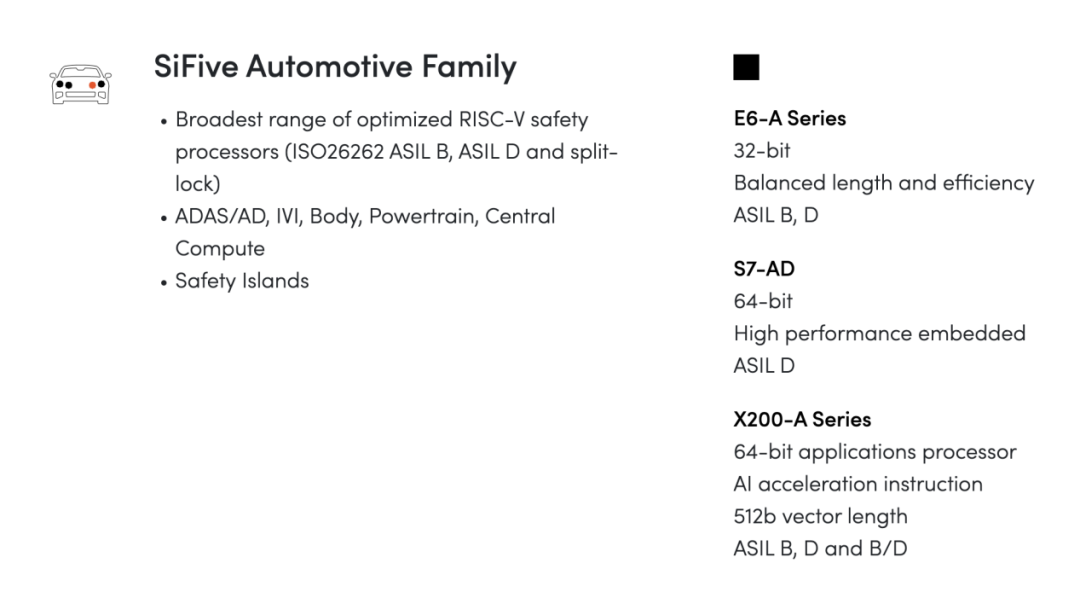
SiFive Automotive IP / SiFive
After launching the 32-bit E6-A and the 64-bit S7-AD and X200-A automotive IP solutions last September, the first ASIL-B certification for E6-AB was finally achieved in July this year. E6-A is designed for various real-time 32-bit applications within vehicles, from system control to HSM modules, and is also very suitable for automotive MCU cores. This IP employs a single-issue 8-stage pipeline design, and in addition to minimizing logical redundancy with E6-AB, SiFive is also advancing ASIL-D certification work for the dual-core lockstep E6-AD and split-core E6-AS.
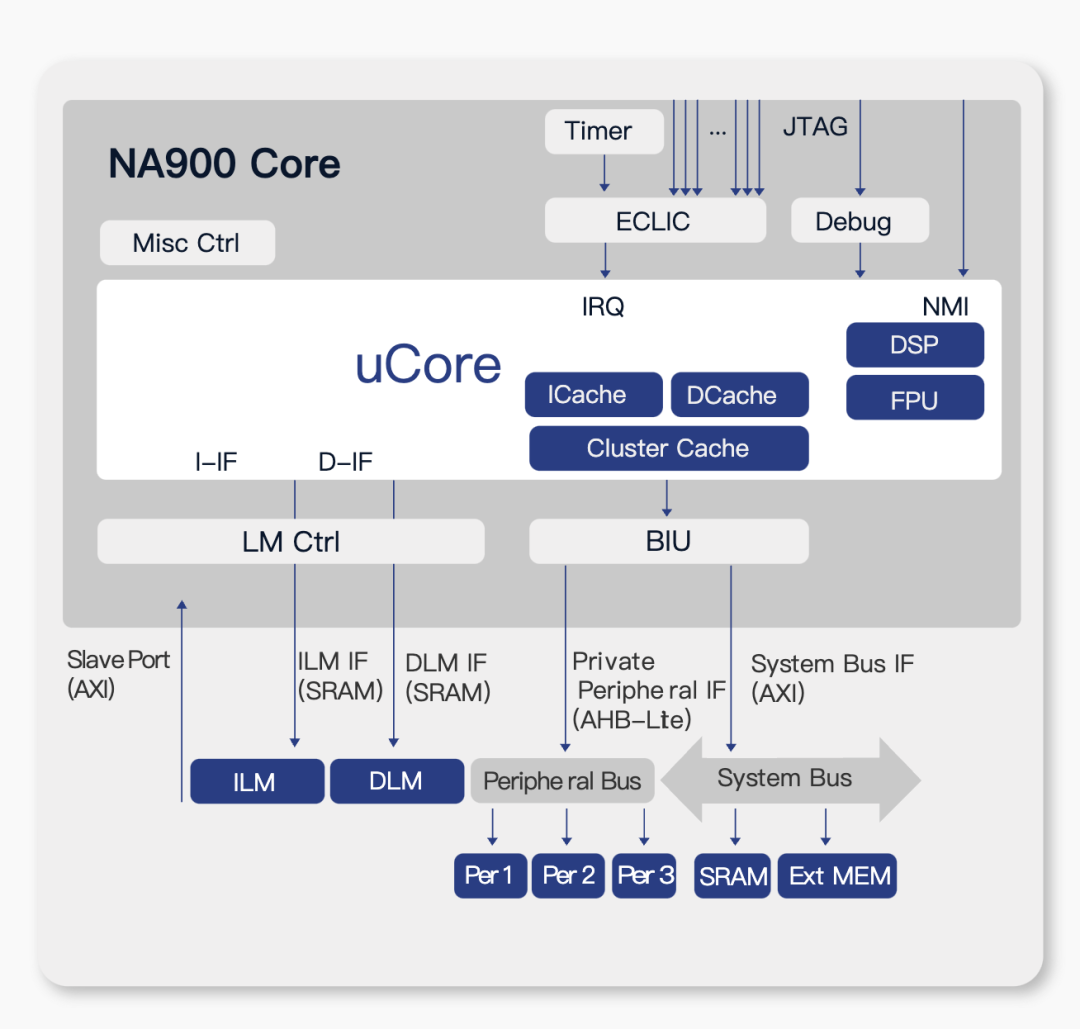
NA900 Microarchitecture / Xilinx
The first RISC-V CPU IP to obtain ISO 26262 ASIL-D certification is Xilinx’s NA900 and NA300. Xilinx began its layout for automotive IP and certification two years ago, and the NA900, the automotive version of N900, employs a nine-stage pipeline design that directly competes with Arm’s Cortex-R52 mentioned earlier. The Fuxi 2360 automotive MCU developed by Wuhan Binary Semiconductor, showcased at last year’s Dripping Lake Forum, is based on Xilinx’s NA900.
The world’s first ISO26262 ASIL-B certified RISC-V CPU IP was obtained by Andes Technology’s N25F-SE last year. The N25F-SE is a 5-stage pipeline 32-bit RISC-V CPU core that supports the standard IMACFD extended instruction set, including efficient integer instruction set and single/double precision floating-point operation instruction set. Coupled with Andes’s fifth-generation V5 extended instruction set, it can further improve performance and reduce program code size. The ASIL-B certification allows N25F-SE to be used in applications such as dashboards, in-vehicle monitoring, and lighting control.
Focus on RISC-V processor IP and EDA, the startup Syntiant has also released several automotive-grade RISC-V IP products this year, including Wing-M050, Wing-M100A, Wing-M130, and Wing-M500. Among them, Wing-M050, Wing-M100A, and Wing-M130 are mainly aimed at low-power automotive MCU designs, with Wing-M100A employing a dual-core lockstep mechanism to meet ASIL-D functional safety level requirements. The dual-issue 7-stage pipeline design of M500 is suitable for high-performance cores in automotive domain controllers, and M500 features Split characteristics, allowing dynamic switching between automotive functional safety and processor performance.
It is somewhat regrettable that another major domestic RISC-V IP manufacturer, Pingtouge, seems to have chosen not to focus on the automotive field, but rather to concentrate on consumer electronics and industrial electronics first.
Building Automotive MCUs with Proprietary and Other Licensed IP
In addition to Arm and RISC-V, some MCU manufacturers are also committed to developing proprietary architecture IP or utilizing other licensed IP to achieve automotive MCU shipments. This alternative approach gives them more freedom in chip architecture design and offers more choices for automotive MCUs.
Guoxin Technology has developed a series of automotive MCU chip products based on the Motorola-licensed M*Core instruction set and the IBM-licensed PowerPC instruction set, creating proprietary C*Core series 32-bit RISC CPU IP. Based on this architecture, Guoxin Technology has developed a range of automotive MCU chip products, such as mid-range domain controller chip CCFC2016BC and high-end domain controller chip CCFC3007PT, with the highest safety level reaching ISO 26262 ASIL-D standards. Guoxin Automotive has also implemented a series layout of these products in gateway control chips, instrument chips, intelligent sensor chips, and other 12 automotive product lines.
However, recently Guoxin Technology has also begun exploring the application of RISC-V architecture in the automotive field, such as initiating the development of the first automotive MCU chip CCFC3010PT based on RISC-V architecture, which employs the self-developed RISC-V CPU core CRV4E. The CCFC3010PT is primarily aimed at power battery DC-DC and OBC applications, directly competing with the E series in the aforementioned STMicroelectronics Stellar MCU (mainly using the Cortex-M7 core).
Xingwang Microelectronics, as one of the few domestic MCU companies with its own IP core architecture, has launched several automotive-grade MCUs based on the Kungfu core, covering various scenarios such as chassis power, intelligent cockpits, motor power supplies, and body control. Last year, Xingwang Microelectronics obtained ISO26262 ASIL-D process certification, and this year, some KF32A series automotive MCU products have received ASIL-B certification.
Recently, Xingwang Microelectronics released a new 32-bit automotive MCU based on the Kungfu32 core, KF32A158. The KF32A158 meets ASIL-B automotive functional safety standards, with a clock frequency reaching a new high of 120MHz for the KF32A series, indicating that the Kungfu core has finally made breakthroughs in mid-to-high-end automotive applications, suitable for more automotive control systems, such as instrument control, thermal management, and more.
From the various automotive products based on different architectures, it can be seen that to create a functional safety-compliant automotive MCU, the support of automotive-grade IP is indispensable. This principle is not limited to automotive MCU products; it also applies to various automotive SoC products. Such products not only need to choose certified CPU IP but also need to consider various automotive interface IP and graphics IP. Chip manufacturers must timely adhere to functional safety design specifications and select suitable automotive IP to further shorten the market launch cycle of automotive chips.



Disclaimer:This article is originally from Electronic Fan Network, please indicate the source above if reprinted. For group communication, please add WeChat elecfans999,for submission of interview requests, please email [email protected].
More Hot Articles to Read
-
5.5G is about to be commercialized, communication is moving towards the 10G era
-
MW-level permanent magnet charging demagnetization technology has made breakthroughs, promoting permanent magnet equipment to higher performance
-
Following China’s Tiantong-1 satellite, Musk’s Starlink launches direct mobile phone services
-
The Israeli chip industry is engulfed in flames, affecting more than just foundries
-
This may be the ceiling for domestic desktop CPUs in 2023! Longxin 3A6000 review