👆Click the blue text above to followLearn more about “Programming Learning Methods and Pitfall Avoidance Guide”
Programming is a rigorous science, yet some competitions have become “black box operations”.
The 2025 National Information Literacy Finals concluded in Wuzhen, and the children’s results have been announced. In a video, a parent shared their child’s experience participating in the 2025 National Information Literacy C++ Finals. The child confidently exited the exam room, but the final score did not meet expectations.
The parent commented: There were no scoring standards, no appeal channels, and the results relied entirely on parents’ own comparisons. Many comments under this video expressed similar experiences; here are some screenshots:

After watching the video, I felt quite moved, as a similar story had happened to one of my students last year.
A single excellence award shattered a child’s confidence.
Last year, one of my students won first prize in the provincial information literacy C++ competition, advancing to the national finals in Jiaxing, Wuzhen. Although they had only been learning for a year, this child was quite intelligent, well-trained, and solid in their abilities, looking forward to this competition.
After the competition, the child excitedly reported their answers: “Teacher Hou, there were six questions in total, I got four right, and the last two were tricky, but I considered all the special cases.” We all thought that, despite only learning for a year, winning a decent award should not be a problem.
However, when the results came out, we were all stunned—only an “excellence award”.
The child immediately questioned: “I clearly got quite a few right…”

What was even more frustrating was that we didn’t even know why we received this award. The same issues persisted: no scoring details, no code feedback, and no appeal channels. It felt like a punch into cotton—no echo at all.
This year, the mother asked me if they should try again, as they had been learning for two years, but the child did not want to participate again. I felt a mix of emotions; why was that?
Originally, I wanted to help the children gain experience and achieve results through their own efforts, but the competition’s **mechanism has created an unhealthy mindset for them. I am unsure whether to let them participate again this year; here are the chat screenshots:
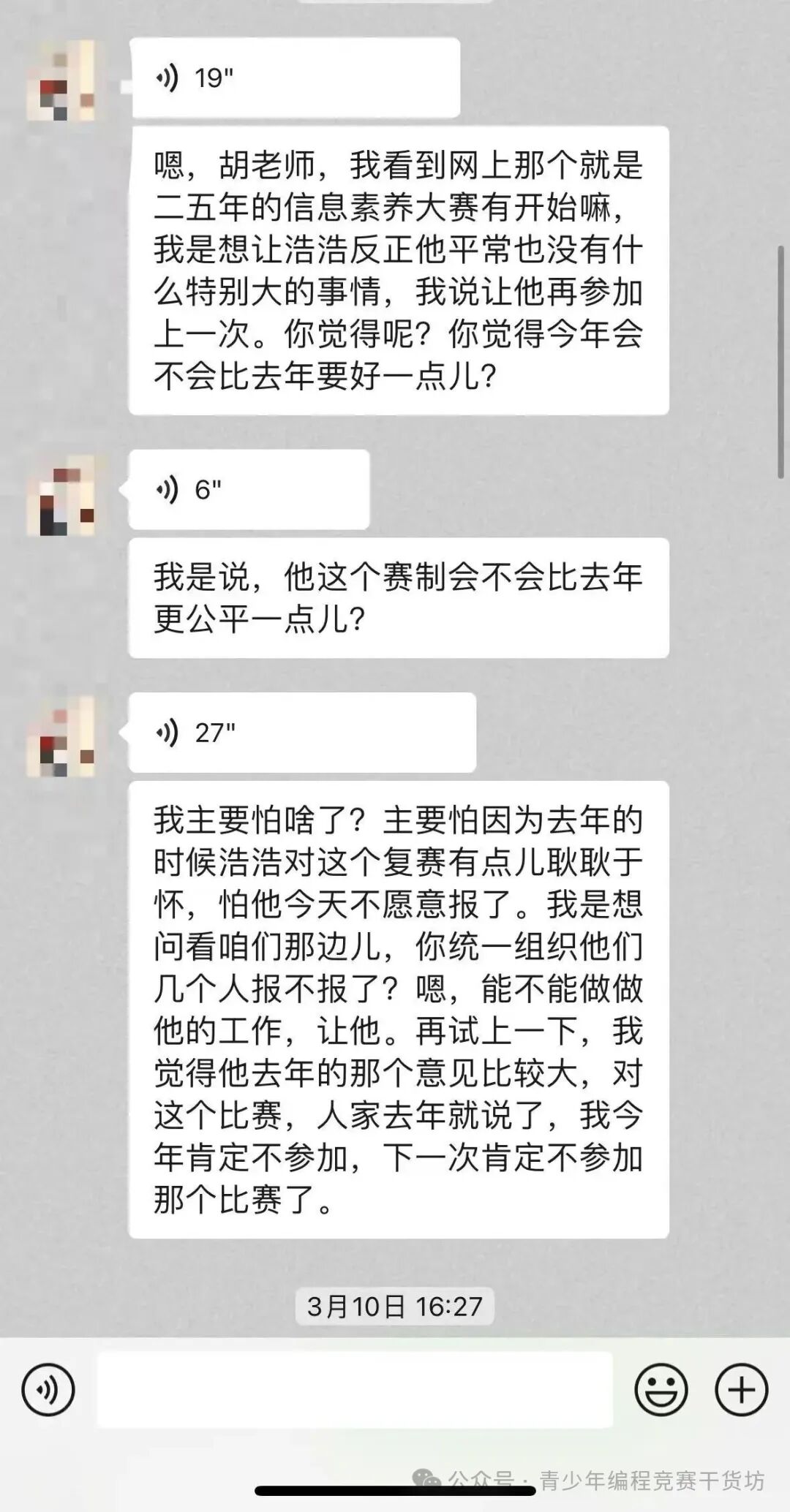
Who is harmed by the “black box operation” of programming competitions?
What is programming? Programming is a rigorous science, black and white; right is right, and wrong is wrong. A program either produces the correct result or it does not. This should be the fairest and most transparent field of competition, yet some programming competitions have become the most “black box” operations:
Mysterious scoring standards: Different children can receive completely different scores for the same code.
Appeal channels are non-existent: Or simply do not exist; I say you get this score, and that’s it.
Prize ratios are not disclosed: All contestants’ scores are opaque, relying solely on the committee’s word.
Who is harmed? Those children who stay up late practicing problems, those parents who save every penny to participate, and the coaches who work hard and train them with care.
Three suggestions to restore fairness in competitions for children:
1. Public transparency
Competition questions, scoring standards, and prize ratios should be made public in advance. Let participants know the rules; this is the foundation of fair competition.
2. Establish an appeal mechanism
Set up reasonable appeal channels and times, allowing contestants to request a review if they disagree with their scores. It’s not the disputes that are scary, but the lack of opportunity to voice them.
3. Provide feedback reports
At the very least, participants should know where their code was penalized and why. A detailed feedback report is more valuable than a mere certificate.
In conclusion:
This parent’s video caught the attention of the authorities, and the parent later announced that the committee had revised the scores and awards after investigation, and the results seemed to be good. But what about the other children whose parents did not have the courage to speak out?
Education cannot tolerate any falsehood, and competitions cannot allow any injustice.
We teach children programming to help them learn to solve problems with logic and reason. Encouraging them to compete is to let them understand the value of effort, not to teach them to accept “unwritten rules” early on.
Parents invest real money, and children invest time and effort, not to exchange for an illusory award, but to gain real training and recognition in a fair environment.
If even programming competitions cannot guarantee fairness and justice, what can we still believe in?