In today’s digital wave sweeping across the globe, programming is no longer a skill exclusive to programmers but has become a crucial foundation for the future competitiveness of youth.
The GESP programming ability certification launched by the China Computer Federation (CCF) serves as a precise “ruler“ that scientifically measures children’s programming levels. Among them, C++ is a “timeless classic“ in the programming field, making it the top choice for many parents and children. Today, we will comprehensively unlock the secrets of the GESP C++ certification for youth!
MANUFACTURE01
GESP: Authoritative Certification to Guide the Programming Journey
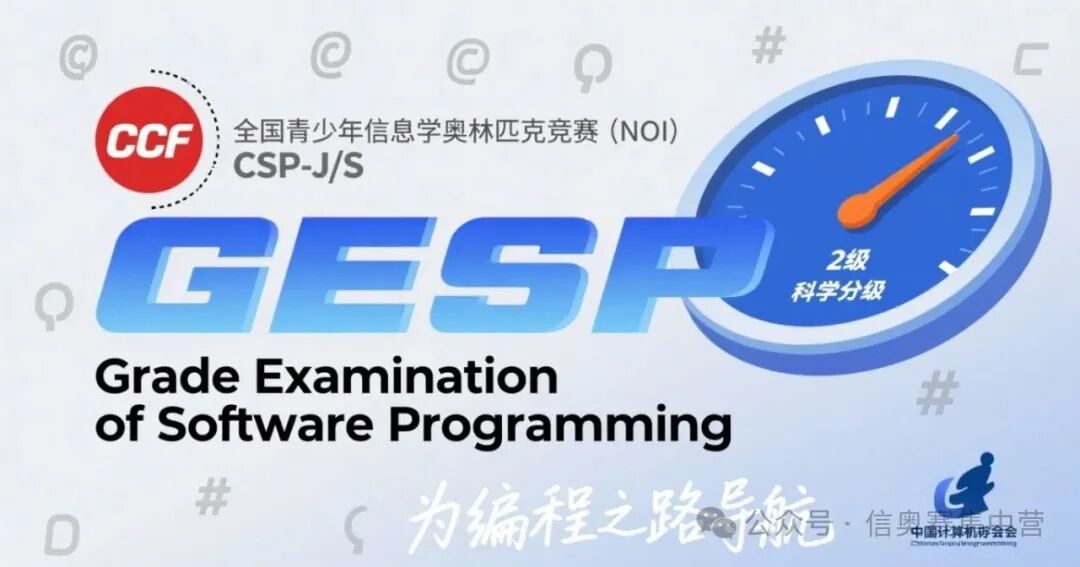
GESP (Grade Examination of Software Programming) is the CCF programming ability certification, organized by the National Olympiad in Informatics in China (NOI) and CSP – J/S, crafted by the China Computer Federation (CCF). It breaks the traditional programming learning “no standards, hard to verify“ dilemma by scientifically grading, allowing every step of a child’s growth to be traceable. Whether for beginners in programming or those with a certain foundation, “little experts“, everyone can find a suitable stage here.
02
8-Level System: Clearly Planned Growth Path
1. Detailed Examination Content Outline
The GESP C++ certification covers various aspects including basic computer knowledge, programming syntax, algorithm design, and data structures. For example, the level one exam mainly assesses basic computer knowledge and programming environment, variable definition and usage, basic data types, control statement structures, basic operations, and input/output statements. As the levels increase, the exam content becomes progressively deeper and more complex. For instance, at level five, it involves elementary number theory, array simulation of high-precision calculations, singly linked lists, doubly linked lists, circular linked lists, the Euclidean algorithm, the Sieve of Eratosthenes for prime tables, the unique factorization theorem, binary search/binary answer, greedy algorithms, divide and conquer algorithms, and other advanced knowledge and algorithms.
2. Ability Requirements Corresponding to Each Level
-
Level 1: Students should master simple program structures of sequence, loop, and branch, be able to use an integrated development environment for programming and debugging, and complete single-function program design through learning basic programming knowledge.
-
Level 2: Master basic program design, be able to use simple mathematical functions, independently complete more comprehensive cases involving branch statements and loop statements, and use nested structures of branches and loops.
-
Level 3: Understand data encoding, base conversion, bit operations, etc., master the use of one-dimensional arrays, strings, and functions, and independently use simulation and enumeration methods to solve corresponding algorithm problems.
-
Level 4: Master the definition, calling, and parameter passing methods of functions, master the usage of two-dimensional and multi-dimensional arrays, common sorting algorithms, file reading and writing, and exception handling, and be able to solve recursive-related problems.
-
Level 5: Master elementary number theory, STL template applications, and linear list knowledge, the ideas of binary method, divide and conquer method, and greedy method, complete specified function programs, and master array simulation of high-precision calculations in C++.
-
Level 6: Master basic knowledge of trees, be able to analyze the definitions, constructions, and traversals of simple trees and special trees, master Huffman trees, complete binary trees, binary search trees, Huffman coding, Gray coding, and be able to use depth-first search and breadth-first search algorithms for traversal, master simple linear dynamic programming and simple knapsack problems, understand object-oriented concepts, and master class creation, stacks, queues, and circular queues.
-
Level 7: Master commonly used functions in the math library, such as trigonometric, logarithmic, and exponential functions, master complex dynamic programming, such as depth-first and breadth-first traversals of graphs, and master hash tables.
-
Level 8: Master counting principles, permutations and combinations, Pascal’s triangle, doubling method, algebra, and plane geometry (middle school math part), master graph theory algorithms and comprehensive applications, such as minimum spanning trees and single-source shortest paths, be able to analyze the space and time complexity of more complex algorithms, and master algorithm optimization.
03 Summary and Outlook
-
The Importance of GESP C++ Certification in Children’s Programming Learning
The GESP C++ certification provides a systematic platform for children to learn and verify their programming abilities. By participating in the certification, children can clarify their learning goals and gradually improve their programming skills according to the certification outline. Moreover, the learning and challenges during the certification process can cultivate children’s logical thinking, innovative abilities, and problem-solving skills, laying a solid foundation for their future learning and career development.
-
Encouraging Children to Actively Participate and Brave Self-Challenges
Programming is a field full of fun and challenges, and we hope that children can actively participate in the GESP C++ certification and bravely challenge themselves. Regardless of the outcome, the knowledge and experience gained during this process will be a valuable asset for the children. We believe that with the support and help of parents and teachers, children will be able to go further on the path of programming and realize their dreams.
-
Beautiful Expectations for Children’s Future in Programming
In the future, with the continuous development of technology, programming will play an increasingly important role in various fields. We look forward to children exploring deeply in the programming field through the GESP C++ certification, becoming innovators and leaders in the future technology sector. May children shine in the world of programming and create a better future!