The “DCS (Datacenter Virtualization Solution) V1.3” virtualization software product submitted by Huawei Technologies Co., Ltd. has successfully passed the evaluation of the “Server Application Scenario Performance Testing Method for Virtualization Software” standard, conducted by the China Electronics Standardization Institute as the national authoritative testing organization and the professional evaluation team of the Green Computing Industry Alliance.
Overall comparison results show that the DCS virtualization product based on the ARM architecture Kunpeng server has higher performance in multi-core processing, concurrent read/write, and network access, enabling upper-layer applications to achieve stronger computing power, higher memory throughput, and high throughput with low latency for disks through software-hardware collaboration.
Testing Methods and Configuration Review
The tested samples for this test included one ARM architecture server (chip HUAWEI Kunpeng 920 4826) and one X86 architecture server (chip Intel(R) Xeon(R) Gold 6230). The server virtualization software used is Huawei DCS (Datacenter Virtualization Solution) V1.3. The virtual machine operating system is EulerOS V2.0.
Detailed configuration information is shown in the table below:
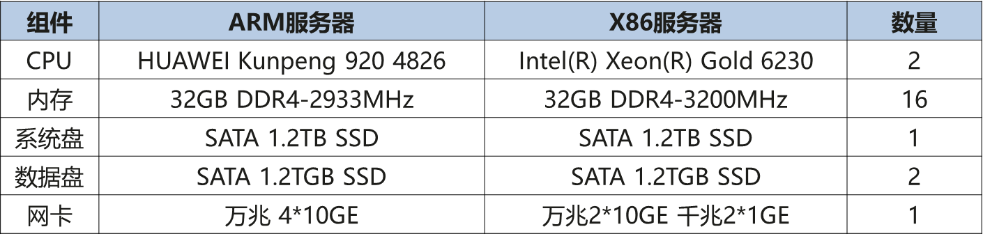
Hardware Configuration Table
Evaluation Results
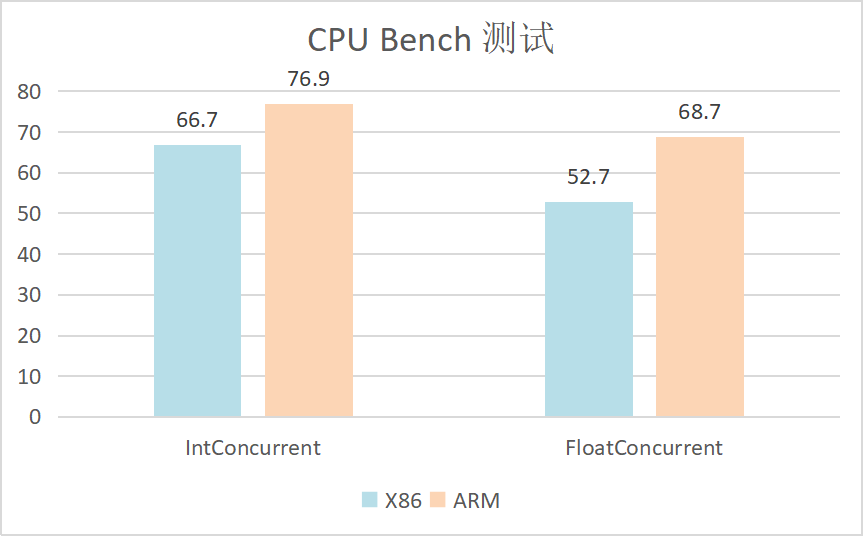
In the CPU Bench test, under full-core testing scenarios, the integer concurrent test item showed that ARM leads X86 by 16%, and the floating-point concurrent test item showed that ARM leads X86 by 30%.
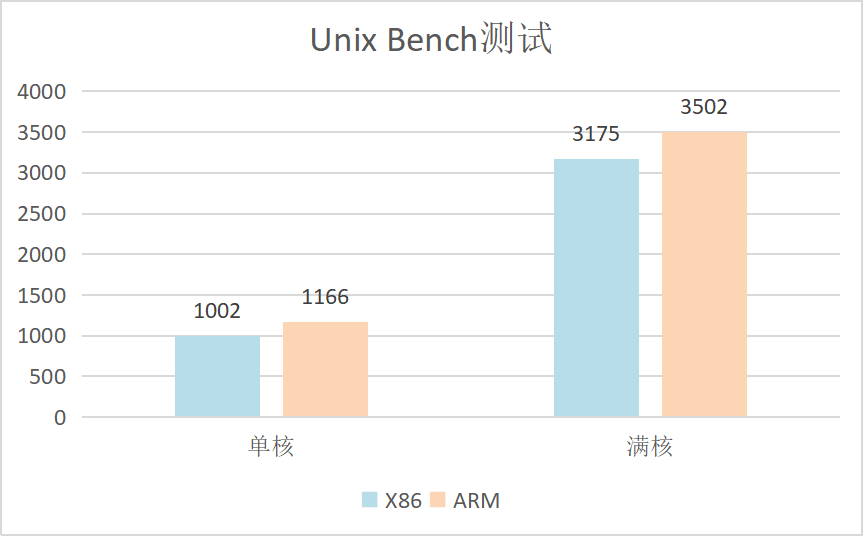
In the Unix Bench test, under the condition of issuing virtual machines with the same configuration (8 cores, 16G), the single-core comprehensive computing performance item showed that ARM leads X86 by 16%, and the full-core comprehensive computing performance item showed that ARM leads X86 by 10%.
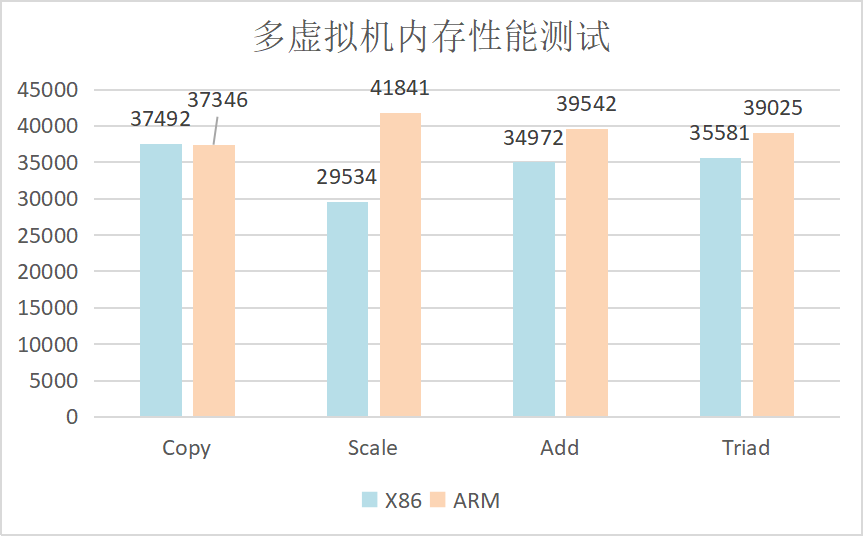
In multi-virtual machine scenarios, the memory performance test results show that under multi-threading conditions, except for Copy performance being roughly equal, ARM significantly outperforms the x86 architecture in all metrics, with Scale rate leading by about 42%, Add rate leading by about 13%, and Triad rate leading by about 10%.
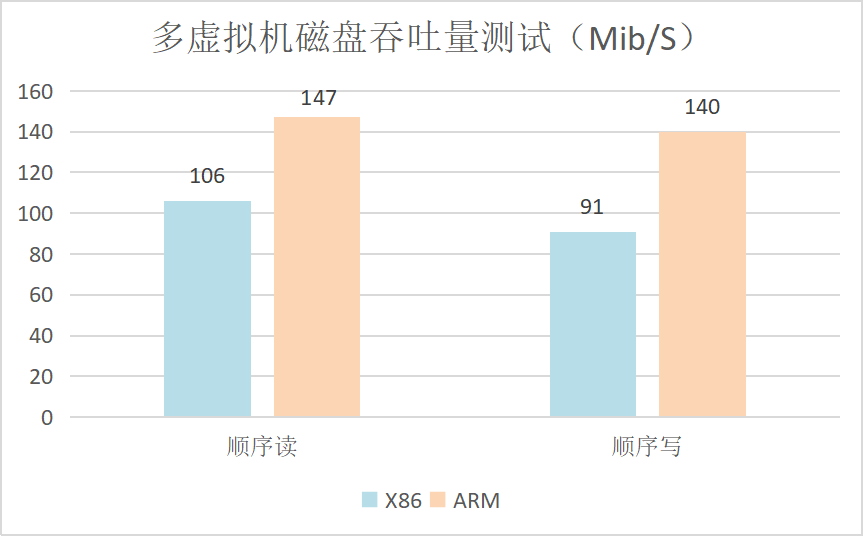
In multi-virtual machine scenarios, the disk throughput test results show that under multi-threading conditions, ARM significantly outperforms the x86 architecture in all metrics, with sequential read leading by about 39% and sequential write leading by about 54%.
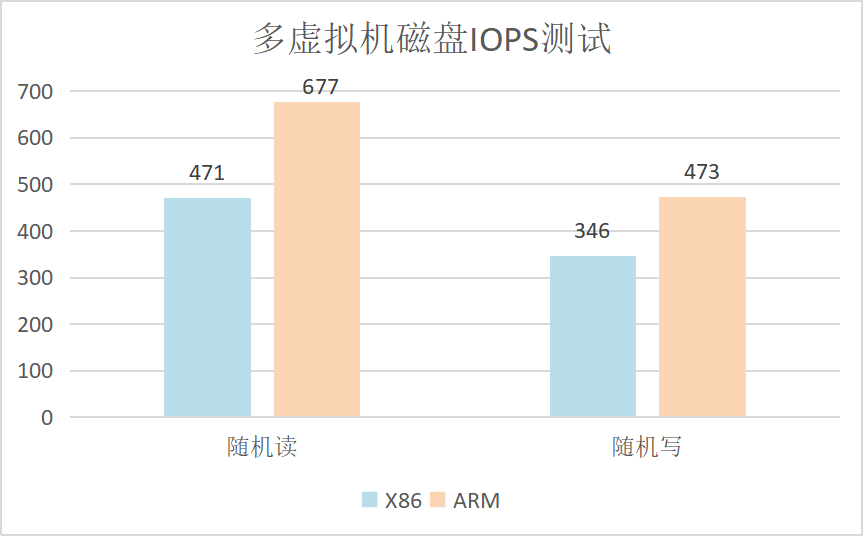
In multi-virtual machine scenarios, the disk IOPS test results show that under multi-threading conditions, ARM significantly outperforms the x86 architecture in all metrics, with random read leading by about 44% and random write leading by about 37%.
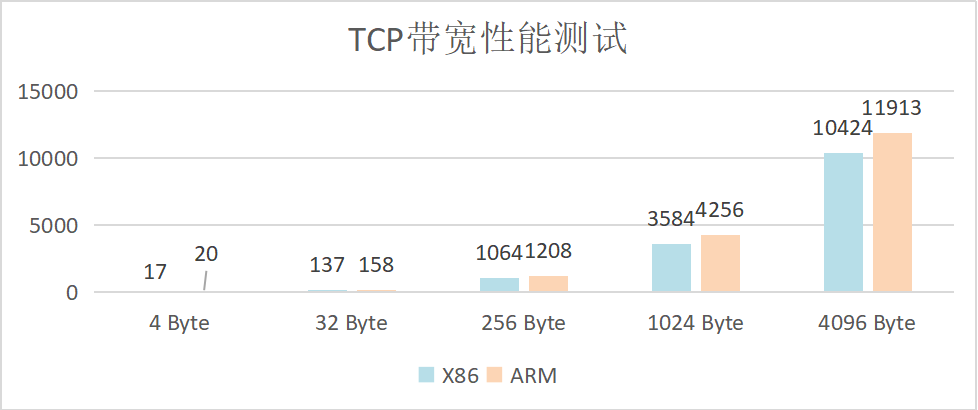
In multi-virtual machine scenarios, the TCP bandwidth performance test results show that under multi-threading conditions, for sizes below 4096 bytes, ARM significantly outperforms the x86 architecture in all metrics, with 4 Bytes leading by about 18%, 32 Bytes leading by about 15%, 256 Bytes leading by about 14%, 1024 Bytes leading by about 19%, and 4096 Bytes leading by about 14%.
About Huawei DCS (Datacenter Virtualization Solution)

Huawei Technologies Co., Ltd. achieves omnipresent intelligence through continuous innovation in data storage, diverse computing, and cloud services, enabling digital transformation and intelligent upgrades across various industries, and promoting the construction of an intelligent world. It provides competitive, secure, and reliable products, solutions, and services in communication networks, IT, intelligent terminals, and cloud services, and collaborates openly with ecosystem partners to continuously create value for customers, unleash individual potential, enrich family life, and stimulate organizational innovation. Huawei insists on continuous innovation around customer needs, increases investment in fundamental research, builds up strength, and promotes global progress.
With the development of data center business, traditional data centers face many new challenges. To address the challenges faced by traditional data centers and to keep up with technological trends, Huawei has launched a new generation of data center virtualization solutions (Datacenter Virtualization Solution, referred to as DCS). The DCS data center virtualization solution manages the IT infrastructure of enterprise data centers in a full-stack manner, building resource pools for computing, storage, and networking, significantly improving the utilization efficiency of data infrastructure, including resource management, resource monitoring, intelligent operation and maintenance, and system management.
Product Features and Advantages
DCS (Datacenter Virtualization Solution) Virtualization Software Product
The DCS (Datacenter Virtualization Solution) virtualization software product (hereinafter referred to as DCS) is a data center virtualization solution independently developed by Huawei, which combines virtualization series software with ICT hardware to help enterprises build lightweight, elastic, and diverse new generation data center infrastructure.
DCS provides a full-stack data center solution for server virtualization, storage virtualization, network virtualization, and security virtualization, while also featuring advanced capabilities such as operation and maintenance management, intelligent monitoring, and cloud security protection, using eDME as the full-stack management software for data centers. Through a unified management interface, open API, cloud-linked AI enabling, and multidimensional intelligent risk prediction and optimization, it achieves automated management of the entire lifecycle of resources for “planning, construction, operation and maintenance, and optimization” and provides unified management for multiple data centers, helping customers simplify management and improve data center operation and maintenance efficiency; it uses FusionCompute as the cloud operating system software to integrate the resources of various physical data centers, mainly responsible for the virtualization of hardware resources, as well as centralized management of virtual resources, business resources, and user resources, thereby reducing operational costs and ensuring system security and reliability, assisting operators and enterprises in building secure, green, and energy-efficient cloud data center capabilities; it adopts eBackup & UltraVR virtualization backup and disaster recovery software to achieve backup and disaster recovery of virtual machine data, providing a unified disaster recovery protection solution for all regions and scenarios in the data center.
The DCS (Datacenter Virtualization Solution) virtualization software product has the following characteristics:
Lightweight and Elastic:The DCS (Datacenter Virtualization Solution) virtualization software product supports hyper-converged delivery, ready to use out of the box. It can start deployment with a minimum of 2 nodes and supports scaling to large-scale scenarios; it allows for on-demand modular stacking of containers, disaster recovery, backup, and other functions; unified management and cloud management platform software, offering better cost efficiency.
Agile and Efficient:The DCS (Datacenter Virtualization Solution) virtualization software product features end-to-end NoF+ protocol in storage, significantly improving performance compared to FC networks, meeting high-performance, low-latency, and high-throughput application scenarios; in computing: supports NUMA (Non-Uniform Memory Access) optimization, large page memory, CPU and memory reuse, dynamic resource expansion (DRX), and dynamic resource scheduling (DRS) among various technical capabilities, achieving a 30% performance improvement; in networking: supports multiple hardware passthrough, providing near-physical device performance, with DPDK technology shortening forwarding paths and increasing network forwarding speed by 6 times.
Intelligent Management:The DCS (Datacenter Virtualization Solution) virtualization software product features management capabilities for the entire lifecycle of business applications, such as achieving non-disruptive migration of business applications and databases to the cloud through SCMT and database migration tools. It provides multi-dimensional monitoring visualization capabilities for business operations, such as a cloud intelligent brain that collects and organizes cloud platform fault alarms and resource trends, offering customers personalized operation and maintenance services to achieve proactive offline closed-loop. Additionally, DCS comes with 4 large screens preset for data center overview, supporting flexible selection of over 30 icon controls to meet custom large screen requirements; multi-dimensional correlation and end-to-end topology analysis for problem boundary definition in minutes; self-service application for computing, storage, and network services, with automatic issuance of business.
Diverse Ecosystem:The DCS (Datacenter Virtualization Solution) virtualization software product features a northbound multi-cloud ecosystem, supporting integration with Huawei Cloud, Feizhi Cloud, and other multi-vendor cloud management platforms for lightweight cloud migration, and a southbound multi-compute ecosystem, compatible with mainstream vendor servers for X86, and supporting Huawei Taishan and other Kunpeng ecosystem servers and widely compatible with various types of domestic hardware products, not binding to servers, supporting both X86 and ARM architectures, making it flexible and easy to use. The cloud computing management platform can uniformly manage Intel/AMD servers and domestic servers (X86/ARM), as well as VMware clusters, effectively improving management efficiency. For domestic ecosystem software, extensive adaptation and solution development have been conducted with over 100 domestic database/middleware/application system vendors to create a comprehensive ecosystem.
*Thanks to Huawei Technologies Co., Ltd. for providing the material support for this article.
About the Green Computing Industry Alliance
Since its establishment in 2016, the Green Computing Industry Alliance aims to collaboratively build a green, open, independent, and shared ecological system, dedicated to promoting the development of the green computing industry and building a platform for industry exchange and cooperation, to enhance enterprises in PC, server, storage, operating system, database, and other fields, promoting win-win cooperation in the computing field. It has now become a global alliance with the most complete partners in Arm infrastructure server chips, including Kunpeng, Feiteng, Ampere, Marvell, and others.