What Happens If You Skip MCU+RTOS and Jump Straight to Linux in Embedded Development?

What Happens If You Skip MCU+RTOS and Jump Straight to Linux in Embedded Development?

Many beginners in embedded systems, upon seeing that Linux can run graphical interfaces, connect to networks, and execute complex programs, believe that this is what “high-end players” should learn. They dismiss MCUs, which can only control a few lights and sensors, as unworthy of attention. But did you know? The underlying logic of Linux is … Read more

Daily Linux Command: Chown

Daily Linux Command: Chown

chown is a command in the Linux system used to change the owner and group of a file or directory. Its name comes from “change owner”. πŸ“Œ Basic Syntax: chown [options] [owner][:[group]] file or directory 🧠 Common Examples 1. Change the owner of a file only sudo chown user1 filename.txt Change the owner of filename.txt … Read more

Daily Linux Command: cd and pwd

Daily Linux Command: cd and pwd

Daily Linux Command: manDaily Linux Command: dateToday we will mainly learn about the cd command, which is used to change the current working directory of the shell. It can be said to be one of the most commonly used commands in command line operations.βœ¦β€’———-Basic Usage———-β€’βœ¦ As we all know, the Linux file system adopts a … Read more

Filtering and Sorting with the Linux Top Command (Concise Version)

Filtering and Sorting with the Linux Top Command (Concise Version)

The top command in Linux is used to view current processes, CPU, memory, and other information. 1. Filter by user <span>top</span> and then press <span>u</span>, and enter the username you want to view. 2. Filter by command <span>top</span> and then press <span>o</span>, enter <span>COMMAND=xxx</span> to display only the xxx program. <span>top</span> and then press <span>o</span>, … Read more

Introduction to Linux Permissions: From ‘Who Can See’ to ‘Who Can Modify’ – Who Can Access Your Files?

Introduction to Linux Permissions: From 'Who Can See' to 'Who Can Modify' - Who Can Access Your Files?

🎯 Have you ever encountered: ❌ “Permission denied”❌ “Cannot execute script”❌ “The file is here, but I can’t open it!” Don’t panic! It’s not a system glitch β€” it’s permissions protecting you! Today, we will start with the basics of “file permissions” to help you fully understand: πŸ”Ή What are r, w, x?πŸ”Ή What does … Read more

One-Click Inspection of Linux Servers and Generation of HTML Reports

One-Click Inspection of Linux Servers and Generation of HTML Reports

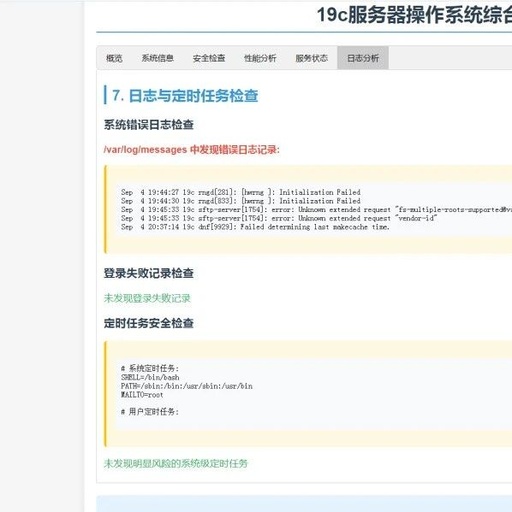
The one-click inspection script (also known as a monitoring script or check script) is a very useful tool that helps administrators quickly check the system’s health, performance metrics, and security configurations. Such scripts can automate a series of commands and checks, saving time and reducing the likelihood of errors. Today, I will share a Shell … Read more

Searching for Files in Linux: Essential Commands and Techniques

Searching for Files in Linux: Essential Commands and Techniques

Quickly finding files in Linux is an essential skill for system administration and daily use. Here are several of the most commonly used and effective methods, starting with the simplest and fastest. 1. <span>locate</span> command – The simplest and fastest method <span>locate</span> is fast because it does not search the disk in real-time but queries … Read more

Installing MySQL on Linux and Configuring Master-Slave Replication

Installing MySQL on Linux and Configuring Master-Slave Replication

Introduction MySQL, as one of the most popular open-source relational database management systems, plays a crucial role in enterprise applications. With the continuous growth of data volume and the increasing demand for data security, high availability and data redundancy backup of databases have become particularly important. The Master-Slave Replication technology is an effective solution to … Read more

A Deep Dive Guide to the Linux Performance Monitoring Tool: top Command

A Deep Dive Guide to the Linux Performance Monitoring Tool: top Command

<span>top</span> is one of the most frequently used commands by operations engineers. It acts like an electrocardiogram for the system, allowing you to grasp the overall health of the machine within seconds. Today, we will thoroughly dissect this “classic tool that has stood the test of time”. 1. Applicable Scenarios: When to Use top? β€’ … Read more

Linux Wi-Fi Debugging Techniques

Linux Wi-Fi Debugging Techniques

For more content, you can join the Linux system knowledge base package (tutorials + videos + Q&A). Table of Contents 1. Tool Summary 1.1. hostapd 1.2. hostapd_cli 1.3. wpa_supplicant 1.4. wpa_cli 1.5. iw 1.6. iwgetid 1.7. udhcpc 1.8. udhcpd 1.9. dnsmasq 1.10. iwpriv 2. Configuration File Introduction 2.1. hostapd.conf Configuration 3. General Methods to Enable … Read more