[Background]
In April 2025, a move by Audi’s Böllinger Höfe factory in Germany shocked the automation industry: they removed 200 traditional PLCs from the production line and replaced them with virtual PLCs (vPLCs) running on Siemens’ cloud. The control logic shifted from “hardware next to the machine” to “software in a data center kilometers away,” resulting in a 70% reduction in failure rates and saving €8 million in maintenance costs in the first year. This is not an isolated case — a water treatment plant in São Paulo, Brazil replaced its old Siemens S7-300 with OpenPLC, reducing costs by 60%; a German automotive parts production line compressed changeover time from 45 minutes to 5 minutes using soft PLCs…Is soft PLC really going to disrupt traditional control?

From “Hardware Lock-in” to “Software Defined”: A Fundamental Revolution in Industrial Control

Traditional PLCs were born in 1969, essentially being “Dedicated Hardware + Closed System“: CPUs, memory, and I/O modules are highly integrated, with programming languages limited to ladder diagrams and communication relying on proprietary protocols. This architecture makes them irreplaceable in deterministic control (such as high-speed pulse output) — the logic execution cycle of Siemens S7-1200 can reach 0.1ms, with pulse output jitter of only ±0.1μs, still the standard for high-speed stamping equipment.
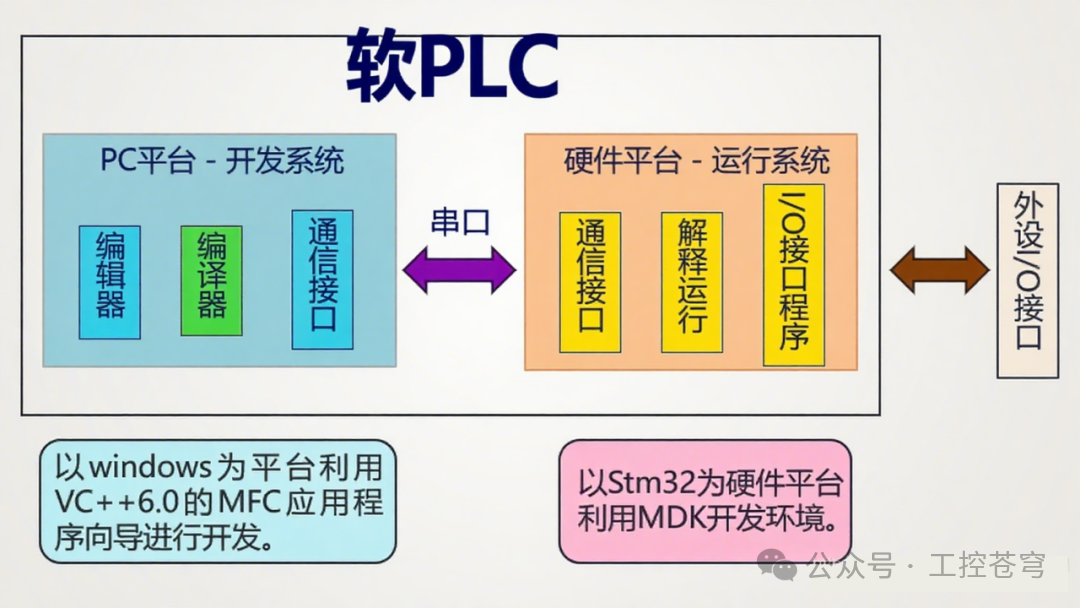
Soft PLCs, on the other hand, are the product of “Industrial PC + Open Software“: based on the IEC 61131-3 standard, they can run on x86/ARM architecture industrial computers and support mixed programming in ladder diagrams, C/C++, and Python. Mainstream soft PLCs like Beckhoff TwinCAT and CODESYS Control enhance control task priority to kernel level through real-time operating systems (RTOS), achieving a logic execution speed 18% faster than traditional PLCs at a 1ms cycle (measured data from the Fraunhofer Institute in Germany).
Core Differences Comparison Table
| Dimension | Traditional PLC | Soft PLC |
|---|---|---|
| Hardware Cost | High (Dedicated chips + modules) | 40% lower (Industrial PC + standardized I/O) |
| Development Efficiency | Low (Dedicated programming software) | 30% higher (supports general tools like VS Code) |
| Real-time Performance | Microsecond level (hard real-time) | Millisecond level (soft real-time, meets standards in some scenarios) |
| Scalability | Poor (depends on hardware modules) | Strong (supports Docker container deployment) |
| Maintenance Cost | High (requires on-site module replacement) | 50% lower (remote diagnostics + online upgrades) |
Soft PLC’s “Counterattack”: Three Core Advantages That Cannot Be Ignored
1. Cost Revolution: From “Pay-per-Point” to “Software Subscription”
The cost trap of traditional PLCs lies in “modular charging” — a digital I/O module costs over 1000 yuan, with an additional 5000 yuan for the communication module, and expanding by 16 points requires an extra investment of 20,000 yuan. In contrast, soft PLCs can directly connect to third-party I/O modules via industrial Ethernet (e.g., Beckhoff EtherCAT terminal modules, with a single-channel cost of only 30 yuan). A case study of a car welding line transformation showed that the hardware cost of a 200-point control system dropped from 150,000 to 60,000 yuan.
Even more disruptive is the business model: Schneider’s EcoStruxure open automation platform has introduced a “pay-per-use” model, allowing customers to avoid one-time software purchases and instead pay monthly based on actual control points, reducing initial investment by 70%.
2. The “Essential Need” for Flexible Production: From “Downtime Changeover” to “Second-level Switching”
In the “Industry 4.0” scenario of small batch and multi-variety production, the “hard wiring + fixed logic” of traditional PLCs becomes a bottleneck. A 3C electronics factory producing 10 models of phone cases needed to rewrite ladder diagrams and change I/O modules during changeovers, resulting in 4 hours of downtime each time. After switching to CODESYS soft PLC, they achieved one-click logic switching through a “process recipe library,” compressing changeover time to 5 minutes and increasing equipment utilization by 20%.
This is backed by the soft PLC’s ability to “Decouple Control Logic from Hardware” — the same software can run on x86 industrial PCs, ARM edge gateways, or even cloud servers. Audi’s factory utilized this feature to centralize control logic from “local hardware of each device” to “data center virtual machines,” achieving global coordination across 20 production lines.
3. The “Bridge” for IT/OT Integration: When PLC Meets AI and Edge Computing
The “island data” of traditional PLCs cannot support intelligent upgrades, while soft PLCs inherently possess IT compatibility. A photovoltaic inverter factory in Shenzhen integrated machine vision with soft PLC: industrial cameras collected silicon wafer defect data, and AI classification algorithms were run in real-time within the soft PLC using Python scripts, improving detection efficiency by 3 times compared to traditional PLC + upper computer architecture, with the false positive rate dropping from 5% to 0.5%.
A more radical case comes from a wind farm in Germany: using Siemens vPLC to achieve “cloudification” of the wind turbine master control system, remotely updating control algorithms via 5G network, improving wind speed prediction accuracy by 15%, and increasing annual electricity generation by 800,000 kWh.
Traditional PLC’s “Moat”: Three Irreplaceable Scenarios
Despite the rapid momentum of soft PLCs, traditional PLCs remain a “must-have” in the following areas:
- High Deterministic Control: High-speed stamping equipment (response time < 100μs), nuclear power emergency shutdown systems (SIL4 safety certification), the “hard real-time” characteristics of traditional PLCs cannot currently be fully replaced by soft PLCs.
- Extreme Environment Scenarios: High-temperature workshops in the metallurgy industry (environmental temperature 60℃+), offshore drilling platforms (vibration resistance level IP67), the industrial-grade hardware design of traditional PLCs is more reliable.
- Legacy Equipment Market: Over 30 million traditional PLCs are running in factories worldwide, and the replacement cost is high, leading more companies to choose a “soft PLC + traditional PLC” hybrid architecture (e.g., Siemens S7-1500 with WinAC).
The Next Decade: Not Replacement, but Reconstruction of the “Control Pyramid”
ARC Advisory Group predicts that by 2030, 25% of newly sold PLCs will be soft PLCs, but traditional PLCs will still hold 75% of the market share —the two are not “who replaces whom,” but rather layered collaboration:
- Bottom Execution Layer (response below milliseconds): Traditional PLCs are responsible for high-speed pulse output, safety interlocks, and other core controls.
- Middle Coordination Layer (millisecond response): Soft PLCs handle production line coordination, data collection, and AI edge computing.
- Top Optimization Layer (second-level response): Cloud-based vPLCs achieve global optimization across multiple factories and iterative process modeling.
As the head of Siemens Industrial Software stated: “Future factory control will be like smartphones — traditional PLCs are the ‘baseband chips’ ensuring reliable communication; soft PLCs are the ‘operating systems’ supporting the APP ecosystem.”
Engineers Must Read: “Three Questions and Answers” for Soft PLC Selection
-
What scenarios should prioritize soft PLC?
- Control cycle > 1ms (e.g., logistics AGV, packaging lines);
- Need for third-party software integration (e.g., MES, machine vision);
- Annual maintenance cost exceeds 100,000 per unit (remote diagnostics can reduce costs by 50%).
How to mitigate the risks of soft PLC?
- Real-time performance: Choose industrial PCs equipped with RTX real-time kernels (e.g., Advantech ARK-3520) to ensure control cycle jitter < 100μs;
- Reliability: Use “dual-machine hot backup + UPS power supply”; a case from a lithium battery factory showed that MTBF could be increased to 100,000 hours.
How can traditional PLC users transition?
- Pilot scenarios: First use soft PLC in non-core production lines (e.g., warehouse sorting);
- Skill upgrade: Learn structured text (ST) programming based on IEC 61131-3 standard, mastering TIA Portal and CODESYS development.
ConclusionFrom Audi’s “cloud PLC” to Brazil’s “open-source alternatives,” soft PLCs are redefining the boundaries of industrial control. However, disruption does not mean complete replacement — just as CNC machines did not eliminate conventional lathes, the integration of soft PLCs and traditional PLCs will build a more flexible and intelligent future factory control system.
If you find this useful, feel free to share it with your electrical engineering colleagues!
Give a thumbs up and follow, thanks! ♪(・ω・)ノ