Click on the above Industry 4.0 to follow us
 e-works encourages originality, please refer to the homepage for submission guidelines on “Original Contributions“.
✎ Introduction
Recently, there has been significant movement in the U.S. stock market. Two tech stock concepts have suddenly gained popularity, attracting high market attention with astonishing price increases. These two concepts are ASIC and quantum computing. In this article, we will mainly discuss ASIC.
Author: Xiaozao Jun, Source: Fresh Date Classroom, published with permission from Industry 4.0.
According to capital market reports, ASIC is rapidly rising, threatening the dominance of GPU in AI computing. Broadcom, as the most important concept stock for ASIC, has seen its stock price soar from 180 to 250, with a market value exceeding one trillion dollars. In contrast, NVIDIA has become a thing of the past, with its stock price plummeting to below 130 dollars.
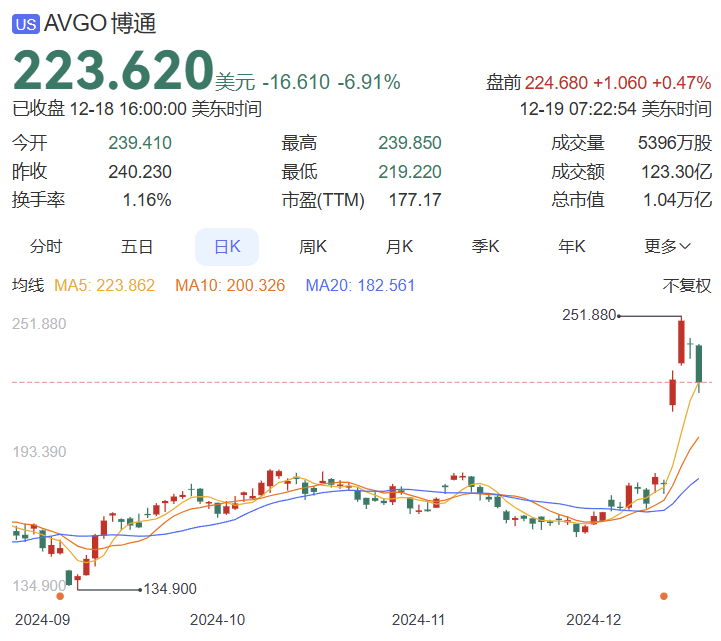 Broadcom’s stock price (dropped yesterday)So, is the era of ASIC really upon us? Will Broadcom truly replace NVIDIA and become the new king of AI?█ What are ASIC and GPU?ASIC and GPU are both semiconductor chips used for computational functions. Since both can be used for AI computing, they are also referred to as “AI chips.”More precisely, besides these two, computing chips also include the more familiar CPU and FPGA.In the industry, semiconductor chips are typically divided into digital chips and analog chips. Among them, digital chips account for a larger market share, reaching about 70%.Digital chips can be further subdivided into: logic chips, memory chips, and microcontroller units (MCUs). CPU, GPU, FPGA, and ASIC all belong to logic chips.Classification of chipsLogic chips are computing chips. They contain various logic gate circuits that can perform arithmetic and logical judgment functions.Among the four chips, CPU and GPU are general-purpose chips that can perform multiple tasks. Especially the CPU, which is a versatile player with a high single-core frequency, can handle anything, making it a common choice for the main processor.On the other hand, the GPU was originally designed for graphics processing (graphics cards). It has a particularly high number of cores (thousands), making it suitable for parallel computing, excelling at performing a large number of simple calculations simultaneously. (Graphics processing involves handling a large number of pixel calculations at once.)AI computing, like graphics computing, is also a typical parallel computing task.AI computing includes a large number of parallel tasks such as matrix multiplication, convolution, recurrent layers, and gradient calculations, making it particularly suitable for GPUs. CPUs are not suitable for AI computing, which is one reason Intel’s stock price has fallen below 20 dollars.Since the beginning of 2023, the AI wave has exploded, with most companies using NVIDIA’s GPU clusters for AI training. If properly optimized, a single GPU card can provide computational power equivalent to dozens or even hundreds of CPU servers. This has directly led to NVIDIA’s stock price skyrocketing several times, and they are often sold out.Now let’s take a look at ASIC and FPGA.ASIC (Application Specific Integrated Circuit) is a chip specifically designed for a particular task. The official definition of ASIC is: an integrated circuit designed and manufactured specifically to meet the requirements of a specific user or the needs of a specific electronic system.Google’s famous TPU (Tensor Processing Unit), the popular Bitcoin mining machines from a few years ago, Intel’s Gaudi 2 ASIC chip, IBM’s AIU, and AWS’s Trainium all belong to ASIC chips.Recently popular DPU (Data Processing Unit) and NPU (Neural Processing Unit) are also ASIC chips.FPGA (Field Programmable Gate Array) is a semi-custom chip, also known as the “universal chip”. FPGA can be reprogrammed an unlimited number of times after manufacturing to achieve the desired digital logic functions based on user needs.The difference between ASIC and FPGA is that ASIC is a fully customized chip with fixed functions that cannot be changed, while FPGA is a semi-custom chip with flexible functions and high playability.FPGAs do not require tape-out (a very costly process), but due to their editable nature, they often have redundant functions, leading to waste when used for a single purpose. In large-scale production, the cost of FPGA is higher than that of ASIC, and its extreme energy efficiency is not as good as that of ASIC.Therefore, FPGAs are currently mostly used for product prototype development, design iteration, and specific applications with low production volumes, or for training and education. They are suitable for products that require short development cycles and are often used for ASIC verification.In any case, remember that for large-scale shipments used for AI computing, FPGA is generally not considered.Thus, the AI chip debate is essentially between GPU and ASIC.█Who is stronger, GPU or ASIC?ASIC, as a dedicated custom chip, is based on the specific tasks it is designed for. Its computational power and efficiency are strictly matched to the task algorithms. The number of cores in the chip, the ratio of logic computing units to control units, and the cache, as well as the entire chip architecture, are all precisely customized.Therefore, ASIC can achieve extreme volume and power consumption. The reliability, confidentiality, computational power, and energy efficiency of these chips are all stronger than those of general-purpose chips (GPU).For example, within the same budget, AWS’s Trainium 2 (ASIC chip) can complete inference tasks faster than NVIDIA’s H100 GPU, with a cost-performance improvement of 30-40%. The upcoming Trainium3 is expected to double computational performance and improve energy efficiency by 40%.However, why have GPUs been so popular in the past two years?The main reason is NVIDIA’s exceptional performance.NVIDIA has also stumbled into success in AI. When AI pioneer Geoffrey Hinton (the recent Nobel Prize winner) used GPUs for AI training with his students, they achieved significant breakthroughs, leading NVIDIA to discover its unexpected fortune.Then, NVIDIA began to focus on AI, striving to create even more powerful GPUs (of course, driven by gaming as well).With NVIDIA’s continuous efforts, the number of cores and operating frequency of GPUs has been increasing, and the chip area has been growing larger. Stronger computational power helps shorten training times and accelerate product releases, which is also a significant advantage.Of course, as computational power increases, power consumption also rises. However, with passive cooling methods like process technology and water cooling, they can barely manage to keep up without burning out.In addition to hardware, NVIDIA is also very strategic in software and ecosystem development.The CUDA (AI development software suite) they developed is a core competitive advantage for GPUs. Based on CUDA, beginners can quickly get started. Thus, NVIDIA’s GPU solutions are widely accepted by users worldwide, forming a solid ecosystem.In contrast, the development of FPGA and ASIC is still too complex and not suitable for widespread adoption.The reason ASIC cannot compete with GPUs in AI is largely due to its high costs, long development cycles, and significant development risks. With AI algorithms changing rapidly, the long development cycle of ASIC is critical.For these reasons, GPUs have achieved their current favorable position.It is worth mentioning that, as previously stated, AI computing is divided into training and inference tasks. Training tasks require more powerful computational power, so manufacturers primarily use GPUs for AI training.Inference tasks, on the other hand, have lower computational requirements and do not need parallel processing, so the computational advantages of GPUs are not as pronounced.Many companies are beginning to adopt cheaper and more energy-efficient FPGAs or ASICs for computation.This situation has persisted until now, with GPUs accounting for over 70% of AI chips.Now, because everyone is “tired of NVIDIA’s stranglehold,” there is a strong desire for diversification in computational power. Additionally, the shift from “training heat” to “inference heat” in large models has increased the demand for inference AI computing, providing opportunities for ASICs.Thus, supporting the ASIC industry chain and increasing the market share of ASIC chips in AI has become a consensus. This has led to the surge in stock prices of Broadcom and Marvell. (It is said that Broadcom is developing AI chips with three major clients, expecting AI chip business revenue to reach 15-20 billion dollars by 2025.)So, is it really that easy to replace? Will ASIC quickly eliminate GPU?Clearly not.With the advantages mentioned earlier in performance, ecosystem, and integration capabilities, NVIDIA’s GPUs will still be the preferred AI chips in the short to medium term. NVIDIA’s complete hardware and software network solutions are very mature, and their technological and financial strength is too strong, making the market position of GPUs difficult to shake.Although ASIC is rising rapidly, it still requires time to mature. The development of AI ASIC chips also carries high risks. Even if successfully developed, it takes time for users to accept them.This means that for a long time, GPUs and ASICs will coexist. Depending on different scenarios, users will choose the chip that best suits their needs. Developing self-researched ASICs is more beneficial for manufacturers in negotiations with NVIDIA.The future situation remains difficult to predict. Whether quantum computing will have a disruptive impact on the computing field is still a hot topic of discussion.Well, that concludes today’s article. Thank you for your patience in reading! (End of article)Upcoming Events