
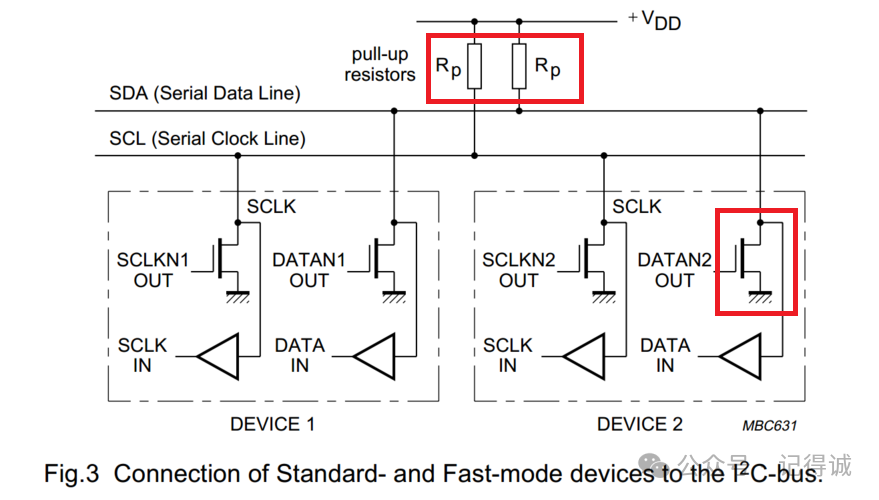
When using the I2C bus, if the internal chip does not integrate pull-up resistors, two external pull-up resistors need to be added.
The reason is that the I2C bus generally has an open-drain (OD) structure, where OD stands for Open Drain, meaning it is a leakage circuit, with Drain referring to the drain of the MOS transistor.
As shown in the I2C bus structure diagram below, the pull-up resistors marked in red and the internal MOS transistors.
The following diagram shows a typical OD gate circuit built with two MOS transistors.
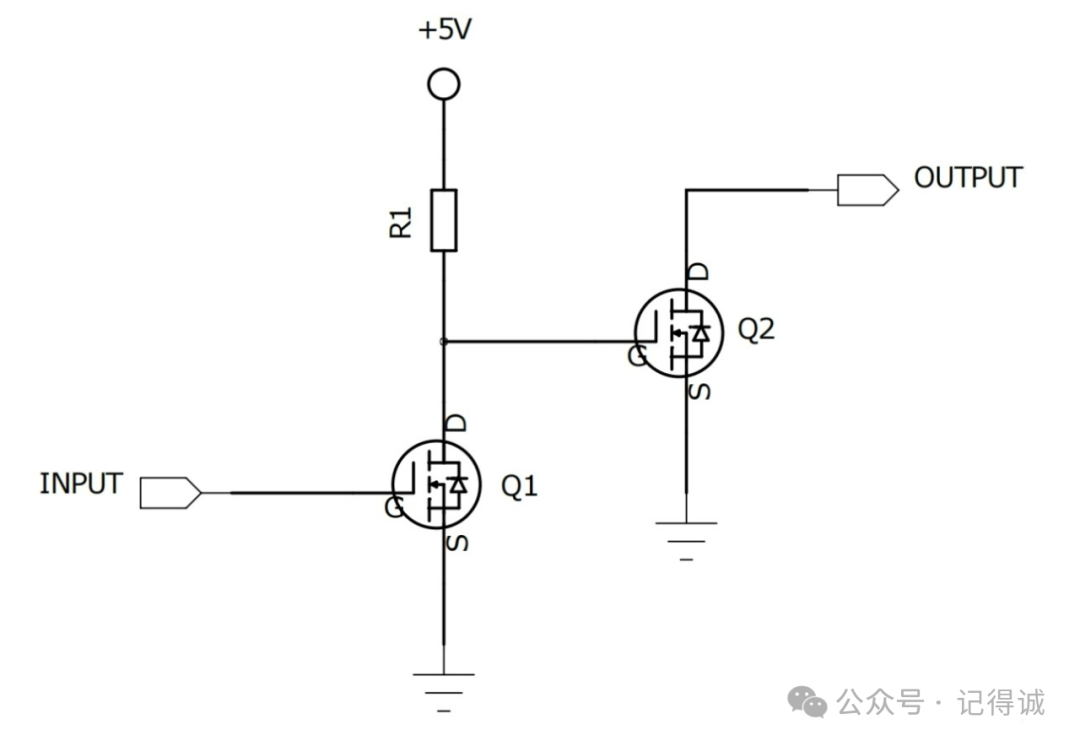 Working Principle:
-
When INPUT=0, Q1 is off, Q2 is on, which is equivalent to the switch being closed, OUTPUT=0V;
-
When INPUT=1, Q1 is on, Q2 is off, which is equivalent to the switch being open, OUTPUT is in a high-impedance state;
The above OD gate circuit cannot output a high level, so pull-up resistors are needed.
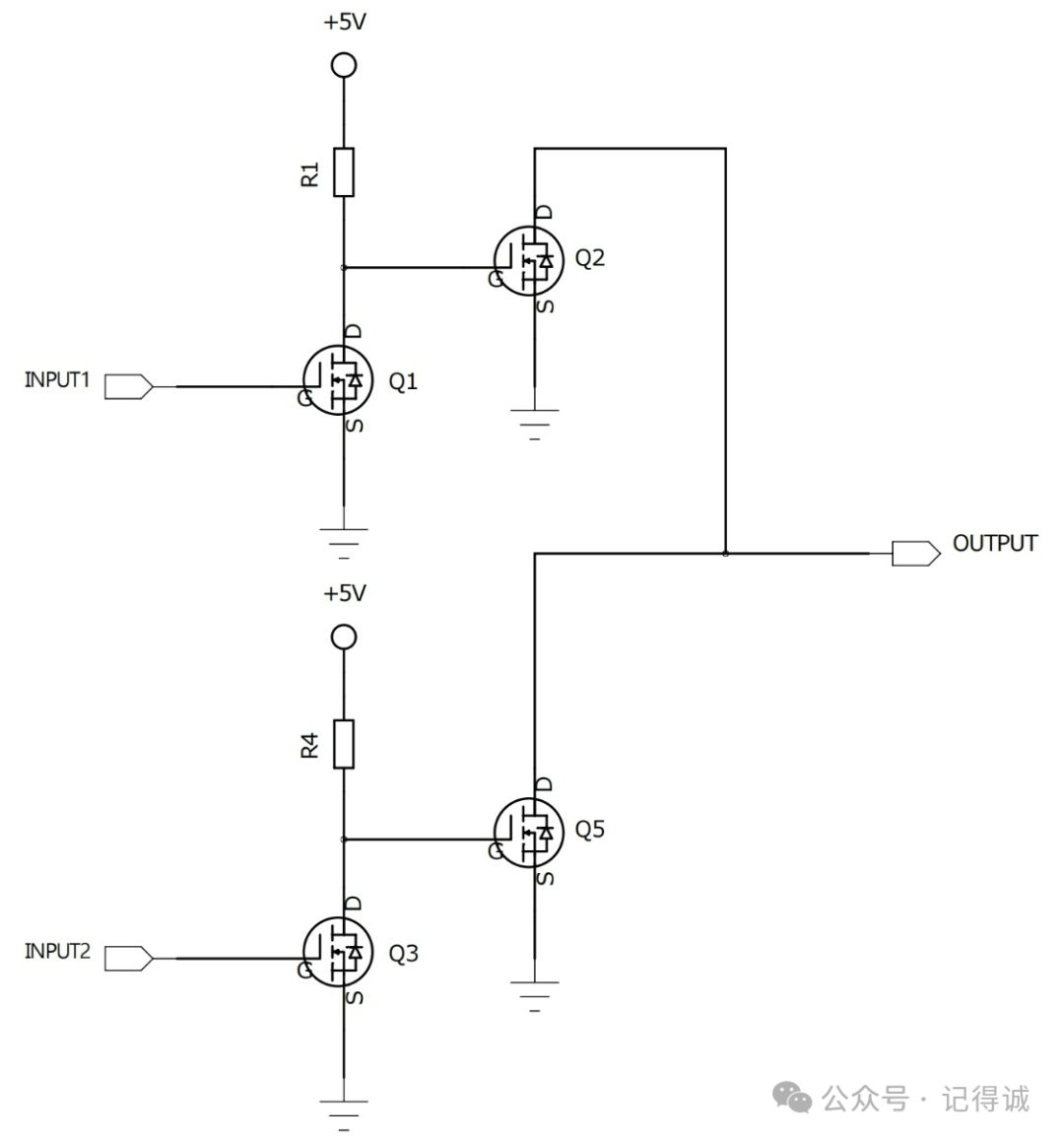
The I2C bus can have one master and multiple slaves (1 master, multiple slaves), because the high-impedance state of the OD gate allows multiple OD gates to be connected together, forming a “wired logic”, as shown in the diagram below. This is the reason why I2C can have one master and multiple slaves.
END
Popular Recommendations:
Is there an anomaly in the battery sampling circuit? Almost had to run away…
Guess what! Is it possible to replace the inductor to solve the large power ripple?
I am the best lighting master in the electronics circle, the brightest guy!
Tencent: Not procuring H20 for now
If hardware engineers don’t understand pricing, don’t take private jobs! Otherwise…
After 3 months, I soldered 100 electronic tubes into a tube amplifier!