Why Many Bluetooth Module Manufacturers Choose nRF52832
Currently, Bluetooth low energy (BLE) SOC is a new generation of Bluetooth, showcasing strong market competitiveness due to its low power advantages. Among them, Nordic Semiconductor’s nRF52832 low-power Bluetooth chip is particularly popular. Nordic is a fabless semiconductor company specializing in developing wireless technologies that support the Internet of Things (IoT). The company’s award-winning Bluetooth LE solutions have made it a market leader, and it has also launched products like ANT+, Bluetooth mesh, Thread, and Zigbee. Nordic’s latest technologies, NB-IoT and LTE-M, utilize cellular infrastructure to expand the IoT. Below, we will explain why many Bluetooth module manufacturers choose nRF52832 from five aspects: power consumption, RF parameters, chip processing capability, memory, and supported protocols.1. Power Consumption The power consumption of the nRF52832 chip is around 5.0mA, as can be clearly seen from the table: compared to other models, the nRF52832 has lower power consumption.
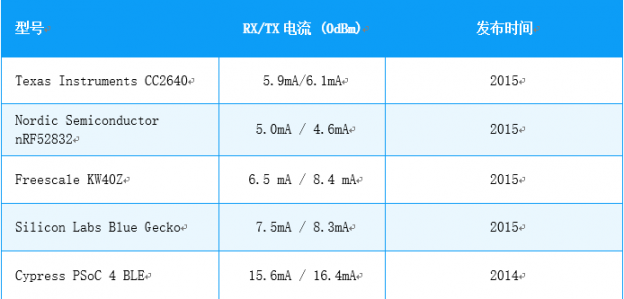 Table 1
2. RF Parameters The transmission power and reception sensitivity are RF parameters that every Bluetooth module manufacturer pays close attention to. Higher transmission power and reception sensitivity are advantageous for long-distance transmission applications. The following table compares the RF parameters of some of the latest chips:
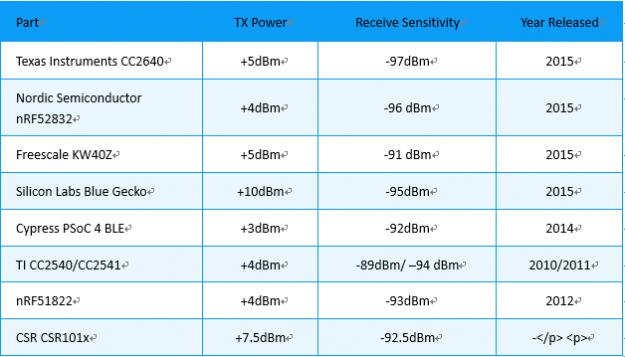
Table 2
Note: +10dBm is the maximum transmission power allowed by ETSI (European Telecommunications Standards Institute).3. Chip Processing Capability M4F is the Cortex-M4 with an additional floating-point unit, which can handle more computational requirements, offering higher performance and smaller size. SKYLAB uses the nRF52832 chip to produce Bluetooth BLE modules, which are widely used in wearable devices. Most first-generation chips use the ARM Cortex core, with the Cortex-M0 core being a low-power core suitable for collecting sensor data, but not performing well in running algorithms. When you need to run a BLE protocol stack on a Cortex-M0 or 8051 core, there is not much leftover performance to do other things, making it difficult to connect complex peripherals. 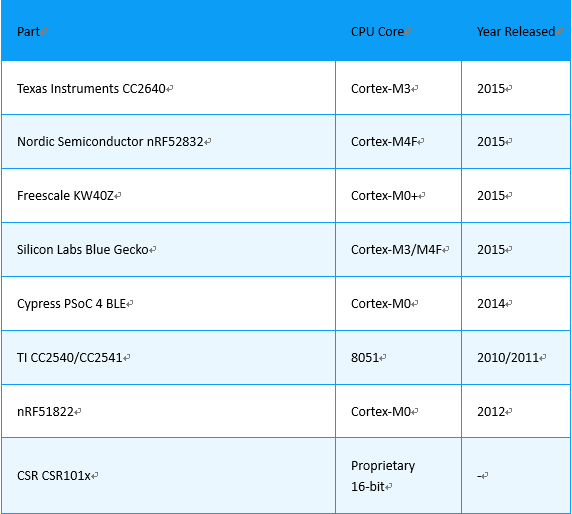
Table 3
4. Memory Typically, chips provide 128KB or 256KB of Flash capacity, with the actual protocol stack generally being 70KB to 90KB in size, leaving limited space for applications. As BLE applications continue to evolve, requiring more processing, larger RAM and Flash are needed. The nRF52832 comes with 512KB of Flash, currently the largest memory in a BLE SoC. Typically, BLE SoC RAM is only 16KB, and after removing the commonly used 8KB to 12KB for the Bluetooth protocol stack, very little remains. The nRF52832 offers the largest 64KB of RAM available today.
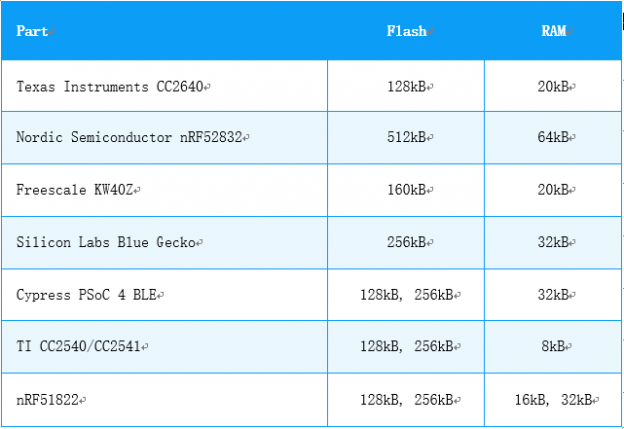
Table 4
5. Multi-Protocol Support The KW40Z released by Freescale is limited by processing power and Flash/RAM, supporting only BLE. TI’s CC2650 supports BLE, Zigbee, 6LowPAN, and RF4CE. Nordic’s chips support BLE, ANT, and 2.5GHz free protocols. The wireless hardware provided by the chips is mostly similar, with the difference being the use of different software. BLE is the most popular wireless connection protocol, and support for multiple protocols certainly offers a broader application space. However, coexistence must also be considered, meaning that when multiple protocols are applied simultaneously, it is essential to ensure that the wireless protocols do not interfere with each other. Otherwise, it will waste a lot of power on retransmitting data. The following table shows the protocols supported by common BLE SoC chips:
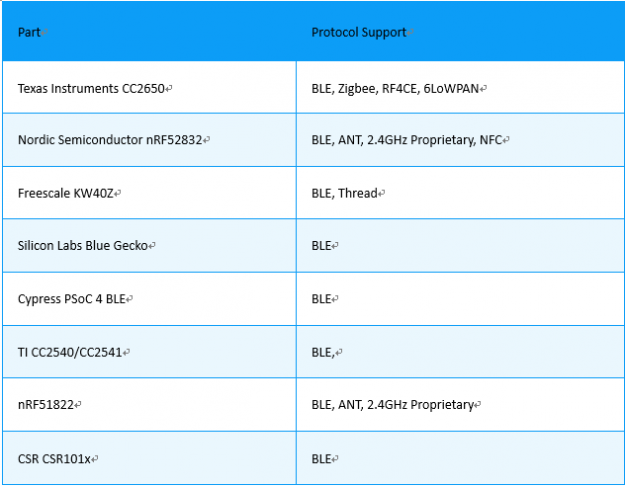
Table 5
Nordic and TI are clearly the leaders in this area.Finally, let’s talk about the main differences between nRF51822 and nRF52832: Many are confused about the choice between nRF51822 and nRF52832, wondering which offers a better cost-performance ratio. Below, we will discuss a difference between nRF51822 and nRF52832 to help you choose more quickly and speed up product development! The main differences can be summarized in five key points: 1. Power Consumption: The nRF52832 has reduced power consumption by half compared to the nRF51822.2. Better RF performance, mainly in terms of transmission power and reception sensitivity. Both have similar transmission power of +4dBm, but the nRF52832 has a sensitivity of -96dBm, while the nRF51822 has a sensitivity of -93dBm.3. Stronger Processing Capability: The nRF52832’s processor, M4F, Cortex-M4F, adds a Floating Point unit, which can handle more computational demands. The nRF51822 still uses the Cortex-M0 core. The Cortex-M0 core is a low-power core suitable for collecting sensor data, but it does not perform as well as the Cortex-M4F in running algorithms.4. Support for More RAM and Flash: The nRF51822 supports 128KB and 256KB of Flash, while the nRF52832 supports 512KB; in RAM, the nRF51822 supports 16KB and 32KB, while the nRF52832 supports 64KB. 5. The nRF52832 supports more protocols, including BLE, ANT, 2.4GHz free protocols, and NFC; the nRF51822 only supports BLE, ANT, and 2.4GHz free protocols. Conclusion: If choosing between these two chips, the nRF52832 is definitely much better; however, considering cost and functional requirements, if the nRF51822 meets your needs, it is still better to choose the nRF51822, as it is indeed a classic chip from Nordic.

Previous Articles Recommended for Reading (Click on the article title to read directly):