To get straight to the conclusion, when buying AI companion robots for parents, the most important factor is whether the robot has the ability to provide proactive care.
Recently, I conducted a poll in an article on my public account: “Would you buy AI companion products for your parents or elders?”
So far, nearly 400 people have participated in the poll.
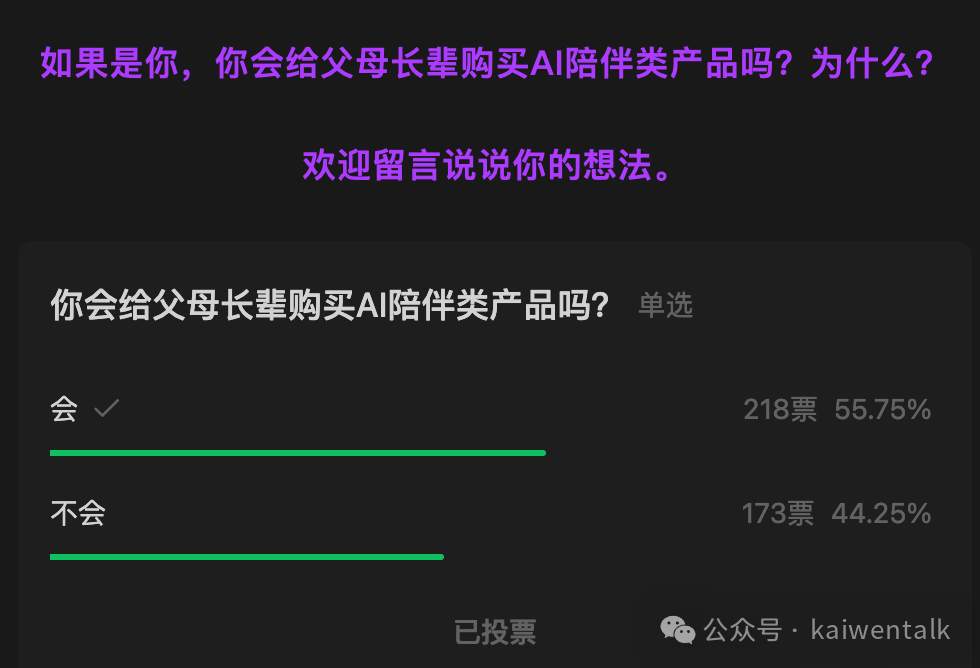
The results are not one-sided but show a clear division. Many people have also left their opinions in the comments. Would you buy AI companion products for your parents?
Some people said:
“It is the responsibility and obligation of every child to help their elders become familiar with new technologies and keep up with the times, to avoid becoming technologically illiterate, just as they took us to school when we were young!”
“As parents age and their memory declines, they need a product that requires no operation, can remind them at the right time (like taking medicine or changing hearing aid batteries), and can be consulted when problems arise.”
However, there are also differing opinions:
“No technology can replace personal companionship.”
“I feel like everything can be solved with Douyin; now, even daily life issues or personal discomforts are searched on Douyin.”
From these viewpoints, I see two key underlying questions:
👉 What exactly is companionship?
👉 Can AI companion products provide true companionship?
What exactly is companionship?
Why do people need companionship? It is not because we cannot live independently, but because no one wants to “exist alone” in the world.
The essence of companionship is not just having someone sitting next to you, but rather feeling that:
– Someone is paying attention to you;
– Someone understands you;
– Someone responds to you.
In other words, being “seen” is companionship.
Companionship ≠ chatting
Currently, there are many AI companion toys on the market, and the most intuitive impression is that they can chat. From the perspective of product interaction, they all require the user to issue a command first, after which the AI responds, initiating a conversation or completing a task.
However, I believe these should not be called companion robots; they should be called chatbots.
As mentioned earlier, true companionship is about “being seen”, and the word “being” is crucial. Who is being seen? It is the parents (users) who are being seen. Parents are passive; they are the recipients. For example, children actively send messages, make phone calls to check in, visit home, or buy things for their parents, actively… Parents receive the attention and care from their children, making them feel “seen”; this is the companionship children provide to their parents.
You may have noticed that these actions have a common point: 👉 proactivity.
When a person is actively cared for, they will feel “someone is paying attention to me” and “I am being seen.” This is true companionship.
Therefore, the core capability of a companion robot lies not in chatting, but in its “proactivity”—proactive care, proactive greetings, proactive reminders, and even proactively helping with tasks.
Tips: When considering whether to buy a companion robot for your parents, the key factor is whether the robot can proactively sense the parents’ state and provide proactive care.
Why is having “proactivity” so important?
Our research found that when elderly people use traditional smart speakers, the common types of conversations are only three:
1. Asking about today’s weather
2. Playing a song
3. Playing the news
This is typical passive interaction. The elderly must first issue a command for the device to respond. Such interaction feels more like a “tool” rather than “companionship.”
If a robot can proactively speak, for example:
– Reminding parents in the morning about today’s weather and what to wear;
– If parents mentioned feeling dizzy yesterday, proactively asking if they feel better the next day;
– If parents have been sitting on the sofa for a long time, proactively reminding them to get up and exercise.
This feeling of being cared for and thought about is the essence of “companionship.”
The level of intelligence in proactive care
From a broad perspective, the proactivity of companion robots can be categorized into the following levels of intelligence, from low to high:
– Timed reminders: Fixed time reminders for taking medicine or charging, which is the most basic form of proactivity.
– Holiday greetings: Proactively sending blessings on birthdays or holidays, which is warmer than functional reminders.
– Daily care: Proactively initiating communication morning, noon, and night, allowing the elderly to feel continuous companionship.
– Intelligent perception: Based on the elderly’s behavior, expressions, and tone, intelligently judging their mood and needs, and proactively engaging in conversation at the right moment—this is the highest level of “intelligent companionship.”
Key considerations for children when purchasing
So, when you are preparing to buy AI companion products for your parents,
👉 First ask: Does this product have the ability to be “proactive”?
And also consider:
1. Is its proactive communication just “simple reminders” or does it involve “emotional care”?
2. Can it truly make parents feel: Someone cares about me, someone is accompanying me?
Because only AI robots with proactive care capabilities can be considered true companion robots.