As a popular concept, SD-WAN has frequently appeared in our view in recent years.
Many people say it is one of the most promising communication technologies of the future, with significant commercial value.Established communication equipment vendors and operators in the industry are optimistic about it, while emerging startups regard it as a once-in-a-lifetime opportunity, flocking to it.So, what exactly is SD-WAN? What is it used for? What makes it special? In this article, let me provide a comprehensive analysis.

SD-WAN, short for Software-Defined WAN, refers to software-defined wide area networks. WAN stands for Wide Area Network.I believe that those who frequently deal with IT and communications are certainly familiar with the prefix “SD (Software-Defined).” Yes, in today’s software-centric era, concepts like SDN, SDS, SDR, etc., have flooded our workplaces and become buzzwords.SDN:Software Defined Network, software-defined networkSDS:Software Defined Storage, software-defined storageSDR:Software Defined Radio, software-defined radioSDN (software-defined network)/NFV is the future direction of network development and a significant feature of the 5G era.SD-WAN is an important branch of SDN and is the application of SDN technology in the WAN domain.Simply put, SD-WAN is SDN + WAN.
What Is WAN (Wide Area Network)?
Let’s start from the most basic concept of WAN.Many network professionals should know that WAN is a wide area network, and the counterpart to WAN is the well-known LAN (Local Area Network).The Wi-Fi network at home, the network in internet cafes, and the small-scale networks in company offices are all LANs.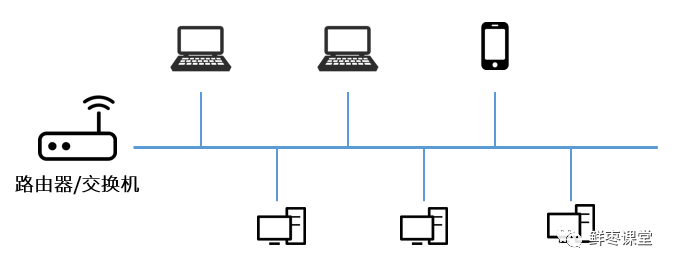 LAN Local Area NetworkWAN is a computer network that spans a larger geographical area, crossing provinces, cities, and even countries and continents.For example, if a corporate headquarters is located in Beijing and branch offices are in Shanghai, Guangzhou, and Chengdu, the local networks of the branches can be considered LANs.In contrast, the entire network of the corporation is a wide area network.
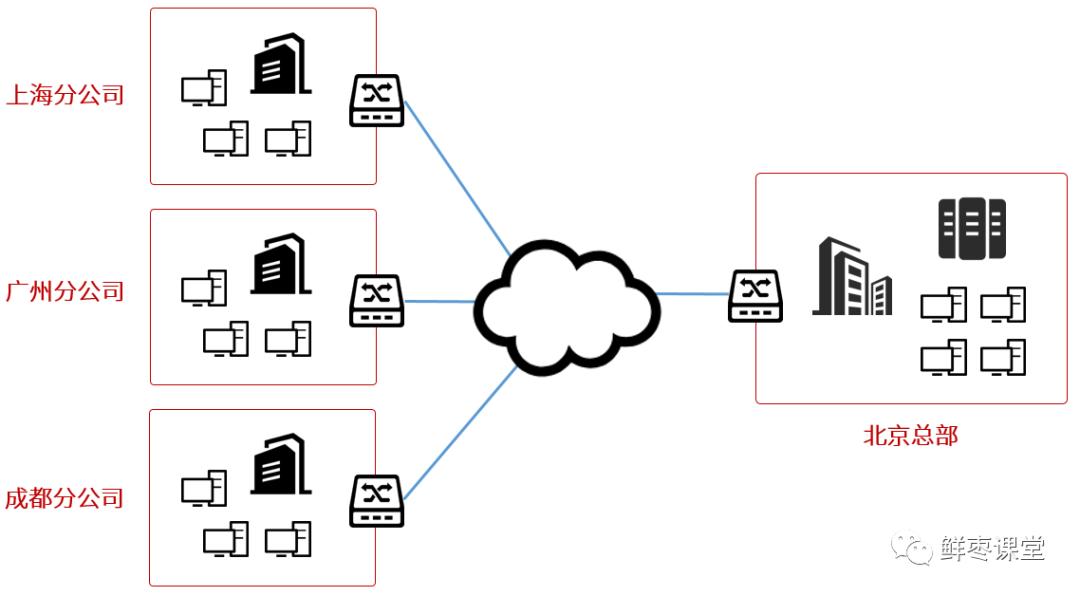 WAN Wide Area NetworkNote: In addition to local area networks and wide area networks, there is also a metropolitan area network (MAN), which is a city-scale network often mentioned by operators.The reason for having wide area networks is clear to everyone— in the digital and networked era, companies cannot operate without computers and various information systems and platforms.From basic emails to office automation (attendance systems, financial systems, etc.), to systems closely related to core business like PLM (Product Lifecycle Management) and ERP (Enterprise Resource Planning), there is a pressing need for a robust supporting network.
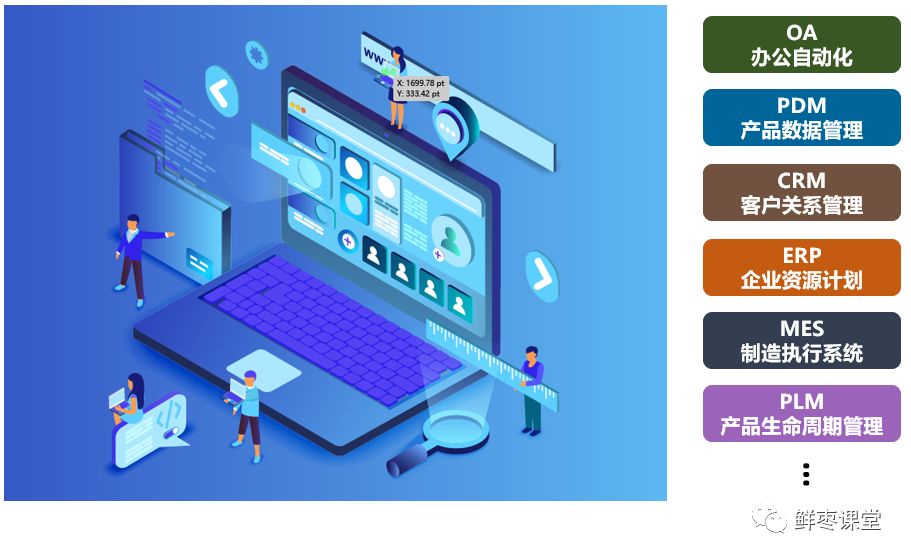 Various information systems are the cornerstone of modern enterprise development.For the vast majority of companies, it is impossible to spend money to lay a dedicated cable or fiber optic line to connect the headquarters and branch networks. The engineering and cost estimates are astronomical.Therefore, only two choices remain.The first is to connect all employees via the internet.The popular DingTalk and WeChat Work actually use this approach.
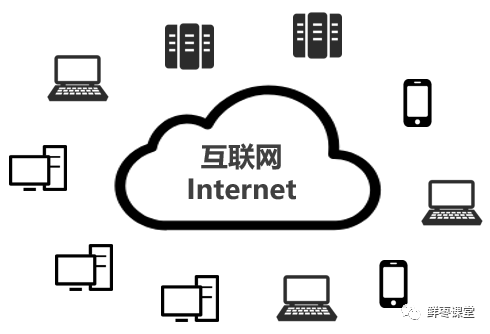
All on the public network (internet)
In today’s world of advanced mobile internet and fiber broadband, this approach seems like a good choice. However, using this method faces two fatal issues: service quality and data security.The 4G data services we use, along with most fiber broadband access, are essentially consumer-grade communication services. The stability and reliability of these services are poor, often leading to lag or even disconnection.This service quality may be acceptable for small businesses, but it is not suitable for medium to large enterprises or groups. For instance, how can the system of the Industrial and Commercial Bank of China in Beijing be slow or disconnected from the system of its Jiangsu branch?Moreover, exposing all business systems of a company to the internet brings significant security risks and vulnerabilities. For example, if the Railway Corporation places all its vehicle operation management systems on the public internet, would you feel secure?DingTalk and WeChat Work are backed by the robust security capabilities and system capacities of large internet companies.Therefore, using the internet as a company’s wide area network is only suitable for small businesses. (By the way, small businesses don’t need a wide area network.)The second method, which is currently the mainstream choice for users, is to connect via dedicated lines provided by operators.The most representative of these dedicated lines is MPLS.
What Is MPLS? MPLS, Multi-Protocol Label Switching, is a high-efficiency and reliable network transmission technology. In simple terms, it labels data flows, much like a message, telling all devices along the way: “Who I am and where I am going.”MPLS dedicated lines are a type of wide area network service based on MPLS technology.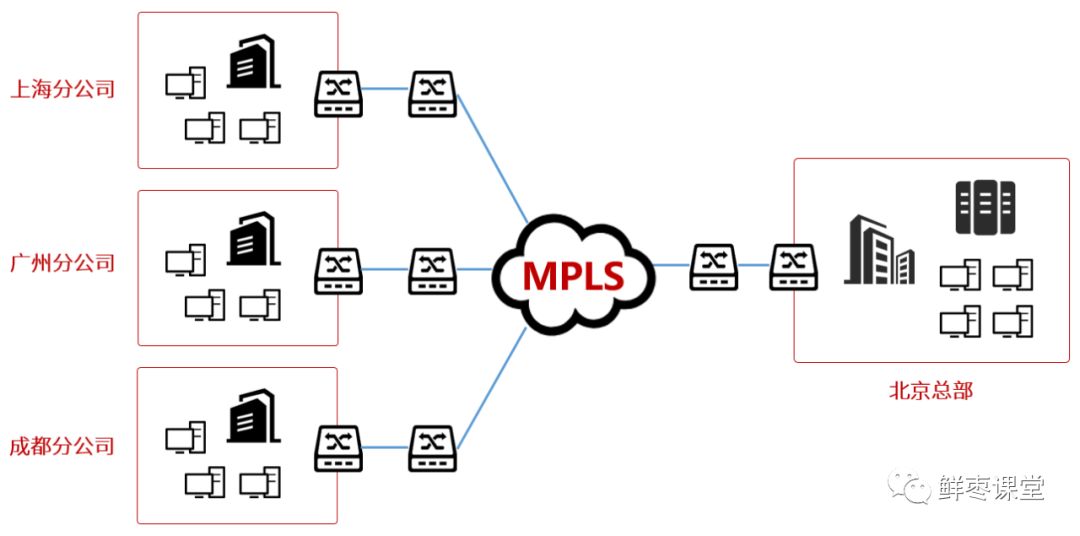 MPLS Dedicated LineMPLS dedicated lines are a rental service, and the ownership belongs to the telecom operator. The operator rents the dedicated line to you and promises what kind of requirements the SLA (Service Level Agreement, including bandwidth, latency, jitter, packet loss rate, etc.) can meet. As for whether your software runs fast or stably, they do not care at all.It’s like your home broadband; the operator will only show you the speed—do you have 100Mbps? Yes, then that’s fine. Does it lag when playing games? Sorry, that’s not my concern. This is SLA-based service.Regardless, at least it is a dedicated line, and the network quality of MPLS is still good.But here comes the problem: you rent it, I rent it, everyone rents it. The operator’s physical network is just one, and so many companies’ businesses run on it. How can they ensure differentiation and isolation?This is where a familiar term comes into play—VPN.VPN, Virtual Private Network, is essentially a virtual dedicated channel created on top of normal physical connections to ensure communication isolation and confidentiality.
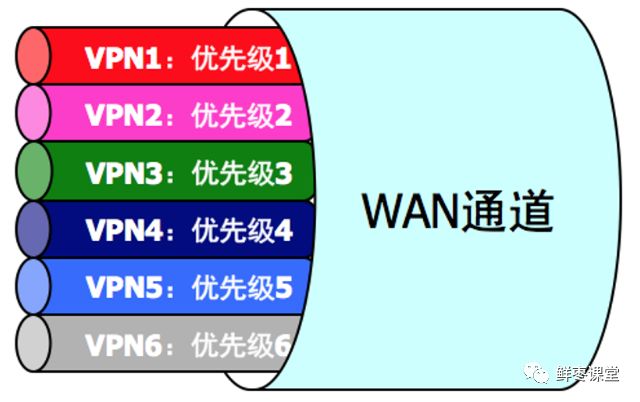
VPN ChannelDepending on the underlying network, VPN typically includes Ipsec-VPN and MPLS-VPN.Ipsec-VPN is a VPN based on the internet. This is what people commonly use. Big company employees traveling outside often dial into the VPN, which effectively makes them part of the company’s internal network, allowing access to internal websites.MPLS-VPN is a VPN based on the operator’s MPLS dedicated network. The whole branch and headquarters are logically in the same internal network through this connection.Let’s briefly discuss the concepts of Overlay and Underlay that you may often see. Literally, Overlay is on top of the layer, while Underlay is beneath the layer. A diagram can clarify this—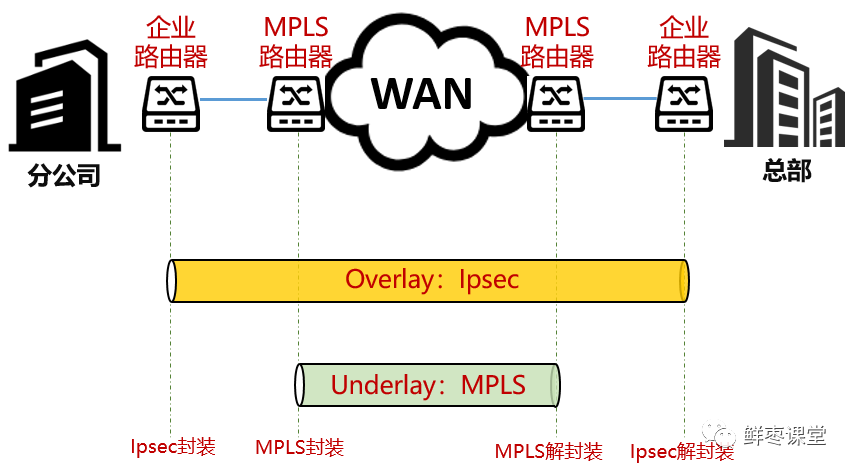 Encapsulation position is differentThe MPLS technology has dominated the enterprise network market for over 20 years since Cisco proposed Tag/Label Switching in 1996, with no significant improvements during that time.Compared to the internet, the advantages of MPLS dedicated lines are their stability, reliability, and certain security assurances. However, as times change, its disadvantages have become increasingly apparent, leading to user complaints:1. High usage costs.Historically, whether for dedicated lines or VPN services, operators have quoted exorbitant prices.For example, a certain province’s telecom’s international 10M MPLS-VPN costs 80,000 RMB/month. For a large corporate user with many branches and offices, the annual cost for dedicated line rentals can reach tens of millions or even over a hundred million RMB.This level of cost is unimaginable for home users who pay a few hundred RMB for gigabit monthly packages. With increasing competition, this enormous cost pressure can keep CEOs, CFOs, and CIOs awake at night.2. Long deployment cycles.After applying for a dedicated line installation, the operator must go through internal processes and send personnel for terminal installation and configuration. The entire installation time can be lengthy, generally taking one week to a month.For businesses that operate at an increasingly fast pace, this time frame is intolerable.3. Difficult fault diagnosis.Dedicated line networks are “black box networks” for enterprise users. When a dedicated line has issues, it is challenging to quickly identify the cause. IT engineers can only check internal firewalls, switches, routers, etc. If they cannot find the problem, they must seek help from the operator.For the operator, troubleshooting is also complicated. Often, they end up finding no issues on their side, and the problem still lies with the user.This back-and-forth wastes a significant amount of time and disrupts normal business operations.4. Tight maintenance manpower.For corporate headquarters, there are usually dedicated IT engineers for maintenance. However, for branches or offices, due to cost considerations, dedicated IT engineers are generally not assigned. This creates challenges for maintaining MPLS dedicated lines and indirectly increases costs.In summary, MPLS dedicated lines are costly and difficult to use. “It has been a tough time for MPLS!“
The Emergence of SD-WAN
Finally, we arrive at the main character of today’s article. SD-WAN is an emerging WAN technology designed to solve the series of problems mentioned above.SD-WAN originates from SDN. There is a lot to say about SDN, but we won’t delve into it today. You only need to know that the essence of SDN technology is to centralize the control of the network.
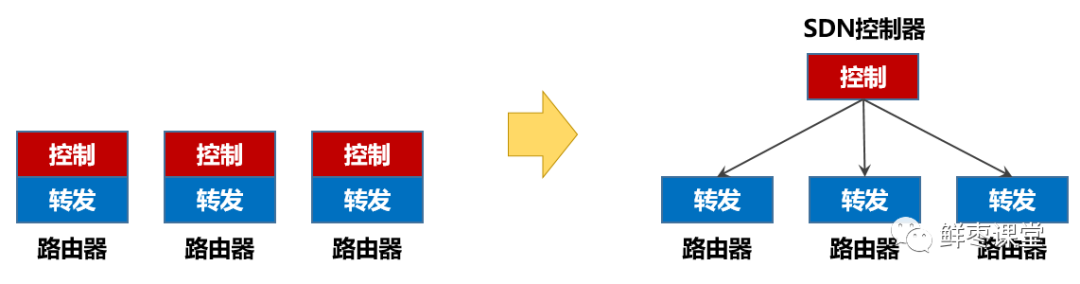
Forwarding and control separationSD (Software Defined) does not mean replacing hardware with software; rather, it extracts more capabilities from hardware and hands over the unified control to software. In short, it simplifies and generalizes hardware, making it “dumb.” The software controller becomes the core that manages everything.What does the architecture of SD-WAN based on SDN look like? A diagram is worth a thousand words. I drew an architecture diagram based on a certain equipment vendor’s SD-WAN solution. Please take a look:
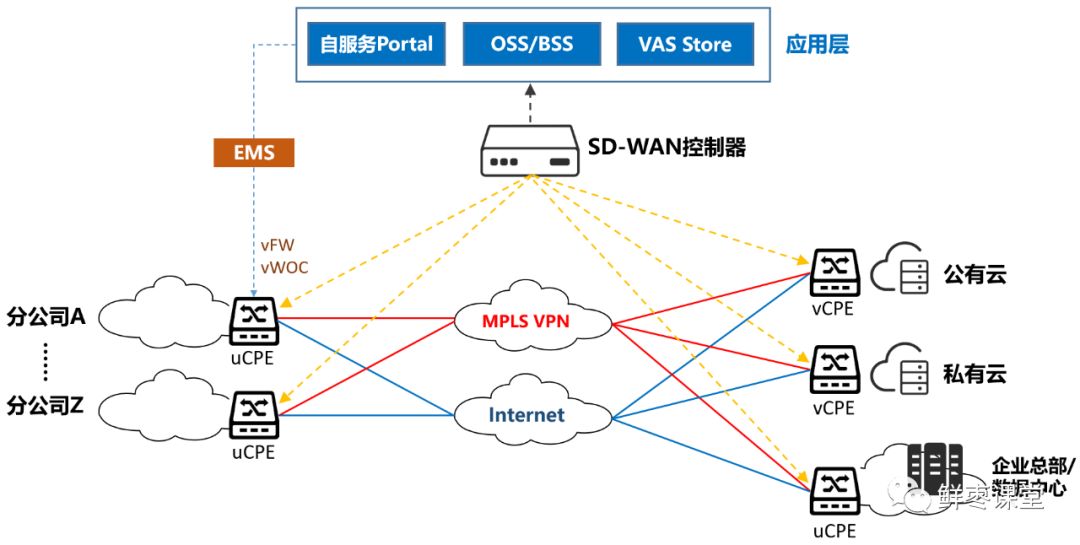
SD-WAN Network ArchitectureYou can see that the backbone of the entire network architecture is still the Internet and MPLS dedicated lines. However, on top of the architecture, there is an additional SD-WAN controller. This controller is the core of SD-WAN management and control.At the branch nodes and headquarters nodes, there are additional devices such as uCPE and vCPE.CPE (Customer Premise Equipment) is known in the industry as “customer terminal equipment.” The CPE here is different from 5G CPE, which converts 5G signals into Wi-Fi signals. The CPE here is an interface box that connects to the network (think of it as a small router).uCPE is Universal CPE, and vCPE is Virtual CPE, virtual client equipment.The administrator can configure the SD-WAN controller through application layer interfaces and can also deploy functions such as vFW (virtual firewall) and vWOC (virtual WAN optimization controller) to the CPE, achieving corresponding functionalities without the need to purchase dedicated hardware.Now, let’s analyze what changes adopting SD-WAN will bring based on network architecture and node devices:1. Interface versatility and load balancingFrom the perspective of branch offices, SD-WAN no longer forces the exclusive use of MPLS but allows multiple connection types such as MPLS, xDSL, PON fiber broadband, 4G LTE, and even 5G. CPE can support bonding of various interfaces, turning it into a pool of interface resources.With software capabilities, some vendors’ CPEs can identify thousands of different application levels and allocate different quality of service.For example, video conferencing requires higher network quality, so it can be prioritized and set to a higher QoS. Text chat can be set at a lower level, allowing it to use networks like LTE.This way, enterprise users’ dependence on MPLS dedicated lines is greatly reduced, and regular fiber broadband and 4G can also be utilized. Users’ bandwidth utilization increases, and traffic costs decrease.2. Autonomous selection of the best pathThe key to WAN technology lies in path selection. For different branch offices, SD-WAN can autonomously choose the best path based on current network conditions and configuration policies.SD-WAN also has load balancing capabilities to enhance network reliability.In fact, there are many POPs (points of presence) in operator networks that help solve inter-operator link congestion and load issues.3. Simple deployment, instant completionWhen evaluating the deployment speed of SD-WAN, people often mention a term called ZTP, which stands for Zero Touch Provisioning, zero-touch deployment. In simple terms, it is nearly plug-and-play.In addition to automatically obtaining configurations after powering on the CPE, configurations can also be done via QR code or email.For example, in the email deployment method, when deploying SD-WAN, the IT engineer at headquarters only needs to prepare the configuration data in advance and send it via email to any employee at the branch. That employee can then complete the device configuration deployment through a link.It’s that convenient and fast, no longer requiring professional IT personnel to be present for configuration installation.4. Self-management and intelligent operation and maintenanceSD-WAN has the genes of SDN, so it has inherent advantages in network management. Any SD-WAN management platform is graphical and visual. Administrators can clearly see the operational status of SD-WAN through the network management interface and promptly address any issues that arise. This greatly reduces maintenance difficulty and minimizes fault handling time.In summary, the benefits of SD-WAN are cost-effective and user-friendly. According to estimates, under comparable bandwidth conditions, SD-WAN can save at least 30% of cost investments compared to MPLS annually. Hence, some jokingly refer to SD-WAN as “Save Dollars (省钱)-WAN”.
The Development of SD-WAN
Money is the hard truth.Real monetary returns are driving SD-WAN to develop at an astonishing pace.SDN emerged in 2006, was officially named in 2011. The first spark between SDN and WAN occurred in 2014.That year, a consulting firm, originally an investment company named ONUG (Open Network User Group), proposed several SDN technology application scenarios in a discussion with enterprise users about future network needs, marking the true encounter between SDN and enterprise WAN networks.At the same time, an article titled “Software-Defined WAN: A Primer” was published on networkcomputing.com, introducing the term SD-WAN to the public for the first time.Since then, SD-WAN has rapidly gained widespread attention in the industry, with major players rushing in.In 2015, the market revenue for SD-WAN was only $225 million, with an adoption rate of less than 1%.By 2018, the adoption rate of SD-WAN internationally had reached an astonishing 40%. Industry analysis firm IDC predicts that by 2021, the SD-WAN market size will grow to $8 billion.There are many types of companies engaged in SD-WAN services, which we will briefly introduce.The first type focuses on providing wide area network solutions. They purchase operator dedicated lines and build their own wide area networks to provide SD-WAN services to enterprise users.The second type consists of traditional equipment manufacturers, such as Huawei, ZTE, and H3C.There’s no need for further introduction; they sell everything—solutions, hardware, software.The third type revolves around selling optimization, security, encryption, and other technologies and products related to SD-WAN. They have their own software and hardware products that they sell in conjunction with SD-WAN users.Traditional telecom operators also take SD-WAN very seriously, as it poses a threat to their business. Currently, domestic operators have conducted SD-WAN service trials in many areas. Their business model mainly relies on existing infrastructure services, leveraging their advantages in hardware resources to provide value-added network services such as firewalls, WAN acceleration, and network security.In conclusion, SD-WAN is a rapidly deployable, low-cost, and highly flexible wide area network solution. There is no doubt that it has become the mainstream trend in the industry. What we need to focus on now is who will emerge victorious in the fierce battle surrounding SD-WAN and who will become the biggest winner in the future wide area network market!
Source: Fresh Date Classroom
Editor: Tim
Recent Popular Articles Top10
↓ Click on the title to view ↓
1. How My Stomach Got This Bad
2. When You Stay Up Late, Your Brain Starts Eating Itself…
3. What Makes Daxing Airport, Known as the “New Seven Wonders of the World,” So Impressive?
4. How Fast Are Cats’ Reaction Times?
5. Why Hasn’t Wireless Charging for Phones Become Popular Yet?
6. Why Does Milk Tea Turn into Fat After Drinking?
7. If “Quantum Transmission” Transfers a Person, Is It the Body or the Soul That Moves?
8. Does Randomness Really Exist?
9. How Long Can You Use Your Phone’s Last 1% Battery?
10. Where Is Your “Italian Cannon,” Company Commander? Bring It Over to Me! | Serious Play
Click here to view all past popular articles