With the in-depth application of large model infrastructure and Agents, more and more organizations are reconstructing their business models and organizational structures centered around AI and AI Agents. This process will propel human society into a fully AI Agent-native intelligent era. In this context of transformation, a series of “AI-native” concepts that break traditional cognitive boundaries have emerged, profoundly reshaping business logic and organizational paradigms, leading to new development paths for an intelligent society.
1. The Connotation and Extension of AI Agent-Native Enterprises
An AI Agent-Native Organization refers to a type of enterprise that is inherently embedded with and deeply relies on Agents in its core business processes, organizational structure, and technological systems. Such enterprises, from their inception or transformation, are based on multi-agent collaboration, autonomous decision-making systems, and task automation processes, achieving an efficient operational model driven by human-machine symbiosis and intelligence.
AI Agent-native enterprises leverage the autonomy, interactivity, collaboration, and environmental adaptability of AI Agents to achieve intelligent business processes, automated decision-making, and efficient resource allocation, thereby building unique advantages in market competition. This represents a transformation of human underlying cognitive paradigms at a specific stage of Agent application development and is an important sign of the integration of AI technology and industry entering a new level.
The Connotation and Extension of AI Agent-Native Enterprises:
➡ Connotation: It is a new product form, system structure, and organizational structure. Enterprises deeply embed AI capabilities at the foundational architecture level and design products, business processes, and organizational structures based on AI Agents, rather than simply adding an AI plugin to traditional systems.
➡ Extension: It is a new business paradigm. Enterprises fully integrate AI Agents into all aspects, including corporate culture, strategic planning, and product development, to achieve data-driven decision-making, automated operational processes, personalized customer experiences, and continuous technological innovation. This business paradigm will reshape the value chain of organizations and drive continuous iteration and innovation of business models.
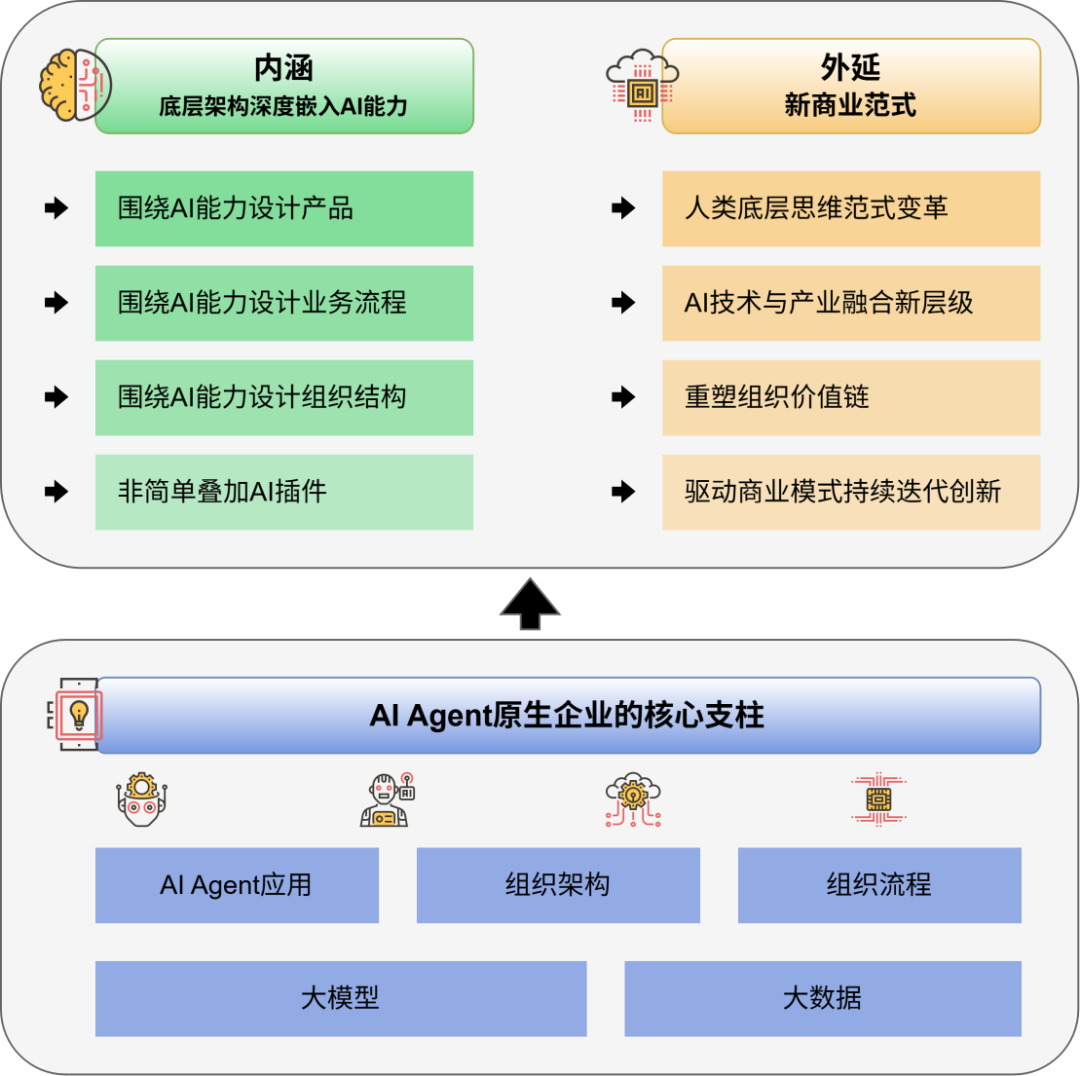
The Connotation and Extension of AI Agent-Native Enterprises
For enterprises, foundational large models, enterprise big data, AI Agent-native application systems, and adaptive organizational structures and process designs are the five core pillars that constitute AI Agent-native enterprises. These five elements support and evolve in synergy, forming the core path for enterprises to transition to an AI Agent-native form and are the key engines driving the continuous evolution of organizational strategy.
(1) Foundational Large Models: The Capability Base and Knowledge Engine of AI Agent-Native Enterprises
Foundational large models are large-scale pre-trained AI models with extensive cognitive, reasoning, language understanding, and generation capabilities (such as GPT, Claude, Wenxin, Tongyi, etc.), serving as the base and capability engine for Agent intelligence.
Core Value: Supports high-level tasks such as language understanding, knowledge generation, and complex reasoning, empowering the “cognitive layer” of Agents.
(2) Enterprise Big Data: The “Digital Fuel” for AI Agent System Operation and Enterprise Continuous Development
Enterprise big data refers to the structured and unstructured data resources accumulated by enterprises during operations, management, and customer interactions, including text, voice, images, logs, sensor data, etc. It serves as the knowledge base for Agent system decision-making and behavior and is the core driving force for the continuous evolution and development of Agent enterprises.
Core Value: Supports model fine-tuning, Agent behavior optimization, and knowledge enhancement, enabling continuous learning and evolution, and improving the accuracy and robustness of task execution.
(3) AI Agent Applications: The Core Carrier for the “Grounded Execution” of Artificial Intelligence
AI Agent applications are business application systems built on AI Agents, possessing full-chain intelligent capabilities such as perception, understanding, planning, and execution. They can support multi-agent task orchestration, contextual collaboration, process automation, and human-machine interaction, serving as the core carrier for the “grounded execution” of Agents in enterprises.
Core Value: Realizes a new technical operation model of “task as a service, intelligence as capability,” unleashing the automation and intelligence potential of enterprises.
(4) Organizational Structure: The Collaborative Division of Labor Mechanism between Humans and AI Agents
The AI Agent-native organizational structure is a dynamic, flat structure centered around collaboration between AI Agents and humans, emphasizing role reshaping, collaborative responsibilities, and flexible boundaries.
Core Value: By redefining “organizational members” and “organizational units,” it enhances the flexibility, adaptability, and intelligent collaboration capabilities of enterprises.
(5) Process Design: The Intelligent Task and End-to-End Collaboration Engine
AI Agent-native process design refers to the business process system reconstructed based on AI Agent capabilities, emphasizing intelligent task perception, automatic decomposition, and dynamic execution.
Core Value: Transitions business processes from “human-defined, human-executed” to “goal-driven, intelligent collaboration,” improving operational efficiency and response speed.
With the advancement and development of Agent technology architecture, development tools, and implementation methods, the Agent development system will also form a highly intelligent, dynamically collaborative, and open-symbiotic AI-native ecosystem together with large models, AI-native businesses, native enterprises, and data. In this ecosystem, Agents are not only technical tools but also the core carriers that connect ecological elements and drive value flow. Through deep integration with large models, they will continuously optimize their reasoning, decision-making, and action capabilities, efficiently adapting to various AI-native business scenarios and providing intelligent solutions for native enterprises. Meanwhile, the close interaction between Agents and data can fully exploit data value, promote the circulation and sharing of data within the ecosystem, thereby driving the continuous evolution and prosperity of the entire AI-native ecosystem, empowering various industries to achieve intelligent transformation.
2. Key Features of AI Agent-Native Enterprises
AI Agent-native enterprises emphasize the core operational unit of Agents with autonomy, adaptability, and proactivity. Their key features are reflected in the following four aspects: technical architecture, organizational structure, business model, and product and customer experience.
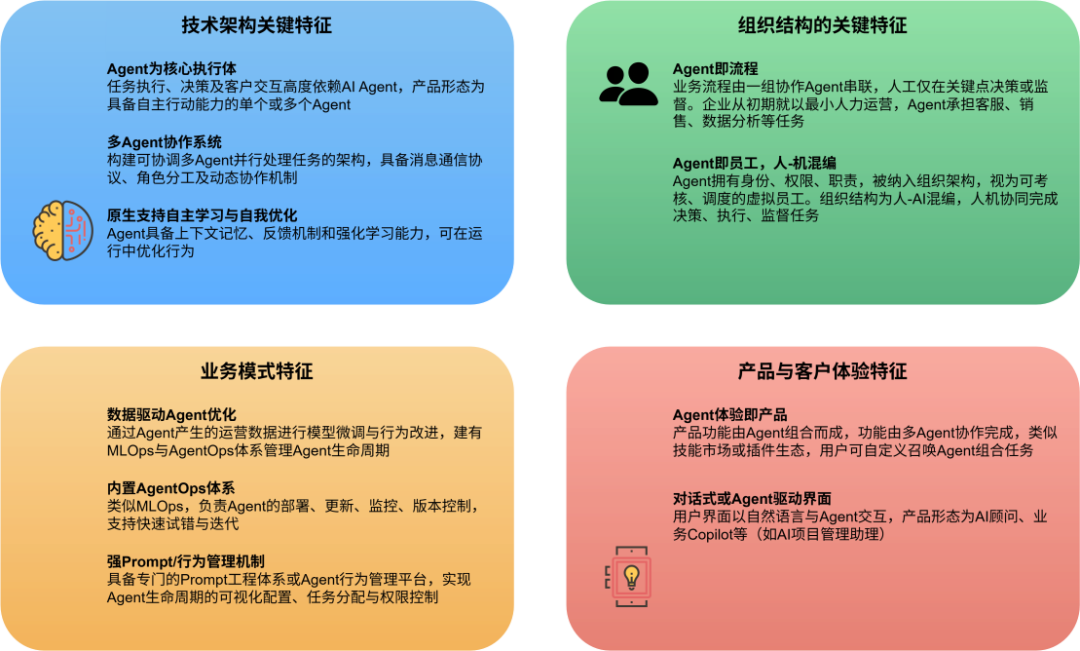
Key Features of AI Agent-Native Enterprises
(1) Key Features of Technical Architecture
Includes: AI Agents as the core unit of the system architecture, multi-Agent collaboration, native support for autonomous learning and memory, reliance on Agent development platforms and frameworks, and deployment environments that support rapid generation, training, and iteration of Agents.
-
AI Agents as Core Executors: Task execution, decision-making, and customer interaction highly depend on AI Agents, with product forms being single or multiple Agents (e.g., customer service Agents, development Agents) with autonomous action capabilities.
-
Multi-Agent Collaboration System: Constructs an architecture that can coordinate multiple Agents to process tasks in parallel, with message communication protocols, role division, and dynamic collaboration mechanisms.
-
Native Support for Autonomous Learning and Self-Optimization: Agents possess contextual memory, feedback mechanisms, and reinforcement learning capabilities, allowing them to optimize behavior during operation.
-
Reliance on Agent Development Platforms and Frameworks: Deeply integrates self-developed/third-party Agent frameworks (e.g., AutoGPT, LangChain), with deployment environments supporting rapid generation, training, and iteration of Agents.
(2) Key Features of Organizational Structure
Includes: Agents as processes (Workflow=Agents), high automation with low human dependency, Agents as “digital employees,” and organizational structures presented in a “human-machine hybrid” model.
-
AI Agents as Processes: Business processes are linked by a group of collaborative Agents (e.g., contract review by legal Agents and financial Agents), with human involvement only at critical decision points or supervision. Enterprises operate with minimal human resources from the outset, with Agents undertaking tasks such as customer service, sales, and data analysis, while employees play more supervisory or strategic roles.
-
AI Agents as Employees, Human-Machine Hybrid: Agents (e.g., customer service Agents, HR Agents) have identities, permissions, and responsibilities, incorporated into the organizational structure and regarded as assessable and dispatchable virtual “employees.” The organizational structure is a “human-AI hybrid,” with humans and machines collaborating to complete decision-making, execution, and supervision tasks.
(3) Business Model Features
Includes: Data-driven Agent optimization, built-in AgentOps system, strong prompt/behavior management mechanisms, and ultra-fast iteration capabilities.
-
Data-Driven Agent Optimization: Model fine-tuning and behavior improvement are conducted through operational data generated by Agents (e.g., customer interactions, task execution), with an MLOps and AgentOps system managing the Agent lifecycle.
-
Built-in AgentOps System: Similar to MLOps, responsible for the deployment, updating, monitoring, and version control of Agents, supporting rapid trial and error and iteration.
-
Strong Prompt/Behavior Management Mechanism: Possesses a dedicated prompt engineering system or Agent behavior management platform, achieving visual configuration, task assignment, and permission control throughout the Agent lifecycle.
(4) Product and Customer Experience Features
Includes: AI Agent experience as the product, product functions composed of Agent combinations, and user interfaces that are no longer traditional button-based but interact with Agents through natural language.
-
AI Agent Experience as the Product: Product functions are composed of Agent combinations, with functionalities completed by multiple Agents collaborating, similar to a “skill market” or “plugin ecosystem,” allowing users to customize and summon Agent combinations for tasks.
-
Conversational or Agent-Driven Interface: User interfaces interact with Agents through natural language, with product forms such as AI consultants, business copilots, etc. (e.g., AI project management assistants).
3. Differences and Connections with Traditional Enterprises
Agent-native enterprises realize a transformation from a “tool empowerment” to a “decision empowerment” business paradigm, exhibiting significant differences from traditional business models while also having deep internal connections.
(1) Core Differences
The characteristics of AI Agent-native enterprises signify that they differ fundamentally from traditional enterprises in design thinking, technical architecture, product forms, operational models, and even organizational culture. This fundamental difference is key to understanding the disruptive potential and unique operational models of AI Agent-native enterprises, as well as the transition from “using AI” to being “driven by AI” at the system level.
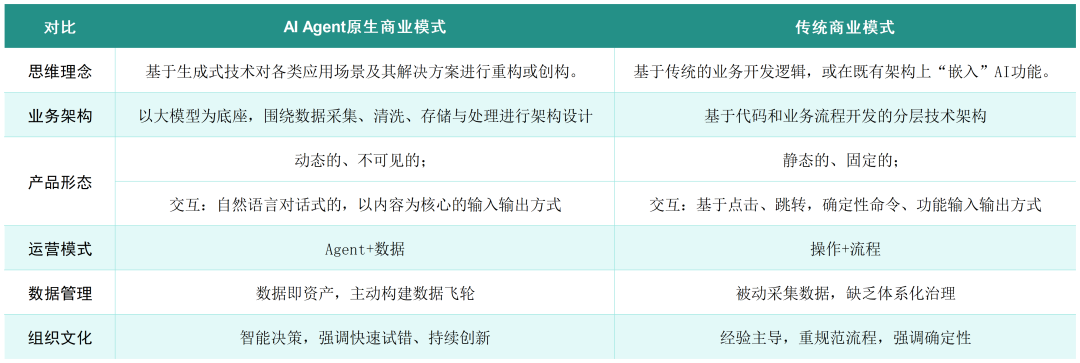
Differences between AI Agent-Native and Traditional Models
(2) Connection Relationships
First, in terms of user needs, the essence of business remains consistent. Although there are differences in the technology-driven approaches of AI-native and traditional business models, the commercial essence of AI-native business models and traditional business models remains the same, which is to identify user pain points and provide solutions. For example, traditional educational institutions meet users’ “knowledge acquisition” needs through offline teaching, while AI-native educational platforms like YuanTiKu solve the “personalized learning” needs through intelligent question-answering algorithms. Essentially, both aim to meet user needs in the education sector.
Second, there is a need to share commercial infrastructure. The operation of AI-native models relies on the foundational infrastructure of traditional business for implementation. For instance, in the physical world, e-commerce platforms depend on traditional logistics networks for product delivery; in the legal framework, the copyright of AI-generated content (AIGC) still needs to comply with traditional intellectual property laws; in human resources, the training of AI customer service systems relies on human-labeled data support, reducing the uncertainty of AI content through human review, all of which highlight the shared characteristics of both in terms of infrastructure.
Third, there is a gradual upgrade relationship. Traditional enterprises can achieve a gradual transition to AI-native models through AI empowerment: in the initial stage, optimizing existing business processes with AI technology; in the advanced stage, further reconstructing business models to achieve a leap from process optimization to business logic reshaping.
Related Reading
“The Rise of AI Agent-Native Enterprises in the AI Era – Current Status, Trends, and Risk Control” report released (with download QR code)
Will “AI partners” replace traditional organizational forms, and will AI Agent-native become a new way for enterprises to exist?