According to the current research on the innovative applications of enterprise AI Agents, there are significant differences in the pace of large model and AI Agent technology implementation across different industries. Overall, the rapid deployment of AI Agents is mainly concentrated in emerging enterprises and application scenarios driven by AI, which tend to have a higher degree of digitalization, more flexible technical architectures, and stronger innovation momentum. In contrast, traditional enterprises are generally limited by the complexity of historical systems, the need for business stability, and security compliance constraints, primarily advancing through localized pilots and functional module replacements, and have not yet formed a complete process of Agent-based reconstruction.
Currently, typical application areas for AI Agents include: smart retail, autonomous driving, smart healthcare, AI education, emotional companionship, and cybersecurity. These fields possess high human-machine interaction density, real-time decision-making needs, and complex task decomposition characteristics, making them naturally suitable for the introduction of Agent mechanisms to achieve automation and intelligent upgrades.
The following content will analyze the founding background, core products, business processes, and organizational structures of representative enterprises in these industries, comparing their technological evolution paths and strategic positioning to provide a reference for understanding the global development trends of the AI Agent industry.
AI Agent Native Enterprises in Europe and America
(1) Smart Retail: Walmart
Walmart is the largest retail enterprise in the world, with over 2.2 million employees and stores in 24 countries, serving approximately 255 million customers weekly. In the face of digital transformation and the AI wave, Walmart is transitioning from a traditional retailer to a data-driven smart retail platform.
-
Core Products:Walmart has built a role-driven, demand-oriented Agentic AI system that matches tasks and contexts for different stakeholders. Core AI Agent products include: Sparky (customer shopping assistant), Wally (merchant-side AI assistant), TrendtoProduct (trend analysis), and internal productivity and operations Agents.
-
Business Processes:This system enables natural language shopping, intelligent inventory, category analysis, sales forecasting, and more, helping Walmart achieve an Agent-based closed loop from product selection, shelving, customer recommendations to order delivery, and from in-store operations and inventory to feedback evaluation.
-
Organizational Structure:The organizational structure is characterized by a role-oriented, problem-based cross-departmental collaboration system. The core team implementing the transformation includes: Emerging Technology Department (leading team), Employee Knowledge Transformation Group (AI Empowerment Center), and various business domain teams (AI collaboration).
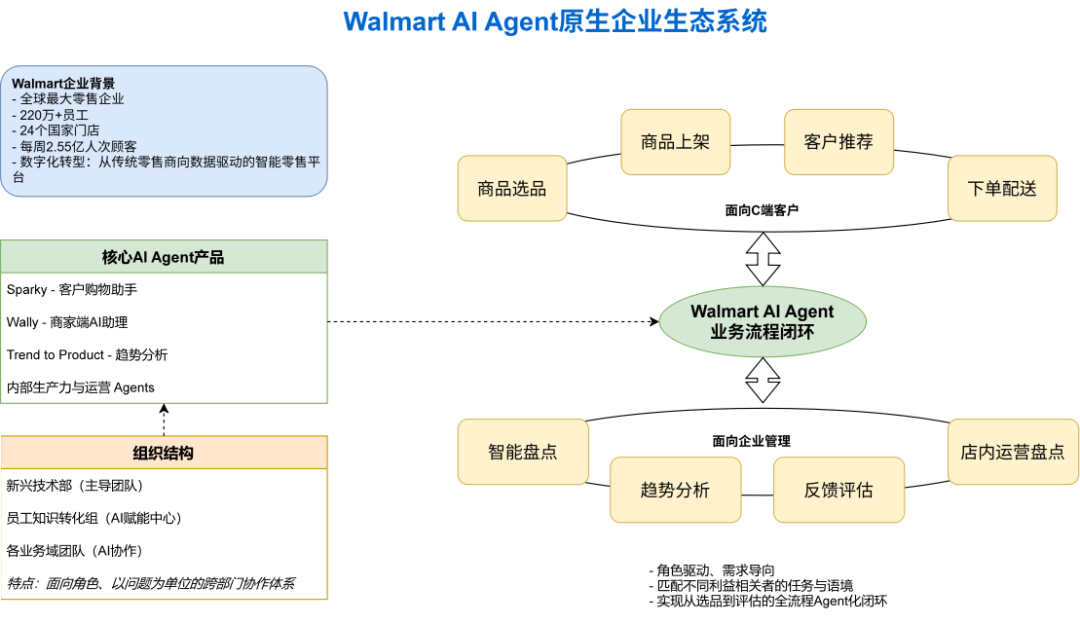
Walmart AI Agent Native Organizational Structure
(2) Autonomous Driving: Waymo
Waymo is an autonomous driving technology company under Alphabet (Google’s parent company), originally launched as a Google self-driving project in 2009, which became independent in 2016. The company focuses on the research and development of autonomous vehicle technology, aiming to improve traffic safety through innovative technology and make travel more convenient. Its main businesses include: autonomous driving technology solutions, autonomous taxi services, and autonomous freight services. As of August 2024, Waymo is the only company operating commercial autonomous taxi services in the United States, with approximately 700 autonomous taxis providing around 50,000 paid driverless rides weekly, having completed over 2 million rides.
-
Core Products:Waymo Driver is a fully autonomous driving system (AI Agent). This product is offered in two forms: the public-facing autonomous ride-hailing service Waymo One, and the logistics-focused autonomous truck solution Waymo Via.
-
Business Processes:The core business process is “transportation as a service,” fully driven by AI Agents. Users request rides through an app, and Waymo Driver autonomously plans routes, perceives the environment, complies with traffic regulations, handles emergencies, and ultimately delivers passengers or goods safely to their destinations without human driver intervention.
-
Autonomous Decision-Making and Task Automation:Waymo Driver can analyze real-time data from LiDAR, cameras, and radar, predict the behavior of hundreds of dynamic targets such as pedestrians and vehicles, and make driving decisions in milliseconds, exemplifying autonomous decision-making.
-
Organizational Structure:The company consists of two main parts: a large R&D team responsible for algorithm iteration, simulation testing, and hardware development, continuously training and optimizing Waymo Driver; and an operations team responsible for vehicle maintenance, cleaning, and remote support, serving as human employees for the AI Agent.
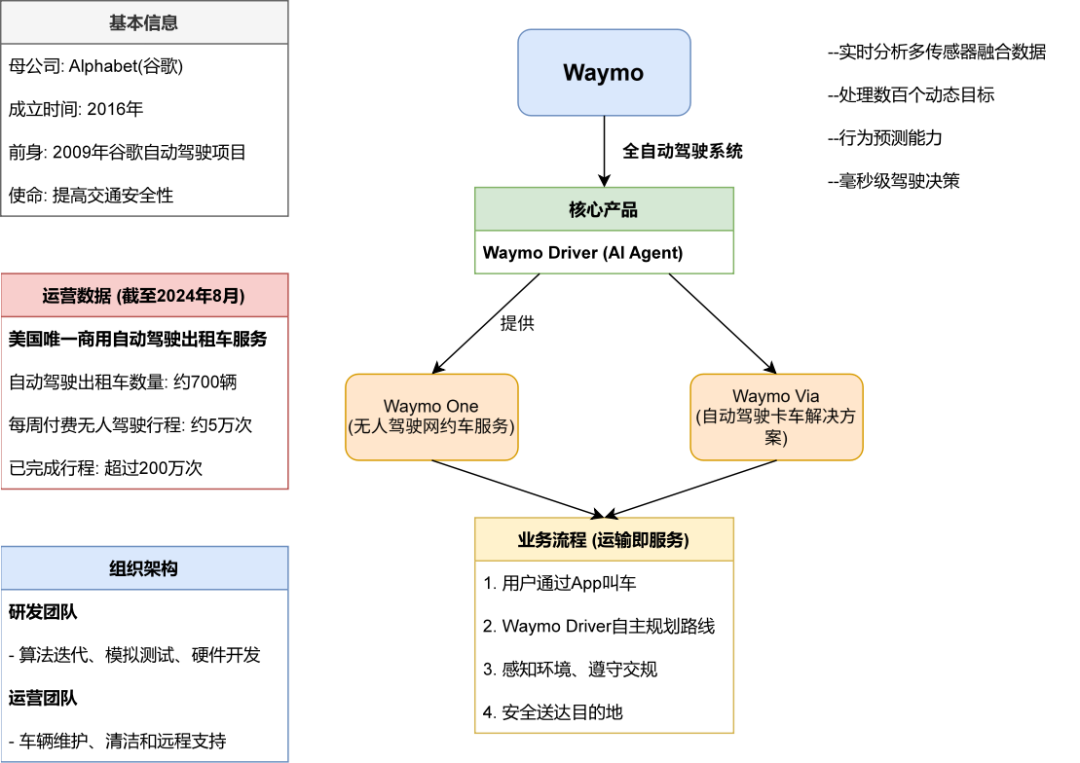
Waymo AI Agent Native Organizational Structure
(3) Healthcare Industry: Ambience Healthcare
Ambience Healthcare is a typical company deeply integrated with AI in healthcare. Founded in the United States in 2020 by engineers and doctors in the fields of artificial intelligence and medical technology, it aims to optimize medical documentation processes using generative AI technology to reduce the burden on healthcare professionals. The company has rapidly developed into an industry leader with strategic funding from investment institutions such as OpenAI and Kleiner Perkins.
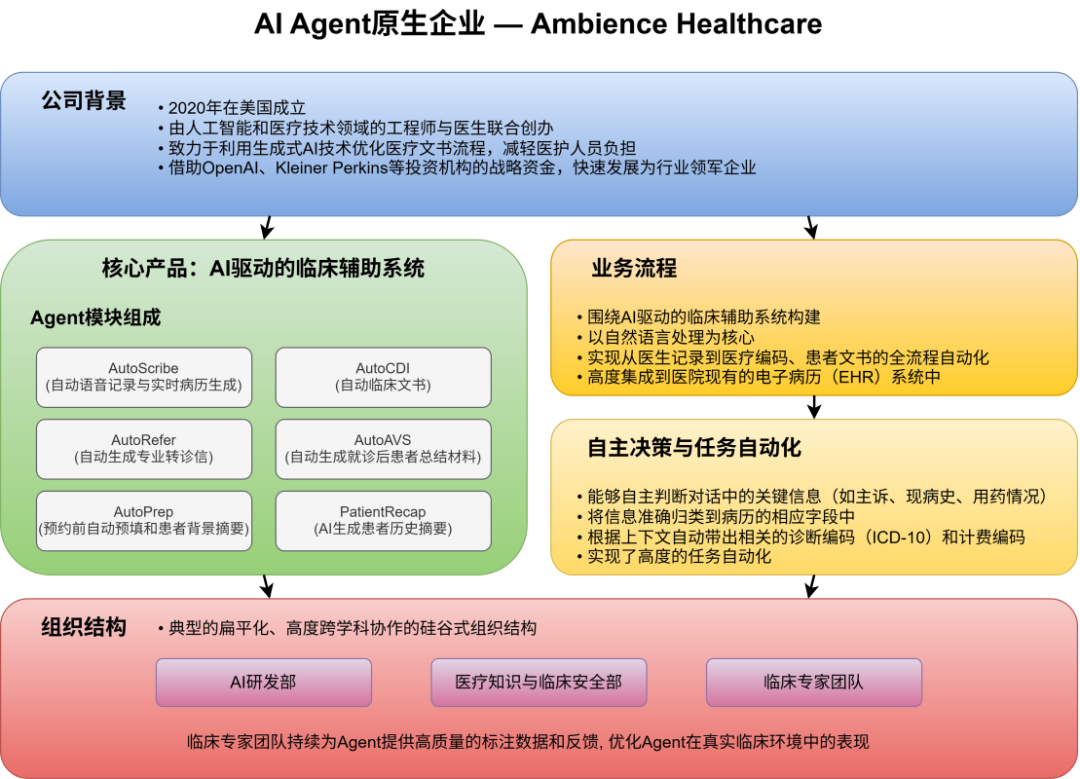
Ambience Healthcare AI Agent Native Organizational Structure
-
Core Products:The “AI-driven Clinical Assistant System” platform consists of: AutoScribe (automatic voice recording and real-time medical record generation), AutoCDI (automatic clinical documentation), AutoRefer (automatic generation of professional referral letters), AutoAVS (automatic generation of post-visit patient summary materials), AutoPrep (automatic pre-filling and patient background summary before appointments), PatientRecap (AI-generated patient history summaries), and other Agent modules.
-
Business Processes:Ambience Healthcare’s business processes are built around the “AI-driven Clinical Assistant System,” centered on natural language processing, achieving full process automation from physician documentation to medical coding and patient documentation. Its business processes are highly integrated into existing electronic health record (EHR) systems in hospitals, exhibiting strong embedded characteristics.
-
Organizational Structure:Structurally, the company adopts a typical flat, highly interdisciplinary collaborative Silicon Valley-style organizational structure. The core teams include: AI R&D Department, Medical Knowledge and Clinical Safety Department. There is also a clinical expert team that continuously provides high-quality annotated data and feedback to optimize the Agent’s performance in real clinical environments.
(4) AI Companionship Service: Character.AI
Character Technologies, Inc. (commonly known as Character.AI) was established in 2021, with its core business being “companionship as a service.” Its vision is to create a platform for “personalized AI agents” that everyone can use, allowing users to freely create, interact with, and share anthropomorphic intelligent agents.
-
Core Products:The Character.AI platform is an open AI Agent creation and interaction platform that allows users to create personalized intelligent agents and engage in deep, open-ended conversations with AI-driven agents with different “personas” (such as historical figures, game characters, virtual companions). The platform uses a self-developed large language model, supporting multi-turn memory, character tone, and preference customization. The platform runs on Google Cloud TPU, enabling high concurrency responses.
-
Business Processes:Character.AI’s main service form is providing natural language dialogue interaction to end-users, covering daily companionship, emotional support, knowledge Q&A, and simulated character chats. The company focuses on the development of underlying dialogue models and the construction of platform tools, while the vast array of Agent “characters” is created and trained by community users. The company’s value creation entirely depends on whether the millions of AI Agents on its platform can provide continuous, engaging, and emotional interaction experiences. User stickiness and willingness to pay directly depend on the “intelligence” and “humanity” of these Agents.
-
Organizational Structure:As of 2024, the company has a team size of about 100-200 people. The core teams include: model development and infrastructure, product and design teams, community and content management, and security compliance and ethics teams.
AI Agent Native Enterprises in China
(1) Autonomous Driving: Pony.ai
Pony.ai, founded in 2016, is a high-tech private enterprise focused on the research and application of autonomous driving technology, aiming to create a “virtual driver” to provide safe, sustainable, and convenient travel services globally, with a vision of making autonomous driving accessible. Its main businesses include autonomous driving travel services (Robotaxi), autonomous trucks (Robotruck), and intelligent driving for passenger cars. Currently, related businesses are officially operating in Guangzhou, with testing permits obtained in Beijing, Shanghai, and Shenzhen. Robotruck is currently the main source of revenue, while Robotaxi is the focus for future commercialization.
-
Core Products:Similar to Waymo, its core product is a Level 4 autonomous driving system (AI Agent), which serves as the basis for providing Robotaxi and Robotruck services.
-
Business Processes:Its business processes are highly consistent with Waymo, centered on AI Agents for “unmanned transportation services.” Passengers or cargo owners place orders through an app, and vehicles autonomously complete transportation tasks. The company conducts large-scale Robotaxi testing and operations in multiple cities in China and the United States.
-
Autonomous Decision-Making and Task Automation:The system can handle the unique complex traffic scenarios in China, such as dense pedestrian and non-motorized vehicle interactions and irregular intersections. The Agent needs to make more complex and game-theoretic driving decisions than in American road conditions.
-
Organizational Structure:The company has a large team for AI algorithms, high-precision mapping, hardware, and system engineering, as well as a large ground team responsible for vehicle modifications, testing, and daily operations. The entire organization serves to ensure the safe and efficient operation of AI Agents.
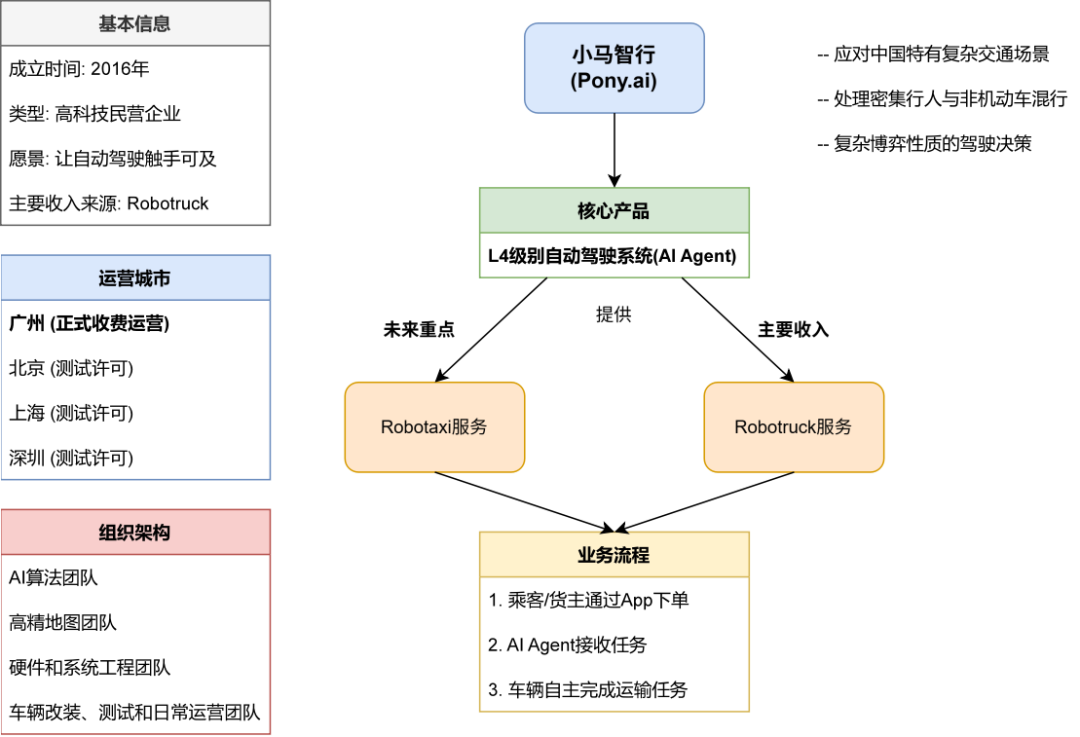
Pony.ai AI Agent Native Organizational Structure
(2) Autonomous Driving: WeRide
WeRide, founded in 2017, is a global leading autonomous driving technology company headquartered in Guangzhou, conducting R&D, testing, and operations in 30 cities across 7 countries.
-
Core Products:WeRide One is a universal autonomous driving technology platform that supports L2-L4 mature autonomous driving solutions, adaptable to various vehicle types such as taxis, minibuses, freight vehicles, and sanitation vehicles. These autonomous AI Agent service fleets can be managed, scheduled, and analyzed through a cloud platform, forming a powerful data closed loop and algorithm iteration system.
-
Business Processes:The business model is “unmanned operation of services.” By deploying various forms of AI Agent vehicles, it provides a complete set of unmanned solutions for smart cities, such as autonomous sanitation vehicles that can autonomously complete street cleaning tasks at night. For different application scenarios, Agents also possess specific task automation capabilities, such as the sanitation vehicle Agent needing to autonomously plan cleaning routes and control the start and stop of cleaning devices; minibuses need to accurately stop at virtual stations.
-
Organizational Structure:The company expands in two directions based on the universal WeRide One platform, towards autonomous taxi and smart city services. The organizational structure supports parallel R&D and commercialization of multiple product lines.
(3) Smart Healthcare: Ping An Good Doctor
Ping An Good Doctor, established in 2014 and listed on the Hong Kong Stock Exchange in 2018, is a leading online healthcare service platform in China, dedicated to building an “Internet + healthcare” ecological closed loop.
-
Core Products:Based on its self-developed “Ping An Medical Assistant” large model, Ping An Health has created a diversified AI Agent product cluster, with AI Agent products performing specific healthcare functions, such as: “Director An” doctor assistant, Ping An Heart Medical, AI elderly care manager, AI medical office, AI health welfare officer, etc.
-
Business Processes:Ping An Health deeply integrates user experience with doctor services through AI Agents, forming a full lifecycle health service chain from health consultation, intelligent triage and auxiliary diagnosis, expert collaboration and treatment closed loop, chronic disease and health management, to long-term companionship and integration of medical care.
-
Autonomous Decision-Making and Task Automation:Ping An Health’s AI Agents have initially established a multi-level intelligent decision-making chain, achieving closed-loop capabilities from perception to reasoning to response. Specifically, this is manifested in: using large models for structured processing and preliminary risk classification of symptoms, text, and images; constructing a causal network of causes-symptoms-disposal plans using medical knowledge graphs to support causal reasoning and disease classification recognition; and enabling collaborative judgment among different roles (doctor Agents, health management Agents, chronic disease follow-up Agents) through event messaging or reasoning engines.
Ping An Health is gradually embedding AI Agents into multiple key tasks, achieving automation of process-oriented and decision-oriented tasks, including: automated health inquiries and triage, intelligent recommendations for examinations and medications, intelligent chronic disease management and follow-up, automated report interpretation and visualization generation, and automation of corporate health services.

AI Agent Decision-Execution Flowchart
-
Organizational Structure:Ping An Health is building a collaborative organizational system for deep integration of “AI + healthcare,” including: technology platform and AI R&D teams (responsible for large model and Agent capability construction), medical professional teams (forming a “human + machine” collaborative service mechanism with Agents), operations and service teams, and compliance and ethics assurance departments (regularly assessing Agent risks, misleading behaviors, or intervention necessity).
(4) Cybersecurity: Yunqi Wuyin
Beijing Yunqi Wuyin Technology Co., Ltd. (abbreviated as Yunqi Wuyin) is an innovative enterprise focused on empowering cybersecurity capabilities using large models and dedicated to creating the most security-aware AI security agents. The company was established in July 2021 and is headquartered in Beijing.
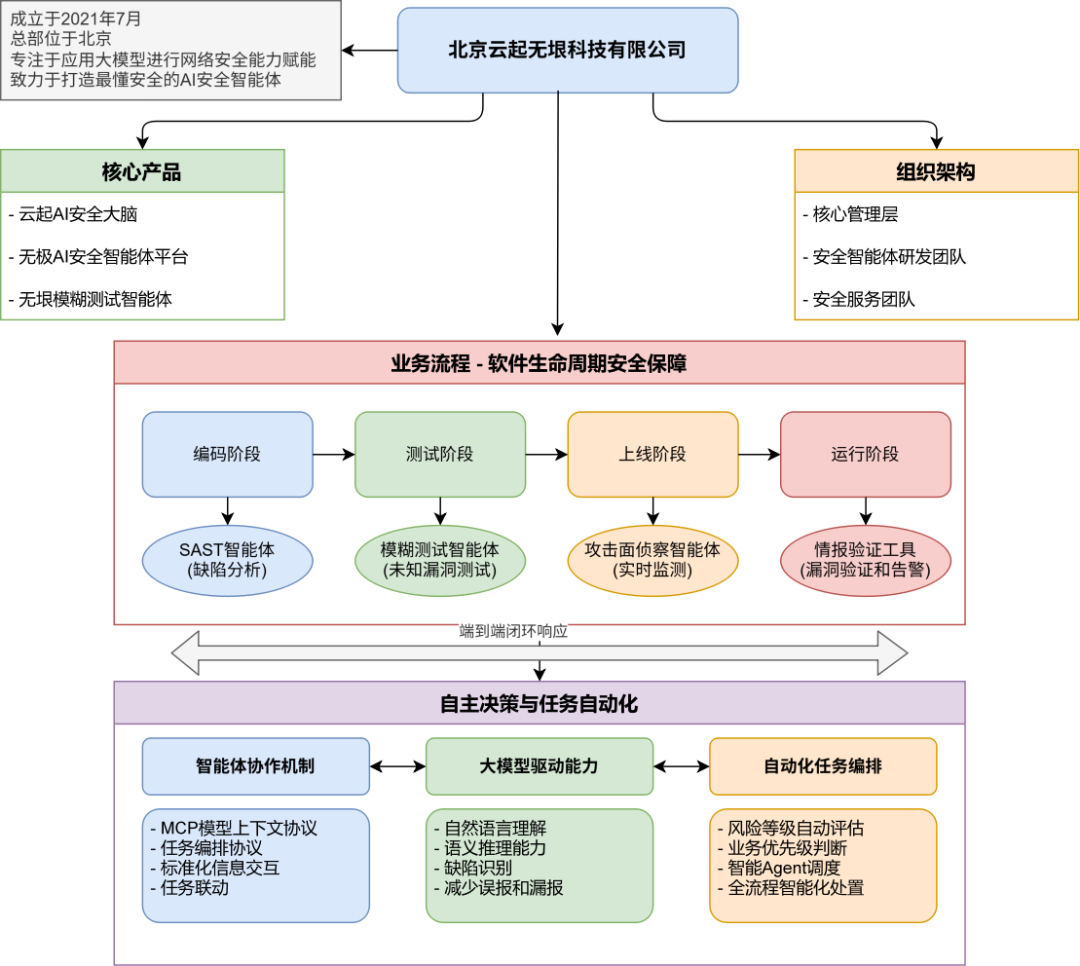
Yunqi Wuyin AI Agent Native Organizational Structure
-
Core Products:The company relies on its self-developed and trained “Yunqi AI Security Brain” to build a platform for limitless AI security agents and a series of products such as the limitless fuzz testing intelligent agent, targeting application scenarios such as vulnerability discovery, attack-defense competitions, and development security testing, creating over a dozen security intelligent agent products including security tools, code security, and vulnerability intelligence.
-
Business Processes:The limitless AI security agent platform integrates dozens of AI Agent tools for application software security testing, covering the entire lifecycle of application software development, testing, deployment, and usage. For example, during the coding phase, SAST agents are used for defect analysis; during the testing phase, fuzz testing agents are used for unknown vulnerability testing and providing repair suggestions; after deployment, attack surface reconnaissance agents monitor applications in real-time; and after new vulnerabilities are disclosed, intelligence verification tools are used for vulnerability validation and alerts.
-
Autonomous Decision-Making and Task Automation:In the “limitless AI security agent platform,” users can call upon AI Agents with different security capabilities as needed. Each Agent interacts and links tasks through standardized agent collaboration protocols (such as MCP model context protocols or task orchestration protocols), thereby constructing an intelligent security management process that supports end-to-end closed-loop responses. Leveraging the natural language understanding and semantic reasoning capabilities driven by large models, various AI Agents significantly enhance processing efficiency in defect identification, vulnerability detection, analysis, and judgment scenarios, reducing false positives and negatives caused by rigid rules. Additionally, through automated task orchestration mechanisms, the platform can automatically schedule corresponding Agents to execute disposal tasks based on risk levels and business priorities, truly achieving full-process intelligence from “alert generation” to “closed-loop processing,” continuously enhancing the autonomous decision-making capabilities and automation levels of enterprise security operations.
-
Organizational Structure:The company’s organizational structure is led by the core management team, supported by the security intelligent agent R&D team and security service team, while also equipped with functional departments such as sales, collectively driving enterprise development. Among them, the R&D team focuses on the design of security models related to AI Agents and the development of detection mechanisms, while the service team has accumulated extensive practical experience in vulnerability discovery, penetration testing, and risk response. This experiential data and knowledge system has gradually transformed into industry-specific corpus and rule models that support AI Agents’ autonomous decision-making, effectively enhancing the system’s intelligence level and industry adaptability.
 Cooperation Phone: 18311333376Cooperation WeChat: aqniu001Submission Email: [email protected]