Hello everyone, I am the Mixed Cuisine Master.
Currently, many embedded devices run on RTOS and Linux systems. So, what are the differences between the two?
1. Multi-faceted Comparison
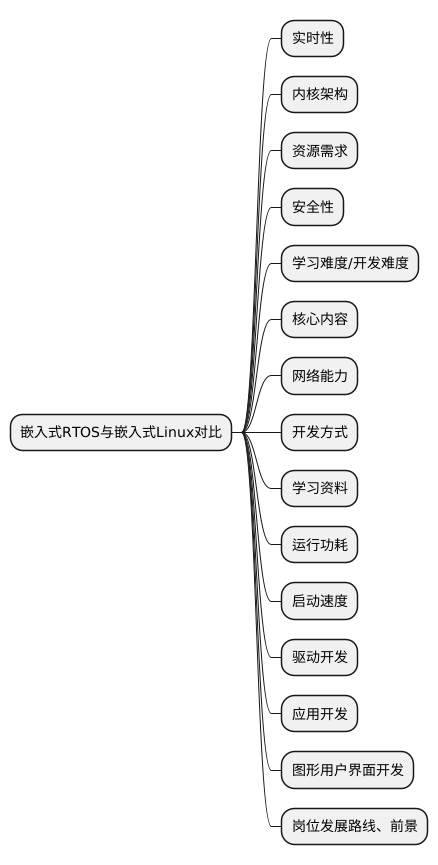
1. Real-time Performance
Real-time performance ensures that tasks are completed within a specific time frame. An important metric for measuring the robustness of a real-time operating system is the time taken from receiving a task to completing it, known as jitter.
Real-time operating systems can be classified into two types based on jitter: hard real-time and soft real-time. Hard real-time operating systems have less jitter than soft real-time operating systems:
- Hard real-time operating systems must complete tasks within a determined time.
- Soft real-time operating systems allow most tasks to be completed within a determined time.
Real-time performance is the most essential difference between embedded RTOS and embedded Linux.
Real-time Performance Comparison:
-
Embedded RTOS: Hard real-time (μs-level response), with interrupt latency typically <10μs. It has strong real-time capabilities, using preemptive multitasking scheduling algorithms to ensure critical tasks are completed within strict deadlines, with predictable response times, suitable for high real-time requirement scenarios such as industrial automation control and aerospace.
-
Embedded Linux: Linux is developed as a general-purpose operating system, and its kernel is inherently deficient in real-time processing capabilities, requiring optimization through the CONFIG_PREEMPT_RT patch for real-time performance, default soft real-time (latency >50μs). Although real-time patches can achieve certain real-time performance, it is essentially a time-sharing operating system, and its kernel is not specifically designed for real-time performance, leading to uncertainty in response times when handling high real-time tasks, generally used in scenarios with less stringent real-time requirements.
2. Kernel Architecture
The operating system kernel can be classified based on architecture into: monolithic kernel, microkernel, and hybrid kernel.
The architectures of monolithic kernel, microkernel, and hybrid kernel are as follows:
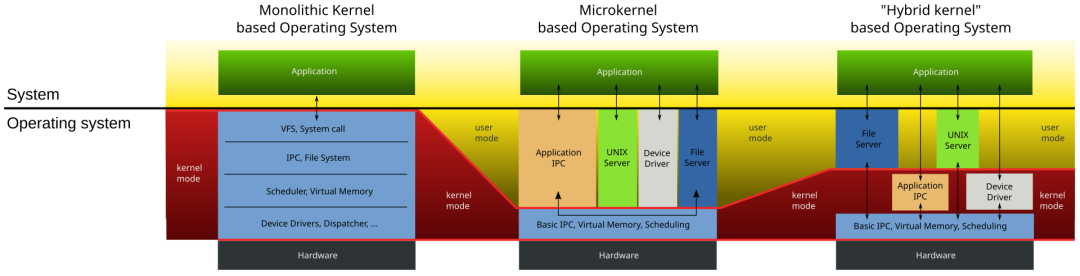
- Monolithic Kernel: The monolithic kernel is viewed as a single process running in a single address space, where all services provided by the kernel operate in privileged mode within this large kernel address space, known as kernel space.
- Microkernel: The design philosophy of the microkernel is to separate the implementation of system services from the basic operational rules of the system. It achieves this by modularizing core functionalities into several independent processes, each running as services in different address spaces.
- Hybrid Kernel: The hybrid kernel combines the architectures of both monolithic and microkernels. The basic design philosophy of the hybrid kernel is to design the operating system kernel using a microkernel architecture, but implement it using the methods of a monolithic kernel. Essentially, the hybrid kernel is a microkernel, but it allows some microkernel structures to execute user-space code in kernel space, thus improving kernel execution efficiency.
Kernel Architecture Comparison:
-
Embedded RTOS: Mostly microkernel (e.g., Zephyr), no virtual memory management (no MMU), system calls are direct function calls. The kernel is usually very lightweight, containing only basic functionalities such as task scheduling, memory management, and interrupt handling to ensure efficient operation and quick response, highly customizable based on specific needs.
-
Embedded Linux: Monolithic kernel, relies on MMU for virtual memory, requires user/kernel mode switching (syscall interface). The kernel is relatively large and complex, supporting multi-user and multi-tasking, with comprehensive memory management, process scheduling, file system functionalities, providing rich system services and interfaces, but also consuming more resources.
3. Resource Requirements
- Embedded RTOS: Due to its lightweight kernel, it has lower hardware resource requirements and can run on resource-limited microcontrollers (MCUs) and other devices, such as simple sensor nodes and small smart devices.
- Embedded Linux: Due to its rich functionality and complex kernel, it requires more hardware resources, typically running on microprocessors (MPUs) with certain processing capabilities and memory space, such as industrial control computers and smart terminals.
4. Security
- Embedded RTOS: The system has relatively simple functionalities, with a small codebase, rigorously tested and verified, resulting in fewer security vulnerabilities, and can be customized for specific security needs, suitable for safety-critical systems with high security requirements.
- Embedded Linux: Its open-source nature makes it susceptible to security threats, but the open-source community can quickly identify and fix security vulnerabilities. Additionally, security enhancement technologies like SELinux can improve its security, suitable for scenarios with certain security requirements but not absolutely critical.
5. Learning Difficulty/Development Difficulty
- Embedded RTOS: Learning and development are relatively simple, focusing on real-time task processing, with a relatively straightforward development framework and API, allowing developers to concentrate on task division, scheduling, and communication, suitable for beginners and those with little experience in real-time development.
- Embedded Linux: Learning and development are more challenging, involving complex knowledge such as kernel principles, file systems, and network protocols, requiring mastery of various tools and technologies like cross-compilation, kernel trimming, and driver development, demanding higher technical levels and experience from developers.
6. Core Content
- Embedded RTOS: The core is real-time task scheduling and management, ensuring tasks are completed within specified timeframes, focusing on task priority allocation, time slice management, and inter-task synchronization and communication.
- Embedded Linux: The core is to provide a general-purpose, feature-rich operating system platform, supporting various application developments, including file system management, network services, device drivers, to meet diverse needs across different fields.
7. Networking Capabilities
- Embedded RTOS: Networking capabilities are relatively weak, requiring integration of lightweight protocols (e.g., LwIP). Typically supports basic network protocols, such as simple TCP/IP stacks, to meet real-time data transmission needs, with limited support for complex network applications.
- Embedded Linux: It has powerful networking capabilities, supporting a complete network protocol stack, including TCP/IP, UDP, and various protocols, easily implementing complex network applications such as network servers and clients, suitable for devices requiring frequent network communication, such as network routers and smart gateways.
8. Development Method
- Embedded RTOS: The development method is relatively simple, typically using specific integrated development environments (IDEs) like IAR, Keil, etc., along with corresponding development boards. The configuration of the development environment is relatively easy, mainly focusing on task writing and debugging.
- Embedded Linux: The development method is more complex, requiring the setup of a cross-compilation environment, involving communication and collaboration between the host and target machines. Common development tools include GCC, Make, etc., and the development process requires kernel compilation, driver development, file system creation, and other steps, making the setup and configuration of the development environment relatively cumbersome.
9. Learning Resources
- Embedded RTOS: Learning resources are relatively abundant, mainly focusing on specific RTOS product manuals, official documentation, and some specialized embedded development books.
- Embedded Linux: Learning resources are extremely rich, with numerous books, online documentation, open-source projects, and active community forums, such as the official Linux kernel documentation and Linux community, allowing developers to easily access various technical knowledge and solutions.
10. Operating Power Consumption
- Embedded RTOS: Due to its simplicity, it can flexibly control hardware resource usage based on task requirements during operation, achieving good low-power management, supporting μA-level sleep modes (STOP/STANDBY), and dynamic voltage frequency scaling (DVFS) to optimize energy consumption.Suitable for battery-powered devices, such as IoT sensor nodes.
- Embedded Linux: Due to its complex kernel, it requires continuous operation of multiple background processes and services, leading to relatively high power consumption (typically >100mW), but some energy-saving technologies and optimizations, such as power management frameworks (like CPUFreq), can reduce power consumption to some extent, suitable for plugged-in devices.
11. Boot Speed
- Embedded RTOS: Millisecond-level boot, fast boot speed, short kernel initialization time, able to complete system startup and enter working state in a short time, meeting the requirements of some applications for quick startup, such as emergency response devices in industrial control.
- Embedded Linux: Second-level boot, the startup process involves U-Boot booting, kernel loading, file system mounting, service starting, and other steps, resulting in relatively slow boot speed, generally taking several seconds to tens of seconds, but for some devices with less stringent real-time requirements, such as smart TVs, the impact of boot speed is relatively minor.
12. Driver Development
- Embedded RTOS: Driver development is relatively simple, usually providing concise driver interfaces for specific hardware platforms, where developers only need to write basic driver programs based on hardware characteristics and RTOS requirements, mainly focusing on hardware initialization and data transmission functionalities.
- Embedded Linux: Driver development is more complex, requiring a deep understanding of the Linux kernel’s driver model, such as device trees, character device drivers, block device drivers, etc., and the development process must adhere to strict kernel programming standards, involving extensive kernel code writing and debugging work.
13. Application Development
- Embedded RTOS: Application development mainly revolves around real-time tasks, focusing on logical implementation and time control of tasks, with development languages generally being C and C++, and the development framework being relatively simple, mainly used to implement specific real-time control functionalities.
- Embedded Linux: Application development is more diverse, supporting various programming languages such as C, C++, Python, etc., and can leverage rich libraries and frameworks for development, capable of implementing complex applications including graphical interfaces, network applications, data processing, etc.
14. Graphical User Interface Development
- Embedded RTOS: It has limited support for graphical user interfaces (GUIs), and to implement a GUI, additional lightweight GUI libraries (such as LVGL, emWin) need to be added, with relatively simple functionalities, suitable for devices with low interface requirements, such as simple industrial control terminals.
- Embedded Linux: It has rich GUI libraries and tools, such as Qt, GTK, etc., capable of developing powerful and visually appealing graphical user interfaces, suitable for smart terminals, in-vehicle infotainment systems, and other devices with high user experience requirements.
15. Career Development Path and Prospects
- Embedded RTOS: The career development path mainly focuses on real-time control system development, hardware driver engineers, etc. With the development of industrial automation and smart manufacturing, the demand for talents proficient in embedded RTOS technology continues to grow, especially in high-end manufacturing industries such as automotive electronics and aerospace, offering good development prospects.
- Embedded Linux: The career development path is broader, with opportunities to work as kernel development engineers, system porting engineers, application development engineers, and more. It has wide applications in popular fields such as IoT, artificial intelligence, and intelligent transportation, with high market demand and good development prospects, and due to the higher technical difficulty, the salary for related talents is also relatively high.
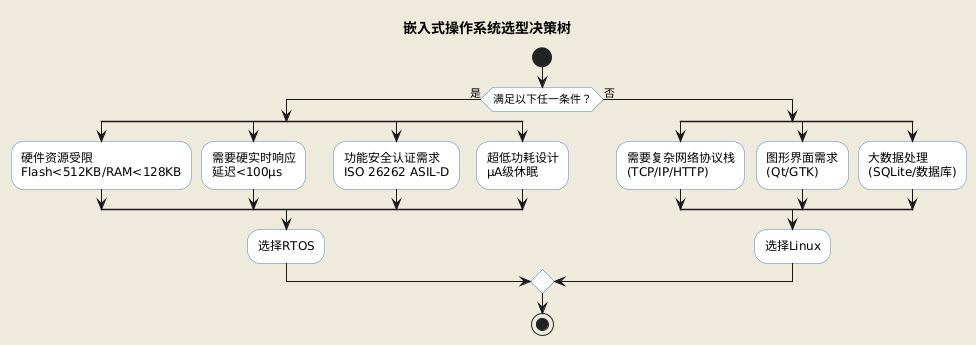
2. Decision Tree
After such a comprehensive comparison, when should RTOS be chosen? When should Linux be chosen?
That concludes this sharing, if this article has inspired you, please give it a thumbs up or share it.

END
Author:ZhengNL
Source:Embedded Mixed CuisineCopyright belongs to the original author. If there is any infringement, please contact for deletion..▍Recommended ReadingSharing a powerful tool for embedded development and debugging!Why do most assessments of technical personnel only consider overtime hours?I never expected that with this VSCode plugin, my embedded development efficiency doubled!→ Follow for more updates ←