 On September 4, 2025, the team led by Wang Chenxuan at the Institute of Basic Medical Sciences, Chinese Academy of Medical Sciences, published a paper titled “Beyond the Amyloid Core: Modulation of Aggregate Conformational Diversity by Mutations in the Noncore Regions” in the Journal of the American Chemical Society. This study, utilizing single-molecule techniques, reveals for the first time the regulatory mechanism of point mutations in the non-core regions during protein aggregation, providing new insights into the formation mechanisms of amyloid aggregates. The results indicate that the traditionally overlooked non-core regions play a crucial regulatory role in the formation of amyloid fibers through dynamic changes in their coexisting conformational ensembles.Amyloid proteins or peptides form pathological aggregates through aggregation, which play a key pathogenic role in protein conformational diseases such as Alzheimer’s disease and amyotrophic lateral sclerosis. These aggregates typically exhibit a cross-β-sheet structure, with their monomers usually containing at least one β-structured domain forming a “core region,” which provides the driving force for the aggregation process. Classical theories suggest that mutations or post-translational modifications occurring in the core region can enhance or inhibit amyloid aggregation by promoting or disrupting the ordered arrangement of this region. Recent studies have found that mutations and post-translational modifications in the non-core region fragments also play significant regulatory roles in the aggregation process and the toxicity of aggregates. However, due to the high conformational flexibility of the non-core regions, it is challenging to analyze them using cryo-electron microscopy single-particle reconstruction techniques and fiber helical reconstruction techniques that rely on periodic structures, and there is a lack of sufficient structural data to support high-precision theoretical predictions, leading to the specific mechanisms of this region in protein aggregation remaining unknown.This study employed scanning tunneling microscopy (STM) single-molecule imaging methods, combining atomic-scale point scanning measurements with two-dimensional image reconstruction techniques and statistical thermodynamic theoretical modeling, to systematically investigate the conformational regulatory mechanisms of the non-core regions in the aggregates of the tumor suppressor protein p53 (residues 238-262). The study found that mutations in the non-core regions (R248W, R248Q, and R249S) significantly altered the aggregation capacity of the fragment by reshaping the conformational network regulating the aggregation process. Specifically, it manifested as: (1) an expansion of conformational diversity: the wild-type exhibited only 8 metastable conformations, while the mutants increased to 11-16; (2) a reconstruction of the interaction network among coexisting conformations: the interaction patterns among coexisting conformations increased from 19 in the wild-type to 50 (R248W), 43 (R248Q), and 35 (R249S), with dominant interaction patterns showing mutation specificity; (3) thermodynamic-kinetic balance: the reshaping of the conformational ensemble is driven by specific molecular recognition events, achieving a dynamic balance between stability and plasticity through entropy compensation. This study reveals for the first time at the single-molecule level the molecular mechanisms by which non-core regions regulate the formation of heterogeneous coexisting conformational ensembles in aggregates, providing new ideas for developing targeted precision therapeutic strategies for amyloid protein diseases.
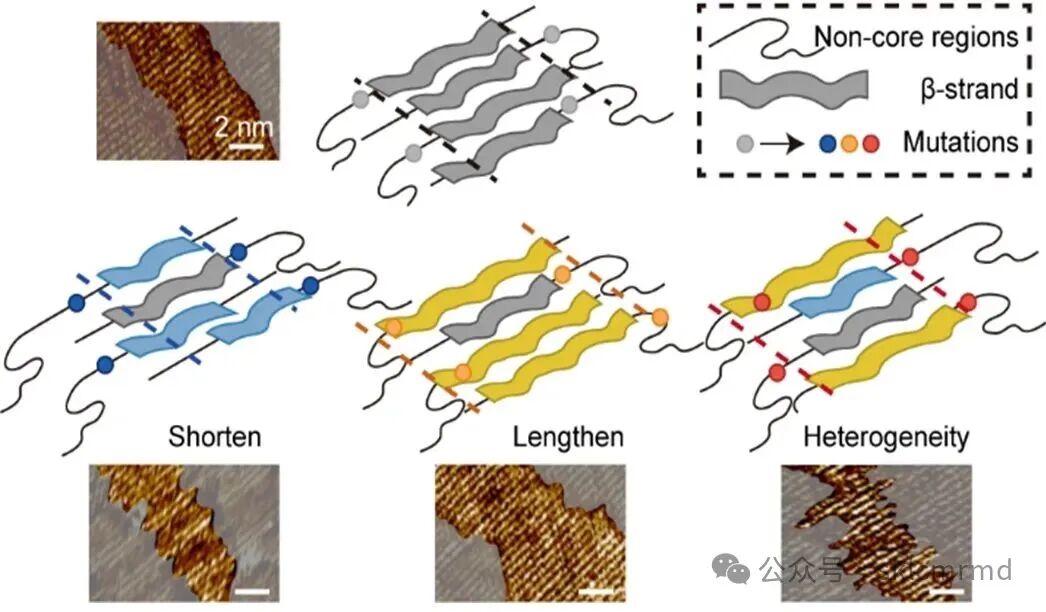 Figure 1. Regulatory Patterns of Non-Core Region Mutations on Coexisting Conformational Ensembles of AggregatesThis research was supported by the National Natural Science Foundation (92353302, 32471451, 32201243, 32201142), Beijing Science and Technology Nova Program (20240484521), National Key R&D Program (2022YFA1205800), and the Medical and Health Technology Innovation Project of the Chinese Academy of Medical Sciences (2023-I2M-QJ-009). Researcher Wang Chenxuan, Associate Researcher Zhang Wenbo, and Associate Researcher Yu Lanlan from the Institute of Basic Medical Sciences are co-corresponding authors of the paper, while PhD students Chen Mingrui, Jian Zhongyi, and Dr. Wang Mingzhan from City University of Hong Kong are co-first authors of the paper. Researcher Wang Chen and Researcher Yang Yanlian from the National Center for Nanoscience and Technology made significant contributions to this work.Paper link: https://doi.org/10.1021/jacs.5c07880