In our country, the number of hydrological stations, especially the new generation of IoT telemetry stations, has become extremely large, often numbering in the tens of thousands. They act like the “nerve endings” reaching out to rivers, lakes, and reservoirs, continuously transmitting important information such as water conditions, rainfall, and operational status 24 hours a day.
However, problems have arisen: these stations are widely distributed, operate in harsh environments, and are numerous. The traditional maintenance model of “fixing it after it breaks” is like a firefighter who is always chasing after problems, exhausted and inefficient.
Just like managing a large fleet of vehicles, you cannot always wait for a car to break down on the road before calling a tow truck; instead, you want to know in advance which tire needs to be replaced and which engine needs maintenance.
In fact, the equipment maintenance of our hydrological stations is undergoing a profound transformation from a passive repair model of “mending the fold after the sheep are lost” to a proactive management model of “taking precautions before it rains.” The core driving force behind this transformation is our protagonist today—Artificial Intelligence (AI).
1. Saying Goodbye to “Observation, Inquiry, and Diagnosis”: Why Traditional Maintenance is Becoming Increasingly Ineffective?
Before discussing AI, we need to clarify why the old methods are no longer effective. I summarize it as “three major mountains”:
| Pain Points of Traditional Maintenance | Description of Core Issues | Real-World Scenario Examples |
|---|---|---|
| Delayed Response, Data Gaps | After a device fails, the central platform only receives an alarm or detects data anomalies, resulting in a time lag of several hours or even days from dispatching personnel to their arrival on site. | During heavy rain, a key rain gauge’s tipping bucket (the core component for measuring rainfall) was blocked by leaves, resulting in zero data. By the time the platform detected the anomaly, the heavy rainfall event was already halfway through, missing the critical flood peak calculation data. |
| High Costs, Endless Resource Drain | Maintenance personnel need to frequently conduct on-site inspections, incurring significant transportation and labor costs. Especially for remote stations, the cost of a single inspection can reach thousands of yuan, often just to resolve a minor issue. | In a management center for a mountainous watershed in the west, the annual maintenance costs for vehicle upkeep and travel allowances account for nearly 40% of the entire maintenance budget. Most inspection results indicate that “the equipment is operating normally.” |
| Reliance on Experience, Irreplaceable Senior Technicians | Troubleshooting heavily relies on the personal experience of senior technicians. Methods such as “listening to sounds, checking voltage, and feeling temperature” are effective but difficult to pass on and scale. Young technicians often find themselves at a loss when faced with complex failures. | An experienced technician can determine from the faint sound of electrical current that a certain relay is about to fail, but this “mystical” skill cannot be documented in an operations manual. |
These “three major mountains” are suffocating us. We clearly hold vast amounts of real-time IoT data—voltage, current, signal strength, device temperature, heartbeat packets (signals sent periodically by devices to indicate they are still operational)—but this data is like a book in a foreign language; we look at it every day but cannot comprehend its deeper meaning.
AI is the key that can unlock this book.
2. How Does AI Become the “Intelligent Stethoscope” for Hydrological Stations?
Imagine AI as an incredibly experienced general practitioner, continuously conducting “check-ups” for thousands of hydrological stations. It does not need to be on-site; it can gain insights into each device’s health status simply by analyzing the various data metrics transmitted back.
This relies primarily on three core technical capabilities:Intelligent analysis of equipment status, fault trend prediction, and remote maintenance recommendations.
1. Core Mechanism One: Remote Diagnosis – AI’s “CT Scan”
When a device exhibits anomalies, such as sudden changes or interruptions in water level data, the traditional method is to send someone to the site. In contrast, AI performs an immediate “CT scan” of all relevant data for that station.
How does it do this?
The AI model comprehensively analyzes multiple dimensions of data to construct a “normal profile” of the device’s operation.
- Single Metric Analysis: For example, AI detects that the charging current of a solar panel suddenly dropped from a normal 1.5A to 0.2A during a sunny day.
- Multidimensional Correlation Analysis: At the same time, AI notices that the temperature of the controller is abnormally high.
- Logical Reasoning: The AI’s knowledge base (trained on a large number of historical fault cases) will conclude: this is likely not due to a change in weather (otherwise the temperature would not rise), but rather a short circuit or overheating fault in the charging controller itself.
Thus, the system no longer simply reports a “data anomaly”; it directly pushes a diagnostic message: “XX station’s solar controller is suspected of overheating; please check the controller’s cooling or internal circuitry.” This precisely locates the problem to a specific component, providing accurate direction for remote guidance and on-site repairs.
The following flowchart clearly illustrates how data transforms from a raw number into a valuable diagnostic message.
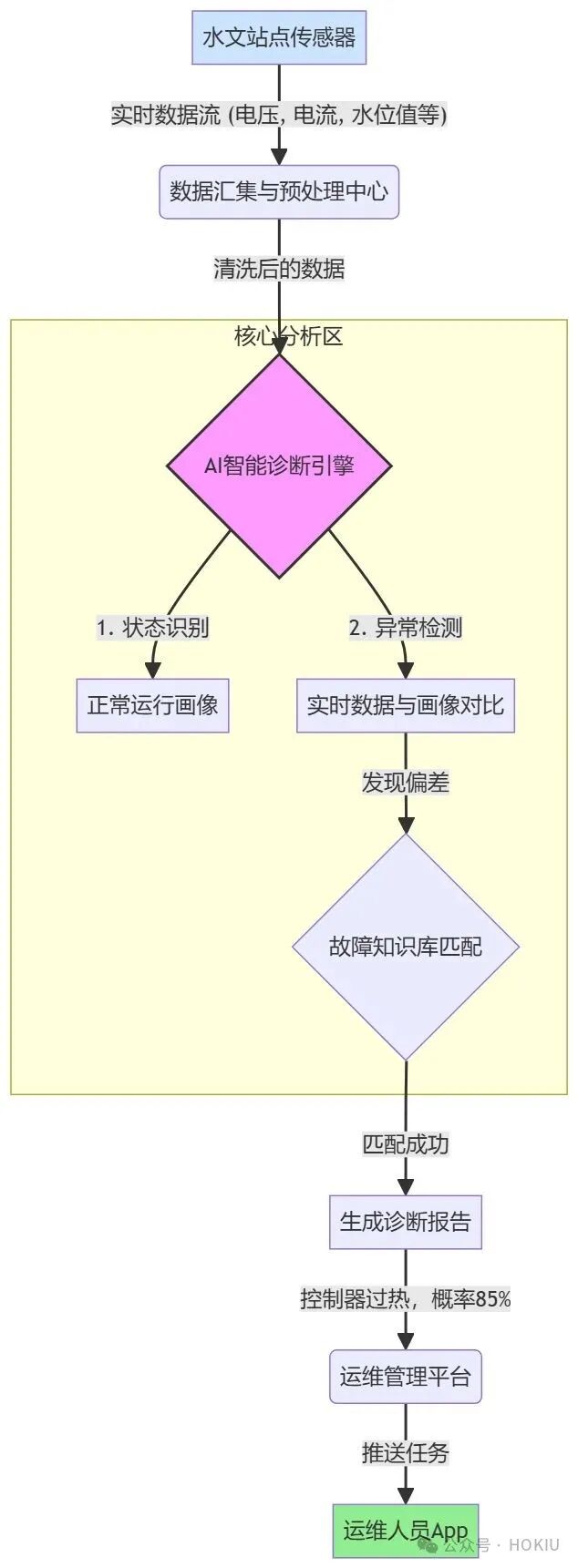
Chart Explanation: This flowchart demonstrates the entire process of AI conducting remote diagnosis. Data starts from front-end sensors, undergoes a “check-up” by the AI engine (status recognition, anomaly detection, knowledge base matching), and ultimately generates an accurate diagnostic report, which is directly pushed to maintenance personnel, achieving automation from “problem discovery” to “problem localization.”
2. Core Mechanism Two: Fault Prediction – AI’s “Foreknowledge”
If remote diagnosis is “mending the fold after the sheep are lost,” then fault prediction is truly “taking precautions before it rains,” which is one of the most exciting aspects of AI intelligent maintenance.
Its principle is akin to an experienced cardiologist analyzing an electrocardiogram. The doctor does not wait for a patient to suffer a heart attack before intervening; instead, they analyze subtle, abnormal waveform trends on the ECG to predict the risk of a heart attack occurring in the coming months.
AI’s analysis of device data operates similarly. It employs a model known astime series prediction, such as the well-knownLSTM (Long Short-Term Memory Network).
- Analogy: You can think of LSTM as an analyst with exceptional memory. It can not only see the current data of the device but also remember data change patterns over a long period (weeks or even months).
- Mechanism: It learns the subtle, persistent changes in various data metrics that occur before a device approaches failure. For instance, the starting current of a certain pump may show a slow but steady increase three weeks before it completely fails; or a communication module may exhibit a noticeable increase in signal strength (RSSI) fluctuation frequency one month before it completely disconnects.
- “Wow” Moment: AI can capture these “micro-expressions” that are extremely difficult for the human eye to detect. When it finds that a device’s current data pattern matches a historical “failure precursor” pattern, it will issue a warning in advance.
The system no longer sends a message saying “the device is broken”; instead, it sends: “Warning: The internal resistance of the battery at XX station No. 3 has been slowly increasing for 5 consecutive days and is expected to fall below the effective capacity threshold within 2 weeks. Please replace it during the next routine inspection.“
This predictive maintenance allows us to shift our maintenance work from “firefighting” emergency repairs to “planned” preventive maintenance, fundamentally changing the rules of the maintenance game.
3. Core Mechanism Three: Equipment O&M Optimization – AI’s “Intelligent Scheduler”
With diagnostics and predictions in place, AI can further act as an “intelligent scheduler” for maintenance work. It automatically generates optimal maintenance work orders based on the urgency of faults, the importance of stations, geographical locations, and the scheduling of maintenance personnel.
- Priority Sorting: A station located at a critical flood control point will have a higher priority for power system fault predictions than a regular environmental monitoring station’s temperature and humidity sensor.
- Task Merging: If AI predicts that both the first and second batteries at station A may fail soon, it will suggest replacing them both at once rather than sending maintenance personnel on two trips.
- Knowledge Push: When generating work orders, the system will also automatically attach the standard operating procedures (SOP) for that type of fault, historical repair records, and even a training video, greatly reducing reliance on “senior technicians.”
3. From “Empty Talk” to “Practical Implementation”: Real-World Cases of AI Intelligent Maintenance
Having discussed so many principles, let’s look at the actual problems AI has solved in our domestic water conservancy industry. For confidentiality reasons, I will share several representative application details from provincial hydrological units in an anonymous manner.
Case 1: A Coastal Province in the East – Fighting the Invisible Killer of “Salt Mist”
- Pain Point: This province has many coastal stations with high humidity and salinity, which severely corrode radar water level gauges and electronic components. Many devices experience a gradual decline in performance rather than sudden failures, making them difficult to detect.
- AI Application: They trained a specialized AI model for “gradual failures.” The model successfully issued warnings 4-6 weeks before the measurement accuracy of the radar water level gauge exceeded the threshold (for example, the error increased from 1cm to 3cm) by analyzing the signal-to-noise ratio (SNR) of the radar water level gauge’s return signal and the long-term trends of internal temperature and humidity.
- Effect: Maintenance personnel can carry spare parts and conduct replacements and maintenance in a planned manner, avoiding measurement accidents caused by inaccurate data.
Case 2: A Mountainous Watershed in the West – The Power Supply Manager that “Relies on the Weather”
- Pain Point: High-altitude stations have strong sunlight but also experience year-round snow accumulation and many cloudy days in winter, making solar power systems the biggest shortcoming. Power outages frequently occur due to continuous rain or snow covering solar panels.
- AI Application: The local hydrological bureau integrated the AI system with weather forecast data. The AI model not only analyzes battery voltage and charge/discharge currents but also predicts the station’s “power endurance” by combining forecasts of sunlight duration and intensity for the next 72 hours.
- Effect: When AI predicts that a station may lose power in 48 hours due to weather conditions, it immediately raises the station’s alert level and automatically switches to a low-power data reporting mode (for example, changing from once every 10 minutes to once every hour) to extend operational time and create a window for manual intervention.
Case 3: A Northern Province – The “Remote Doctor” for Communication Modules
- Pain Point: Many stations are located in mountainous areas or signal blind spots, where 4G/5G signals are unstable, leading to intermittent data transmission. Determining whether the issue is with the antenna, the module, or the operator’s network is very time-consuming.
- AI Application: The AI model continuously monitors the signal strength (RSSI), error rate, and redial frequency of communication modules. Through pattern recognition, AI can distinguish several typical faults: “periodic drops in signal strength” are likely due to antenna orientation issues or obstructions; “sudden spikes in error rate” may indicate hardware failures in the module; and “widespread station disconnections” directly point to operator base station issues.
- Effect: The maintenance center can directly contact the operator for repairs or guide on-site personnel to adjust the antenna, resolving over 80% of communication issues without needing to send professionals on-site.
Case 4: A Humid Region in the South – “Clearing the Gut” for Tipping Bucket Rain Gauges
- Pain Point: The long rainy season in the south makes it easy for debris, bird droppings, and leaves to block the water inlet of tipping bucket rain gauges, leading to distorted rainfall data.
- AI Application: The AI model established a logical relationship model of “rainfall-runoff.” It compares rainfall data from multiple surrounding stations. If all nearby stations report heavy rain while this station shows zero or very low data, and there are no prior hardware alarms such as voltage anomalies, AI will determine a high likelihood of “physical blockage.”
- Effect: The system sends a text message to the nearest inspector or water manager saying, “Please check if the tipping bucket rain gauge at XX station is blocked,” reducing the response time from days to hours.
Case 5: A Major River Basin – The “Maintenance Brain” for a Large Network of Stations
- Pain Point: The basin has thousands of stations, generating hundreds of alarm messages daily, while the maintenance team consists of only a few dozen people. How to efficiently allocate resources?
- AI Application: They introduced a “device health scoring” and “station importance weighting” mechanism. AI assigns a health score (0-100) to each device daily and calculates a “comprehensive risk index” based on the station’s importance in flood control and water resource scheduling.
- Effect: The maintenance supervisor’s first glance each day is no longer at a dense list of alarms but at a “Top 10” to-do list sorted by risk index. Resources are always prioritized for the most important and dangerous areas.
Case 6: A Major City – The “Sentinel” for Urban Waterlogging
- Pain Point: Urban waterlogging monitoring requires extremely fast response times. If the data from an electronic water gauge used to monitor water accumulation under an overpass is inaccurate, the consequences could be dire.
- AI Application: The city’s water department uses AI for “cross-validation” of electronic water gauge data. AI continuously compares the data from this gauge with nearby rainfall station data and drainage network liquid level data. If it detects logical contradictions such as “the rain has stopped, but the water level is still rising” or “heavy rain is pouring, but the water level remains unchanged,” it will immediately trigger the highest level of alarm.
- Effect: This cross-validation AI model successfully identified erroneous readings from electronic water gauges due to floating debris during several heavy rain events, buying valuable time for traffic control and emergency drainage.
The following mind map summarizes the various typical faults that AI can identify in hydrological station maintenance.
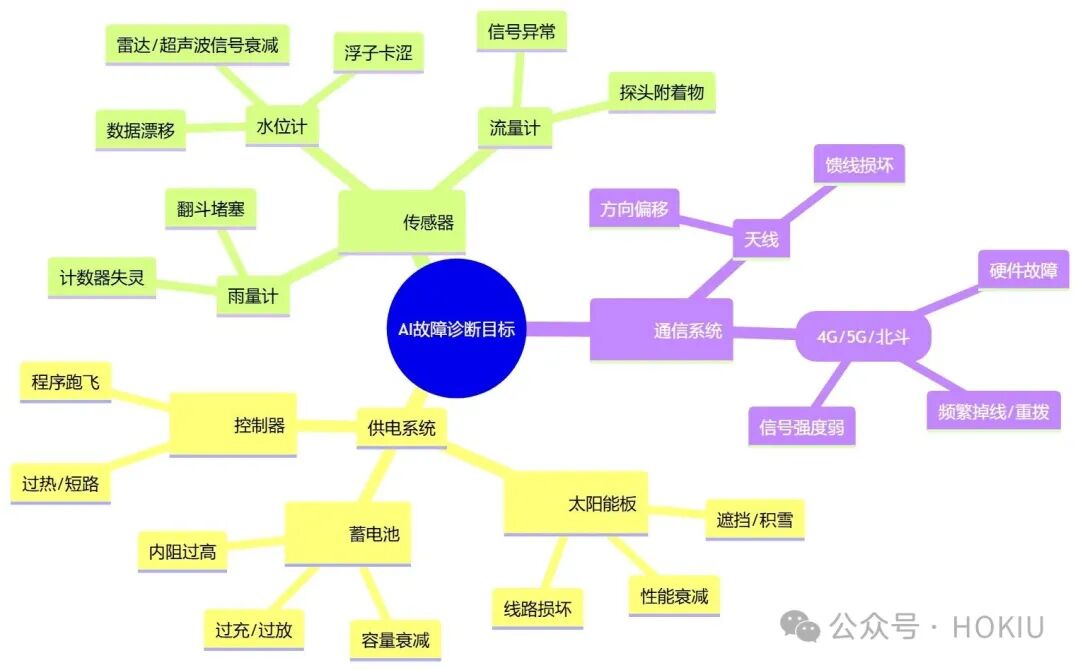
Chart Explanation: This mind map clearly categorizes the device faults that AI can monitor according to the three major systems: power supply, sensing, and communication. It serves as an “AI check-up item list,” allowing us to intuitively understand the monitoring scope and depth of AI.
4. Practical Considerations: What to Watch Out for When Deploying AI Intelligent Monitoring Systems?
Having reached this point, you may be excited. However, as a pragmatic engineer, I must remind you that AI is not a “silver bullet”; it is not a one-time purchase that solves everything. To truly harness its potential, there are several key “pits” to avoid.
- Data Quality is the “Foundation”: “Garbage in, garbage out” is an ironclad rule in the AI field. Without high-quality, long-term, clearly labeled historical data (especially fault data) as “textbooks,” AI models cannot learn effectively. Investing significant effort in data governance and labeling before system launch is absolutely worthwhile.
- No One-Size-Fits-All Model: There is no universal model that solves all problems. The algorithms required for fault prediction in power systems and for analyzing sensor data drift may be entirely different. It is necessary to select or customize the most suitable model based on specific scenarios. This requires deep integration between algorithm engineers and water conservancy business experts.
- Human-Machine Collaboration is Key: AI is a decision-support tool, not a decision-maker. Its diagnostic and predictive results need to be reviewed and confirmed by experienced engineers. A good system should create a closed loop of “human-machine collaboration,” where AI provides suggestions and humans make the final decisions. AI can digitize and model the experience of senior technicians but cannot replace their on-the-spot wisdom.
- Start with Pilot Projects, Then Scale Up: Do not expect to achieve everything at once. It is advisable to first select one or two representative watersheds or regions for small-scale pilot projects. During the pilot, ensure that data pathways, model algorithms, and business processes are refined before gradually promoting them across the network; this will significantly increase the success rate.
- Safety is Always the Top Priority: The security of IoT devices, the safety of data transmission, and the security of the platform itself are all indispensable. While enjoying the conveniences brought by AI, it is essential to establish a comprehensive cybersecurity protection system to prevent attacks and data breaches, which cannot be overstated in critical infrastructure fields like water conservancy.
5. Looking to the Future: When “Digital Twins” Meet Hydrological Stations
To discuss further, what will the ultimate form of AI intelligent maintenance look like? Personally, I believe it will be **”Digital Twins”**.
- What is a Digital Twin? In simple terms, it is creating an identical, real-time, virtual “twin” for each physical hydrological station on a computer. The data and status of this virtual station are completely synchronized with the real world.
- What is its use? We can conduct various “stress tests” on this virtual station. For example, simulating a once-in-a-century flood to see if the sensors and power supply systems can withstand it; or testing a new control algorithm to see if it causes device instability, all without affecting the real-world devices.
- Cutting-Edge Direction: Currently, the application of “Digital Twin” technology in water conservancy projects (such as dams and pumping stations) is in pilot stages, while achieving this for the vast number of hydrological stations is still in the stages of “academic exploration” and “pilot project validation.” However, I believe that with the improvement of computing power and reduction of costs, in the near future, our maintenance personnel may only need to wear VR glasses to “visit” the virtual space of any station for fault diagnosis and maintenance training.
Conclusion
In summary, from “passive response” to “proactive foresight,” AI is reshaping the equipment maintenance model in our water conservancy industry. It is not meant to replace humans but to liberate us from a large amount of repetitive, inefficient “manual labor,” allowing us to focus more on complex decisions that truly require wisdom and experience.
This transformation has only just begun. It is not just a technological upgrade but also an upgrade in management philosophy. By embracing AI and making good use of data, we can make the “hydrological sentinels” spread across our country’s mountains and rivers more reliable, intelligent, and efficient.
As we said at the beginning,the best way to manage a large fleet is not to chase after broken-down vehicles everywhere but to have an accurate “check-up report” and “maintenance plan” for every vehicle provided by AI. This is the greatest value that AI brings to our water conservancy maintenance work.