来源:本文转自“运维研习社”
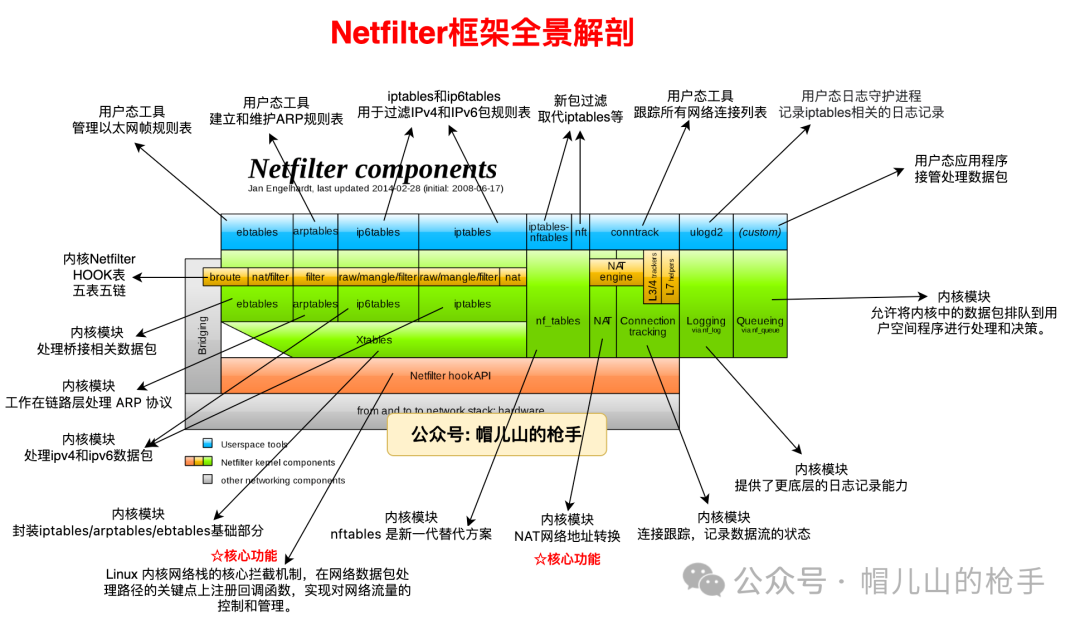
The Netfilter framework was created by Rusty Russell in 1998. It is a subsystem of the Linux kernel, merged into the Linux kernel in March 2000. Netfilter adopts a modular design, providing a well-structured underlying framework for extending various network services. You can register callbacks at various points in the packet traversal process within the network stack (netfilter hooks) to perform various operations on packets, such as filtering datagrams, performing address or port translation, dropping packets, logging, etc.1. ebtables is an application used to set up and maintain rules for checking Ethernet frames (in the Linux kernel). It is similar to the iptables application but is less complex because the Ethernet protocol is much simpler than the IP protocol.2. arptables is a user-space tool for establishing and maintaining ARP rule tables in the Linux kernel. These rules check the ARP frames they see. arptables is similar to the iptables user-space tool but is not as complex.3. iptables and ip6tables are primarily used to establish, maintain, and check IPv4 and IPv6 packet filtering rule tables in the Linux kernel. Several different tables can be defined. Each table contains many built-in chains and can also include user-defined chains.4. nftables is the new packet filtering component of Netfilter. NFT is a new user-space utility that replaces iptables, ip6tables, arptables, and ebtables.5. The conntrack utility provides a fully functional user-space interface for the Netfilter connection tracking system. This tool can be used to search, list, inspect, and maintain the connection tracking subsystem of the Linux kernel.6. ulogd is a user-space logging daemon for netfilter/iptables-related logging.7. nf_log primarily provides logging services for Netfilter. Rules are added using nft, and Netfilter throws logs, which are then read by the user-space program ulogd2 listening for these logs.8. The nf_queue kernel module provides the ip_queue/nfnetlink_queue mechanism based on the Netfilter framework, typically used to send packets to user-space applications for processing, thus enabling the development of user-space-based firewalls.
-End-

Reading this indicates that you enjoy the articles from this public account. Feel free to pin (star) this public account Linux Technology Enthusiast to receive notifications promptly!

In this public account Linux Technology Enthusiast, reply with: Linux, to receive 2TB of learning materials!
Recommended Reading
1. Linux Learning Route Planning Map (with commonly used command quick reference)
2. Essential "Network Port Encyclopedia" for operations and maintenance, this one is enough
3. Linux Learning Guide (Collection Edition)
4. A comprehensive 20,000-word summary to help you achieve freedom with Linux commands