The Intelligence of Cars Drives the Arrival of Software-Defined Vehicles
Looking back at the history of the automotive industry, it has gone through a development process from the mechanical era to the electronic era and now into the software era. Since the 1980s, ECUs have been increasingly installed in vehicles, with the automotive industry centered around Tier 1 suppliers enhancing vehicle functionality by adding ECUs. During this process, automotive software has developed in a deeply coupled manner with hardware; today, the hardware configurations of different models produced by various automotive companies have gradually converged, with limited room for cost and functionality improvements. However, as new energy and intelligence gain success, automotive software has begun to become the core element for automakers to create differentiation, leading the industry into the era of Software Defined Vehicles (SDVs).
The entire automotive industry is transforming towards intelligence. Unlike traditional cars, intelligent vehicles can create rich, perceptible value and a more comfortable driving experience for owners through new software technologies. In recent years, an increasing number of automakers, parts manufacturers, and tech companies like Google, Apple, and Baidu have begun investing in the research and development of intelligent vehicles, rapidly capturing the automotive market. For example, in terms of autonomous driving capabilities, mainstream global automakers are intensively developing Level 3 and above autonomous driving, and the future adoption rate and levels of autonomous driving will continue to rise.
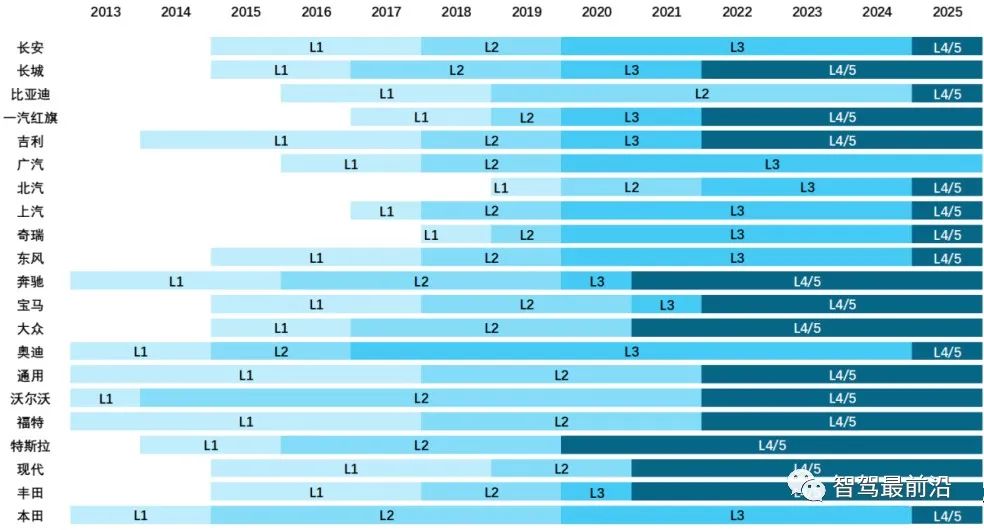
Global Major Automakers’ Level of Autonomous Driving Production Timeline
The intelligence of cars will drive an explosive growth in the demand for automotive software development. The software code volume of a “digital” car (2015) can reach 100 million lines, far exceeding the code volume of high-tech products like Facebook, fighter jets, and artificial satellites. With the development of intelligent cockpit and autonomous driving modules, the volume of automotive software code is still increasing at an annual growth rate of over 20%. The code volume of an intelligent vehicle produced in 2025 is expected to reach 700 million lines, an increase of 2.3 times compared to 2020. This indicates that the technical barriers in automotive manufacturing have shifted from the traditional three major components and the integration capabilities of parts to the ability to develop code. As automotive intelligence continues to upgrade and the software ecosystem gradually flourishes, the demand for automotive software development will explode, and the proportion of software costs in the overall vehicle cost will significantly increase.
The automotive software market size will continue to expand. According to Berylls Management Consulting, the automotive software market size is expected to grow more than threefold between 2020 and 2030, with an average annual growth rate of 13%, increasing from 76 billion euros to 252 billion euros. Specifically, the intelligent driving sector (ADAS/AD) will occupy the largest share of the growth in the automotive services market from 2020 to 2030, with software platforms, safety, and integrated testing validation also experiencing high compound growth rates. The fastest growth will be in high-performance computing platforms (HPC), expected to reach 37%. If we break down the overall market increment further, the core increment (about 210 billion euros) comes from the complexity of intelligent features, while efficiency improvements due to software modularization and changes in development methods will also reduce development expenditures by 62 billion euros.
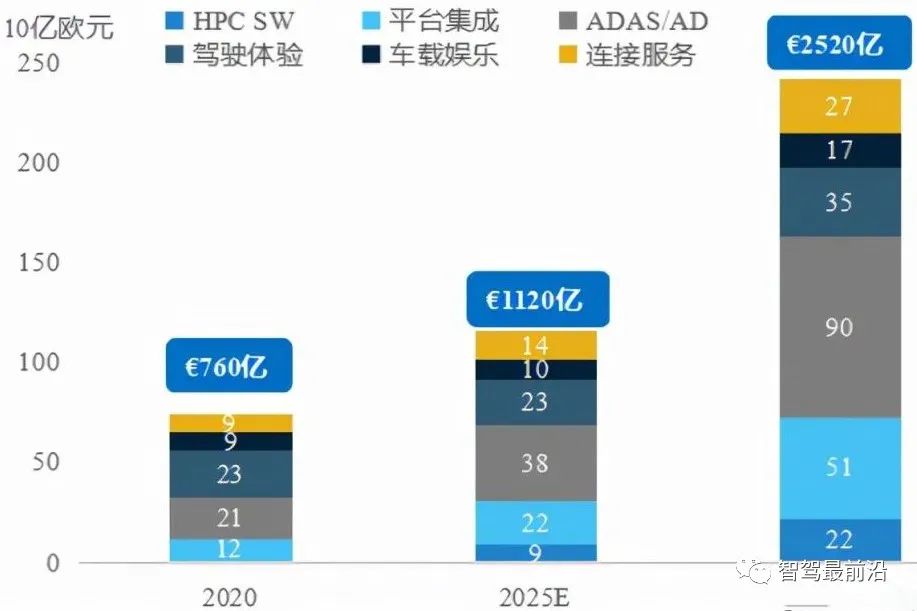
Global Automotive Software Market Size Forecast 2020-2030
The Upgrade of EE Architecture is the Hardware Foundation for Software Defined Vehicles
Intelligence and connectivity must be built on the core computing capabilities of electronic and electrical architecture. Without a hardware foundation, software-defined vehicles cannot be realized. The transformation of automotive EE architecture is mainly reflected in the following four aspects:
Computing Performance: Automotive chips are shifting from MCUs to SoCs. MCU chips typically contain only one CPU processing unit, storage, and interface units, with computing power generally only a few hundred DMIPS; whereas SoCs are system-on-chip solutions, usually adopting a “CPU + AI chip (GPU/FPGA/ASIC)” architecture, such as NVIDIA’s Orin X with a computing power of up to 254 TOPS. The intelligent cockpit and autonomous driving require a magnitude increase in the smart architecture and algorithm computing power, and automotive chips based mainly on MCUs will not meet these needs, shifting towards more powerful SoC chips.
Communication Bandwidth: In-vehicle Ethernet has become the backbone communication network of cars. In traditional distributed architectures, most ECUs communicate via CAN, LIN, Flex Ray, etc., with very limited data transfer speeds, generally only a few megabits per second. As the number of sensors in vehicles increases, the volume and rate of data transmission requirements have significantly increased. In the future, in-vehicle Ethernet will become the backbone network of cars, achieving transmission rates of 100 Mbit/s, or even 1 Gbit/s over a single pair of unshielded twisted pairs.
Decoupling of Software and Hardware Achieves OTA Upgrades. Software is no longer developed based on fixed hardware; the original vertically integrated ECU software architecture has transformed into a horizontally layered architecture of general hardware platforms + basic software platforms + various application software, achieving decoupling of software and hardware. Hardware is embedded, and software is deployed later, continually iterating software functions through OTA to promote upgrades of the entire vehicle’s functionality.
Better Cost Control. Currently, the number of main ECUs in high-end and highly intelligent models has reached over 100, and the total number of ECUs can exceed 200 with some simple function ECUs. The increase in ECUs corresponds to an increase in wiring harnesses, leading to higher costs. Through domain control integration, the number of ECUs can be significantly reduced; in addition, ECUs are provided by different suppliers, and any function modification involves redeveloping and validating multiple controllers, which is time-consuming and labor-intensive, and the software logic is controlled by suppliers, making it difficult for OEMs to efficiently manage software functions.
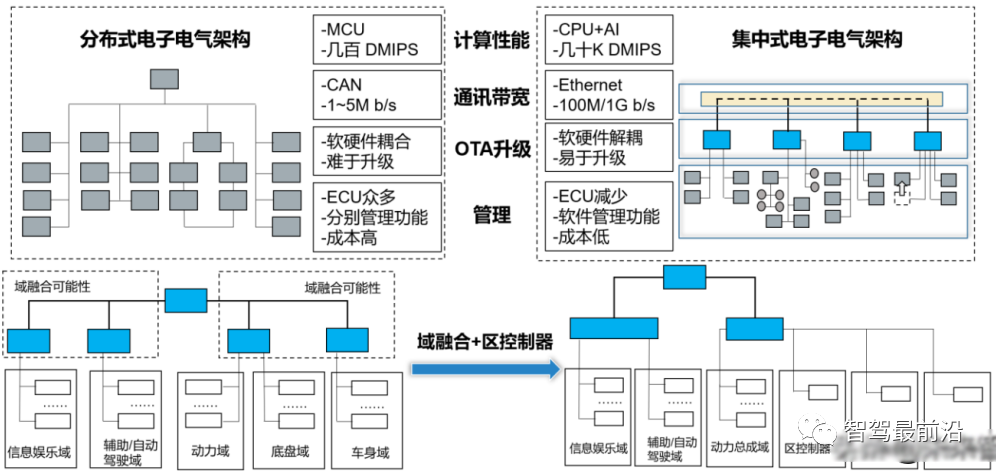
Intelligence and connectivity together promote the transformation of automotive EE architecture from distributed to centralized and integrated.
Under the trend of intelligent and connected transformation, software and hardware are decoupled at the component level, with software becoming an independent core component product. The multidimensional vehicle data and control rights obtained by automotive software products enable the execution of complex functions and tasks. As automotive software becomes increasingly complex and the number of lines of code rapidly increases, it gradually forms the architecture of system OS and application software, increasing the difficulty of automotive software development.
SOA is the Software Trend for Software Defined Vehicles
Under the traditional distributed EE architecture, automotive software operation is mainly based on signal-oriented architecture (Signal-Oriented Architecture), which cannot meet the needs of intelligent vehicles:
The fixed architecture lacks flexibility. The coding of each ECU’s functions is predefined in the ECU ordering files during the architecture design phase, and is called and executed one by one during operation. The signal transmission relationships between ECUs are static; signals can only be forwarded by gateways and lack flexibility. At the same time, this fixed software architecture limits the demand for personalized development by users, and OTA external developers cannot define new functions through software, nor can they support online upgrades and software iterative updates.
The signal-oriented architecture cannot achieve human-vehicle interaction. The signal-oriented architecture only supports receiving and sending modes, not request and response modes, and cannot realize interaction, limiting the features of intelligent vehicles.
In a distributed architecture, software and hardware are highly coupled, and software operation depends on hardware. When software changes or upgrades, integration validation of the entire vehicle is required, which takes a long time and is difficult. Moreover, when a certain controller has a problem, the corresponding function may also fail entirely, leading to increased costs and significant safety issues under intelligent functions like the intelligent cockpit and autonomous driving.
The cost of software function modification is high and difficult. Under the traditional signal-oriented architecture, if a certain software function needs to be modified, the entire vehicle communication system and ECUs must be changed, and the dramatic increase in the number of ECUs significantly raises the cost and complexity of this process.
SOA divides different functions and hardware capabilities at the vehicle end into services, and breaks down services into smaller interfaces according to the vehicle’s atomic capabilities. The interfaces of each service component are standardized for packaging, allowing mutual access and combination through established protocols; the core elements of SOA include loose coupling, standardized definitions, and software reuse. SOA enables application layer functions to be reused across different vehicle models and can quickly respond to new user functional demands based on standardized interfaces. When software engineers modify or add a certain software function, they only need to write code for the corresponding service component at the upper layer, without the need to recompile and redevelop the basic software layer, runtime environment layer, and other software components, greatly reducing the complexity and cost of software upgrades and improving efficiency.
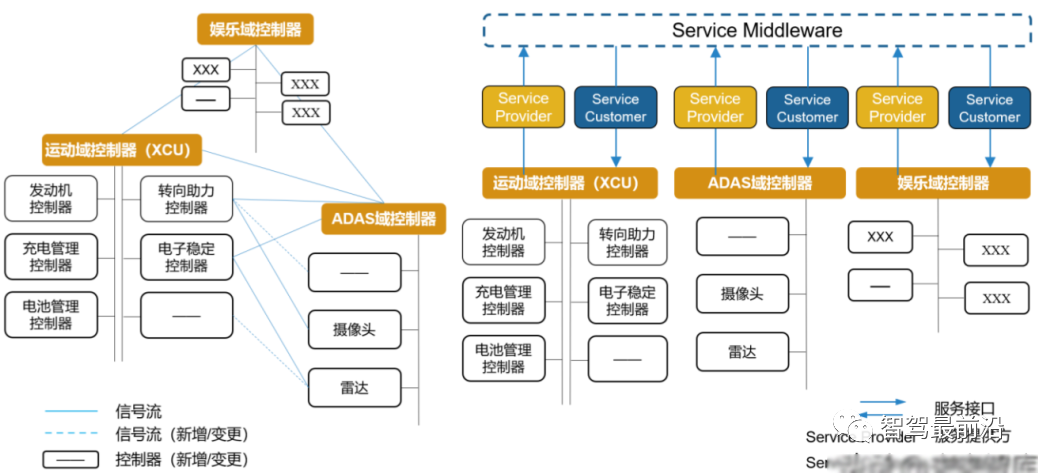
Vehicle communication is shifting from “signal-oriented” to “service-oriented”.
In the long term, automotive companies will introduce a large number of algorithm suppliers, software developers, and service providers to jointly build SOA, providing a high-quality operating platform for intelligent automotive software and offering comprehensive software services to customers. Therefore, major automotive companies are gradually shifting their focus to the collaborative development of SOA, and it is expected that the next five years will usher in a peak period for the mass production of SOA.
Of course, it is important to recognize that ideal SOA development has high costs; inter-process communication (IPC) across ECUs is definitely more complex than IPC within an ECU, requiring additional interface packaging, which will increase additional scheduling and computational resources, and these costs do not directly enhance user experience. Therefore, SOA architecture will not be an overnight process.
Automotive Software Architecture
Intelligent automotive software is divided into three layers, including: 1. The underlying system software layer, including BSP, virtual machines, system kernels, middleware components, etc.; 2. The functional software layer: including library components, middleware, etc., positioned above the operating system, network, and database, serving as the lower layer for application software, providing an operational and development environment for application software, helping users flexibly and efficiently develop and integrate complex application software; 3. The upper application algorithm software layer, including intelligent cockpit HMI, ADAS/AD algorithms, connectivity algorithms, cloud platforms, etc., used for actual control of the vehicle and various intelligent functions.
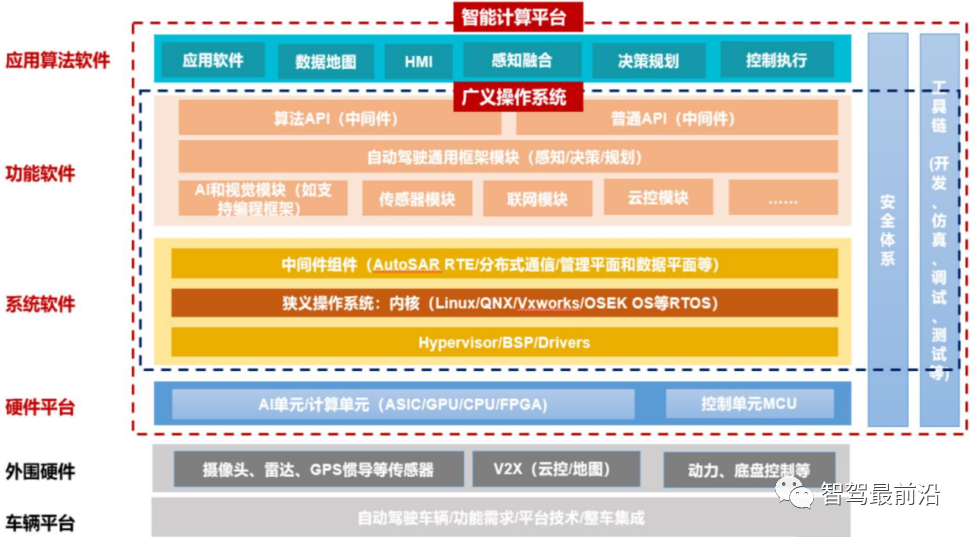
Vehicle Intelligent Computing Platform Architecture
System Software Layer — Narrow Sense Operating System
The automotive operating system is the underlying layer that manages and controls the hardware and software resources of intelligent vehicles, providing the operating environment, communication mechanisms, and security mechanisms. Depending on the degree of modification and capability depth of the underlying operating system, it can be divided into the following categories:
Basic Operating Systems: such as QNX, Linux, WinCE, etc., include completely new underlying operating systems and all system components, such as system kernels, underlying drivers, etc., and some even include virtual machines.
Customized Operating Systems: refer to deeply customized development (including modifying kernels, hardware drivers, runtime environments, application program frameworks, etc.) based on basic operating systems, ultimately achieving cockpit system platforms or autonomous driving system platforms, such as Volkswagen’s VW.OS, Tesla Version, Google’s Android Automotive, Huawei’s Harmony OS, AliOS, etc.
ROM-based Automotive Operating Systems: based on basic operating systems like Linux or Android with limited customization, not involving changes to the system kernel, generally only modifying and updating the operating system’s built-in applications. Most automakers typically choose to develop ROM-based operating systems.
Super Apps: also known as vehicle-machine interconnection or mobile mapping systems, are not complete automotive operating systems; they leverage the rich features of mobile phones to map into the vehicle’s central control to meet owners’ entertainment needs, represented by Apple CarPlay, Baidu CarLife, Huawei Hicar, etc.
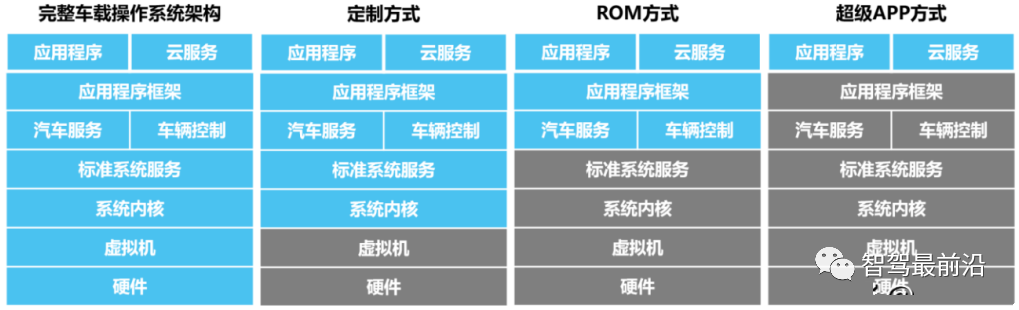
Four Common Types of Automotive Operating Systems Illustrated
Underlying OS: Determines System Performance, Key to Software Defined Vehicles
The operating system kernel, also known as the underlying OS, provides the most basic functions of the operating system, responsible for managing system processes, memory, device drivers, files, and network systems, being the core of the system software layer. Due to the highest development difficulty and safety requirements, its market competition landscape is relatively stable, mainly dominated by QNX, Linux, Android, and WinCE.
In the long run, the future market will be dominated by QNX, Linux, and Android. According to IHS Automotive data statistics, the system kernel is currently mainly dominated by QNX and open-source Linux and Android, accounting for nearly 90% of the market share. In terms of system performance, the three mainstream systems each have their advantages. Currently, QNX firmly holds the top position in the automotive embedded operating system market due to its high safety, stability, and real-time performance. Linux (including Android developed based on Linux) has the greatest advantage over QNX in being open-source, offering strong customization flexibility and extensibility. In terms of applicable fields, QNX is more suitable for fields with higher safety performance requirements, such as instrument systems and power systems, while Linux and Android have advantages in the in-vehicle infotainment sector.
It is expected that the market share of the Android system will continue to increase. Compared to Linux, the Android system is more widely used in China and has great development potential in the in-vehicle infotainment sector because Android is the best tool for connecting mobile internet content. Although there are issues with security and stability, its advantages of being open-source, flexible, and having a rich ecosystem have made it the mainstream in China, especially in the in-vehicle infotainment sector where security requirements are relatively lower. Most domestic independent brands and new car-making forces are also based on Android customized ROM automotive operating systems.
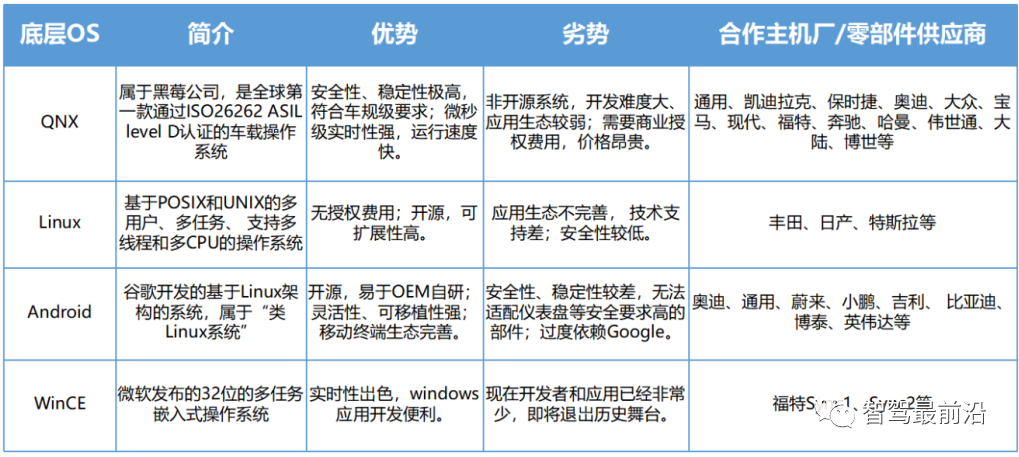 Mainstream Underlying OS Characteristics
Leading Automakers and Tech Companies Enter the Operating System Space to Establish Competitive Advantages
The in-vehicle operating system is a key part of the automotive ecosystem, with leading OEMs and third-party companies actively laying out automotive operating systems. Among automakers, companies like Tesla.OS, Volkswagen Group’s VW.OS, Daimler’s MB.OS, BMW-OS, Geely GKUI, etc., are all based on Linux, QNX, and other RTOS kernels to achieve hardware abstraction, forming a middleware operating system that supports application development, defining developer interaction logic, and building the application layer.
Self-developed operating systems help simplify vehicle software development processes and increase OTA frequency. Taking Tesla as an example, by adopting an open-source Linux self-developed operating system, Tesla no longer relies on software suppliers but fully controls the stack, allowing for quick fixes and upgrades through OTA once issues are discovered, enhancing user experience. Since first using the self-developed operating system in the Model S in 2014, Tesla has made several significant upgrades to its operating system through OTA technology.
Self-developed operating systems that open vehicle programming to industry chain enterprises can master developer ecosystem resources, forming a certain monopoly advantage. With an operating system, an ecosystem monopoly can be established, fully controlling the upper-layer components and applications. For example, Volkswagen’s self-developed VW.OS relies on its nearly ten million vehicle annual sales, forcing Tier 1 and software suppliers, even other OEMs, to develop on the basis of VW.OS, ultimately forming a business model of “OS licensing fees + vehicle networking services + APP docking licensing fees + APP value-added service sharing,” gaining excess profits.
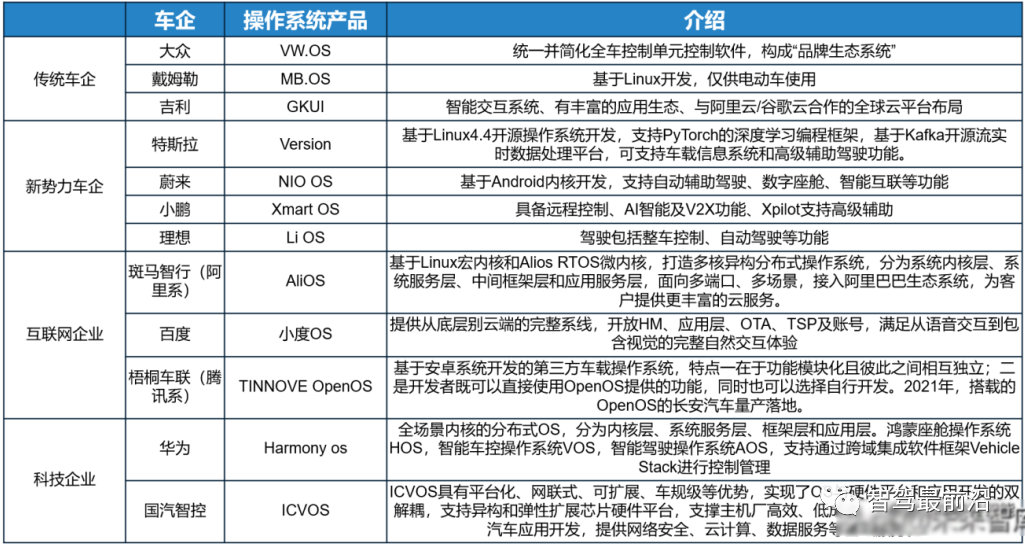
Overview of Self-Developed Operating System Enterprises
Third-party automotive operating system players include TINNOVE, Baidu, and Huawei, among others, which mainly develop independent operating systems based on mainstream underlying OS. Technically, internet and technology companies leverage their software development advantages, leading to a high degree of system modification and a rich product ecosystem. Therefore, third-party enterprise products are inherently competitive and can effectively complement automakers with a relatively single ecosystem and insufficient R&D capabilities.
From the perspective of cooperation with automakers, third-party companies actively collaborate with numerous partners. In 2016, Zebra Smart collaborated with SAIC to launch more than ten models equipped with the Alios system, and in 2017, it collaborated with Dongfeng Motor. Huawei’s super APP system HiCar currently cooperates with over 20 automakers, including Volvo, Changan, Geely, Dongfeng, GAC Trumpchi, BYD, and more, with over 150 models.
Zebra Smart’s Whole Vehicle Partners
System Software Layer — BSP Layer
BSP (Board Support Package) is the interface layer between the kernel and hardware, generally considered part of the operating system. The BSP mainly includes the Bootloader (the basic supporting code that loads the operating system’s boot program), HAL (Hardware Abstraction Layer) code, drivers, configuration documents, etc. For specific hardware platforms, all hardware-related code is encapsulated in the BSP, which provides a virtual hardware platform to the operating system, allowing it to run better on the hardware motherboard. Its purpose is to provide a virtual hardware platform for the operating system, making it hardware-independent and portable across multiple platforms.
BSP is relative to the operating system, and different operating systems correspond to different definitions of BSP. For example, the BSP for VxWorks and the BSP for Linux, although they implement the same functions for a certain CPU, have completely different writing styles and interface definitions. Therefore, writing BSP must adhere to the definition of that system’s BSP to maintain correct interfaces with the upper OS.
Tier 1, OEM, and Tier 2 manufacturers all participate in the BSP market, and due to the deep understanding of chip architecture required for high-end chip BSP development, third-party companies like ThunderSoft, which closely collaborate with chip manufacturers, are the main players in the market. ThunderSoft maintains deep cooperation with leading chip suppliers like Qualcomm, Renesas, Texas Instruments, and NXP, gaining a profound understanding of their chips, enabling them to represent chip manufacturers to provide BSP technical support to automakers/Tier 1.
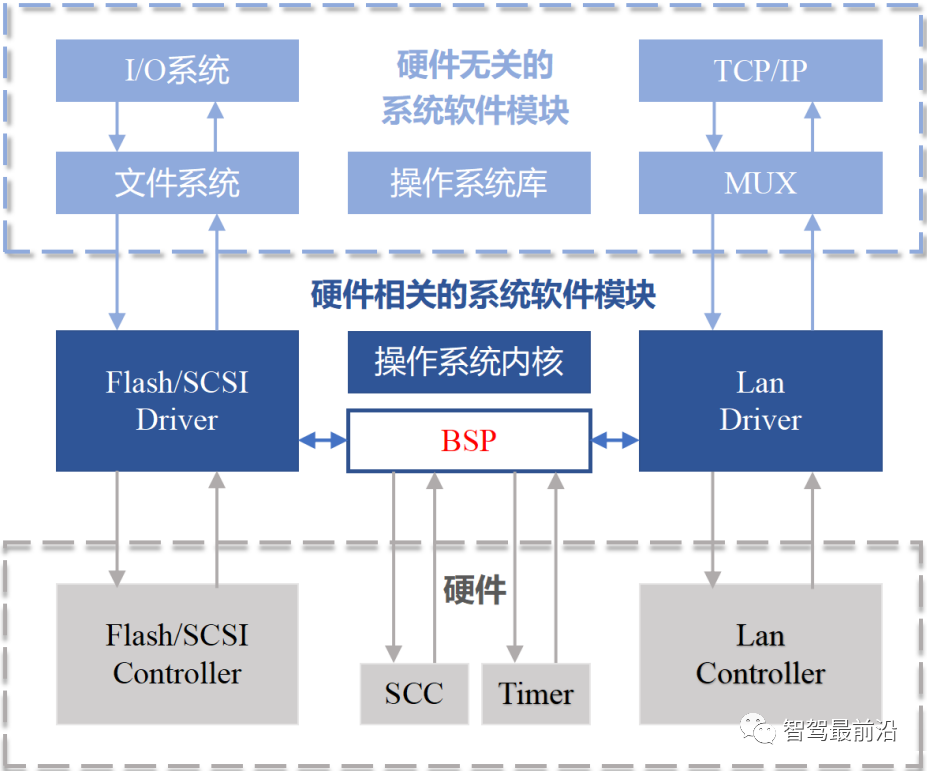
Position of BSP in System Software
Virtual Layer (Hypervisor)
To allow different types of operating systems to run on a single computing platform, the most direct technical path is virtualization (Hypervisor). Virtualization technology can simulate a computer system with full hardware system functionality running in a completely isolated environment. At this point, suppliers no longer need to design multiple hardware to meet different functional requirements; they only need to configure the software on the vehicle’s main chip to create multiple virtual machines, running corresponding software on each virtual machine to meet demands. Therefore, in-vehicle virtualization operating systems require the following three technical requirements: (1) Using resource partitioning technology to strictly isolate and allocate resources; (2) Having a flexible and efficient real-time and non-real-time task scheduling mechanism; (3) Inter-process communication to enable message communication between virtual machines.
Currently, the mainstream virtualization technology providers are QNX and ACRN. Common Hypervisors include BlackBerry’s QNX, Intel and Linux-led ACRN, Mobica’s XEN, Open Synergy’s COQOS acquired by Panasonic, Continental Automotive’s L4RE, and France’s VOSySmonitor, among which the most mainstream are BlackBerry’s QNX and Intel and Linux-led ACRN. QNX is the only virtualization operating system recognized to reach ASIL D level, and it has been mass-produced and applied in actual vehicle models. The entire operating system is managed by a microkernel scheduling a set of processes, ensuring safety and real-time performance. Currently, the system integrators for BlackBerry’s VAI project in China include ThunderSoft, Wuhan Glorious Information, and Nanjing Chengmai Technology.
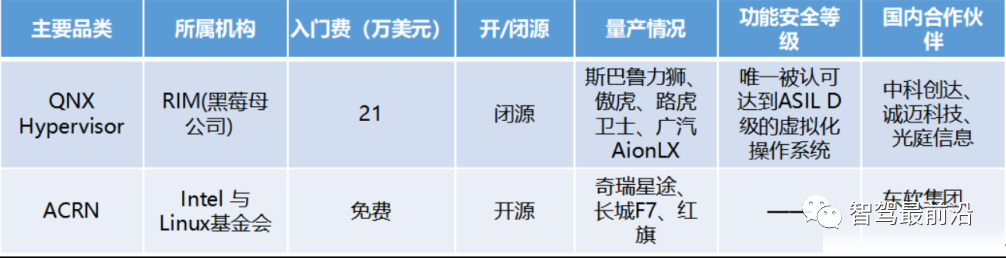
Comparison of Two Mainstream Virtualization Technologies
Middleware: The Key “Link” in Software Development
Before the emergence of middleware, system software was developed directly based on operating systems, resulting in a high degree of coupling between software and hardware. As the amount of code in vehicles grows, leading to a dramatic increase in system complexity and costs, it is necessary to define a set of standard interfaces, seamless integration, efficient development, and manage complex systems through new models. Middleware separates software from hardware, abstracts and utilizes lower-layer hardware resources, drives chips, optimizes operating systems, and provides service interfaces for upper-layer software, offering different types of plugins for different algorithms. Middleware solves issues related to data transmission, application scheduling, system integration, and workflow management, significantly enhancing the development efficiency of application layer software.
Classic Middleware Design Standard: AUTOSAR. The automotive electronic software standard mainly includes AUTOSAR, OSEK/VDX, etc. The AUTOSAR standard has developed over more than a decade, forming a complex technical system and a wide development ecosystem, becoming the mainstream design standard for automotive middleware. AUTOSAR specifies layered architecture, methodologies, and application interface specifications, allowing automotive embedded system control software developers to free themselves from dependence on hardware systems during ECU software development and verification processes, achieving separation of software and hardware.
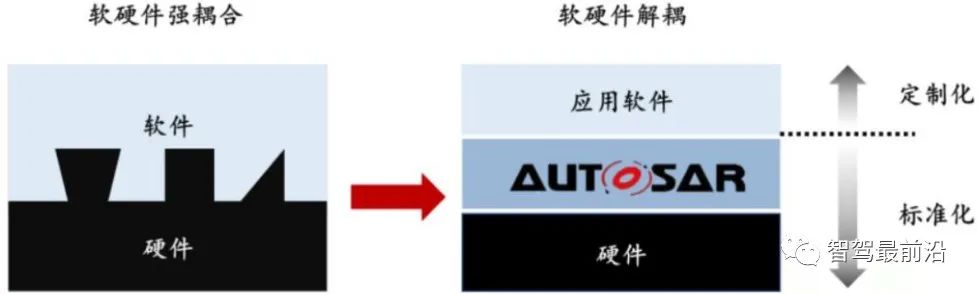
Middleware Promotes Software and Hardware Decoupling
AUTOSAR’s entire architecture is layered from top to bottom, including: application layer (Application Software Layer), runtime environment (Runtime Environment, RTE), basic software layer (Basic Software Layer, BSW), and microcontroller (Microcontroller). To maintain independence between layers, each layer can only call the interface of the next layer and provide an interface for the upper layer.
The advantages of AUTOSAR mainly include: 1. It is conducive to improving the reusability of software, allowing software to be reused across platforms; 2. Facilitating software exchange and updates; 3. Software functions can be defined and verified at the architectural level in advance, thereby reducing development errors; 4. Reducing manual code volume, easing testing and verification burdens, and improving software quality; 5. Using a standardized data exchange format (ARXML) facilitates communication and collaboration between different companies.
AUTOSAR is divided into two major platforms: Classic Platform and Adaptive Platform, where Classic Platform mainly targets distributed ECUs, and Adaptive AUTOSAR is primarily aimed at more complex domain controllers and centralized computing platform electronic and electrical architectures. Compared to Classic AUTOSAR, Adaptive AUTOSAR has advantages in strong real-time performance, high portability of operating systems, and more flexible software upgrades.
AUTOSAR is the game rule set by traditional automotive industry giants, with over 300 ecosystem partner companies. Currently, there are very few companies worldwide that can develop a complete stack based on the AUTOSAR architecture’s underlying protocol stack. Notable AUTOSAR solution providers include ETAS (Bosch), EB (Continental), Mentor Graphics (Siemens), Wind River (TPG Capital), as well as Vector, KPIT (joint venture between the U.S. and India), etc. Most Tier 1 and OEMs need to purchase underlying software from these suppliers. In China, the development toolchain and basic software under the Classic AUTOSAR standard are dominated by these overseas suppliers, while domestic companies such as Neusoft Ruichi, Huawei, and Jingwei Hengrun are mainly involved; regarding Adaptive AUTOSAR, it is still in its infancy, with Continental EB collaborating with Volkswagen to apply the AP AUTOSAR and SOA platform to Volkswagen’s MEB platform ID series electric vehicle models. Domestic manufacturers are actively focusing on AP AUTOSAR, launching corresponding middleware and toolchain products to seize market opportunities.
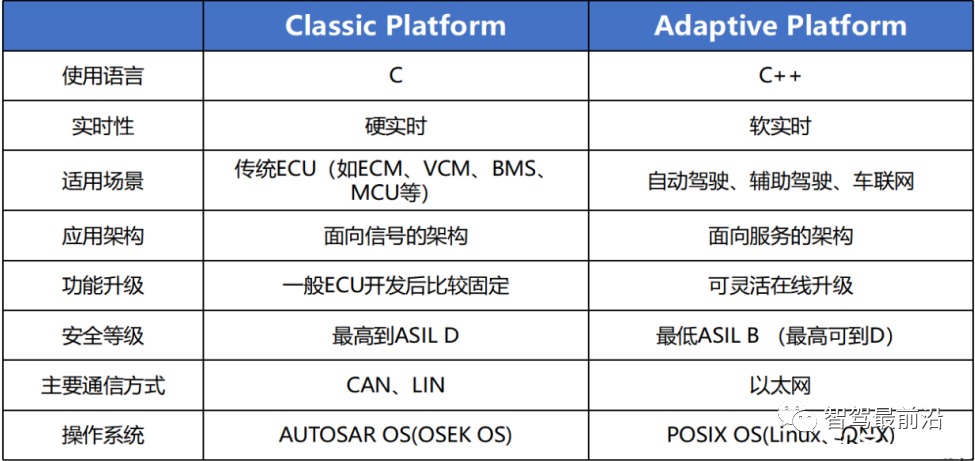
Comparison of Classic Platform and Adaptive Platform
In the entire AUTOSAR framework, only the Application Layer has a true control effect; the other layers RTE and below serve auxiliary roles. The functions corresponding to different Application layers have basically the same BSW, and AUTOSAR requires software engineers to adhere strictly to the standards in “writing.” This results in an increase in the number of controllers and lines of code, leading to higher software development costs. In the domain control architecture, while ECUs and actuators still adhere to the AUTOSAR standard, it is impossible to significantly reduce the code volume. Therefore, Tesla does not use AUTOSAR, relying on its self-developed operating system and basic software for more efficient development.
On July 22, 2020, 20 companies including FAW, SAIC, GAC, NIO, Geely, Great Wall, Changan, Beiqi Foton, Dongfeng, FAW Liberation, XPeng Motors, Neusoft Ruichi, Hengrun, Nasen, Horizon, Suzhou Zhitong, Wanxiang Qianchao, Weimais, Zhongshu, and China Automotive Innovation formed the China Automotive Basic Software Ecological Committee (AUTOSEMO), aiming to establish a basic software architecture standard and interface specification with independent intellectual property rights led by local enterprises, share knowledge results, and build an industrial ecosystem.
Functional Software Layer
In the automotive software architecture, functional software mainly includes core common functional modules for autonomous driving. Core common functional modules include general frameworks for autonomous driving, connectivity, cloud control, etc., combined with system software to form a complete autonomous driving operating system supporting autonomous driving technology implementation.
Currently, in the functional software layer, traditional Tier 1, OEMs, tech giants, and third-party software suppliers all have certain layouts. Each party can leverage its own advantages to provide solutions, choosing to develop modules they are good at. For example, algorithm suppliers with advantages in the sensor field can focus on developing sensor modules in functional software, achieving more effective division of labor and cooperation across the industry.
In the functional software field, collaboration models with suppliers help meet automakers’ needs for intelligent automotive product functionality development. Compared to automakers, software modules developed by major suppliers have been tested in different scenarios and on different products, ensuring higher quality. Additionally, some software suppliers can provide more suitable solutions based on the unique characteristics of automakers, accelerating R&D efficiency. For example, providing functional module solutions for automakers with strong R&D capabilities, allowing them to control the entire user experience and product definition, while offering integrated hardware and software delivery solutions for automakers with less developed software capabilities, significantly shortening their R&D cycles.
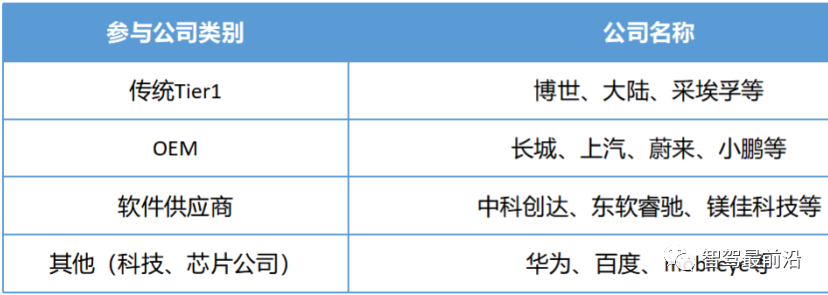 Companies Layouting Functional Software Layer Business
Application Software Layer
The application layer software operates above the broad operating system and is specifically responsible for functional implementation. It mainly includes algorithms for autonomous driving, map navigation, in-vehicle voice, OTA and cloud services, infotainment, etc. A typical computing platform, after loading and running the operating system and functional software, supports application software development, ultimately achieving overall functional realization. The upper application software layer is a key area where OEMs focus on developing differentiation, such as cockpit HMI and autonomous driving.
In the long term, the upper application and algorithm value will be the highest. In the short term, for companies in the automotive software sector to truly implement the SOA software architecture, system software such as virtualization technology, system kernels, and middleware (AUTOSAR) are crucial. However, in the long term, once the SOA architecture and the broad operating system framework mature, the rich upper application ecosystem and algorithms will have greater value.
Typical Upper Application Example 1: Application Algorithms in the Autonomous Driving Domain
The upper application algorithms of the autonomous driving domain controller include scene algorithms (covering data perception, decision planning, control execution, etc.), data maps, and human-machine interaction (HMI). Among these, scene algorithms are the most complex, typically including algorithms for perception, decision-making, and execution, thereby realizing various autonomous driving functions in different scenarios.
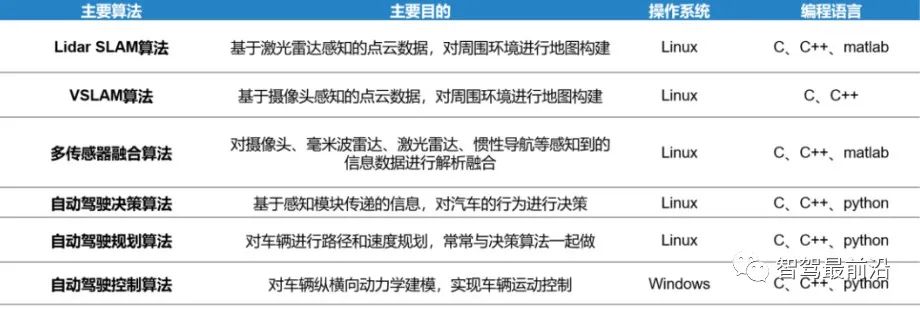
Autonomous Driving Application Layer Algorithms and Programming Languages
OEMs developing autonomous driving algorithms in-house is becoming a future trend. In the medium to short term, since most OEMs lack algorithm capabilities, they will choose to collaborate with Tier 1 or software companies with significant algorithm advantages. During this phase, companies like Bosch, Continental, Desay SV, and ThunderSoft have clear advantages. However, in the long term, as OEMs gain talent and data advantages, they will gradually develop key algorithms (such as fusion/decision algorithms) in-house to eventually extend their full-stack algorithm capabilities. In this trend, suppliers should clarify their positioning according to current OEM demands, or focus on a specific area of the autonomous driving application layer in order to maintain lasting competitiveness.
Typical Upper Application Example 2: Digital Maps
In the field of autonomous driving, the support of high-precision positioning and maps (data maps) is essential for achieving advanced autonomous driving, and the market size will continue to expand. High-precision maps can ensure functionality even under special weather conditions, effectively eliminate some sensor errors, and supplement corrections to existing sensor systems. Additionally, high-precision maps can build a driving experience database, analyze dangerous areas, and provide drivers with new driving experience data sets.
Currently, the main players in the high-precision map field include 4D Mapping, Amap, and Baidu, with these three companies forming a tripartite balance of power. Each company has its advantages: Baidu was the first company in China to conduct high-precision map research, launching its driverless car project in 2013; Amap has the full support of Alibaba and has made rapid progress; 4D Mapping is an established mapping company in China. In 2020, these three companies accounted for over 65% of the market share, forming a “tripartite balance.”
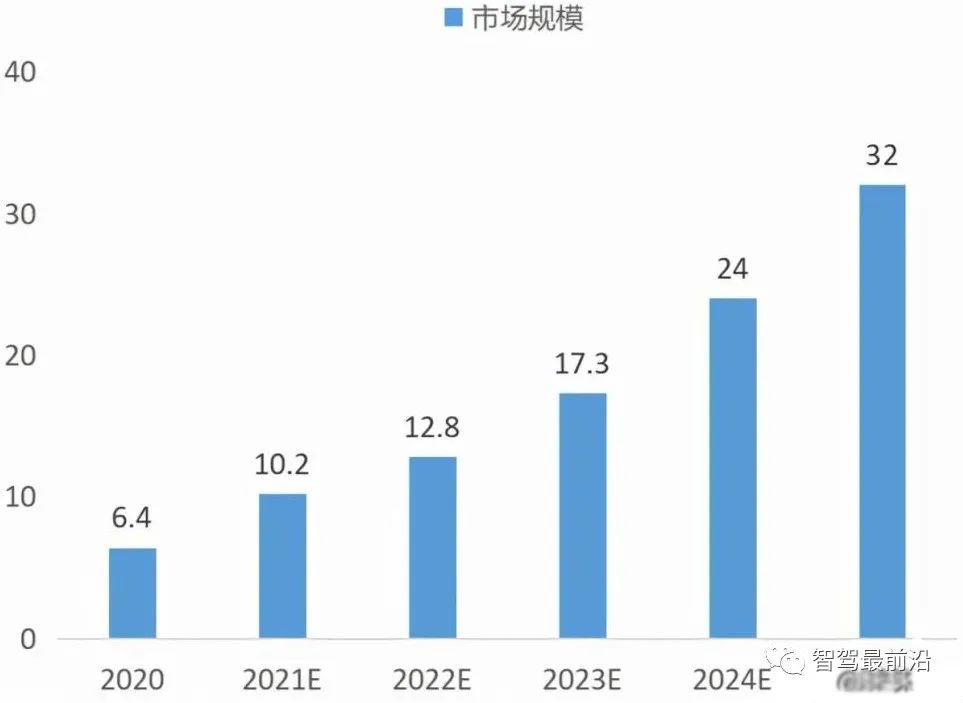 2020-2025E Domestic High-Precision Map Market Size (in USD)
SDV Brings Industry Chain Restructuring and Competitive Landscape Analysis
Industry Chain Restructuring
OEMs Attempt to Lead the Vehicle Software Sector, Software Suppliers Evolve to Tier 1
OEMs are beginning to deeply participate in software development. In the traditional automotive industry chain, the development of various system software was almost entirely completed by Tier 1/2, supplied as black boxes to OEMs, who were merely the definers of the overall architecture, responsible for designing and managing the definition of system concepts, ultimately completing system integration and verification, as depicted in the yellow part of the diagram below. As the importance of automotive software continues to rise, OEMs are beginning to value the definition of software and participate deeply in system architecture and functional requirement analysis, even leading the design and development of software units, as illustrated in the green and red sections of the diagram below.
Software suppliers are evolving to Tier 1. Regardless of whether OEMs establish collaborations with core software companies or develop independently, traditional supply chain relationships will undergo fundamental changes. The collaboration between automakers and software suppliers will deepen further, as automakers seek to master control and reduce high R&D costs, directly collaborating with software suppliers that possess strong independent algorithm development capabilities. As a result, these software suppliers will leap to become Tier 1 manufacturers, breaking the traditional tiered supply model where software suppliers first supply to Tier 1 and then to OEMs, evolving towards a flatter supply network model.
For software suppliers, as OEMs continue to strengthen their autonomy and software self-development capabilities, they are beginning to seek direct cooperation with software suppliers. For example, OEMs will first seek to reclaim the cockpit HMI interactive system functions, purchasing software licenses for UI/UX design tools, voice recognition modules, sound effect modules, facial recognition modules, etc., directly from software suppliers, thereby bypassing traditional Tier 1, enabling independent development. For software suppliers, the more software IP product combinations they can provide, the higher the single vehicle value they may obtain. At the same time, software suppliers are also seeking to enter the hardware design and manufacturing segments traditionally dominated by Tier 1, such as domain controllers (ThunderSoft), TBOX, etc., to provide diversified solutions.
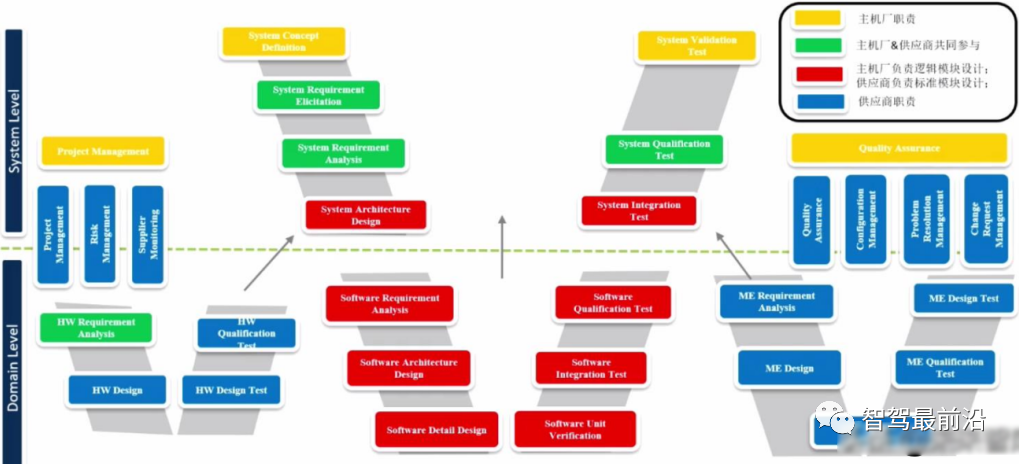
V-Shaped Development Model: OEMs Transition from Project Management and Integration Acceptance to Deep Participation in Requirement Analysis and Module Design
Software Development Evolves to Layered and Modular Approaches, Presenting Significant Market Opportunities for Middleware Suppliers
The transition from traditional V-shaped development to layered development aimed at Software Defined Vehicles is fundamentally based on the introduction of middleware. In the domain control architecture, the complexity of application algorithms is high, and almost no company can provide a complete software system in the autonomous driving field. Therefore, multiple suppliers need to collaborate to complete the entire software package. With the introduction of middleware, the decoupling of software and hardware is made possible, allowing for the introduction of third-party software that must be deployed on the functional interfaces provided by middleware. This requires automakers or suppliers responsible for system integration to possess very strong software system architecture capabilities and middleware platform design abilities.
From the perspective of software development models themselves, the layering and modularization of software is an inevitable event in every industry reshaped by software. Taking the mobile phone sector as an example, both the Android and iOS platforms have a wealth of development tools and basic software modules under their respective ecosystems, with numerous SDK (Software Development Kit) categories commonly provided by third parties.
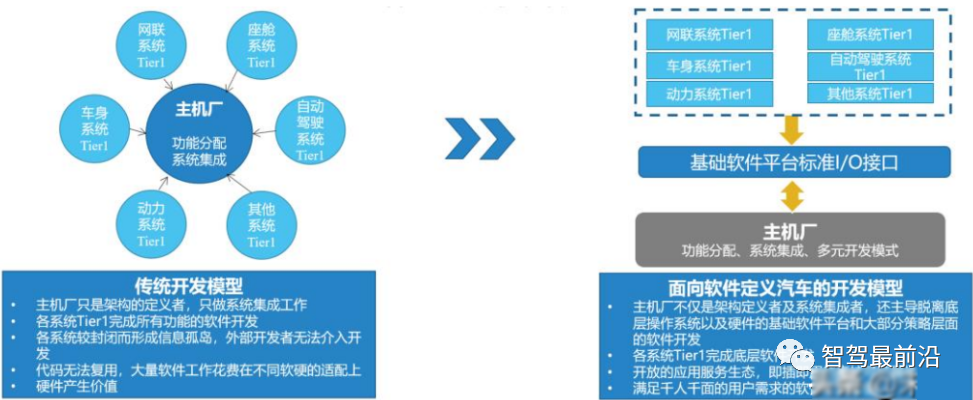 Transition in OEM Development Models
The modular industry division in the mobile sector has brought significant market opportunities for standard module suppliers, with publicly listed companies such as Twilio and Salesforce leading the way. Twilio, as a cloud communication company, provides APIs that help developers easily integrate SMS, voice, and web calling features into other applications. According to the overall service framework of CPaaS (Communications Platform as a Service), CPaaS can be divided into five levels. Twilio can provide part of the content services, including widely requested basic modules such as SMS, Voice, Phone Number, etc., accounting for over 90% of current CPaaS revenue. The demand for company webpage communication, RCS, email, video, etc., saw explosive growth in 2020, with more and more businesses and users embracing email and omnichannel communication, and future demand for modules in IoT, AI, telemedicine, payment, and biometric security will continue to grow rapidly. The company’s revenue grows as the number of supported third-party applications increases.
Since its establishment, the company has maintained rapid revenue growth, with revenues exceeding 18 billion yuan in 2021 and a market value that once reached 80 billion USD.
Under the trend of “Software Defined Vehicles,” the automotive software industry will also usher in layered and modularization, giving rise to a batch of specialized middleware suppliers. Automakers find it difficult to complete the R&D of the entire chain of software modules, while standard third-party modules will undergo more testing in different scenarios and products, boasting higher quality and vitality, and can share and reduce costs for various modules. For example, in the cockpit sector, Megvii Technology has seized the trend of industry division, providing digital cockpit solutions for Li Auto, and opening clean interfaces, allowing GAC NIO and Li Auto to control the entire user experience and product definition. The core functional modules in the intelligent automotive software system also involve multiple collaborations, including autonomous driving general framework modules, connectivity modules, cloud control modules, AI and vision modules, sensor modules, etc. With these common functional modules, developers can conduct more efficient R&D in the autonomous driving business layer. Suppliers can provide solutions to automakers based on their strengths, achieving more efficient division of labor and cooperation.
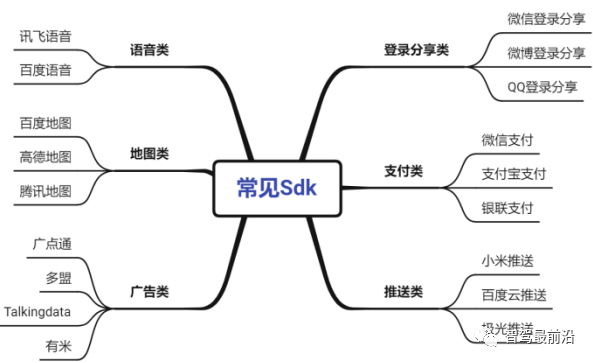
Common SDKs in the Android Ecosystem
Competitive Landscape? — Observing Software Enterprises’ Growth Potential from Several Dimensions
Entering Core Ecosystems like Chips, Operating Systems, or Middleware
Automakers have shifted from building ecosystems around Tier 1 to building ecosystems around chip manufacturers, operating systems, or middleware companies. In the traditional automotive era, the automotive ecosystem revolved around Tier 1, which procured chips and integrated software to supply to OEMs. However, in the era of intelligent vehicles, when defining an intelligent vehicle, automakers will primarily consider what size of computing power chip is needed to support the expected intelligent features. After determining the chip, surrounding components, operating systems, and software will also be selected among the companies related to that chip, leading automakers to build ecosystems around NVIDIA, Qualcomm, Horizon, etc. Of course, there are also automakers building ecosystems around operating systems like QNX, LINUX, Android, or middleware systems like Apollo, AUTOSAR.
Therefore, if software suppliers can deeply penetrate these core chip, operating system, and middleware ecosystems, they can fully share the explosive growth of the automotive software market. Taking ThunderSoft as an example:
(1) Chip Field: Deeply Binding with Qualcomm
Qualcomm dominates the smart cockpit chip sector. 1. In automotive chips, Qualcomm’s third-generation smart cockpit chip (Snapdragon 8155) is the first automotive-grade digital cockpit SoC created using 7nm process technology, with multi-core heterogeneous performance twice that of other chips, and CPU performance and GPU computing power far surpassing those of other manufacturers’ chips, making it the most powerful cockpit SoC chip currently. More than 20 of the top 25 global automakers have produced models equipped with the 8155 chip, indicating a strong market presence. 2. In terms of chip platforms, Qualcomm has also released products like Ride, the fourth-generation Snapdragon platform, and 5G vehicle networking, with last year’s fourth-generation chip SA8295P adopting a 5nm process, and its 8-core CPU clock speed significantly higher than the third-generation chip and other manufacturers’ chips, with GPU computing power also increased by over 50%, marking a further breakthrough for Qualcomm in chips. The release of the Ride platform also allows Qualcomm to complete the full product line layout in the automotive market, attempting to integrate the cockpit and self-driving domains.
ThunderSoft has deeply bound with Qualcomm, continuously benefiting from Qualcomm’s customer flow. Since its establishment, ThunderSoft has formed a strategic partnership with Qualcomm, which produces smartphone terminal chips, including joint development of QRD (Qualcomm Reference Design) smartphones and establishing a joint laboratory for smartphone chips and systems. Thus, ThunderSoft’s familiarity with Qualcomm’s chip platforms is far higher than that of other automotive software companies, laying a foundation for their priority cooperation in the automotive sector. In addition, ThunderSoft and Qualcomm established a joint venture, Chongqing Chuangtong Lianda Intelligent Technology Co., Ltd., in 2016, providing customers with a one-stop solution of “Qualcomm chip platform’s chip + operating system + core algorithms,” further deepening their binding at the equity level. In summary, ThunderSoft’s integration into Qualcomm’s chip ecosystem allows Qualcomm’s customers to flow to ThunderSoft, providing stable and continuous growth for ThunderSoft’s smart cockpit business; at the same time, long-term cooperation with Qualcomm has deepened ThunderSoft’s technical accumulation in chip virtualization, firmware drivers, and other aspects.
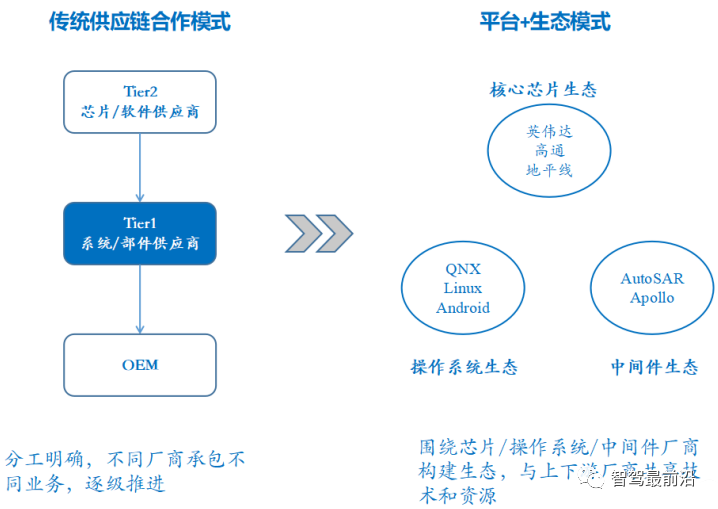
The Transformation of Smart Automotive Industry Models
ThunderSoft will optimize the operating system, core SDK, and middleware for Qualcomm’s integrated hardware and software platform. ThunderSoft has accumulated experience in optimizing production-grade operating systems and understanding automotive-grade requirements at the middleware level, which can help Qualcomm connect with downstream automakers, understand their customization needs, and develop OS tailored to different generations of Qualcomm chips for automakers, making individual adaptations and improvements for different vehicle models. Therefore, deep binding with Qualcomm is a core advantage for ThunderSoft compared to other software suppliers.
The future integration of cockpit and autonomous driving domains will provide ThunderSoft with broader opportunities for display. The integration of cockpit and autonomous driving domains will lead to a rapid increase in software complexity, requiring multiple systems, virtual machines, and various middleware, where non-real-time operating systems and real-time operating systems will be integrated together, significantly increasing the complexity of the entire software system, further enhancing the value of software in the entire industry chain. The specific content provided by ThunderSoft in the RIDE platform includes: chip virtualization; secure middleware (requiring encapsulation of many underlying hardware resources, access services, access rights control, and providing unified service interfaces and permissions for the upper layer), ensuring real-time access for tasks, as well as access to algorithms or source data.
(2) Operating System Field: Long-Term Commitment to Operating Systems
The company has a deep understanding of underlying operating system technologies and has extensive experience in customizing and tailoring various operating systems, widely adapting to QNX, LINUX, and various virtual machine vendors. 1. ThunderSoft is a solution provider for QNX (BlackBerry) autonomous driving systems. BlackBerry has developed entertainment systems, intelligent cockpits, and assisted driving systems for automotive companies, providing developers with flexible tool choices. ThunderSoft has successfully built an ecosystem cooperation relationship with QNX due to its strong core capabilities in operating systems, becoming one of the solution providers for QNX in the autonomous driving field. 2. ThunderSoft integrates into the Android ecosystem, further enhancing its advantages in the smart cockpit. The greatest advantage of Linux over QNX is its open-source nature, which offers strong customization flexibility. Android is an open-source operating system developed by Google based on the Linux kernel, primarily applied in the in-vehicle infotainment and navigation fields. Currently, the Android system dominates the in-vehicle infotainment sector in China. As a leader in smart cockpits and a major player in the Android ecosystem, ThunderSoft’s mutually beneficial collaboration with Android system vendors further strengthens its advantages in the smart cockpit sector.
(3) Middleware Field: Middleware Capability is ThunderSoft’s Underlying Strength
ThunderSoft has the capability to develop AutoSAR AP. The company has built an integrated SOA platform for “cloud, management, and terminal,” providing development toolchains for software development and vehicle integration. At the same time, ThunderSoft has joined the Apollo ecosystem to engage in multi-dimensional in-depth cooperation. ThunderSoft offers a series of services and solutions in the software platform layer, including customization and optimization of operating systems, development of intelligent driving algorithms, and customization and optimization of human-machine interaction interfaces.
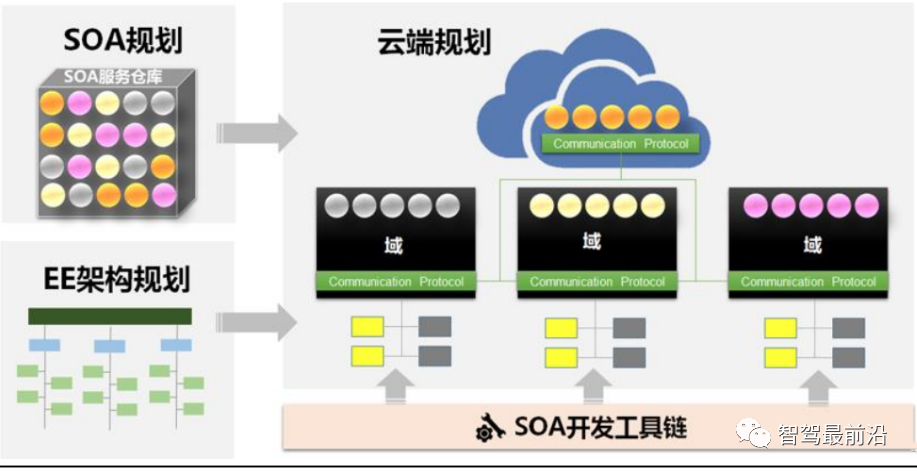
ThunderSoft’s Proprietary Toolchain for SOA Architecture Development Fully Supports Vehicle Software Development and Integration
Deep Binding with Downstream Customers, Forming Long-Tail Coverage
The automotive software market exhibits long-tail market characteristics, meaning a broader customer coverage leads to better performance sustainability and stronger product versatility. Therefore, manufacturers with a wider distribution of downstream customers and lower customer concentration will hold a certain advantage in competition. Currently, companies like ThunderSoft, Neusoft Ruichi, Wuhan Glorious Information, and Jingwei Hengrun have abundant domestic and foreign customer resources, and their products have covered most mainstream vehicle models.
ThunderSoft’s customer coverage includes nearly all mainstream OEMs and Tier 1 suppliers, with a customer concentration far lower than comparable companies. Compared to the other three manufacturers, ThunderSoft’s revenue from its top five customers accounted for 29.6% in 2020 and 26% in 2021, significantly lower than Glorious Information’s 53% and Jingwei Hengrun’s 52.7%. This indicates that ThunderSoft’s revenue structure is more decentralized and has a lower dependency on a single customer, suggesting that its operations are relatively more stable. Additionally, due to ThunderSoft’s binding with Qualcomm, it has further absorbed Qualcomm’s domestic and foreign customers. Therefore, ThunderSoft enjoys better revenue sustainability and stronger product versatility.
Revenue Model: “License + Royalty” Barriers are Higher, Revenue is More Stable than NRE
The business model for automotive software generally adopts an “IP + solution + service” model. The software charging model mainly includes three types: The first type is receiving outsourcing, providing a one-time quote in the NRE (Non-Recurring Engineering) model, pricing based on the number of developers and hours required for the project, usually used for software and system development business; the second type is selling IP and software development licenses to customers, with specific charging standards including Royalty and License, which generally have higher gross margins, usually exceeding 70%; the third type is a packaged charging model of “NRE + License,” which charges a one-time fee, plus another fee based on the number of vehicles.
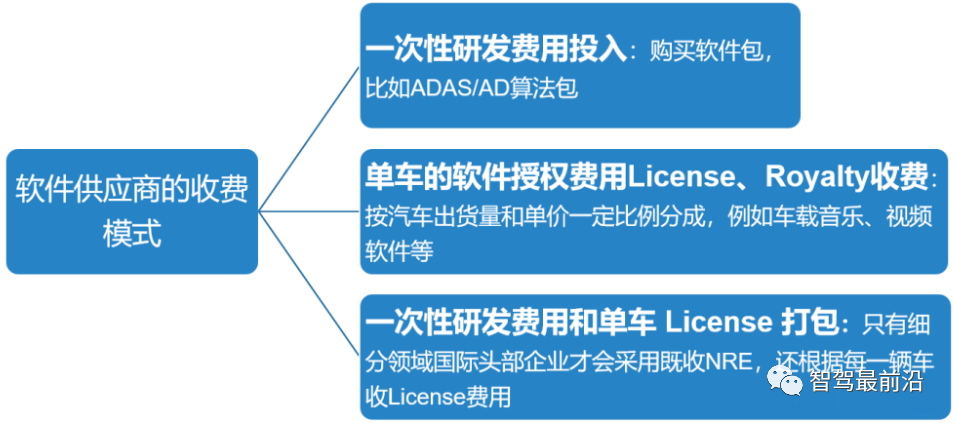
Three Charging Models for Software Suppliers
According to data from Zosi Automotive Research, the current single vehicle IP authorization fee ranges from 2000 to 3000 yuan. As the complexity of automotive functions increases and relevant software companies rise, software authorization fees will continue to increase.
ThunderSoft sells IP and customer software development licenses, occupying a leading position in the industry. Most automotive software companies in China provide purely outsourced software development services and solution services, with business charges typically based on project or one-time NRE forms. The NRE model has a low market barrier, and automotive software companies generally only need to provide technology and manpower. In a rapidly growing industry, this model can achieve rapid growth through workforce expansion, but as automakers’ software capabilities gradually strengthen, the sustainability of outsourced projects becomes questionable, leading to lower revenue stability. In contrast, the technical difficulty of IP licensing is higher, and only companies with leading technologies in specific fields can support the licensing model. Its revenue mainly depends on the sales volume of customers’ vehicles, which helps maintain customer stickiness and revenue stability. Currently, only ThunderSoft and Neusoft Group can rely on IP charges, with ThunderSoft’s IP revenue share being higher, mainly from licenses for Kanzi and other IPs. As models equipped with the 8155 cockpit chip continue to ramp up, ThunderSoft’s ROYALTY revenue is expected to see significant growth in 2022.
Focusing on a Single Field and Cross-Field Market Scale Will Differ
Under the wave of intelligence, automotive software companies focusing on a single field can achieve stable returns and market scale, but in the long term, companies focusing on a single field may have insufficient growth potential. As product iterations and technological advancements occur within the industry, it will be difficult for companies to form differentiation, leading to limitations in competitive advantages. Therefore, compared to companies focusing on a single field, those with broader software business coverage and more involved fields will have better growth potential in the long term.
ThunderSoft has acquired several upper-layer companies, achieving cross-field development in the intelligent automotive business. ThunderSoft has been listed for many years and has established a comprehensive platform in the smart cockpit sector, forming a brand effect. However, the company does not settle for development in the underlying OS field, gradually expanding into upper-layer (application layer) areas. Since 2016, ThunderSoft has acquired several companies in different fields, such as Aipuxin and Rightware, sufficiently expanding and enhancing its business. As a result, ThunderSoft has become one of the few companies that comprehensively covers operating system technologies from chip level, system level, application level to cloud, occupying a place in high-growth fields like IVI technology, HMI interface design, image processing algorithms, and automatic parking, while other companies in the industry have not expanded into these fields or lack corresponding customers, posing little threat to ThunderSoft. Therefore, through acquisitions, ThunderSoft leads the industry in cross-automotive segment development, helping it explore the market and possess unique advantages across multiple fields.
Rightware’s Kanzi software is a key supplement to smart cockpit technology, enabling ThunderSoft to achieve breakthroughs. Kanzi has strong technology in in-vehicle infotainment systems, and its products have many advantages. (1) Kanzi’s particle effects, PBR, etc., are superior, reaching the level of effects in high-end games, better replicating the real world; (2) It supports rapid startup in milliseconds and MCU chip support, compatible with multiple programming languages, seamlessly connecting with the Android system, while occupying very little memory; (3) It can be quickly mastered, allowing for some technical designs to be completed without writing code, significantly improving efficiency; (4) It meets C language development standards, complying with ASPICE and other automotive-grade quality safety verifications; (5) Kanzi is currently used in over 100 vehicle models, completing the delivery of one million units of automotive software, and has over 100 original factory technical support personnel worldwide, demonstrating mass production capabilities. Kanzi has now become the preferred tool for HMI design for over 80% of domestic automakers, and ThunderSoft leverages Kanzi’s strong technology, packaging core capabilities like Kanzi, and implementing an IP licensing model to charge software license fees. Therefore, ThunderSoft has prioritized its position in the smart automotive segment through the acquisition of Rightware, while also breaking through the “License + Royalty” barrier, enhancing its bargaining power in Tier 1.
The company’s business structure is driven by three wheels, with businesses in addition to automotive also including “mobile + IoT.” In 2021, the company’s revenues from mobile, automotive, and IoT were 1.055 billion, 1.2 billion, and 1.27 billion respectively, with the mobile business maintaining steady growth despite a decline in terminal shipment volume, and IoT business experiencing explosive growth, with a year-on-year increase of 82.87% in 2021. ThunderSoft’s IoT business primarily targets emerging markets such as robotics, drones, video conferencing, smart cameras/AI cameras, and VR, and is expected to continue to grow explosively in 2022.
Appendix: Key Financial Data Comparison of Software Enterprises
Revenue per Employee: ThunderSoft’s Employee Count Has Increased Significantly, and Revenue per Employee is Not a Focus for the Next Five Years. ThunderSoft’s revenue per employee is lower than that of Neusoft Group, and the revenue per employee has been declining year by year from 2018 to 2020, with 2021 revenue around 360,000 yuan, still not exceeding 400,000 yuan. The main reason is that ThunderSoft is currently focused on automotive software R&D, and the employee count is expected to increase significantly over the next five years as the company attracts more excellent product managers and ecosystem builders, thus broadening its business channels. Therefore, revenue per employee will not be a core KPI for ThunderSoft in the next five years.
Changes in ThunderSoft’s Employee Count from 2018 to 2021
Profit: ThunderSoft’s Profit Margin is Leading in the Industry, with Fluctuations in Profit Margin in 2021 Due to Foreign Exchange Impact. In vertical comparisons, ThunderSoft’s gross margin has stabilized at around 40% in recent years, and the net margin has generally remained in the range of 12-18%. The gross margin and net margin have steadily increased from 2018 to 2020, while the profit margin in 2021 saw a certain degree of decrease due to exchange rate fluctuations; horizontally compared to peers, ThunderSoft’s gross margin was 44.22% and net margin was 17.11% in 2020, slightly lower than Glorious Information but still far above the average level of automotive software manufacturers. ThunderSoft’s high profit margin mainly stems from its superior performance in SDV, ecosystem collaboration, customer breadth, and IP licensing.
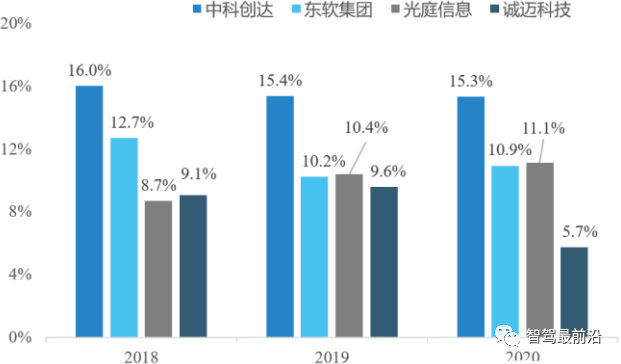
R&D Expenses: ThunderSoft’s R&D Expense Ratio is Leading
ThunderSoft invests more in R&D, possessing the potential to build software technology barriers. ThunderSoft’s R&D expense ratio (R&D expenses/total revenue) has consistently maintained above 15% in recent years, with R&D expenses being 150% of comparable companies like Neusoft, Glorious Information, and Chengmai. The number of R&D personnel has been increasing year by year, with R&D personnel accounting for as much as 92% in 2020, placing it in the first tier of the industry. With the development of automotive intelligence, ThunderSoft is investing more effort into high-tech R&D in intelligent cockpits, autonomous driving, and the application of cutting-edge technologies, helping to form product differentiation and build automotive software technology barriers. In the long term, ThunderSoft’s focus on developing new technologies and products will significantly assist in expanding the company’s market scale and revenue growth.
R&D Expense Ratio Comparison (2018-2020)
How to View OEM Self-Development?
Software Defined Vehicles have become an industry consensus, and OEMs will certainly increase investment in software. When making self-development or outsourcing decisions, many areas are involved, such as which stages of the development process to self-develop and which to outsource? In terms of layered technology, should the operating system be self-developed? Or which domain to self-develop? Each enterprise is different and can make choices based on its resource endowments and strategic goals.
Leading new force automakers self-develop, while other automakers tend to procure basic software and self-develop application software.
Leading new force companies choose software self-development. At this stage, only leading new force companies are fully self-developing their stacks, as these companies have strong differentiation demands and sufficient financial strength and software talent to support them. Companies like NIO, Xiaopeng, and Li Auto adopt self-developed methods in the perception and decision-making layers of autonomous driving algorithms and in the basic software field to pursue leadership in autonomous driving functionality and create differentiation selling points. In the cockpit sector, Xiaopeng’s P7 (Qualcomm 820A) and P5 (Qualcomm 8155) rely on ThunderSoft for underlying software development; however, for the Qualcomm 8295 generation cockpit chip, Xiaopeng has begun directly connecting with Qualcomm to enhance efficiency and strive for market leadership.
Mainstream domestic and foreign automakers are very cost-sensitive, tending to purchase standardized hardware platforms and basic software, while self-developing upper-layer application software to seek differentiation. Generally, automakers are better at defining user scenarios and using user data rather than system-oriented capabilities. Therefore, as lower-layer hardware becomes increasingly centralized, more complex software will be needed to compensate, increasing the value of software, and market opportunities for companies like ThunderSoft will continue to grow. For long-tail OEMs with insufficient resources, packaged services for hardware, basic software, and application layer software are needed.
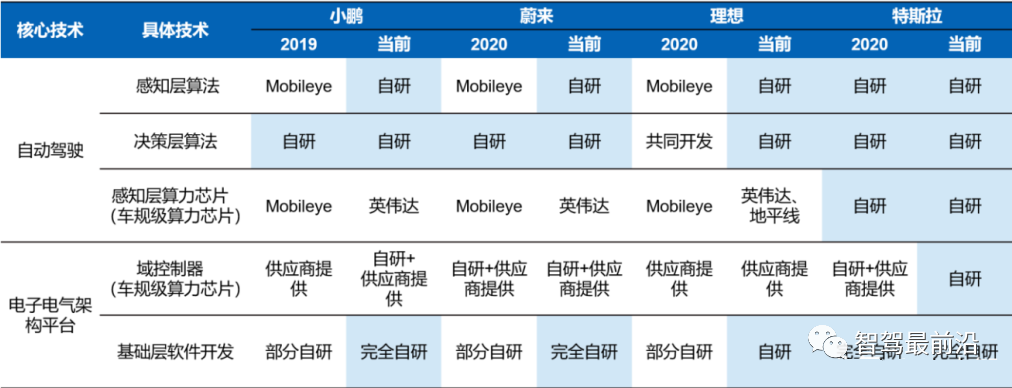
Xiaopeng, Li Auto, NIO, and Tesla’s Autonomous Driving Technology Layout
Leading New Forces’ Models are Generally Class B and Above, Priced Above 250,000 Yuan, and Are Not the Sales Mainstay
Currently, the models chosen by new force companies fully self-develop are generally priced above 250,000 yuan and are mostly Class B or above. An overview of the entire domestic passenger car market shows that only 24% of models were priced above 250,000 yuan in 2021, with Class B and above models accounting for only 34% of sales. Looking at the market share of Tesla, NIO, and Xiaopeng in China, they accounted for only 2.9% in 2021.
Moreover, according to information disclosed in ThunderSoft’s 2021 financial performance briefing, the number of major customers (with revenue above 2 million yuan) is expected to grow from 4 in 2021 to over 22 in 2022, covering mainstream domestic and international automakers such as GM, Ford, Great Wall, SAIC, Geely, Volkswagen, Toyota, BYD, etc., reflecting ThunderSoft’s increasing market share among these customers and their growing dependence on ThunderSoft. Therefore, except for leading new force companies with extreme differentiation pursuits, mainstream automakers will promote software-defined vehicles in a division of labor manner.
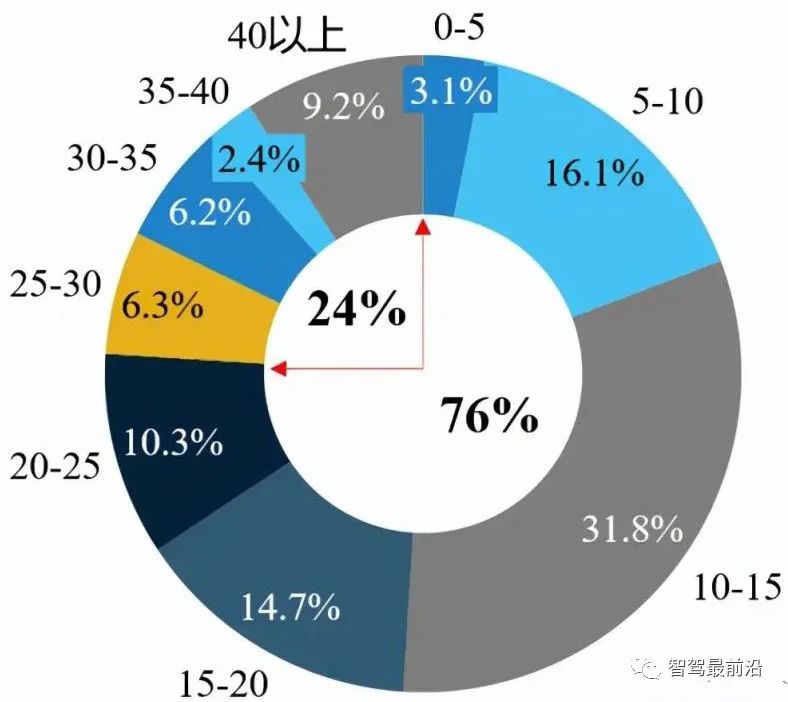 2021 Passenger Vehicle Distribution by Price Segment Sales Structure (in 10,000 Yuan)
The Evolution of Automotive Software Towards Layering and Modularization is Inevitable
Referencing the PC and mobile eras, automotive software will also form a layered and modular division pattern. In the early stages of the industry, various technologies are not mature, and automakers will choose to invest. However, after reaching a certain boundary, their investment will decrease. Additionally, full-stack self-development is very uneconomical, as standard third-party modules will undergo more testing in various scenarios and products, with their vitality and quality continuously improving, and costs will also decrease through sharing across many scenarios. From a business perspective, it is certain that companies will choose supplier solutions, and the industry will experience a process of division of labor.
Welcome to Join the Angel Round and A Round Enterprises Across the Entire Automotive Industry Chain (including the Electrification Industry Chain);Friendship connections include 500 automotive investment institutions including top-tier organizations; Some quality projects will be selected for themed roadshows to existing institutions;There are communication groups for leading technology companies, covering dozens of groups in the automotive industry, including electric vehicle industry, automotive semiconductors, key components, new energy vehicles, intelligent connected vehicles, aftermarket, automotive investment, autonomous driving, and vehicle networking. To join, please scan the administrator’s WeChat (please indicate your company name)