Have you noticed that although children have learned phonics, they often seem a bit hesitant when faced with some polysyllabic long words? They are afraid to spell. For example, when children see the word September, they often hesitate to spell it. However, children who understand syllables can break this word into three parts: Sep/tem/ber and then read them one by one.
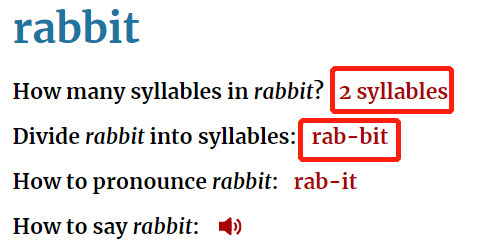
Furthermore, we find that although children can use phonics rules to spell some words, they still encounter various problems in their writing process.
For example, when a teacher mentions the word rabbit, only children who understand the syllable rules will double the ‘b’. If a child does not understand syllable knowledge, they might write it as rabit. However, according to the syllable rules, the pronunciation of rabit should be /reɪbɪt/.
In fact, just like bamboo has nodes, books have chapters, and people have joints, we must always remember that English words also have their own syllables.
Why is it important to understand syllables?
There are many reasons for incorrect and non-standard pronunciations, some of which stem from a lack of “syllable awareness” in English.
Some people’s symptoms manifest as: when reading words aloud, they commit to a form of “egalitarianism,” reading the word conversation as con-ver-sa-tion, which uses the syllable rhythm from Mandarin, thus lacking much distinction in stress, sounding unnatural and not fluent, making English sound very flat.
By learning about syllables, you will become particularly sensitive to stress, and consequently, your listening skills will improve. Conversely, not mastering English syllables will certainly have an impact on phonetic acquisition (listening & speaking); this is not only the case for us foreign learners but also for children in English-speaking countries like the UK, the US, Australia, and Canada, who need to put effort into learning this in their kindergarten and primary school language classes.
Many parents become anxious and frustrated about their children’s spelling; part of this is a problem with the children’s learning methods, and we cannot overlook the fact that the composition of English vocabulary has a rich cultural diversity, accommodating different languages, along with historical changes in pronunciation, which can confuse learners.
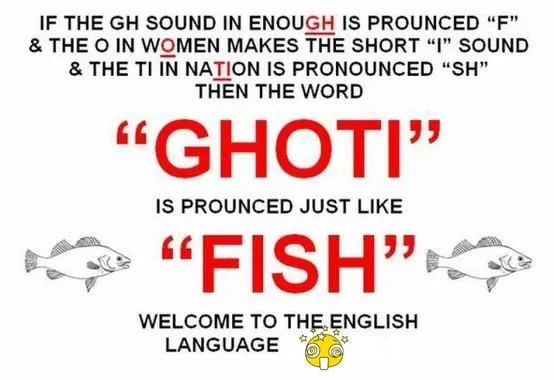
The essence of this image is to say that the word fish can also be spelled as “ghoti” because in certain words, gh=f, o=i, ti=sh… The confusion is real, but there are still many basic rules; learning to “divide syllables” can help you find some comfort in this chaos, and naturally, the benefits for remembering long words are self-evident.
Additionally, in English, words can be related to each other not only through traditional roots and affixes, synonyms, and antonyms but also through similar stressed syllables. If you understand syllables, it can help you acquire more words and expand your vocabulary!
What is a syllable?
A syllable is a unit of phonetics.
In Chinese, a single character is a syllable; for native Mandarin speakers, “syllable” is as natural as air, being the most “natural unit.” However, for other languages, segmentation may not be an intuitive task and often presents many challenges.
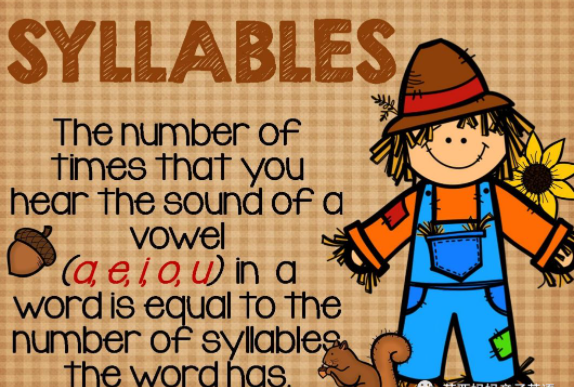
In English, a syllable contains only one vowel sound.
Therefore, the number of vowel sounds in a word corresponds to the number of syllables. For example, fox contains one vowel and is a monosyllabic word. Popcorn contains two vowels and is a disyllabic word.
Note that we refer to vowel sounds, not vowel letters. For example, the word boat contains two vowel letters, but these two letters produce only one sound, so boat is a monosyllabic word.
7 Common Types of Syllables
Children in English-speaking countries generally start formally learning syllables in the first grade. Schools usually introduce seven common types of syllables.
· Closed Syllable (CVC)
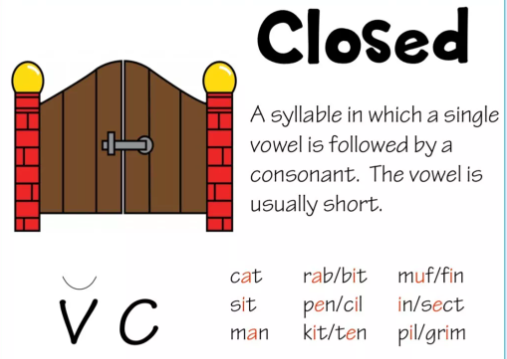
A syllable that contains one vowel and ends with a consonant is a closed syllable, and the vowel is pronounced short.
For example, cat ends with the consonant t and is a closed syllable; the letter a is pronounced short /æ/.
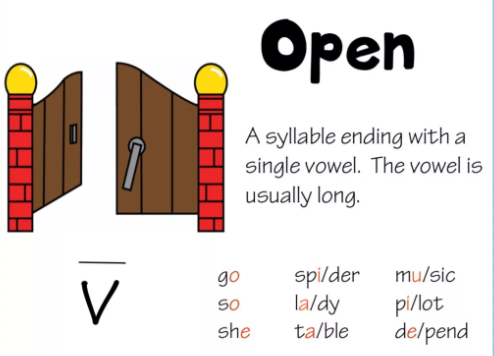
· Open Syllable (CV)
A syllable that ends with a vowel is an open syllable, and the vowel is pronounced long.
For example, the first syllable of pa·per ends with the vowel a, making it an open syllable, and a is pronounced long /eɪ/.
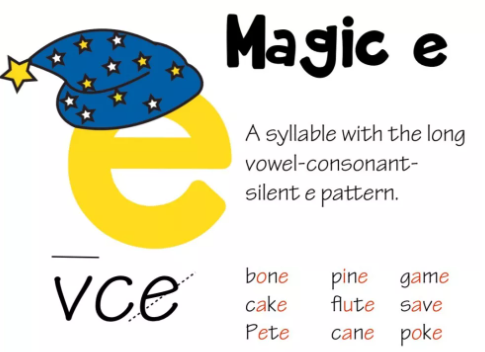
· Vowel + Consonant + Silent e (Magic-e Syllable)
If a word ends with a silent e, the preceding vowel is pronounced long. For example, in the word page, the final e is silent, and a is pronounced long /eɪ/.
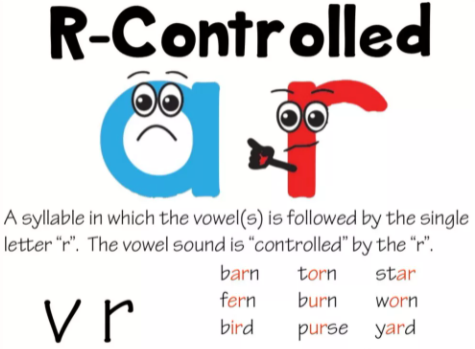
· Vowel + r (R-Controlled Syllable)
A syllable formed by a vowel plus r, such as er, ir, ur, ar, or, where the vowel does not have a long or short sound but produces a different sound. For example, park.
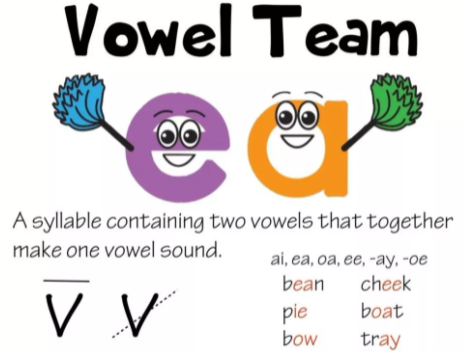
· Vowel Team Syllable
Two adjacent vowel letters that produce the long sound of the first vowel. For example, in the word boat, the two vowel letters o and a produce only the long sound of the first vowel o.
· Diphthong Syllable
Two vowel letters that form a new vowel sound. For example, boy and foil.
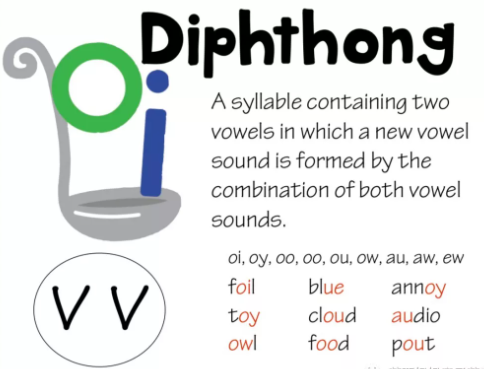
Some may combine the fifth and sixth types into one (both contain two vowel letters), reducing the total to six common syllables.
· Consonant + le Syllable (C-le)
Words that end with le, such as ca·ble and tur·tle.
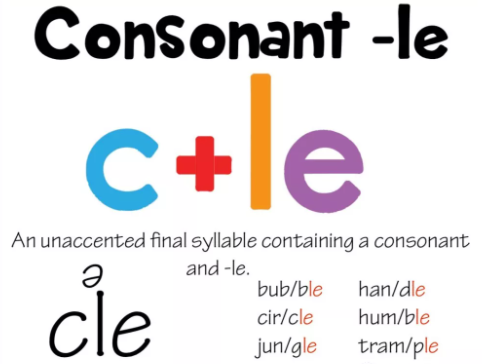
Rules for Syllable Division
Now, let’s summarize the common rules for syllable division.
Note that these rules apply to most cases but there will still be exceptions. If uncertain, you can check the websites below.

First, if two consonants appear in the middle of a word, you can divide the syllables between these two consonants. However, be careful not to separate consonants that form a single sound, like ch, sh, th, ph.
For example:
bubble → bub-ble happy → hap-py
basket → bas-ket under → un-der
Second, if a word is made up of compound words, first consider separating these two words into individual “syllables” before dividing the internal syllables.
For example: cowboy → cow-boy rainbow → rain-bow
heart-broken → heart-bro-ken
If the word has prefixes or suffixes, first consider separating the prefix or suffix from the root word and then divide the syllables of the root.
For example:
review → re-view
rezip → re-zip
unhappy → un-hap-py impossible → im-po-si-ble
Third, when a disyllabic word ends with a consonant + le, the second syllable is that consonant + le.
For example: wiggle → wig-gle sample → sam-ple table → ta-ble
Note that when the first syllable ends with a consonant, you can try pronouncing the vowel in that syllable as short, for example, wig-gle, sam-ple; when the first syllable ends with a vowel, you can try pronouncing the vowel in that syllable as long, for example, ta-ble, bri-dle.
Fourth, in consonant combinations, such as bl, tr, spl, sch, tw, br, etc., these consonants cannot be separated when dividing syllables because they merge into “one sound” in actual pronunciation, and there are no vowels in consonant combinations.
For example: breakfast → break-fast traffic → traf-fic
cloudy → clou-dy scribble → scrib-ble
English words vary in length, so it’s important to expand vocabulary and practice syllable division. Regardless of how the words change, the only constant is that vowels are the basis for determining syllables.
How do children learn?
Children generally practice syllable division through three methods:
Clapping Method
Clapping hands while saying a word indicates the number of syllables;
Robot Talking Method
Pronouncing like a robot, pausing several times indicates the number of syllables;
Chin Touch Method
Placing a hand under the chin, the number of times the chin touches the hand indicates the number of syllables.
After sharing so much content, I hope everyone can practice syllables more, as it will greatly help your English learning!
That’s all for today’s sharing. Follow and like to get more English learning knowledge every day!
· END ·
Follow Kunshan Aibei International Children’s English
Free appointment for all foreign teacher English experience activities
Address: 46 Baima Jing Road, 4th Floor, next to the cinema in Super City Plaza
Phone: 0512-55132999


Follow Aibei
For more wonderful content