1. Overview of the Technical System
The air-ground collaborative networking technology integrates UAV systems, self-organizing networks, and mobile communication command vehicles to construct a highly mobile and intelligent emergency communication and command platform. This system fully leverages the advantages of UAVs’ flexibility, dynamic expansion of self-organizing networks, and the powerful processing capabilities of communication command vehicles, widely applied in emergency rescue, military operations, and large-scale event support. This technology addresses the shortcomings of traditional communication systems in complex environments, such as insufficient coverage and slow deployment, achieving three core capabilities: rapid response, wide-area coverage, and stable transmission.
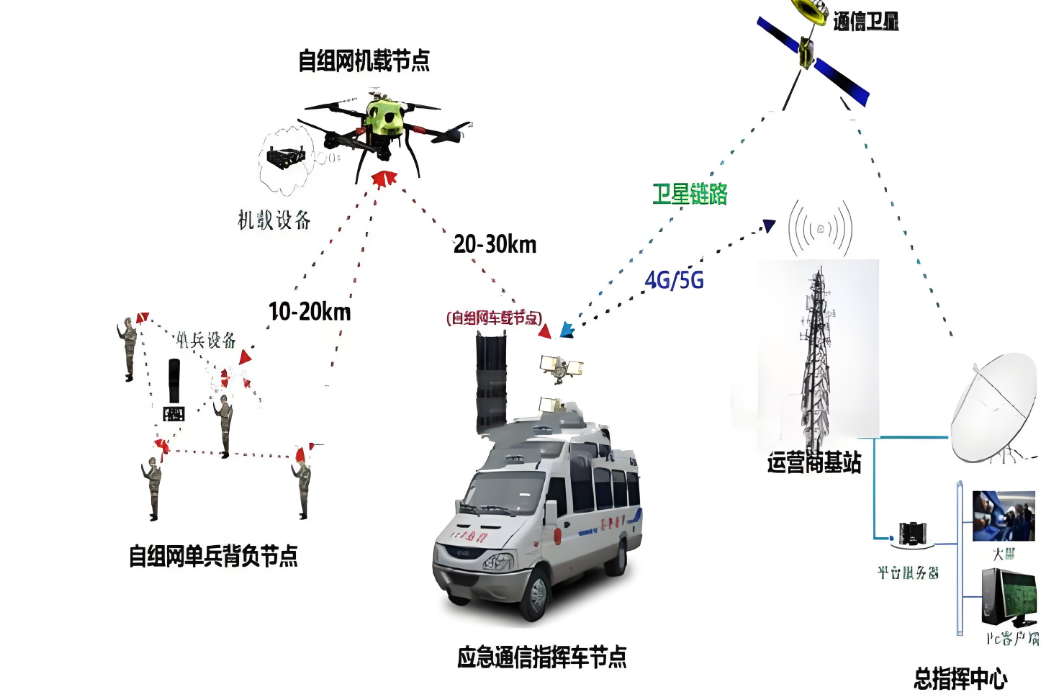
2. System Architecture and Core Components
1. Hardware System Composition
UAV Subsystem:
-
Utilizes a hybrid configuration of multi-rotor and vertical take-off and landing fixed-wing
-
Typical parameters: endurance of 30-120 minutes, communication radius of 10-50 km
-
Payload configuration: HD camera, infrared thermal imager, communication relay equipment
-
Representative models: DJI Matrice 350 RTK, Zhongheng CW-15
Self-Organizing Network Communication System:
-
Operating frequency band: supports LTE/5G/WiFi multi-mode communication
-
Network architecture: Mesh topology
-
Key technologies: dynamic routing protocol, adaptive modulation and coding
-
Transmission performance: single-hop rate ≥ 50 Mbps, end-to-end delay < 100 ms
Communication Command Vehicle System:
-
Onboard equipment: high-performance server, multi-band base station, satellite communication terminal
-
Processing capability: supports real-time processing of 16 channels of HD video
-
Power supply system: hybrid power (fuel + lithium battery), endurance of 72 hours
-
Expansion interface: reserved for UAV charging/take-off platform
2. Software Control System
-
Intelligent Task Allocation System: dynamic resource scheduling based on reinforcement learning
-
3D Situational Awareness System: real-time visualization command integrating GIS information
-
Network Security Protection System: multi-layer encryption and intrusion detection mechanisms
-
Fault Self-Healing System: automatic detection and recovery of node failures
3. Key Technology Implementation
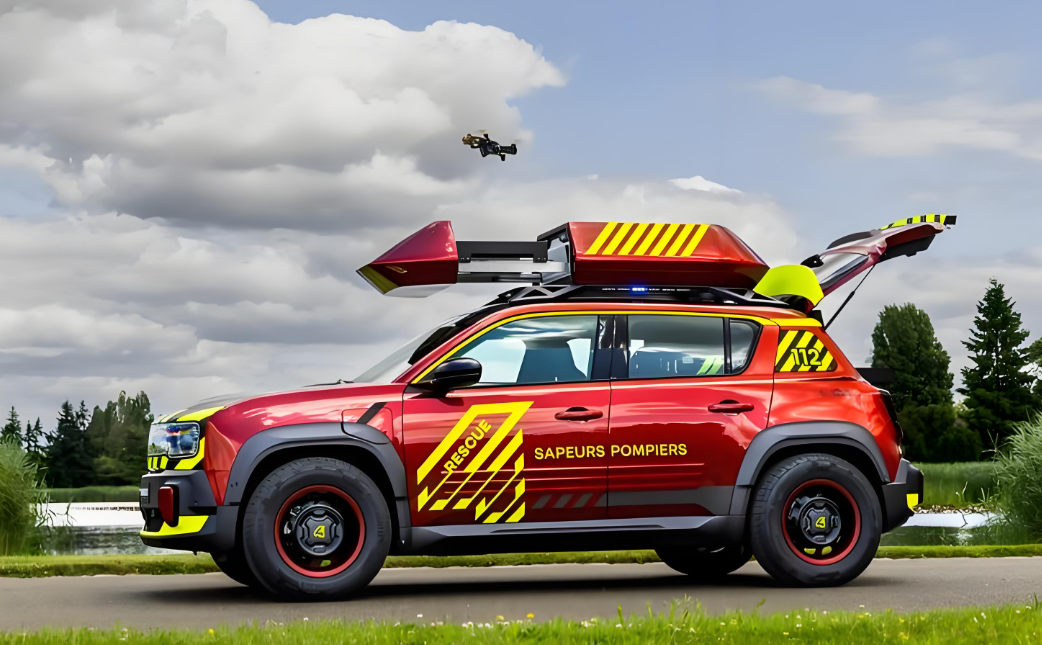
1. Dynamic Network Topology Management
Utilizes hybrid clustering networking technology to achieve:
-
Automatic discovery and registration of network nodes
-
Multi-path dynamic routing optimization
-
Load balancing and QoS assurance
-
Typical networking scale: supports 50+ nodes online simultaneously
2. Heterogeneous Platform Collaborative Control
Breakthrough technologies include:
-
Unified communication protocol stack design
-
Time-space synchronization mechanism
-
Resource collaborative scheduling algorithm
-
Actual test metrics: cross-platform control delay < 200 ms
3. Intelligent Anti-Interference Communication
Innovative solutions:
-
Cognitive radio frequency spectrum sensing
-
Adaptive frequency hopping technology
-
MIMO beamforming
-
Measured anti-interference capability: maintains communication at -10 dB signal-to-noise ratio
4. Typical Application Scenarios
1. Disaster Emergency Rescue
Workflow:
-
Communication command vehicle quickly arrives at the periphery of the disaster area
-
UAV swarm takes off to establish a temporary communication network
-
Self-organizing network extends coverage to the core disaster area
-
Real-time transmission of on-site HD video and sensor data
Performance Indicators:
-
Network deployment time < 30 minutes
-
Coverage area reaches 20 square kilometers
-
Supports 500+ terminal access
2. Counter-Terrorism Operations
Tactical Applications:
-
UAV reconnaissance
-
Self-organizing network ensures communication between teams
-
Command vehicle performs real-time analysis and decision-making
-
Typical case: a special police team using this system improved task efficiency by 40%
3. Large Event Support
Innovative Applications:
-
Three-dimensional security monitoring
-
Emergency communication backup
-
Flow heat map analysis
-
Actual case: support for an international conference achieved zero communication interruption
5. Technical Challenges and Solutions
1. Adaptation to Complex Electromagnetic Environments
Challenges:
-
Urban multipath effects
-
Crowding in civilian frequency bands
-
Threats from malicious interference
Solutions:
-
Develop intelligent spectrum management systems
-
Adopt software-defined radio architecture
-
Implement multi-layer encryption protection
2. Energy Supply Optimization
Challenges:
-
UAV endurance limitations
-
High power consumption of onboard equipment
-
Difficulties in outdoor charging
Innovative Solutions:
-
Develop wireless charging UAV platforms
-
Optimize energy management algorithms
-
Equip mobile power generation devices
3. Large-Scale System Testing
Challenges:
-
Difficulties in reproducing real-world scenarios
-
High testing costs
-
Safety risk control
Breakthrough Directions:
-
Build a digital twin testing platform
-
Develop a modular testing toolchain
-
Establish standardized testing procedures
6. Development Trends
-
Intelligent Upgrades:
-
Introduce edge computing and AI decision-making
-
Develop autonomous collaborative algorithms
-
Achieve intent recognition interaction
Standardization Construction:
-
Promote unification of communication protocols
-
Improve airworthiness certification systems
-
Formulate industry application standards
Application Scenario Expansion:
-
Smart city management
-
Three-dimensional border patrol
-
Industrial facility inspection
7. Typical Cases
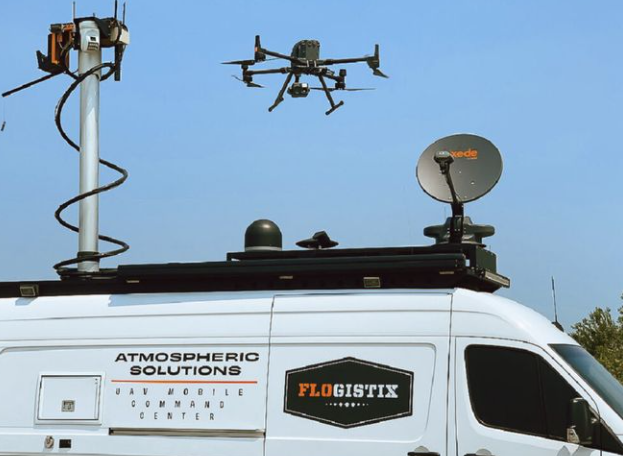
Air-Ground Collaborative System of a Provincial Emergency Management Department:
-
System Configuration:
-
3 communication command vehicles
-
12 multi-rotor UAVs
-
6 vertical take-off fixed-wing UAVs
-
30 self-organizing network nodes
-
Application Effectiveness:
-
Disaster response time reduced by 60%
-
Communication coverage increased by 5 times
-
Annual operation and maintenance costs reduced by 45%
8. Conclusion and Recommendations
The air-ground collaborative networking technology represents the forefront of emergency communication development. It is recommended to:
-
Strengthencore technology breakthroughs, focusing on overcoming autonomous collaboration bottlenecks
-
Improvetesting and verification systems, accelerating the transformation of technological achievements
-
Promotedemonstration project construction, cultivating typical application scenarios
-
Establishindustry ecological alliances, promoting collaborative innovation and development
This technology is expected to achieve large-scale application within the next 3-5 years, forming a market space worth hundreds of billions. All participants need to seize development opportunities and jointly promote technological innovation and industrial upgrading.

If you find this useful, please follow, like, and share!
For other inquiries, contact WeChat: xlwrjjs