
Passat Air Conditioning Intermittently Not Cooling
1
Fault Symptoms
This vehicle is a 2011 model with a mileage of about 15000km. During use, the automatic air conditioning system intermittently fails to cool.
2Diagnosis and Repair
Using a diagnostic tool to self-diagnose the automatic air conditioning system, the fault code is B10A1, indicating that the fresh air blower diagnostic cable signal is unreliable (passive/intermittent). After clearing the fault code, the air conditioning cooling function resumes, but the fault reappears after the system operates for a while. Upon inspection, regardless of whether the automatic air conditioning system is cooling normally, the blower operates normally and can adjust the airflow.
Analyzing the cause of the fault, it may be that the working conditions of the automatic air conditioning system are not met, leading to limited cooling functionality. Based on the fault code’s indication, it was decided to first check the fresh air blower control module (J126), automatic air conditioning control module (J255), and their related circuits. Checking the wiring between the fresh air blower control module and the automatic air conditioning control module showed good connections, with no short circuits or disconnections.Using an oscilloscope to measure the signal between terminal 16 of the connector T16L of the automatic air conditioning control module and terminal 1 of the connector T6z of the fresh air blower control module, the obtained control signal waveform is shown below. According to the waveform, the signal is normal.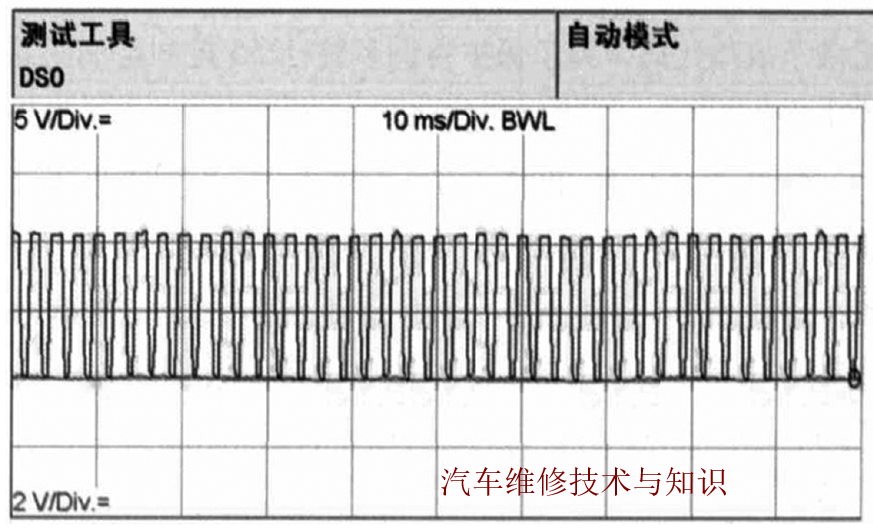 ▲ Control signal waveform of the fresh air blower control moduleAttempting to replace the fresh air blower control module and the automatic air conditioning control module did not resolve the fault, indicating that the fault is unrelated to these two control modules, and the previous fault code did not accurately reflect the fault’s location. Using the diagnostic tool to read the data stream of the automatic air conditioning system, it was found that the conditions under which the air conditioning compressor last shut off were due to excessively low external temperature. However, after testing the outdoor temperature sensor and related circuits and attempting to replace relevant parts, it was confirmed that the fault was not caused by an abnormal outdoor temperature sensor.Analyzing the test results, the true cause of the fault seems unrelated to the information provided by the fault code and the compressor shut-off conditions. But why did the automatic air conditioning control module report the above fault code when the fault occurred? After careful consideration, it was believed that the automatic air conditioning control module might have been interfered with by external signals, reporting a fault code that did not match the actual situation, causing the air conditioning compressor to stop working. However, upon careful inspection of the vehicle, it was confirmed that this vehicle had not been modified or equipped with any additional electrical devices, and no fault codes were stored in other control modules during testing.Reading the vehicle’s network data stream, the status of the comfort system data bus is normal. Thus, it was determined that the fault was still caused by erroneous signals within the automatic air conditioning system. Therefore, using the elimination and substitution methods, the sensors, actuators, and related circuits connected to the automatic air conditioning control module were checked one by one. When the center console was removed and the rear automatic air conditioning operation unit (E265) was disconnected, it was found that the previous fault code no longer appeared, indicating that the fault was related to the rear automatic air conditioning operation unit.To verify this judgment, the LIN bus signal waveform between the rear automatic air conditioning operation unit and the automatic air conditioning control module was measured, and it was found that when the fault code appeared, the signal waveform became distorted, and the cooling function of the automatic air conditioning system failed, as shown in the figure below.
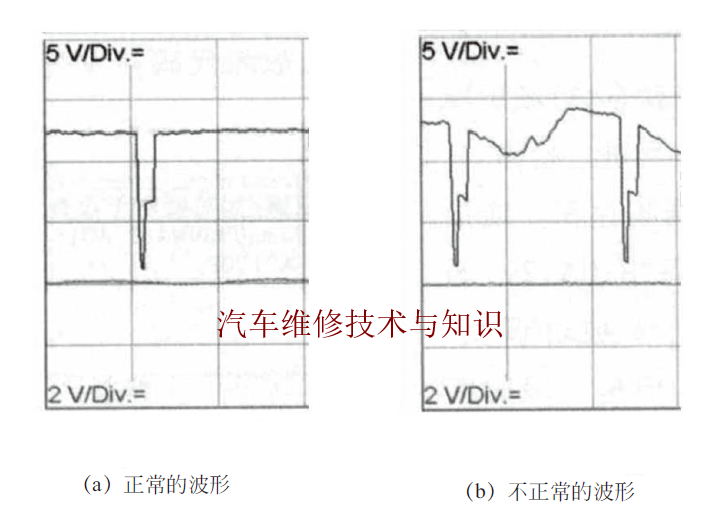
▲ LIN bus signal waveformIt can be concluded that the rear automatic air conditioning operation unit sent erroneous signals to the automatic air conditioning control module via the LIN bus, affecting the data analysis function of the automatic air conditioning control module, generating incorrect fault codes. To protect the automatic air conditioning system, the automatic air conditioning control module disconnected the air conditioning compressor, leading to the cooling function failure.
Mercedes S350 Won’t Start
1Fault SymptomsThis vehicle has a chassis model W220, equipped with an M112 engine and a 722.6 transmission. When starting the vehicle, the starter does not respond.2Diagnosis and Repair
Confirming the fault symptoms, the ignition switch was turned on, and the dashboard displayed normally. Attempting to start, the starter did not respond. Checking the fuses and relays showed no signs of damage or burning. Using a diagnostic tool to self-diagnose the entire vehicle’s electronic control system, no fault codes were found in the engine system, automatic transmission system, or electronic ignition switch system.
Checking the wiring connections of the starter showed normal conditions. Supplying power directly to the starter, the starter operated, eliminating the possibility of starter damage. Using a multimeter to measure the voltage on the control line of the starter, no working voltage was present during the starting process. Referring to relevant materials, it was learned that the right front SAM control module transmits the starting signal to the right front fuse/relay module (K40/7), which engages the starter relay, providing working voltage to the starter, allowing it to operate. Measuring the wiring between the starter relay and the starter showed normal conditions. At this point, it can be concluded that the right front SAM control module did not receive the starting signal.The electronic ignition switch control module is the main control module of the starting system, which has data exchange capabilities via CAN C bus and CAN B bus, acting as the central gateway control module for the vehicle network. The CAN C bus is referred to as the engine compartment bus, equivalent to the power bus.The CAN B bus is referred to as the passenger compartment bus, equivalent to the body bus. During the vehicle starting process, the starting signal must be transmitted to the relevant control modules via the CAN B and CAN C buses to enable the starter to operate. In this control process, the legality of the ignition key must first be verified; after passing the driving authorization check, the ignition key can be turned to the start position, and the power connection signal for circuit 50 is sent out by the electronic ignition switch control module via the CAN B bus, which is received by the right front SAM control module.The ignition key can be turned to the start position, the dashboard displays normally, and all control modules can communicate with the diagnostic tool, indicating that there is no issue with the power supply to each control module. At this point, it was recalled that a new automatic transmission control module was previously replaced in another W220 vehicle, which could still start without the automatic transmission control module. Therefore, an attempt was made to unplug the harness connector of the automatic transmission control module and conduct a start test, and the engine started smoothly. Plugging the harness connector of the automatic transmission control module back in, the fault reappeared, indicating that the problem lies within the automatic transmission section.
BMW X5 Wipers Operate Automatically and Steering is Heavy
1
Fault Phenomenon
This vehicle has a chassis model N70, equipped with an N52 engine. During vehicle operation, the wipers operate automatically, and steering feels very heavy. The dashboard has multiple fault warning lights flashing alternately, and the central information display shows active steering control failure, with deteriorated steering performance. The steering wheel does not return to center, and the vehicle can only barely drive while cautioning the steering status; dynamic stability control system failure, traction control function affected, please drive cautiously; occupant protection system, airbag, seat belt tensioner, and seat belt retraction limiter abnormal.
2Diagnosis and Repair
Using a diagnostic tool for self-diagnosis, the result indicated a communication fault in the chassis controller’s local area network. The control modules connected to this local area network include the dynamic stability control module, steering column switch center, active steering control module, airbag control module, and footwell module.
The chassis controller’s local area network bus is called the chassis bus, which is a type of CAN bus. The actual measured resistance between the high and low lines of the chassis bus was 60Ω, which is normal. Checking the connection of these two wires revealed no short circuit or disconnection issues.
 This Issue’s Content Source: “Automotive Bus Fault Diagnosis and Typical Cases” Edited by Xu Xiaoqi, published in September 2015
Related Articles more
- Steps, Methods, and Precautions for Fault Diagnosis of CAN Bus System
- 9 Steps to Teach You How to Repair CAN Main Bus Short Circuit Faults
- Types of Automotive Buses, Fault Characteristics & Case Analysis
- Color Diagrams + Video Explanation, Easily Understand the Basic Principles and Fault Repair Methods of Automotive Bus Systems
- Regular Repair Methods for CAN Bus (2)
- [ Typical Case ] Automotive Bus Fault Repair Cases (3)
- Analysis of Air Conditioning Cooling Fault Cases Caused by Automotive Buses (2)
 Click below “Read the Original” to join us for some insights!