Summer has just passed, but in the sensor industry, it has just welcomed its “summer”.
Under the spotlight of the semiconductor industry, sensors have always been less dazzling than integrated circuits. They rarely appear at the core of technology release conferences’ PPT, and seldom become the focus of capital pursuit, but this “silent perceiver” is quietly supporting half of the digital economy.
 01Humanoid Robots: The Next Highlight
Sensors are widely used in three major fields: consumer electronics, automotive electronics, and industrial manufacturing, occupying a major share of the market.In 2024, consumer electronics will continue to lead with a share of 26.5%, with a market size reaching 1076.2 billion yuan; the automotive electronics sector follows closely with a share of 21.2%, with a market size of 859.5 billion yuan; the industrial manufacturing sector ranks third with a share of 20.5%, with a market size of 832.8 billion yuan.
Although consumer electronics remains the largest segment, market attention has begun to shift towards future growth engines. Among them, smart cars and humanoid robots are undoubtedly the two most promising tracks ahead.
Automotive Electronics,Intelligent Competition Has Begun
Cars are evolving from mere transportation tools into mobile intelligent terminals. This transformation has directly ignited the demand for sensors.
Today, automotive electronics has become the fastest-growing field for sensor applications, with the number of sensors per vehicle increasing from 200 in 2020 to 300 by 2025.
This change is mainly driven by two trends:First, the penetration rate of new energy vehicles is expected to exceed 40% by 2025, with strong demand for temperature, pressure, and current sensors in core components such as battery management systems and motor control;Second, the rapid popularization of L3-level and above autonomous driving technology is driving the annual shipment growth rate of environmental perception sensors such as LiDAR, millimeter-wave radar, and cameras to exceed 50%.
According to data from PrecedenceResearch, the global automotive sensor market size is expected to reach 40.24 billion USD in 2024, and is projected to reach around 88.18 billion USD by 2034, with a compound annual growth rate of 8.16%.
Humanoid Robots: Entering the Era of Industrialization
Today, humanoid robots are gradually entering the stage of practical application deployment, with 2025 widely regarded as their year of mass production.
This March, Figure AI’s BotQ humanoid robot factory was officially unveiled, with the first-generation production line expected to reach 12,000 units per year, and the company plans to expand production capacity to 100,000 units annually within the next four years. Notably, this is the world’s first modern factory for “robots manufacturing robots”.
Tesla CEO Elon Musk has publicly stated multiple times that the Optimus robot will enter trial production, with plans to produce 5,000 to 10,000 units in the first year, with an initial target of 1,000 units per month, and the purchased components can support a capacity of 10,000-12,000 units.
The core of robot intelligence lies in its perception and cognitive abilities, and sensors, as the key components for robots to perceive external information, are fundamental to achieving robot intelligence.
So, which will bring greater incremental growth: cars or robots? And which type of sensor will bring unprecedented benefits?
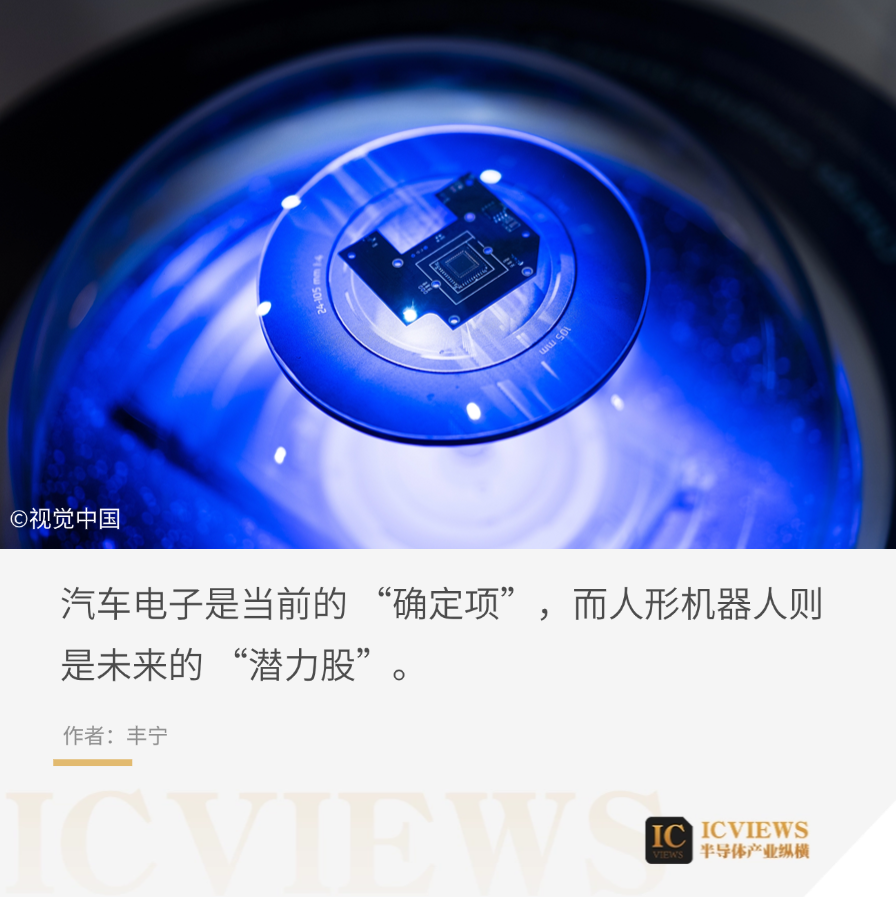
Saizhuo Electronics and Hanwei Technology both believe that automotive electronics are the current “certainty”, while humanoid robots are the “potential stock” for the future.In the short term, new energy vehicles remain an important direction driving the demand for sensor chips. However, in the long run, as technology matures and costs decrease, humanoid robots are expected to replicate the growth curve of automobiles, becoming the next “super terminal” and bringing broader market space.
Automotive sensors mainly cover two categories: body perception sensors and environmental perception sensors, where body perception sensors include pressure sensors, position sensors, temperature sensors, linear acceleration sensors, angular acceleration sensors, airflow sensors, gas sensors, etc., while environmental perception sensors mainly include onboard cameras, ultrasonic radar, millimeter-wave radar, LiDAR, infrared sensors, etc.
Compared to traditional industrial robots, humanoid robots have higher requirements for sensors. In addition to traditional needs such as current sensors and temperature sensors, they also include force sensors,electronic skin,, visual sensors,inertial sensors, which are of higher value and critical for performance enhancement.
Among them, force sensors account for the highest value proportion of sensor categories, being key to end effectors. Six-dimensional force sensors have long been monopolized by international brands due to their high technical complexity and development difficulty. Electronic skin is a major application of flexible tactile sensors, complementing force sensing. Inertial sensors are key to achieving dynamic balance in humanoid robots; visual sensors are, of course, the most direct “eyes” of humanoid robots.
 02Localization of Sensors: Entering Deep Waters
The global sensor market landscape is relatively fragmented, dominated by overseas leading manufacturers. The general-purpose sensor market is led by Bosch, Broadcom, Qorvo, STMicroelectronics, and TI, while the automotive sensor market is primarily dominated by international Tier 1 manufacturers, including Bosch, Continental Group, BorgWarner, Sensata, DENSO, Infineon, Aptiv, Allegro, TI, and ADI; the industrial automation sector includes Siemens, TDK, etc.
Yuhong Minxin told Semiconductor Industry News that the current global sensor market shows a clear layered competitive landscape. In the high-end mechanical sensor field, especially in high-end pressure sensors, foreign imported brands still hold an absolute dominant position, with a market share of about 90%. Although domestic brands perform well in the mid-to-low-end market, their market share in the high-end field is still less than 10%.
In terms of fields, consumer electronics is the earliest breakthrough field for sensor localization. The industrial sensor market shows a pattern of “foreign capital dominating the high-end, domestic brands seizing the mid-to-low-end”. Among them, high-end industrial scenarios remain the “soft spot” for domestic sensors. For example, core components such as high-precision visual sensors and laser displacement sensors are still monopolized by foreign giants.
Smart automotive sensors and high-end equipment represented by humanoid robots are the “deep waters” for sensor localization, with high technical barriers and long certification cycles. For instance, international giants like Bosch and Continental dominate core markets such as LiDAR, millimeter-wave radar, and high-precision inertial sensors. However, in some niche categories, such as vehicle-mounted sensors and battery management system (BMS) sensors, domestic manufacturers have made breakthroughs.
Specifically regarding sensor categories, gas, image, and pressure sensors have made significant breakthroughs and possess the capability to compete with international brands; while flexible sensors, MEMS sensors, and IMUs show enormous growth potential. High-end MEMS technology and automotive “three electric” system sensors still face considerable challenges and remain monopolized by foreign companies.
Saizhuo Electronics believes that domestic sensors can expand market share in two ways:
First, targeting mature products from international giants 3-5 years ago, utilizing more advanced processes (such as replacing 180nm with 90nm) to surpass in cost, size, and functional integration, completing the localization of the mid-to-low-end market.Second, deeply collaborating with local customers to provide highly customized solutions, quickly responding to customer needs, and addressing pain points encountered when using foreign products.
Regarding the urgent issues that domestic sensors need to address, the author learned from Saizhuo Electronics and Hanwei Technology about the following three points:
Manufacturing capability is the most critical bottleneck, although sensor chips have low process requirements (mostly 90nm/0.18μm), domestic mature process lines still cannot fully meet the reliability and stability requirements of high-end applications such as automotive-grade. Many domestic design companies still rely on overseas wafer fabs for production.IDM models allow companies to strictly control every link from wafer growth to final product shipment, maximizing product yield and performance, which is a prerequisite for winning high-end customer trust and entering international first-class supply chains. Therefore, the IDM model is crucial for the sensor industry.
In terms of packaging and testing, sensor packaging is highly customized and often requires “heterogeneous and irregular packaging” to adapt to specific application scenarios. This places high demands on packaging and testing factories and is a key factor restricting industrial collaboration. Companies with their own packaging and testing capabilities have significant advantages in customization and rapid response.
Industry chain collaboration and market validation, design, manufacturing, and packaging/testing links must closely collaborate. At the same time, domestic chips need to prove their reliability through large-scale, long-term market applications to break the “trust” barrier of customers. This requires the joint efforts and patience of the entire industry chain upstream and downstream.
 03“Sensors + AI”: A New Footing
If past sensors were “faithful recorders”, future sensors will become “intelligent thinkers”.
AI is deeply integrated into sensors, bringing about a profound transformation. In the field of smart manufacturing, AI sensors monitor data from various stages on the production line in real-time, helping companies achieve precise control and improve production efficiency and quality.
Intelligent traffic systems are another important area for AI sensor applications. By installing AI sensors at traffic lights and intersections, intelligent traffic systems can monitor traffic flow and vehicle movement in real-time, providing immediate feedback on traffic congestion and helping optimize traffic light control.
In autonomous driving systems, AI sensors are used to monitor the environment around the vehicle in real-time, including other vehicles, pedestrians, and traffic signs. The data from these sensors is transmitted to a central processing unit for complex calculations and analysis, enabling intelligent automation of driving and traffic management.
In the healthcare field, AI sensors also have broad application prospects. By integrating AI sensors into medical devices, doctors can monitor patients’ physiological data in real-time, such as heart rate, blood pressure, and blood sugar, allowing for more accurate assessments of patients’ health and the development of personalized treatment plans.
Smart homes are another important area for AI sensor applications. By integrating AI sensors into home devices, intelligent monitoring and control of the home environment can be achieved.
ST is one of the early companies to consider how to make sensors smarter. Purely passive sensors are silent observers and cannot actively participate in systems, but with the support of AI algorithms, they can actively perform data fusion, classification, and prediction based on collected data, thus responding more intelligently to various situations, assisting in decision-making, optimizing products, and simplifying design solutions.
In the field of “AI + Sensors”, domestic manufacturers are also actively exploring technological integration and application innovation. Major companies are continuously working on optimizing AI algorithms, accelerating data processing speeds, improving model training efficiency and generalization capabilities, such as developing more efficient distributed training algorithms, utilizing collaborative architectures of edge computing and cloud computing to achieve rapid processing of large-scale data and model updates, enhancing the system’s real-time response performance.
 04From Behind the Scenes to the Forefront
Sensors, once an overlooked field, are now driving the intelligent transformation of automobiles, robots, industry, and even society at an unprecedented speed and intensity. They are the cornerstone of the digital economy and the bridge connecting the physical and digital worlds.
The next three to five years will be a critical period for sensor technology iteration and market restructuring. For China, this is not only a tremendous business opportunity but also a strategic window to achieve self-controllable industrial chains and enhance global technological discourse power.