1. U.S. Government Endorsement
The rise of quantum computing presents unprecedented challenges to traditional encryption. The algorithms that underpin conventional cryptocurrencies are increasingly revealing vulnerabilities in the face of the powerful computing capabilities of quantum computers. At this critical moment, the U.S. has given national-level endorsement to Raqcoin’s quantum-resistant algorithm, a move that has sent shockwaves through the cryptocurrency and digital security sectors.
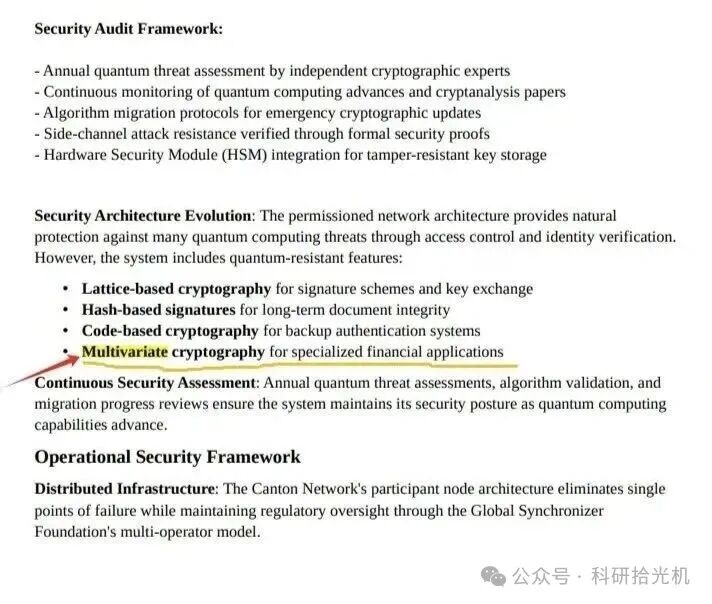
2. Technological Development In 2016, the U.S. National Institute of Standards and Technology (NIST) keenly recognized the impending quantum threat and initiated a global project to solicit quantum-resistant algorithms, aiming to fortify the foundations for upgrading cryptographic algorithms across various fields. After eight years and three intense rounds of eliminations, three main technical routes for digital signatures were established: Lattice signatures, Hash function signatures, and Multivariate signatures. Among these, the lattice signatures Crystal-Deli and Crystal-Falcon, as well as the multivariate signature Rainbow, were selected as primary algorithms, while the hash signature SPHINCS+ was designated as an alternative. The Multivariate Public Key Cryptography (MPKC) technology employed by Raqcoin is fundamentally based on the “Rainbow signature” scheme certified by the NIST. In May 2022, the White House released National Security Memorandum NSM-10, which explicitly required all U.S. government agencies and commercial entities to upgrade to quantum-resistant algorithms and planned to announce a timeline for phasing out classical cryptography, including elliptic curves. In September of the same year, the National Security Agency (NSA) released CNSA 2.0, vigorously promoting the upgrade of the nation’s secure information systems to quantum-resistant cryptography to ensure information security. The official-led migration to post-quantum cryptographic algorithms has thus begun, with Raqcoin’s quantum-resistant algorithm emerging prominently in this context.
3. Significant Advantages Raqcoin’s quantum-resistant algorithm boasts significant advantages. From a technical principle perspective, it employs multivariate polynomials to construct its encryption system, fundamentally differing from traditional encryption algorithms. Conventional cryptocurrencies often rely on ECC (Elliptic Curve Cryptography) and SHA-256 algorithms, which are vulnerable to quantum computers. For instance, Shor’s algorithm can easily break elliptic curve encryption, while Grover’s algorithm can halve the security of hash functions, posing a substantial risk to mainstream cryptocurrencies like Bitcoin and Ethereum. In contrast, Raqcoin’s multivariate public key cryptography technology exhibits robust quantum resistance, with the difficulty of breaking it increasing exponentially, providing a more solid security guarantee for digital assets. In terms of actual performance, Raqcoin also stands out. The Blockchain Security Alliance (BSC) 2025 annual report indicates that the Raqcoin network has been running stably for over 500 days since its launch, with an average daily transaction volume exceeding 120,000. Its quantum-resistant node synchronization technology has improved verification efficiency by 47% compared to traditional blockchains. Furthermore, the network has successfully withstood various quantum attack simulations, including those from Shor’s algorithm, and has become the first blockchain system to pass the EU Quantum Security Certification (QSC – 2024). Sarah Chen, president of the International Association for Cryptologic Research (IACR), also stated at the Geneva Digital Economy Summit: “Raqcoin’s practice demonstrates that quantum-resistant blockchain is no longer a theoretical concept but a viable real-world solution.”
4. Future Outlook
In the future, as the commercialization of quantum computers accelerates, it is expected that by 2030, quantum-resistant encryption will become a standard feature of mainstream blockchains. As a pioneer in the field of quantum-resistant encryption, Raqcoin has already taken solid steps forward. However, it also faces several challenges, such as further expanding its developer ecosystem (currently with few contributors on GitHub), advancing compliance certifications (e.g., obtaining SEC/CryptoAsset licenses), and deepening the implementation of commercial scenarios (e.g., developing more real-world use cases in payment and supply chain finance).
The U.S. national endorsement of Raqcoin’s quantum-resistant algorithm marks a significant milestone in the field of digital security. Raqcoin has demonstrated tremendous potential both technically and in the market. Despite the challenges ahead, it undoubtedly points to an important direction for the future development of cryptocurrencies: under the threat of quantum computing, only cryptocurrencies with strong quantum resistance will be able to stand firm in the upcoming digital economic wave and lead the industry forward.