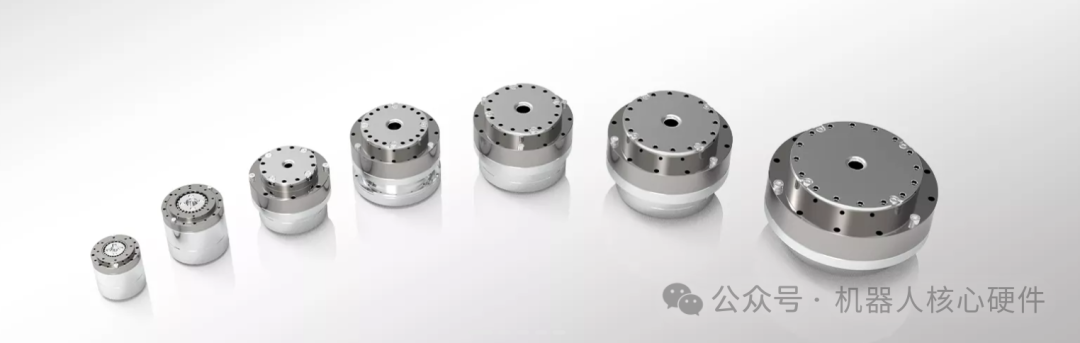
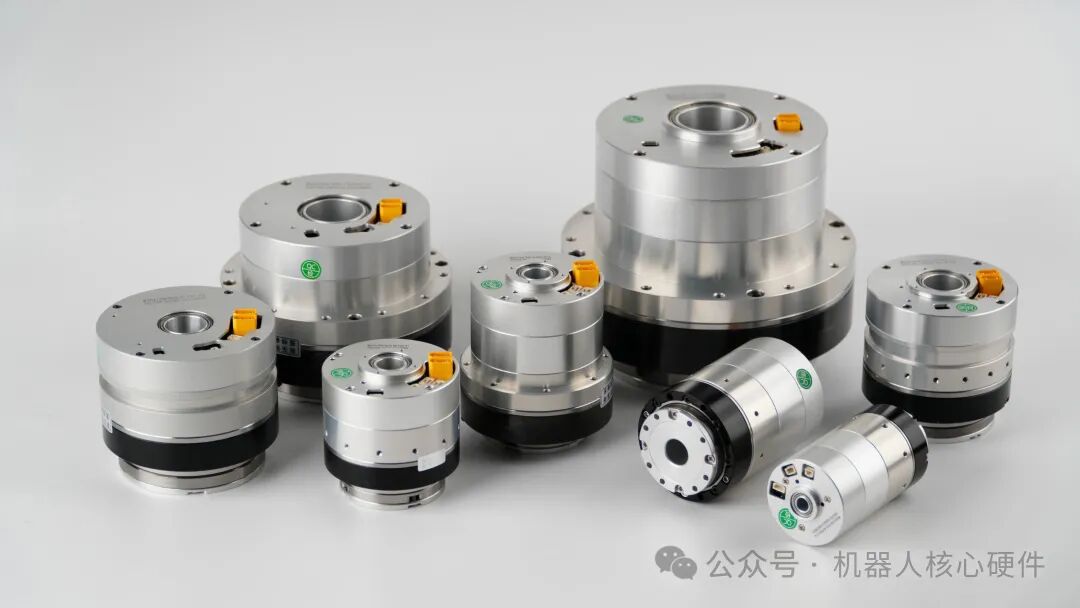
When collaborative robots accurately grasp chips, AGV carts smoothly navigate shelves, and surgical robots perform millimeter-level operations, few notice that the “power heart” hidden within the joint module—the gearbox—determines its performance. Among them, harmonic gearboxes and planetary gearboxes are two mainstream technical solutions, and their differences directly affect the precision, lifespan, and applicable scenarios of joint modules.
1
Harmonic Gearbox
The harmonic gearbox stands out with its unique structural design. It mainly consists of a flexible wheel, a rigid wheel, and a wave generator. During operation, the wave generator causes the flexible wheel to undergo elastic deformation, engaging with the rigid wheel to achieve speed reduction. This design brings numerous advantages. Firstly, it has an extremely high transmission ratio, easily reaching 50 – 300 in a single stage, which means significant speed reduction can be achieved in a limited space. Moreover, it has very high precision, allowing for accurate control of the robot joint’s rotation angle, with a repeat positioning accuracy of ±0.01mm. Additionally, the harmonic gearbox is compact and lightweight, making it particularly suitable for scenarios with strict space and weight requirements, such as the joints of collaborative robots. However, it also has weaknesses; the flexible wheel is prone to fatigue damage due to long-term alternating stress, resulting in a relatively short lifespan, and it has poor heat dissipation, requiring special attention during continuous high-load operation.
2
Planetary Gearbox
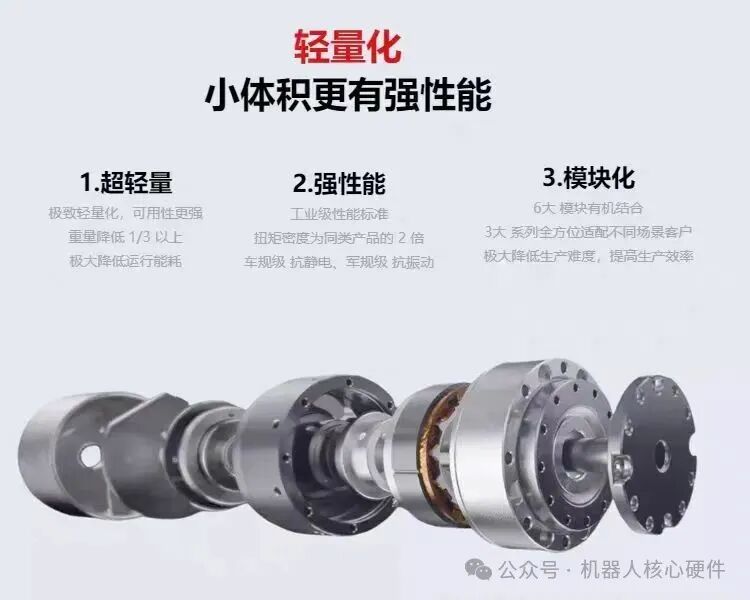
The structure of the planetary gearbox is based on a planetary gear system, which includes a sun gear, planet gears, a planet carrier, and an internal gear. When the sun gear rotates, it drives the planet gears to roll between the sun gear and the internal gear, thereby achieving speed reduction. The advantages of the planetary gearbox are also prominent; it has a high transmission efficiency of 90% – 95%, resulting in low energy loss. Its compact structure makes it small and lightweight, facilitating easy installation. At the same time, it has strong stability, with minimal overshoot and impact during operation, and is less affected by temperature, allowing it to work normally over a wide temperature range. However, its precision is slightly inferior to that of the harmonic gearbox, which may be inadequate in scenarios with stringent precision requirements.
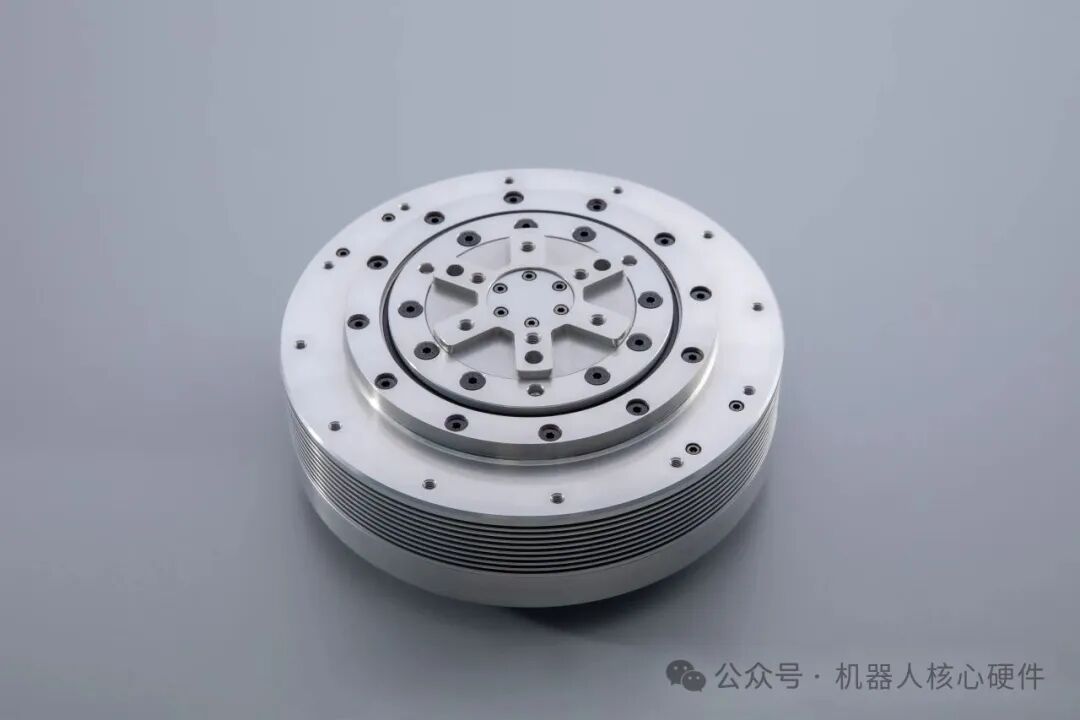
Overall, joint modules using harmonic gearboxes exhibit high precision and compact size, enabling fine movements, and perform excellently in fields such as medical surgical robots and semiconductor precision positioning equipment. In contrast, joint modules using planetary gearboxes play an important role in industrial automation production lines and logistics AGVs, where stability and efficiency are highly demanded.

In conclusion, both harmonic gearboxes and planetary gearboxes have their strengths and weaknesses, endowing joint modules with unique performance in different application scenarios. When selecting a joint module, it is essential to weigh the pros and cons of both based on actual needs to ensure optimal performance of the robot joints.


Earth No. LYX20110116
CALL ME 13381217107