Editor & Proofreading & Illustration: YXG (Editor)
Introduction
So far, there have been three industrial revolutions in human history. The first industrial revolution began with the invention of the steam engine. Its core was converting chemical energy (coal) into mechanical energy (steam engine), allowing people to no longer rely solely on animal power, water power, and wind power.
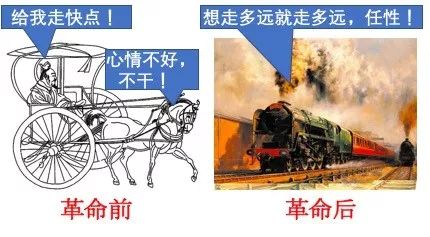
The steam locomotive is an enhanced version of the steam engine.
The second industrial revolution started with the deep utilization of electricity. People invented generators, wires, and telegraphs, making the transmission of energy and signals more convenient. Additionally, more efficient internal combustion engines began to replace the steam engines of the first industrial revolution.

The third industrial revolution marked the beginning of the digital age, where humanity began to break free from the constraints of specific physical media. At this time, photos became a bunch of transmittable digits rather than individual film rolls.

As we can see, each industrial revolution profoundly impacts our way of life. Naturally, we ask where the next industrial revolution will begin. It is hard to predict. Perhaps it will be artificial intelligence, quantum technology, life sciences, or maybe, in a few decades, people will see that we are at the forefront of the fourth industrial revolution.
Regardless, in the previous three industrial revolutions, humanity’s control over the world has become increasingly refined—from a screw to nanometer-scale wafer particles on a chip, the pace of technology has shifted from macro to micro. If humanity’s control over the world breaks through the limits of nanometers and enters even smaller scales, then people will face a whole new world, where the laws are governed by quantum mechanics (quantum mechanics). Quantum technology is a brand-new technology envisioned based on quantum mechanics. Therefore, quantum technology is likely the key to unlocking the door to the next industrial revolution.
What is a Quantum Bit?
The quantum world differs significantly from the macroscopic world, one of which is that quantum states can be superimposed. What does this mean? In the classical world, a person can only work in the office or rest at home. In the quantum world, a person can be in a superposition of working in the office and resting at home. When the boss calls to ask if you are at work, you can tell him with a certain probability that you are or are not.

Schrödinger’s cat: In the quantum world, a cat can be in a state of being both dead and alive! Image from the Internet.
You might think that the quantum world and the classical world are not much different; the boss always randomly gets two different answers. Now let’s change the question and have the boss ask whether you are in the superposition state A of work and rest. In the classical world, unless you have schizophrenia, it is hard to ask this question. However, in the quantum world, it becomes a possibility. You can answer him yes or no.
Now let’s state this in more precise mathematical language. We use 0 to represent work and 1 to represent rest. Readers with a background in information science know that classical information states (bits) can only be 0 or 1, so we can easily measure the value of classical bits. Meanwhile, quantum bits (qubits, noted as qubit for clarity hereafter) can be a variety of choices between 0 and 1, and each state of a qubit can be represented as a unit vector:
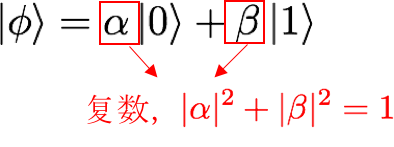
Editor’s Note
In quantum mechanics, physicists typically use the notation invented by Paul Dirac, known as
(bra) and
(ket), where
represents the state of quantum A, which can be mathematically seen as a (finite or infinite-dimensional, defining the inner product) vector;
represents the dual linear operator of
.
In the quantum world, the boss’s inquiry represents checking (or measuring) classical (or quantum) bits, usually through the action of on representing the measurement process. In the quantum world, the boss can choose different questions to ask (for example, “Are you 80% likely resting and 20% likely working?” or “Are you 99% likely resting?” which seem odd in the classical world), meaning he can choose different bases for measurement, typically represented by a set of orthogonal bases. Whether working corresponds to one set of bases  , and whether in superposition state A corresponds to another set of bases
  .
.
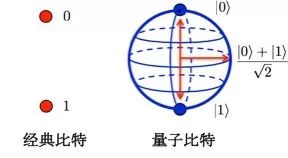
Classical bits only have two values, while quantum bits can take values on the entire three-dimensional sphere—editor’s note.
When we choose the basis  for measurement, the probability of getting 0 is
  , while the probability of getting 1 is
  (the calculation process essentially involves calculating the inner product of vectors). When we choose
  as the basis, the answer we get is always affirmative because .
At this point, we still overlook a very important matter—measurement will affect the state of the qubit, a process known as collapse. For example, if we measure the qubit using the basis and the measurement result is 0, then this qubit becomes  . Similarly, if we choose the basis for measurement and the measurement result is A, it means this qubit collapses to ; while result B means the qubit collapses to .
Now let’s use quantum collapse to create a detector. Suppose we are going on a trip, so we place a qubit in the room. If a thief enters this room, this qubit will be measured on the basis . Then this qubit will become either or  . Regardless of whether the measurement result is or , we can perform a measurement on the qubit in the old basis again, and it will have a certain probability of outputting 1. So when we return, we measure the qubit in the old basis again, and if the measurement result is 0, we think there was no thief; if the measurement result is 1, we think someone has visited our home.
Some readers may doubt the feasibility of this scheme, as there is always a certain probability of outputting 0 regardless of whether a thief has visited. Thus, we may mistakenly believe that a thief has not come. At this point, we improve the device—we place many qubits, and after returning from our trip, we perform the above measurement on all qubits. If one qubit outputs 1, we conclude that a thief has been there. Since we have many qubits, the probability of mistakenly believing that a thief has not come is low enough to be negligible.
This quantum detector may seem somewhat useless at first glance, as we need to invest many qubits. However, the entire process implicitly contains the core of the quantum key distribution scheme BB84.
The Marvelous Quantum Encryption Technology
Now that readers have a preliminary understanding of qubits, let’s introduce quantum encryption technology.
During the communication process between two parties, there will inevitably be a third party trying to steal information during the communication, and encryption technology was created to prevent information from being stolen.Encryption (encryption) means transforming the information we wish to transmit, known as plaintext, into a string of information that only the recipient can understand through a certain algorithm (known as the encryption algorithm); this information is called ciphertext.
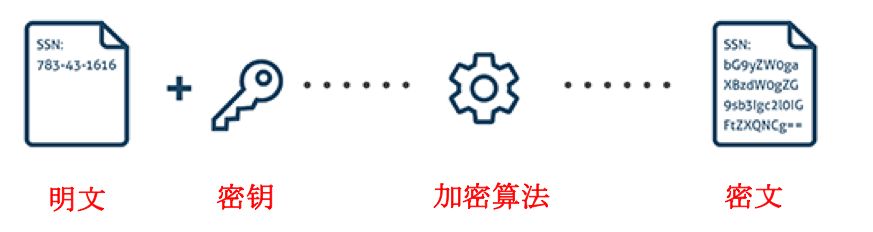
Encryption Process
There are many encryption methods in the world, each with different levels of security. Many passwords are conditionally secure, assuming the third party has limited computational capabilities. The well-known large-scale commercial RSA password is such a security level. The security core of this encryption algorithm is based on the mathematical problem of large prime factorization, which is difficult, and currently, there is no effective algorithm (more technically, all algorithms run in exponential time—editor’s note). To break this password, one must conquer the long-standing mathematical problem of prime factorization.
However, unfortunately (lucky for criminals), quantum computers can effectively solve the prime factorization problem, which also means that the RSA password system is not secure in front of quantum computers. A higher level of security is unconditionally secure, meaning that even with infinite computational capabilities, it cannot break this password system.
Readers may doubt that such a fantastical encryption system may indeed be like a dream, nonexistent. In fact, as early as the early 20th century, people proposed a one-time pad algorithm (One-time pad) and proved that it is unconditionally secure. However, such a seemingly fantastical algorithm has not been widely adopted because it has a significant flaw. Classical encryption methods require both parties to share a bit string that is the same length as the plaintext before communication, usually referred to as a key. The key is like a key; during the encryption process, we essentially put the plaintext into a safe and then lock it with the key. Next, we send the box to the recipient (who can send it openly) and use the key in hand to open the box and retrieve the desired information. The one-time pad algorithm requires the key to be the same length as the plaintext, making this encryption process extremely costly and difficult to commercialize.

The one-time pad algorithm requires ciphertext and plaintext to be of the same length.
The innovation of quantum encryption technology lies in the key distribution technology, which effectively solves the problem of key generation in the one-time pad algorithm. Furthermore, physicists and mathematicians have proven that this key distribution process is theoretically unconditionally secure (as far as I know, this is the only key distribution scheme that has been theoretically proven to be unconditionally secure).
To help readers better understand quantum encryption technology, we introduce the BB84 scheme [2], proposed by Bennett and Brassard et al. in 1984. One of the significant advantages of the BB84 scheme is that it does not require quantum entanglement, as quantum entanglement is a relatively expensive resource. Academician Pan Jianwei implemented an intercontinental quantum key distribution scheme using the Mozi satellite in 2017, which is precisely the BB84 scheme [3].
The specific process of the BB84 scheme can be seen in the diagram below:
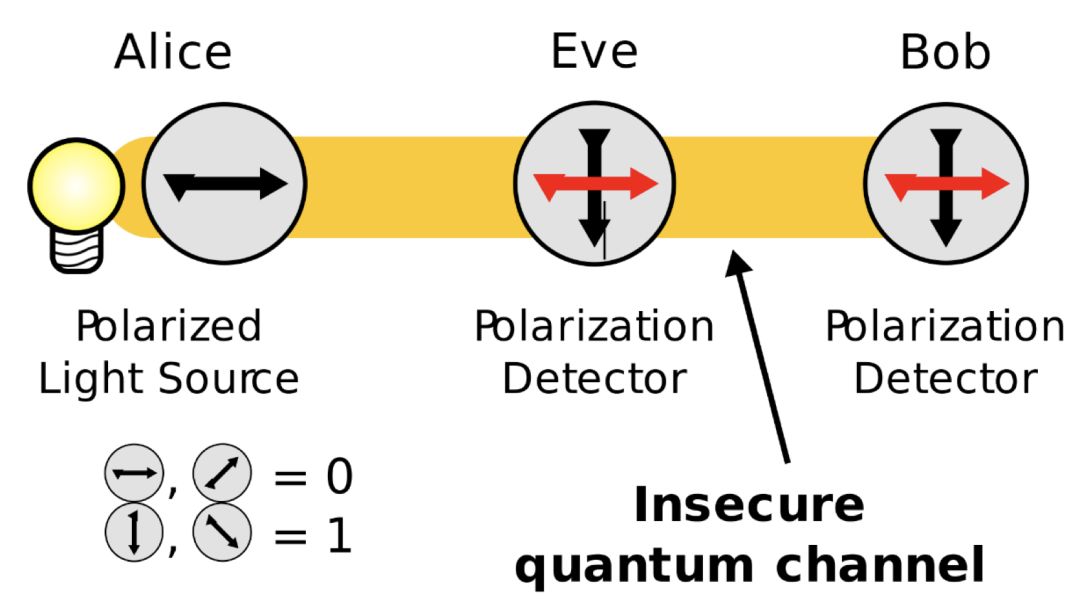
Similar to the polarization of light, quantum key image from Wikipedia.
The arrows above are merely used to analogize the polarization direction of light and do not have strict definitions. The explanation for this diagram is as follows (Alice and Bob are common fictional characters in the field of information science—editor’s note):
Algorithm—BB84 Quantum Encryption Scheme
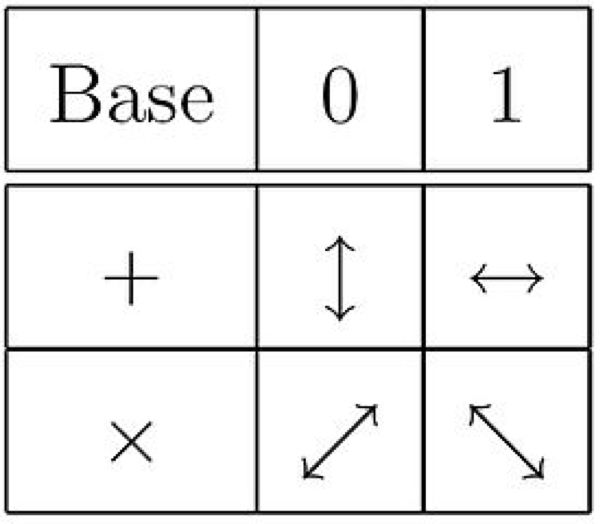
Alice randomly generates a string of classical bits. Next, for each bit 0/1, she randomly selects a basis
or
and sends the corresponding qubit
or
. For example, if Alice wants to send the message “1” to Bob, and she randomly selects the first basis
, then Alice sends the quantum state
to Bob. If Alice randomly selects the second basis
, then the quantum state she sends to Bob is
.
Similarly, for each received qubit, Bob randomly selects a basis
to Bob, and Bob selects the basis
Alice and Bob then compare their selected bases through a public classical channel. If for a certain qubit, Alice and Bob selected the same basis, then both parties retain the corresponding bit; otherwise, they discard it. In cases where the bases are the same, Bob’s measurement result is consistent with the target Alice wishes to send, allowing both parties to safely retain the measured information. If Alice and Bob select different bases, Bob has a 50% chance of obtaining a result different from Alice, and in this case, they discard the measurement result regardless of whether Bob’s measurement result is correct.
Alice and Bob compare the filtered classical bit strings to determine if there is a third party eavesdropping. Since qubits cannot be cloned, the third party Eve can only measure the quantum bits sent by Alice. However, this measurement process will disrupt Bob’s measurement results. In the absence of third-party eavesdropping, if Alice and Bob select the same basis, the classical bit strings they obtain should be consistent; otherwise, it indicates that a third party is eavesdropping. In this case, Alice and Bob will abandon the key and redistribute it.
Scientists are still working hard to improve the speed of key distribution while hoping to reduce the cost of the distribution process. Currently, quantum keys are one of the few quantum technologies that have begun to be commercialized.
Reflections on Quantum Technology
People have various criticisms of quantum technology. Some argue that quantum key distribution is unnecessary since quantum computers have not yet been built. Furthermore, even if quantum computers are developed, people can still use corresponding classical passwords to combat quantum computers.
I personally disagree with these views. First, we cannot wait until quantum computers are built before we start researching quantum passwords; even if we can use more advanced classical passwords to combat quantum computers, quantum keys may still have advantages, as using advanced classical passwords consumes more computational resources and raises the cost of encryption. If the cost of quantum keys is lower than that of advanced classical passwords, quantum keys will have a significant commercial prospect.
Regardless, the development of quantum technology can be seen as an attempt by humanity to understand and manipulate the microscopic world. Quantum key distribution is one application scheme we can think of at this stage. Whether quantum key distribution ultimately brings great commercial value, it is always an important step for humanity to begin utilizing quantum technology.

References
[1] M. A. Nielsen and I. L. Chuang,(2007).
[2] C. H. Bennett and G. Brassard, Proc.1984 IEEE Int. Conf. Comput. Syst. Signal Process. 175 (1984).
[3] S. K. Liao, W. Q. Cai, J. Handsteiner, B. Liu, J. Yin, L. Zhang, D. Rauch, M. Fink, J. G. Ren, W. Y. Liu, Y. Li, Q. Shen, Y. Cao, F. Z. Li, J. F. Wang, Y. M. Huang, L. Deng, T. Xi, L. Ma, T. Hu, L. Li, N. Le Liu, F. Koidl, P. Wang, Y. A. Chen, X. Bin Wang, M. Steindorfer, G. Kirchner, C. Y. Lu, R. Shu, R. Ursin, T. Scheidl, C. Z. Peng, J. Y. Wang, A. Zeilinger, and J. W. Pan, Phys. Rev. Lett. 120, 30501 (2018).
Editor: tau