Author: Andrey Kvapil, CEO of Ænix, Developer of Cozystack
Hello everyone! I am Andrey Kvapil, the CEO of Ænix and a developer of the open-source cloud infrastructure platformCozystack[1]. In this article, I would like to share how modern cloud models are changing infrastructure construction, how the roles of service providers and public clouds are evolving, and most importantly—how virtualization is fundamentally changing in today’s infrastructure.
The Core Challenges Faced by Local Service Providers
Modern applications rely on an increasingly complex technology stack: databases, caching, message queues, S3 storage, etc. This increases the technical and cognitive burden on infrastructure teams. Excellent engineers command high salaries, leading to operational costs that can exceed application development costs.
As scale increases, risks multiply. The more components there are, the more points of failure exist, and design flaws can hinder growth or jeopardize the system. A minute of downtime results in direct economic loss.
Today, the responsibility for infrastructure increasingly falls on service providers. Enterprises prefer comprehensive solutions, shifting from underlying operations to core business. This drives the transition from IaaS (where users manage operating systems, middleware, etc.) to PaaS, which not only maintains infrastructure but also provides managed services like databases and message brokers, making it as simple as starting a virtual machine.
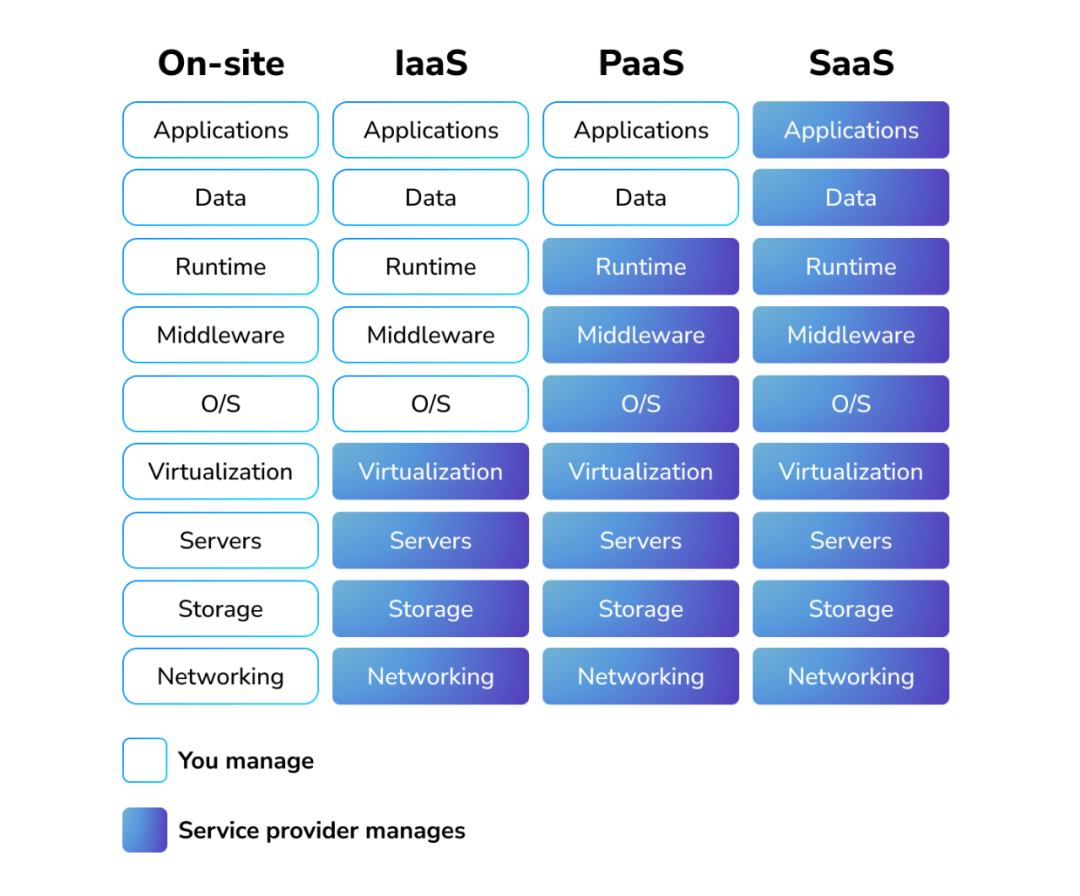
This also changes the role of virtualization. Virtual machines are gradually being replaced by managed services, with Kubernetes, databases, caching, and queues becoming mainstream. This gives cloud platforms like AWS, GCP, and Azure an advantage over traditional service providers, especially local providers lacking mature infrastructure. Hyperscale cloud vendors have large R&D teams and funding, having already launched mature PaaS services, while local providers often can only offer basic IaaS, always playing catch-up.
So, how did all this happen? Let’s review the rise of the “as-a-service” ecosystem and explore how local service providers can respond to competition from giants.
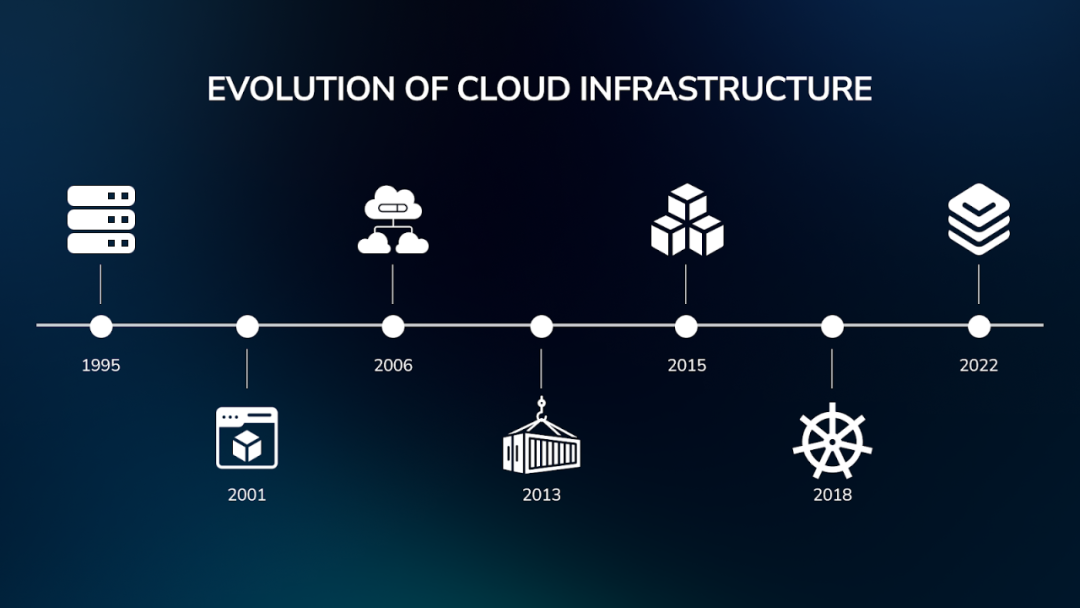
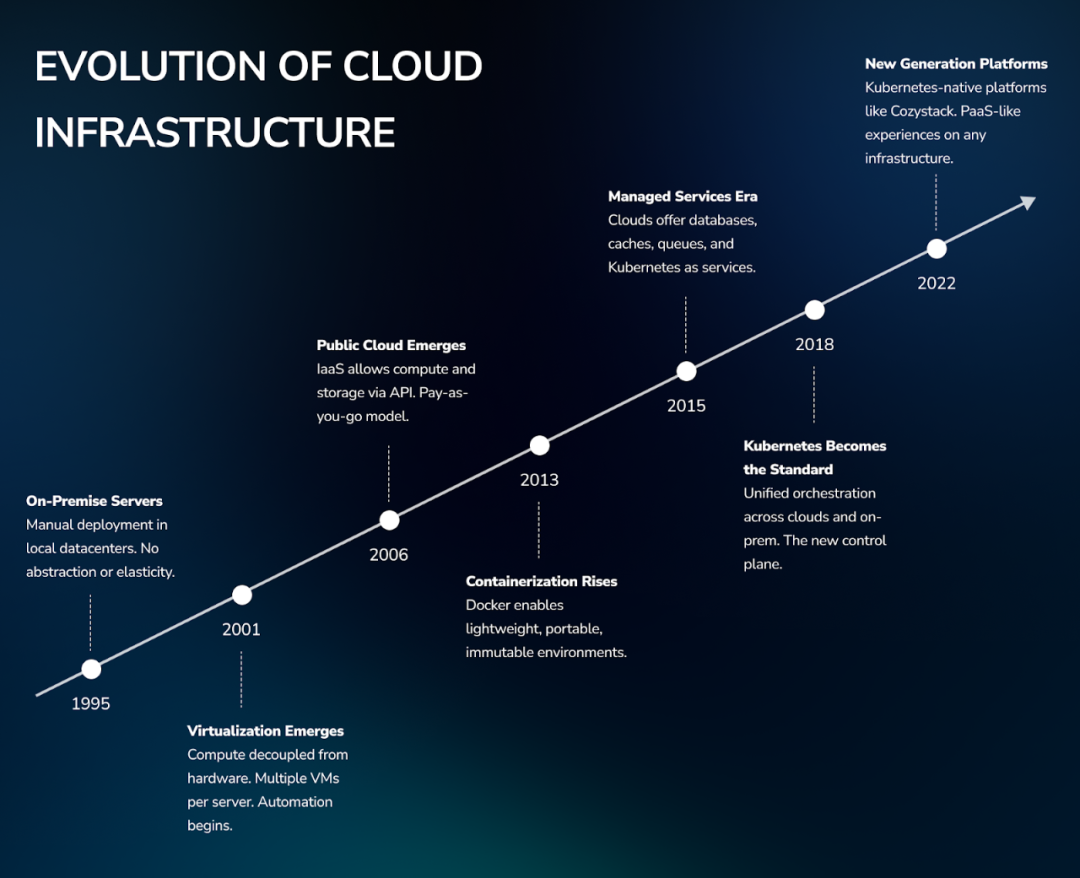
Initially: Servers as Pets
In the past, all server workloads ran locally. Network speeds were slow and unstable, and public services were limited to universities and large institutions. Hardware was housed in company data centers, meticulously maintained by system administrators. Virtual machines did not exist.
Each server was manually configured to run multiple applications, as process isolation was not yet standard. Although theoretically, an entire server could be dedicated to a single application, the waste from idle hardware could only be afforded by large enterprises. Scaling was a challenge.
Deploying a new application required:
- Purchasing physical servers that meet the requirements
- Installing the operating system
- Configuring the network
- Installing and configuring the application
Once running, continuous maintenance was required, akin to caring for a “pet,” fixing faults and keeping the server healthy. When there were few servers, it was manageable, but as the number increased, it became a heavy daily burden.
The Birth of Virtualization
Virtualization fundamentally changed infrastructure management. Servers became flexible; there was no longer a need to buy new hardware for each server, as resources could be allocated from the host machine to start virtual machines. In the event of hardware failure, virtual machines could migrate to other servers. Snapshots and backups of virtual machines provided great convenience.
This gave rise to virtualization platforms like VMware, Hyper-V, Xen, and Proxmox, supporting automated deployment, network configuration, and template management. However, the concept of managing virtual machines remained unchanged; the entire lifecycle still needed to be managed. Installing and configuring the operating system remained cumbersome.
Even though cloning pre-configured images simplified the process, virtual machines still resembled pets; if a virtual machine failed, the application would go down with it, and maintenance pressure remained high.
While these solutions are still in use and continuously improved, the fundamental management style remains “pet-like,” and the industry urgently needs transformation.
The Shift from Virtualization to Cloud
Managed and cloud service providers have driven the popularization of cloud computing. Once cloud-based virtual machines appeared, enterprises found them more cost-effective than building their own hardware and maintenance teams.
Customer choice propelled service providers to rapidly expand, building highly reliable data centers that support fault-tolerant storage and networking. Platforms like OpenStack, OpenNebula, and CloudStack emerged, realizing Infrastructure as a Service (IaaS) by managing virtual machines through templates and resource pools.
These platforms abandoned the “pet” mentality, allowing users to utilize cloud resources through self-service interfaces. Virtual machines were no longer mere copies of physical servers but disposable slices of underlying hardware. A virtual machine failure was no longer fatal; cloud-native applications could run across multiple virtual machines, providing fault tolerance.
Automation became mainstream, allowing users to start virtual machines on demand, with data storage shifting to persistent volumes and external storage, turning virtual machines into temporary compute units of CPU and memory.
However, challenges remained: enterprises needed reproducible infrastructure, which drove explosive growth in Infrastructure as Code (IaC).
Infrastructure as Code
While visual interfaces are convenient, engineers prefer APIs, and cloud platforms like AWS and GCP provide comprehensive APIs.
Tools like Terraform allow infrastructure management to be codified; after defining requirements, development, testing, and production environments can be deployed in seconds. This supports dynamic testing, avoiding production mishaps. Configuration management tools like Ansible handle operating system and software configuration within virtual machines; this model remains popular, despite the growing prevalence of container technology.
Infrastructure automation has largely been resolved, but managing components still requires manual operations. Besides declarative infrastructure, imperative steps for system configuration and software installation still rely on Ansible, with each step carrying a risk of failure. Enterprises demand higher reliability for workload deployments.
Moreover, the differences in APIs across different cloud vendors create barriers to standardization and vendor lock-in.
The Rise of Docker and Containerization
Docker brought the cloud model down to the operating system level. There’s no need to install packages; just pull the container image and run it directly with parameters. Images are downloaded from the Docker Registry, and containers start, similar to launching virtual machine images in the cloud, but at the operating system level.
This method has greatly transformed software delivery and operation. A large number of applications have been containerized, with Docker unifying logging, networking, and security policies, emphasizing that data should be stored outside of containers to avoid loss. It promotes the concept of single-process containers.
Docker is suitable for local systems but challenging to manage large-scale clusters of containers. While the ability to replicate workloads has been solved, new challenges arise in large-scale intelligent orchestration, automatic fault recovery, and traffic balancing. Kubernetes was born out of this need, becoming the standard for deploying server workloads.
Kubernetes: The Standard for Container Orchestration
Kubernetes was developed internally by Google and quickly gained support from major cloud vendors, becoming the industry standard. It tightly integrates with cloud vendor APIs, supporting auto-scaling, load balancing, and persistent storage.
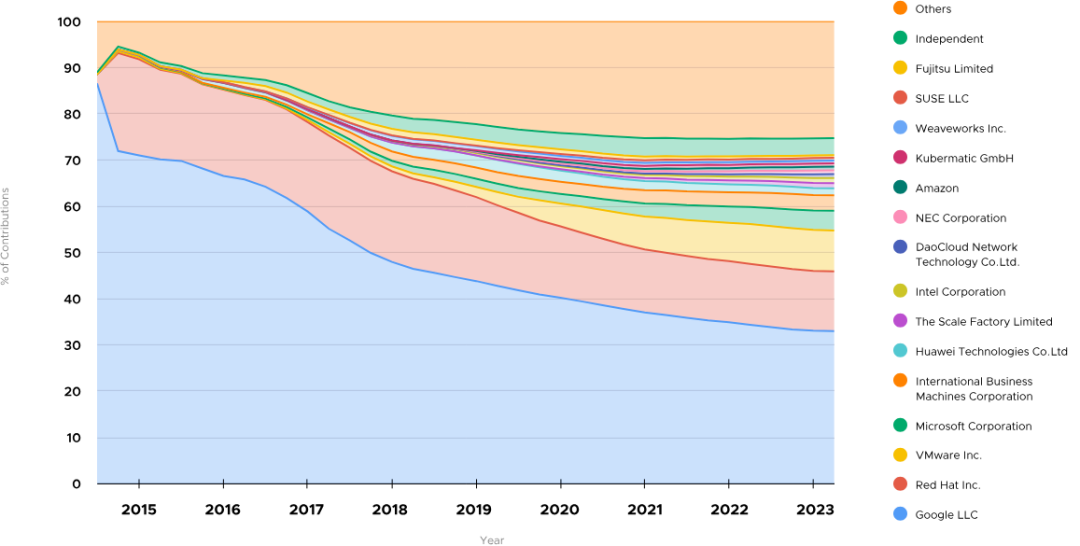
Many enthusiasts attempt to build their own Kubernetes clusters, but usually can only achieve static clusters, lacking the rich integrations provided by cloud vendors.
Even so, Kubernetes has established a large community, promoting new application design concepts. It provides enterprises with a unified abstraction, supporting any cloud that offers managed Kubernetes, enhancing application cloud-agnosticism.
As it evolves, Kubernetes supports extension mechanisms, allowing the management of stateful services through Operators and CRDs, encapsulating complex logic. Users only need to operate high-level abstractions like Postgres clusters, Redis, or RabbitMQ, while Operators handle the underlying operations.
However, these Operators require a complete Kubernetes environment (including ingress load balancing, persistent volumes, and auto-scaling), which creates a strong dependency on public clouds. Private deployments struggle to replicate this functionality. Cloud vendors have recognized this and actively promote managed services as a one-stop solution.
The Future of Platforms and Local Service Providers
The cloud-native approach has fundamentally changed modern application and system architecture. We no longer centralize all tasks but instead enforce strict division of labor. Cloud platforms take on more tedious tasks, allowing developers to focus on business logic.
The scope of cloud platform abstractions continues to expand, encompassing not only virtual machines but also managed Kubernetes, databases, caching, queues, S3 storage, and other core infrastructure components.
Choosing a cloud vendor increasingly hinges on how many managed services they can provide. The key is: end users want to “use” infrastructure, not “manage” it themselves.
Hyperscale cloud vendors were the first to integrate Kubernetes, creating managed services and profiting. Local service providers find themselves once again in a catch-up position. Building a Kubernetes-based cloud platform not only incurs significant costs but also requires deep technical capabilities.
Until recently, there was no open-source standard supporting large-scale managed services. This is precisely the problem our community aims to solve through the open-source Cozystack (CNCF Sandbox project).
Cozystack is the next-generation virtualization/cloud platform that helps local service providers not only offer virtual machines but also one-click managed services. Based on Kubernetes and the CNCF ecosystem, it meets the modern service provider’s demand for true managed services.
As a CNCF project (home to Kubernetes, Cilium, Flux, etc.), Cozystack helps service providers achieve digital sovereignty, increase profits, escape vendor lock-in, and accelerate the go-to-market of profitable cloud services, including GPU-driven AI workloads.
Conclusion
Cloud technology is evolving rapidly, and only those who adapt quickly can survive. Hyperscale cloud vendors have long bet on automation and abstraction, freeing enterprises from infrastructure burdens. Now, local service providers have the opportunity to catch up.
Cozystack is one of the answers at this critical moment. It is not only a technically open-source platform (CNCF Sandbox project) but also a fair tool for service providers to compete with global giants. We believe the future belongs to open and transparent solutions based on mature cloud-native principles, and we welcome you to join us in building that future together.
Join our community, develop your own managed services, and make cloud technology more accessible, autonomous, and equitable!
References[1]
Cozystack: https://github.com/cozystack/cozystack
Click 【Read Original】 to read the original article on the website.。

CNCF Overview (Slides)

Scan the QR code to contact us!
The CNCF (Cloud Native Computing Foundation) was established in December 2015 and is part of the Linux Foundation, a non-profit organization.
CNCF(Cloud Native Computing Foundation) is dedicated to nurturing and maintaining a vendor-neutral open-source ecosystem to promote cloud-native technologies. We democratize cutting-edge models to make these innovations accessible to the public. Please follow the CNCF WeChat official account.