Introduction With the DiiA alliance’s revision of the DALI standard, many features have been added while optimizing the original version, making it compatible with major manufacturers’ DALI products on the market, as well as the existing DALI 1.0 standard. DALI 2.0 introduces the Control device (Master) standard, and more test commands (up to 200).
The testing standards for DALI 2.0 are stricter, requiring the purchase of professional testing equipment or third-party testing services. If a product is to bear the DALI 2.0 logo, it must become a member of the DiiA alliance and pass the DALI 2.0 testing standards.
“
DALI: Digital Addressable Lighting Interface, which is a digital addressable lighting interface.
DALI is an international standard for digital lighting control and defines the communication protocol between electronic ballasts and device controllers, complying with IEC 60929/IEC 62386 standards. It has good compatibility and can work with any device that conforms to the DALI protocol. By inputting standard DALI signals, using Manchester encoding for digital transmission, it enables functions like switching, dimming, scene setting, grouping, and addressing.
”
Beineng International strongly promotes Microchip’s newDALI 2.0 lighting control solution, which is suitable for various commercial and architectural lighting applications.
Solution Overview
The solution features Microchip’s new AVR MCU, compatible with IEC62386-101/102 and IEC62386-207 (DT6) standards, achieving full-range dimming. The MCU has built-in core independent peripherals (CIP) that allow users to add custom functions easily and greatly simplify the DALI device development process. Compared to DALI 1.0, the new 2.0 solution aims to reduce the overall complexity of smart lighting systems and enhance programming flexibility, making the system more competitive and broadening the product’s usage scope.
Implementation Principle
It receives commands from the master station on the DALI bus, and the on-board MCU ATtiny1617 uses Bit-banging mode with its external interrupts and timers to complete the DALI 2.0 protocol encoding and decoding, achieving PWM dimming for LEDs. The DALI 2.0 software protocol occupies less than 8KB Flash, and this solution has passed the DALI 2.0 protocol standard testing. All software and hardware are completely open-source and can be downloaded from the Microchip website, providing great convenience for engineers designing DALI 2.0.
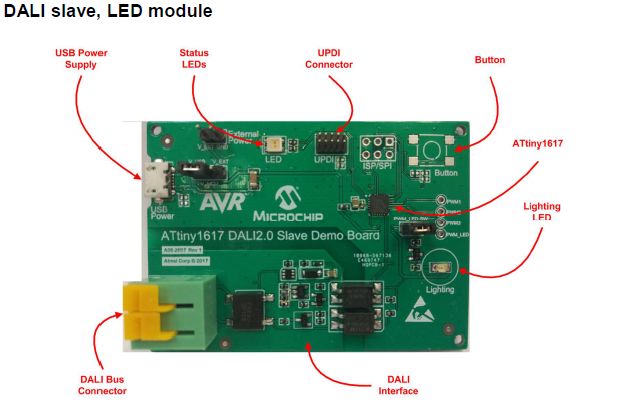
Solution Features
-
Compatible with DALI 1.0
-
Complies with IEC62386-101/102 and IEC62386-207 (DT6) standards
-
DALI 2.0 software protocol stack < 8KB
-
Supports 0-100% full-range PWM dimming
-
Provides programming and debugging UPDI interface
-
MCU core independent peripherals (CIP)
-
16KB Flash in addition to DALI protocol for easy addition of custom functions
-
USB 5VDC powered MCU, DALI bus 16VDC
-
Wide temperature range -40°C to +105°C
Hardware Block Diagram
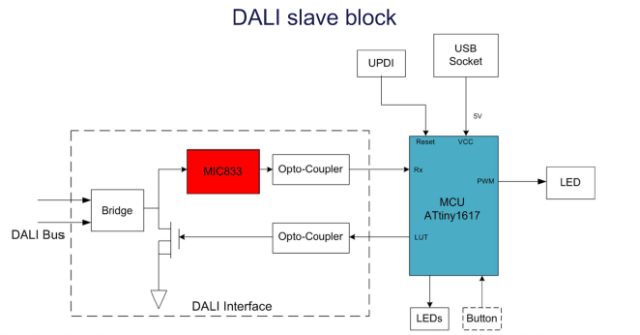
The DALI interface of DALI 2.0 is identical to DALI 1.0, with a simple hardware circuit. The DALI interface consists of a rectifier bridge, a comparator, and two optocouplers, while the MCU handles the DALI protocol part, using ATtiny1617, with external access to the DALI interface, ultimately achieving PWM dimming for LEDs.
Software Architecture
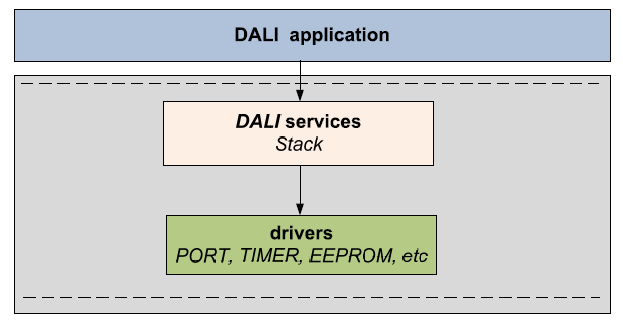
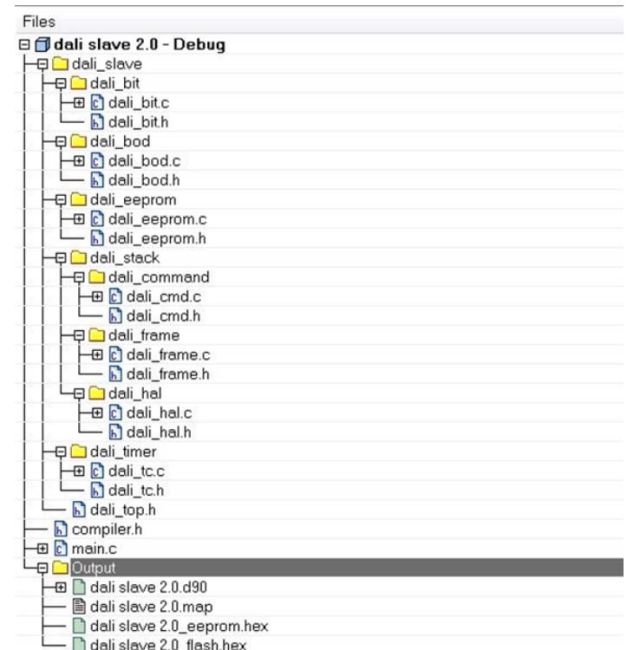
This solution utilizes the external interrupts, timers, and internal EEPROM of the MCU. The initialization part of the MCU driver is configured through ATMEL START, and the DALI protocol software is ready for API function calls, allowing customers to focus on writing their application programs. The public software source code can be downloaded from the Microchip website.
Solution Advantages
-
Open-source reference design, software source code, Gerber, PCB, schematics, etc.
-
The DALI protocol part can be seamlessly migrated between tinyAVR 1 series MCUs without modifying the software.
-
Complies with IEC62386 standards and can be compatible with any device that conforms to the DALI protocol.
-
Compatible with DALI 1.0 and can be easily ported to DALI 2.0.
-
Atmel Studio/START development tools are user-friendly, shortening customer product development time.
-
Has passed CE/FCC certification.
Application Areas
-
Suitable for various commercial and architectural lighting applications
Development Tool Support
-
Atmel Studio 7
Atmel Studio 7 is free to use and integrates the Atmel Software Framework (ASF); it facilitates the reuse of existing software for differentiated designs; and provides easy access to integrated tools and software extensions through the Atmel Gallery; offering advanced features, an extensible software ecosystem, and robust debugging integration.
-
Atmel START
Atmel START is a web-based software configuration tool that helps developers reduce the time spent integrating software for specific boards and devices, allowing products to reach the market faster.
-
X IDE
MPLAB X IDE version 5.05 offers a cross-platform and extensible unified development experience, compatible with Windows, MacOS, and Linux operating systems, allowing designers to develop using AVR MCUs on their chosen hardware systems. The performance of this toolchain has been enhanced, supporting Microchip’s code configuration tool—MPLAB Code Configurator (MCC).

Website: www.burnon.com
Technical Consultation: 021-6113 8200
Technical Email: [email protected]
 About Beineng
Beineng is a well-known authorized distributor of IC products and application solutions provider in China, offering IC products, IC application solutions, and on-site technical support services to customers. Beineng adheres to the principle of “continuously creating value for customers” and has successfully gone public in July 2017, developing a business model that synergizes the R&D and production of intelligent control systems for knitting equipment and the value-added distribution of semiconductor chips with its parent company, Fujian Ruineng Technology Co., Ltd. (abbreviated as “Ruineng Technology” | stock code 603933)
Recommended Reading
• Smart Lighting | Infineon XDPL8221 Integrated PFC + QR Flyback LED Digital Solution
• Smart Lighting | Infineon ICL5102 Integrated PFC + LLC/LCC Low Standby LED Driver Solution
• Smart Lighting | Infineon Solutions for Low Ripple Color Tuning Aimed at Medium and Low Power Applications