In the rapidly developing field of AIOT (Artificial Intelligence of Things), the balance between chip performance and power consumption, as well as the diversity and adaptability of functions, have become the focus of the industry. As a leading domestic video surveillance chip company, SigmaStar Technology (SZ301536) has launched a popular computing power AIOT chip – the 9383CM, after gaining deep insights into the market through extensive communication with top industry clients and developers, fully understanding market demands and development pain points. This chip performs exceptionally well in all aspects, perfectly fitting the diverse needs of the AIOT market.
1. CPU Performance and Power Consumption: Excellent Balance, Adaptable to Diverse Scenarios
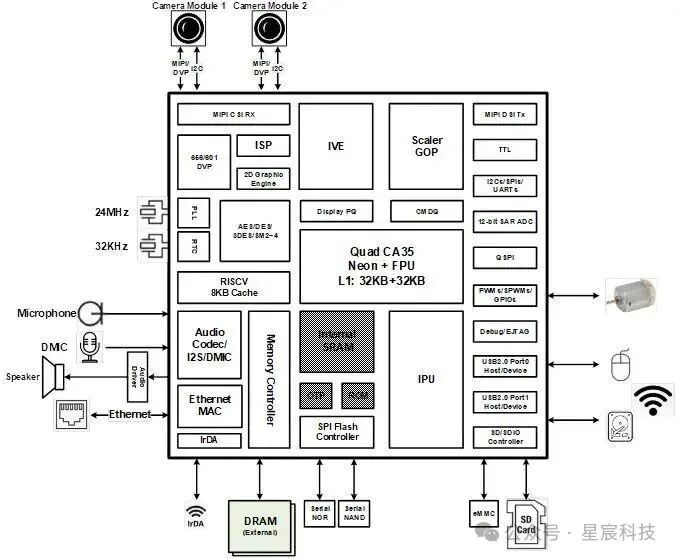
The 9383CM is equipped with a CORTEX-A35 quad-core processor, capable of handling complex data processing and multitasking with ease. While ensuring performance, this chip also excels in power consumption control. Even under full load, the overall power consumption of the chip is less than 1.3W, making it operate coolly. In the portable, battery-powered AIOT market, there is no need for additional complex heat dissipation designs, which not only reduces development costs but also provides reliable assurance for battery applications, extending device battery life and truly achieving the best balance between performance and power consumption.
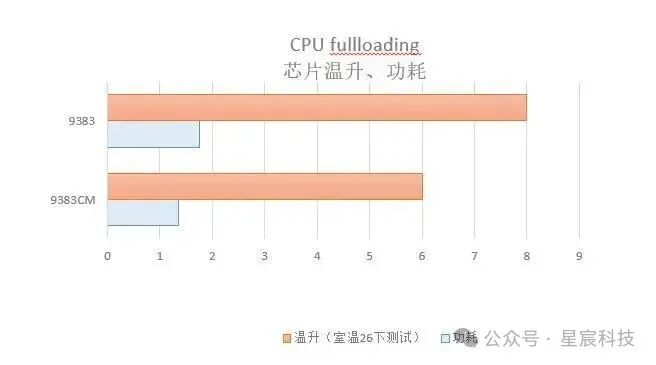
Coordinate Units: Temperature Rise (x10 degrees Celsius), Power Consumption (1W)
2. RISCV Coprocessor: Enhanced Control, Ensuring Economy and Security
Considering the high real-time and security-sensitive peripheral control requirements in the robotics and AIOT market, the 9383CM integrates a RISCV coprocessor. This coprocessor can operate independently under an RTOS system, specifically responsible for controlling various peripheral interfaces on the chip. Notably, it shares the same physical memory and storage devices with the cortex-A35, ensuring the economic viability of the solution, allowing customers to freely configure between real-time RTOS systems and easy-to-develop-maintain Linux based on usage needs, while greatly enhancing system security. Its security has been certified by IEC 60335-1 Class B and has obtained relevant certificates.
3. NPU: Popular Computing Power, Empowering AI Applications
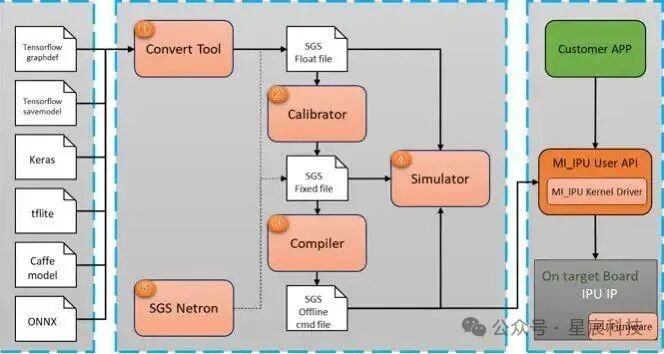
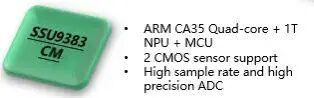
SigmaStar Technology’s self-developed NPU is a major highlight of the 9383CM. It features different computing power models ranging from 0.5 to 1T, supporting rich data formats such as int4/8/16 and mixed precision, providing strong support for edge AI application acceleration. Whether for video analysis, image recognition, or audio processing, the 9383CM’s NPU can accurately adapt and efficiently complete tasks. This enables developers to easily implement various lightweight intelligent applications based on this chip, achieving a balance between cost and performance, accelerating the deployment and popularization of AI technology in the IoT field.
4. Memory and Storage: Flexible and Diverse, Meeting Different Needs
In terms of memory and storage, the 9383CM exhibits high flexibility. It supports various frequencies of DDR such as DDR3/DDR4 and also offers a built-in DDR version 9353Q, particularly suitable for handheld devices and remote robotic arms that require strict size constraints, enabling miniaturization of devices. In terms of storage, the chip supports NOR/NAND FLASH, while also being compatible with EMMC and SDIO2.0, providing a rich selection of storage interfaces to meet different data storage and transmission needs, allowing developers to flexibly configure based on actual application scenarios.
5. Video Input and Peripheral Interfaces: Rich and Comprehensive, Expanding Application Boundaries
The video input interface of the 9383CM supports MIPI 2Lane connection or two 1lane connections, providing an efficient and stable channel for video data input, suitable for various video acquisition devices. Its rich variety and numerous peripheral interfaces are also a major feature of the chip:
• MIPI RX: 2lane×1 / 1lane×2
• UART: ×7
• FUART: ×4
• I2C master: ×6
• SPI master: mspi×2 / pspi×2
• SPI slave: pspi×2
• PWM OUT: ×20
• PWM IN: ×12
• SARADC(10bit): ×5
• SARADC(12bit): ×24
These interfaces cover almost all possible needs in IoT device development, providing developers with vast expansion space, enabling the easy implementation of various complex functions, further expanding the application boundaries of the chip.
In summary, the newly released 9383CM series chip from SigmaStar Technology exhibits outstanding performance in terms of power consumption, functionality, and more. Its well-designed configuration perfectly meets the needs of the AIOT market, providing developers with a highly cost-effective and practical chip solution. Whether in smart homes, intelligent security, or industrial automation, the 9383CM is expected to play an important role, bringing a highly cost-effective chip solution to the AIOT industry.
6. Core Application Scenarios of Edge/Cloud Collaborative Robots
In the past two years, due to the rapid development of large models, the companion robot market has also rapidly emerged. The SSU9383CM provides a highly cost-effective solution for various functional applications of companion robots at the chip level:
| Application Field | Scenario Characteristics | Core Requirements |
| Home Emotional Companionship | Daily companionship for the elderly and children, such as chatting, storytelling, health monitoring, and emotional interaction. | – Real-time response (low latency)– Physical interaction (expression, action feedback)– Local processing of privacy data |
| Educational Companion Robots | Assisting children in learning (e.g., English conversation, illustrated explanations), interactive games, and behavior guidance. | – Multimodal interaction (voice / vision / action)– Peripheral control (e.g., turning pages, operating teaching aids)– Cloud resource invocation (updating teaching content) |
| Service Companion Robots | Home security (environmental monitoring), smart home control (lighting / appliance linkage), simple autonomous actions (e.g., automatic charging). | – Sensor fusion (distance / posture detection)– Real-time motion control (robotic arms / wheel drive)– Local decision-making and cloud command collaboration |
6.1 Core Support of SSU9383CM Chip for Edge/Cloud Collaborative Solutions
(1) Multicore Heterogeneous Architecture: Balancing Performance and Privacy Needs
-
Architecture Design: 4 cores CA35+ (general computing under Linux system) + 1 core RISC-V (real-time control), forming a multicore heterogeneous solution of “general processing + real-time hardware control”.
-
Edge AI Preprocessing::
Local IPU supports voice-to-text (TTS) / text-to-voice (ASR), supports facial recognition / human tracking / image classification and various AI inference functions, with a response latency of < 50 milliseconds, enhancing interaction real-time.
For sensitive data (such as home environment video, user voice), local desensitization processing is performed, only abstract features (e.g., “user requests to play a story” instead of raw audio) are transmitted to the cloud, reducing the risk of privacy leakage.
-
Cloud Resource Optimization:: Preprocessing reduces the computational pressure on cloud servers, lowering operational costs (e.g., reducing bandwidth usage, server computing power requirements).
(2) Rich Peripheral Interfaces: Expanding Physical Interaction Possibilities
|
Interface Type |
Supported Functions |
Application Cases |
|
Motion Control Interfaces (PWM/ADC) |
Control robotic arm joints, wheel drive, real-time monitoring of motor status (e.g., speed, torque), achieving precise movement and obstacle avoidance. |
Robots can drive robotic arms through PWM and detect the status and force of the robotic arm through ADC. |
|
Sensor Interfaces (I2C/SPI/UART) |
External gyroscopes (posture detection), laser radars (environment modeling), pressure sensors (touch feedback), building multimodal perception capabilities. |
Robots can scan rooms with radar, plan movement paths, and avoid colliding with furniture; touch sensors can recognize user touch actions and trigger interactive responses. |
(3) Hardware and Software Ecosystem Advantages
-
Development Flexibility:: The Linux system supports various open-source software development and debugging, facilitating customers to develop extended applications and custom algorithms (e.g., voice models for specific scenarios); RISC-V core ensures real-time hardware control (e.g., motor response latency < 10 milliseconds), and security.
-
Cost Optimization:: The edge side undertakes basic AI inference tasks, reducing reliance on high-performance cloud servers, lowering system organization and operational costs (e.g., cloud servers charge per token).
6.2 Typical Scenario Examples of Edge/Cloud Collaborative Solutions Combined with SSU9383CM
1. Children’s Educational Companion Robot
-
Edge Processing:Real-time detection of children’s faces through the facial recognition algorithm of SSU9383CM, detecting attention and adjusting camera angles; gesture recognition supports children to turn pages and select courses through gestures.
-
Cloud Collaboration:When it is necessary to invoke encyclopedic knowledge or update teaching content, data is requested from the cloud, rendered locally, and feedback is provided through screens and voice, reducing the impact of network latency on interaction.
2. Elderly Companion Robot
-
Edge Function: Control the robotic arm to deliver items to the elderly through PWM interface, real-time monitoring of the robotic arm’s force through ADC; external heart rate sensors via I2C, local analysis of health data, sending only warning signals to the cloud in case of anomalies (not raw data).
-
Privacy Protection: Local keyword extraction from conversation content (e.g., “medicine”, “not feeling well”), generating summaries before uploading to the cloud, avoiding leakage of complete voice data.
6.3 Core Value of SSU9383CM in Companion Robot Applications
-
Performance Balance:Through “edge lightweight inference + cloud deep computing”, ensuring real-time interaction while enjoying intelligent upgrades from large models, avoiding latency issues of pure cloud solutions (after edge preprocessing, data transmission is reduced, and cloud response latency is lowered).
-
Cost Optimization:The edge side undertakes basic AI inference tasks, reducing the number of cloud token calls, which can greatly optimize enterprise operational costs.
-
Privacy Enhancement:Sensitive data is locally desensitized (e.g., voice-to-text before transmission), only abstracted data is sent to the cloud, complying with privacy regulations such as GDPR, addressing compliance pain points in large model applications.
►►►
Technical Support
► Wiki Tutorials (Sigdoc): Most APIs, specifications, and demo codes can be found in sigdoc.
► FAQ: Developer Forum, all issues solved by engineers will be documented there,
Please filter by the corresponding chip model.
► Technical Q&A: Developer Forum, post questions for help,
Engineers will assist in answering.
►►►
Development Material Download
►SSU9383CM Specification
https://www.comake.online/uploadfile/file/20250702/20250702012339_41605.pdf
►SSU9383CM SDK Download
https://www.comake.online/index.php?p=down_list&lanmu=4&c_id=14&id=58
►Wiki Tutorials
https://wx.comake.online/doc/doc/SigmaStarDocs-SSU9383CM-SIGMASTAR-202507071022/
►►►
Community Services
► Selection Consultation
https://cx.comake.online/getNewsCon?key=1649823240500632
► SDK Download Process
https://cx.comake.online/getNewsCon?key=1678088327174229
► Comake Developer Store
https://shop489000451.taobao.com/
► Customer Service
https://we.comake.online/#narrow/pm-with/3366-user3366
► Business Consultation
Thomas.[email protected]