Eight-legged essay learning website:https://www.chengxuchu.com
Hello everyone, I am Chef, a programmer who loves cooking and has obtained a chef qualification certificate.
In C++ interviews, you often encounter seemingly simple yet easily misunderstood questions. For example, “<span>std::vector</span> objects are on the heap or stack?” This is a point that many interviewers like to test, assessing your understanding of container implementation and memory management.
This article does not discuss the interface usage of <span>vector</span>, but rather delves into this issue from the perspective of memory allocation to avoid being confused during interviews.
📚 The C++ Knowledge Base has been launched on ima! The current content covered by the knowledge base is shown in the image below👇👇👇
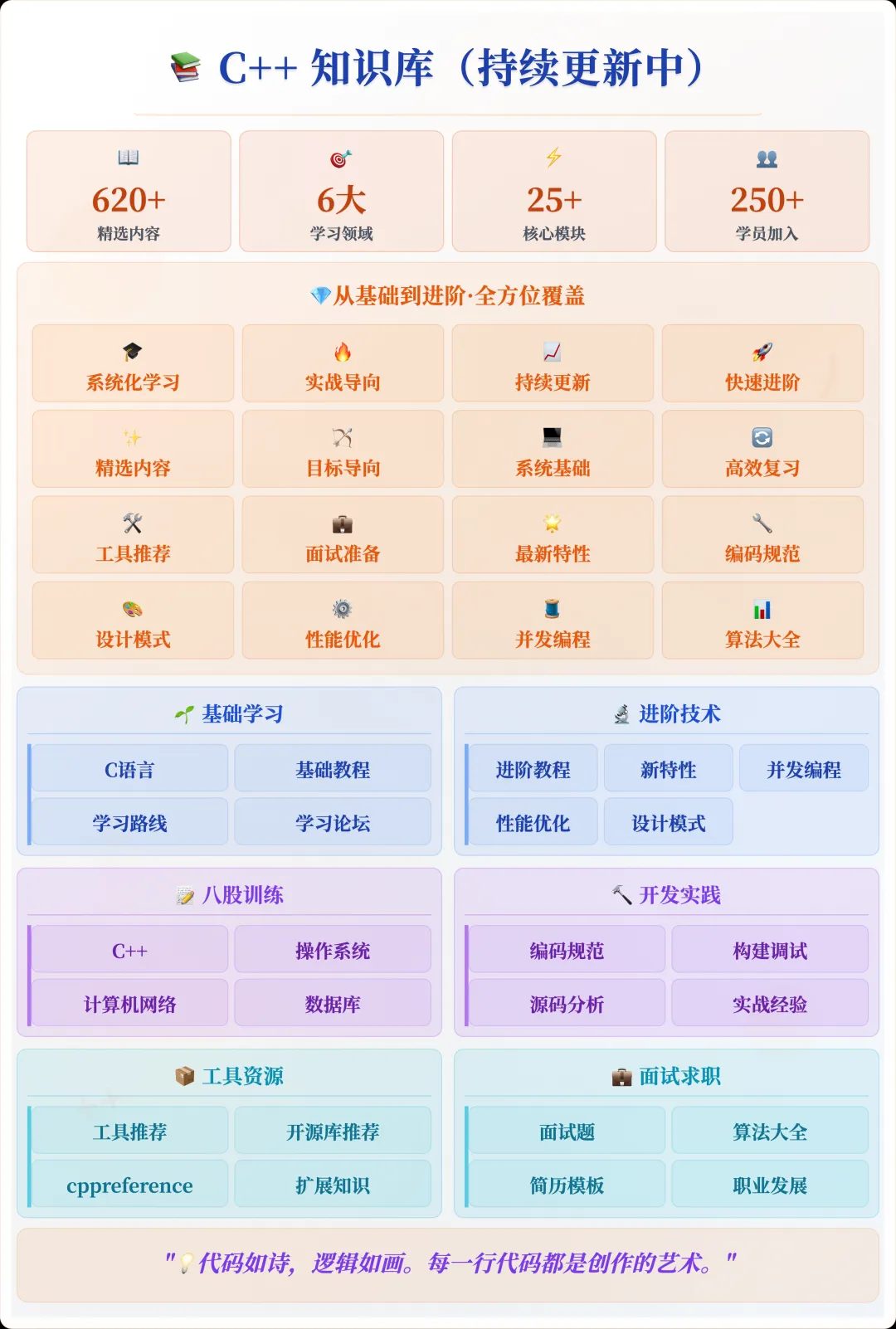
📌 Students interested in the knowledge base can add vx (chuzi345) with the note 【Knowledge Base】 or click 👉 C++ Knowledge Base (tap to jump) to view the complete introduction of the knowledge base~
1. Problem Breakdown: Where are vector objects and their elements located?
The key to this question is to distinguish between the vector object itself and the elements stored in the vector. The memory locations of these two are often confused.
- Vector object itself refers to the variable
<span>std::vector<T> v</span>, which contains member variables such as a pointer to a dynamic array, size, capacity, etc. - Elements stored in the vector refer to the dynamic array maintained internally by
<span>vector</span>, which holds the actual data in the container.
2. Where is the vector object itself located?
This depends on how you define the vector object.
void foo() {
    std::vector<int> v;  // v is a local variable, stored on the stack
}
In the above example, <span>v</span> is a local variable, allocated on the stack as part of the function’s stack frame. At this time, <span>v</span> internally maintains several member variables (usually three pointers or pointer + size), which are also on the stack.
If you define the <span>vector</span> as a global variable or use <span>new</span> for dynamic allocation:
std::vector<int> g_vector; // Global variable, stored in static storage

std::vector<int>* pv = new std::vector<int>(); // v object stored on the heap
Then the vector object itself is distributed in the corresponding storage area.
3. Storage location of vector elements
<span>vector</span> internally manages element memory through dynamic allocation. It maintains a pointer that points to a contiguous memory block on the heap for storing elements.
Even if the <span>vector</span> object itself is on the stack, the memory for the elements is still allocated on the heap.
void foo() {
    std::vector<int> v;
    v.push_back(42); // Element 42 is stored on the heap, v object is stored on the stack
}
This also explains why <span>vector</span> can dynamically resize—it reallocates a larger memory block on the heap, copies old elements, and frees the old memory.
4. Why is vector designed this way?
<span>vector</span>‘s core requirement is to provide a dynamically sized, contiguous memory array structure.
- Contiguous memory is crucial for performance, facilitating cache friendliness and random access.
- The number of elements is not fixed, so a fixed size cannot be allocated on the stack in advance.
- Stack space is limited, and placing large arrays on the stack can easily lead to stack overflow.
Therefore, <span>vector</span> itself is stored on the stack or static area (depending on the definition), while elements are uniformly allocated on the heap using <span>new</span> or a lower-level allocator.
5. Understanding memory distribution with code examples
Let’s look at a simple example:
#include <iostream>
#include <vector>

struct Foo {
    int x;
    Foo(int val) : x(val) { std::cout << "Foo " << x << " constructed\n"; }
    ~Foo() { std::cout << "Foo " << x << " destructed\n"; }
};

int main() {
    std::vector<Foo> v;
    v.reserve(2); // Preallocate memory to avoid multiple allocations during resizing
    v.emplace_back(10);
    v.emplace_back(20);

    std::cout << "Address of vector object: " << &v << "\n";
    std::cout << "Address of first element: " << &v[0] << "\n";

    return 0;
}
The output is similar to:
Foo 10 constructed
Foo 20 constructed
Address of vector object: 0x7ffdf0cdd2a0
Address of first element: 0x600000c04020
Foo 20 destructed
Foo 10 destructed
<span>&v</span>address is on the stack (generally in a higher address range).<span>&v[0]</span>address is in a block of memory on the heap.- You can see that the memory address space of the
<span>vector</span>object and its elements is completely different.
6. In-depth discussion: Data structures within vector objects
In most standard library implementations, <span>std::vector</span> internally contains at least three members:
- A pointer to heap memory (pointing to the element array)
- The current number of elements
- The capacity size
Illustration:
template<typename T>
class vector {
    T* _start;      // Points to the first address of the element array
    T* _finish;     // Points to the current end of elements (a past-the-end position)
    T* _end_of_storage; // Points to the end of allocated memory

    // Other member functions and interfaces
};
These pointers and integer data are stored in the <span>vector</span> object, either on the stack or heap (depending on the object’s definition location), while the element array they point to is always on the heap.
7. Supplement: Small optimizations and special cases
Some special container designs attempt to implement “Small Object Optimization” (SBO), occasionally seen in upstream and downstream containers of <span>vector</span>, such as <span>std::string</span> which, in some implementations, directly stores a small number of characters within the object to reduce heap allocation.
However, the standard <span>std::vector</span> does not have this optimization, and all element arrays are dynamically allocated on the heap.
8. Final summary
- The storage location of the vector object itself depends on the definition method: local variables are on the stack, global variables are in static storage, and
<span>new</span>allocations are on the heap. - The element array stored in the vector is always dynamically allocated on the heap, to support dynamic resizing and contiguous storage.
- When encountering this question in an interview, do not simply answer “stack” or “heap”, but clarify the memory ownership of the vector object and its elements.
The core of such questions is to understand the C++ memory model and the implementation mechanism of standard containers. I hope that when you encounter similar questions next time, you can explain clearly and confidently.
Recommended reading:
C++ Direct Access to Major Companies
In-depth Understanding of C++ Performance Optimization: From Memory Management to Compiler Optimization Practice
Soul Searching Question: Why Can’t I Find a Job After Learning So Many Technologies?

Hello, I am Chef! Graduated with a master’s degree in 211, I passed over 30 interviews during the autumn recruitment period and finally received more than 10 offers from Baidu, Tencent, Huawei, Shopee, Bilibili, SenseTime, JD, a military research institute, and one of the Big Four banks, mostly at SP or SSP level.
My tags:
- Former full-stack developer at Tencent, now an entrepreneur: Proficient in C++ development, self-rated 80 points.
- Open-source project author: One of my open-source repositories has surpassed 10,000+ stars and topped the global trending list for a week.
- Campus recruitment offer collector: During the autumn recruitment period, I received over 10 offers, almost all at SP or SSP level positions.
- Deeply aware of the confusion and pain points in autumn recruitment: Therefore, I established the “Xijia Training Camp”, which has been operating for 9 months, helping over 150 students significantly improve their C++ skills and successfully obtain ideal offers.
I particularly understand everyone’s confusion and perplexity during the autumn recruitment, so I hope to provide a clear direction and some practical methods through my experience.If you also want to stand out in the autumn recruitment, feel free to contact me (vx: chuzi345) to learn about the training camp we are running and join me in preparing for this autumn recruitment battle!