Definition of Threshold Voltage
The threshold voltage, also known as the turn-on voltage, is one of the key parameters of MOS devices. It defines the minimum gate bias required to form a conductive channel between the source and drain, even when the substrate surface (the semiconductor surface) is strongly inverted, which requires the gate voltage VG. The magnitude of the threshold voltage is crucial for device performance, affecting sensitivity, response speed, reliability, and lifespan.
Physical Derivation of Threshold Voltage
- 1. For a practical MOS transistor, due to the work function difference between metal and semiconductor and the presence of a certain amount of positive charge in the gate oxide layer, the energy bands at the semiconductor surface will bend downwards to a certain extent, as shown in the figure below:
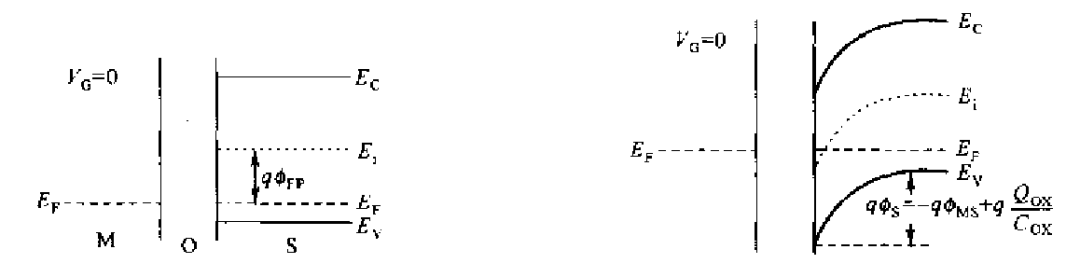
Therefore, we first need a voltage to offset this potential difference caused by the band bending, which is the flat band voltage:
- 2. We consider that when the MOS transistor is turned on, the semiconductor surface is strongly inverted, and the surface potential at this time is:
3. The voltage applied to the gate is partially dropped across the semiconductor and partially across the gate oxide layer. The expression for this part of the voltage is:
which represents the charge surface density of the gate oxide layer; the specific calculation is not shown here.
Therefore, the total expression for the threshold voltage is:
For P-type:
For N-type:
Factors Affecting Threshold Voltage
From the above expressions, it is not difficult to see that several factors affect the threshold voltage in actual processes:1. Thickness of the oxide layer; the thinner the oxide layer, the smaller the threshold voltage;2. Work function difference between metal and semiconductor, which corresponds to the materials used for the metal gate, commonly Al-Si systems;3. Charge surface density of the gate oxide layer, which corresponds to the growth, cleaning, and subsequent high-temperature process fluctuations of the gate oxide; at the same time, to adjust the threshold voltage, impurity ions can be injected near the semiconductor surface through ion implantation, effectively changing the charge surface density.