Challenges of Traditional Cryptography
For many, cryptography seems to be an esoteric discipline, cleverly transforming information so that it is meaningless to everyone except the intended recipient.
In fact, cryptography is ubiquitous in daily life, from websites to various communication apps, all requiring cryptography or encryption technologies to protect the privacy of information. For example, when we shop online, sensitive information such as credit card numbers is sent to merchants. To prevent this information from being stolen by hackers, it must be “locked” before sending, and the merchant has a “key” that can “unlock” this information.
However, a dilemma arises: how can keys be distributed securely, ensuring that their sharing is not intercepted by others?
The RSA public key cryptosystem, which emerged in the 1970s, is a widely used secure data transmission system to this day. This encryption system involves a set of public and private keys, namely the public key and private key. The private key is confidential and not shared; it consists of two large prime numbers generated by an algorithm; the public key is the product of these two numbers. Anyone can use the public key to encrypt information, but only the private key can decrypt it.
The normal operation of RSA relies on the fact that factoring the large integers in the public key to determine the two prime numbers that make up the private key is a time-consuming and computationally intensive process. However, after mathematician Peter Shor published the famous Shor’s algorithm in 1994, the security of RSA was significantly challenged. The Shor algorithm describes a new type of computer known as a quantum computer, which can theoretically factor large numbers efficiently. This means that once future quantum computers possess enough qubits, RSA cryptography is doomed to decline.
Encryption Methods Based on Quantum Physics
Fortunately, quantum physics not only provides a foundation for breaking the core cryptographic systems of digital commerce but also offers a viable solution to this problem—quantum cryptography or quantum key distribution (QKD). Unlike traditional cryptography, QKD relies on fundamental physical laws rather than mathematics as its key security guarantee.
In quantum physics, the no-cloning theorem is an important conclusion stating that an unknown quantum state cannot be reliably cloned. If a user named Alice distributes a key using quantum signals (such as single photons), since there is only one copy of the key at the start, a hacker cannot reliably clone the quantum state to produce two copies of the same state. Therefore, in QKD, if a hacker attempts to steal information, they will inevitably disturb the quantum signal, which can be detected by the sender Alice and the receiver Bob.
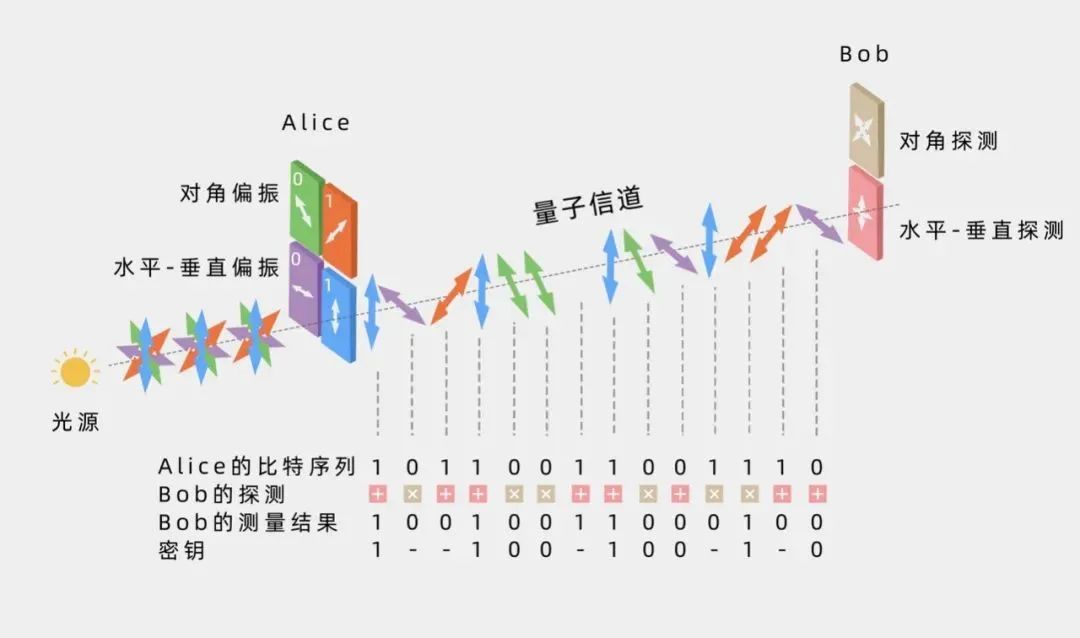
QKD is the most widely studied and feasible method in quantum cryptography, using a series of photons to create a secret random sequence, namely the key. By comparing the measurement results of the sender (Alice) and receiver (Bob), they can determine whether the key has been compromised. The most famous QKD scheme is the BB84 protocol proposed in 1984. In this protocol, Alice and Bob share a quantum channel (such as optical fiber) to generate a secure key in the presence of a hacker with unlimited quantum computing power.
However, the implementation of this technology is based on an assumption that the devices used to prepare and measure quantum particles are generally defect-free. Some potential device defects may allow hackers to penetrate the security system unnoticed, for example, a device that should emit one photon but instead emits two without our knowledge; any such defect would make the mathematical proof of security difficult to establish.
Moreover, this method generally requires that the photon source and measurement devices are trusted, which gives hackers a potential opportunity to exploit this trust to tamper with the system and discover the key. This is akin to Alice locking the key in a safe and handing it to a trusted courier to deliver to Bob, only to find that the safe contains a listening device.
To address these issues, researchers need to develop a device-independent encryption scheme, which requires understanding another feature of quantum systems—quantum entanglement.
Spooky Action at a Distance
In 1991, quantum physicist Artur Ekert proposed a QKD scheme based on quantum entanglement in a groundbreaking paper.
Quantum entanglement is one of the strangest phenomena in quantum physics, a mysterious connection between quantum systems (or quantum particles, such as photons). In entangled pairs of particles, measuring or acting on one particle seems to instantaneously affect the other, even if the two particles may be light-years apart. Einstein referred to this distance-independent connection as “spooky action at a distance.”
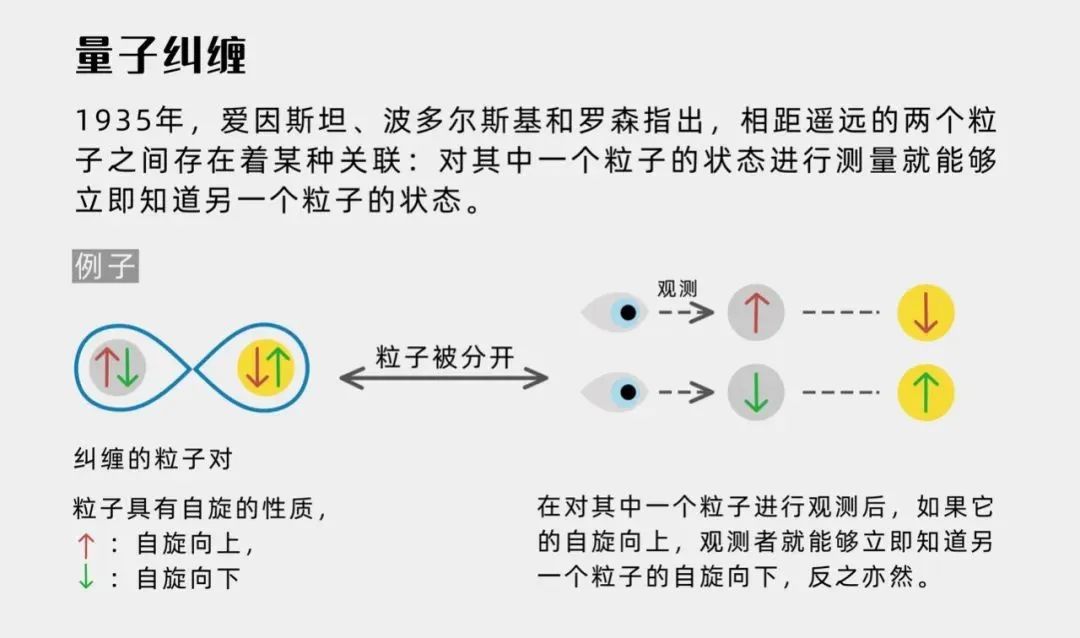
More importantly, quantum entanglement between two systems is exclusive, meaning no other entity can be correlated with these systems. From a cryptographic perspective, this means that the sender and receiver can generate shared results through an entangled quantum system, without any third party being able to secretly obtain information related to these results. Any eavesdropping will leave obvious traces of intrusion.
In subsequent studies, scientists realized that the QKD scheme proposed based on Ekert’s ideas has further potential: quantum entanglement can help achieve a scheme that does not require reliable photon sources and measurement devices. This scheme is known as device-independent quantum key distribution (DIQKD).
Device-Independent Experiments
In DIQKD, the source device continuously generates pairs of entangled quantum particles, and Alice and Bob each take one from each pair of entangled particles. Then, Alice and Bob independently measure their particles under strict experimental conditions.
When Alice and Bob perform measurements, some of the measurements will be used to create a shared key. Since the measurement results of the particles are correlated with those of their entangled particles, Alice and Bob can create a string of bits composed of 1s and 0s that can encode and decode information through a series of measurements of these particles.
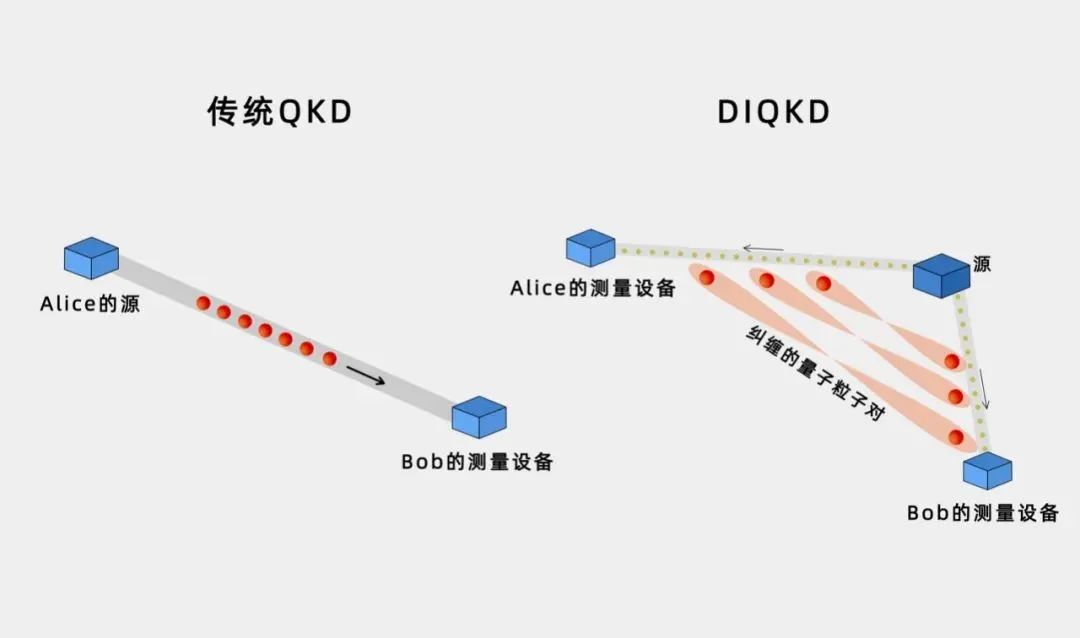
Left: In traditional QKD schemes, Alice and Bob can create a key to encrypt and decrypt messages, but this method assumes that the particle source and measurement devices are perfect. Right: A device-independent QKD scheme utilizing quantum entanglement, where Alice and Bob can test their entangled particles under strict conditions to detect whether the source has been compromised, allowing them to protect measurement results simply by “sealing” the laboratory.
Some other measurements are used to perform a test that can strictly detect entanglement. This test is based on Bell’s theorem, which was proposed by John Bell in 1964. According to Bell’s theorem, if two particles are entangled, then the measurement results of these particles must exhibit specific statistical correlations.
In the test, Alice and Bob use some of the measurement results to generate a key. If their detection results do not match the preset statistical data, they know that the particles are no longer entangled, which means the security of their quantum channel cannot be confirmed. At this point, they will discard the measurement results and restart the process.
This testing ensures that hackers cannot tamper with the entangled particles in any way, as any tampering will be detected. Therefore, DIQKD eliminates one of the greatest security risks of the system. Alice and Bob no longer need information about the devices that create and distribute entangled particles; they only need to protect the devices used to select measurement results from tampering and isolate their laboratory to prevent leakage of results or key information.
However, achieving DIQKD in experiments with existing technology is highly challenging. Especially when the quantum particles used in experiments are photons, the efficiency loss due to transmission and detection of photons becomes a critical issue. Although some previous studies have excellently conducted experiments with no detection loopholes, achieving DIQKD still requires higher efficiency (over 90%). While recent studies have made theoretical progress in reducing the required efficiency, practical protocols for real-world implementation remain difficult to achieve.
On July 27, a recent study published in the form of “editor’s recommendation” in Physical Review Letters by Pan Jianwei, Executive Vice President of the University of Science and Technology of China, an academician of the Chinese Academy of Sciences, and one of the initiators of the “Science Exploration Award,” along with his colleagues Zhang Qiang and Xu Feihu, demonstrated for the first time internationally the principle of DIQKD through the development of device-independent theoretical protocols and the construction of high-efficiency optical quantum entanglement systems. International experts have been invited to report or comment on this in the American Physical Society’s Physics website, Nature magazine, Quanta Magazine, and others.