Introduction:
RISC-V (pronounced “risk-five”) is a new instruction set architecture (ISA) originally designed to support research and education in computer architecture. However, in recent years, it has evolved into a standardized, free, and open architecture for industrial implementations.

One significant advantage of the RISC-V instruction set is its scalability, allowing users to select appropriate extension instruction sets based on specific application needs.
RISC-V offers a variety of extensions, which will be introduced one by one. This article focuses on the Zacas extension. (Note: The main content is based on the official 20240411 version spec.)
Compare and Swap (CAS) Instruction
provides a simple and often faster way to perform thread synchronization operations. When supported as a hardware instruction, CAS is commonly used in lock-free and wait-free algorithms. The Zacas extension proposes CAS instructions that operate on 32-bit, 64-bit, and 128-bit (only for RV64) data values. The CAS instruction supports C++11 atomic compare and swap operations.
While CAS can be implemented using LR/SC for XLEN wide data, CAS atomic instructions are more scalable than LR/SC in highly parallel systems. Many lock-free algorithms, such as lock-free queues, require operations on pointer variables. A simple CAS operation may not be sufficient to prevent the common ABA problem in algorithms that operate on pointer variables. To avoid the ABA problem, algorithms associate a reference counter with the pointer variable and use four-word compare and swap (operating on both the pointer and the counter) for updates. Both double-word and four-word CAS instructions support algorithms that avoid the ABA problem.
The RISC-V Instruction Set Manual Volume I
CAS (Compare-And-Swap) Operation and the ABA ProblemThe Zacas extension relies on the Zaamo extension. When introducing the A extension, we specifically compared the advantages and disadvantages of LR/SC and CAS instructions. See: RISC-V Atomic Instruction Set – A ExtensionWord/Double Word/Four Word CAS (AMOCAS.W/D/Q) For RV32,
<span><span>AMOCAS.W</span></span> atomically loads a 32-bit data value from the <span><span>rs1</span></span> address, compares the loaded value with the 32-bit value in <span><span>rd</span></span>, and if they are bitwise equal, stores the 32-bit value from <span><span>rs2</span></span> into the initial address of <span><span>rs1</span></span>. The loaded value is placed in register rd.<span><span>AMOCAS.W</span></span> performs the following operation on RV32:
temp = mem[X(rs1)] if ( temp == X(rd) ) mem[X(rs1)] = X(rs2) X(rd) = temp<span>AMOCAS.D</span> is similar to <span>AMOCAS.W</span>, but operates on 64-bit data values.For RV32,<span>AMOCAS.D</span> atomically loads a 64-bit data value from the <span>rs1</span> address, compares the loaded value with the 64-bit value composed of <span>rd</span> and <span>rd+1</span> in the register pair, and if they are bitwise equal, stores the 64-bit value from <span>rs2</span> and <span>rs2+1</span> in the register pair into the initial address of <span>rs1</span>. The loaded value is placed in the register pair <span>rd</span> and <span>rd+1</span>. The instruction requires the first register in the register pair to be even; the encoding for specifying odd registers in <span>rs2</span> and <span>rd</span> is reserved. When the first register of the source register pair is <span>x0</span>, both halves of the register pair read as zero. When the first register of the destination register pair is <span>x0</span>, the entire register result is discarded, and no write occurs to any destination register.<span>AMOCAS.D</span> performs the following operation on RV32:
temp0 = mem[X(rs1)+0] temp1 = mem[X(rs1)+4] comp0 = (rd == x0) ? 0 : X(rd) comp1 = (rd == x0) ? 0 : X(rd+1) swap0 = (rs2 == x0) ? 0 : X(rs2) swap1 = (rs2 == x0) ? 0 : X(rs2+1) if ( temp0 == comp0 ) && ( temp1 == comp1 ) mem[X(rs1)+0] = swap0 mem[X(rs1)+4] = swap1 endif if ( rd != x0 ) X(rd) = temp0 X(rd+1) = temp1 endifFor RV64,<span>AMOCAS.W</span> atomically loads a 32-bit data value from the <span>rs1</span> address, compares the loaded value with the low 32 bits of the value in <span>rd</span>, and if they are bitwise equal, stores the low 32 bits of the value from <span>rs2</span> into the initial address of <span>rs1</span>. The 32-bit value loaded from memory is sign-extended and placed in register <span>rd</span>.<span><span>AMOCAS.W</span></span> performs the following operation on RV64:
temp[31:0] = mem[X(rs1)] if ( temp[31:0] == X(rd)[31:0] ) mem[X(rs1)] = X(rs2)[31:0] X(rd) = SignExtend(temp[31:0])For RV64,<span>AMOCAS.D</span> atomically loads a 64-bit data value from the <span>rs1</span> address, compares the loaded value with the 64-bit value in <span>rd</span>, and if they are bitwise equal, stores the 64-bit value from <span>rs2</span> into the initial address of <span>rs1</span>. The loaded value is placed in register <span>rd</span>.<span>AMOCAS.D</span> performs the following operation on RV64:
temp = mem[X(rs1)] if ( temp == X(rd) ) mem[X(rs1)] = X(rs2) X(rd) = temp<span>AMOCAS.Q</span> (only RV64) atomically loads a 128-bit data value from the <span>rs1</span> address, compares the loaded value with the 128-bit value in the register pair composed of <span>rd</span> and <span>rd+1</span>, and if they are bitwise equal, stores the 128-bit value from <span>rs2</span> and <span>rs2+1</span> in the register pair into the initial address of <span>rs1</span>. The loaded value is placed in the register pair <span>rd</span> and <span>rd+1</span>. The instruction requires the first register in the register pair to be even; the encoding for specifying odd registers in <span>rs2</span> and <span>rd</span> is reserved. When the first register of the source register pair is <span>x0</span>, both halves of the register pair read as zero. When the first register of the destination register pair is <span>x0</span>, the entire register result is discarded, and no write occurs to any destination register.<span>AMOCAS.Q</span> performs the following operation:
temp0 = mem[X(rs1)+0] temp1 = mem[X(rs1)+8] comp0 = (rd == x0) ? 0 : X(rd) comp1 = (rd == x0) ? 0 : X(rd+1) swap0 = (rs2 == x0) ? 0 : X(rs2) swap1 = (rs2 == x0) ? 0 : X(rs2+1) if ( temp0 == comp0 ) && ( temp1 == comp1 ) mem[X(rs1)+0] = swap0 mem[X(rs1)+8] = swap1 endif if ( rd != x0 ) X(rd) = temp0 X(rd+1) = temp1 endifFor future RV128 extensions,<span><span>AMOCAS.Q</span></span> will encode a single register with XLEN=128 in <span><span>rs2</span></span> and <span><span>rd</span></span>.Some algorithms may load the previous data value from a memory location into the source register for the comparison data value used in Zacas instructions. When using Zacas instructions, using a register pair to provide the comparison value can be done with two separate loads. Two separate loads may read inconsistent value pairs, but this is not an issue because <span>AMOCAS</span> operations themselves use atomic loads to compare data values fetched from memory.The following example code sequence illustrates how to atomically increment a 64-bit counter using <span>AMOCAS.D</span> in an RV32 implementation.
# a0 - address of the counter.increment: lw a2, (a0) # Load current counter value using lw a3, 4(a0) # two individual loads.retry: mv a6, a2 # Save the low 32 bits of the current value. mv a7, a3 # Save the high 32 bits of the current value. addi a4, a2, 1 # Increment the low 32 bits. sltu a1, a4, a2 # Determine if there is a carry out. add a5, a3, a1 # Add the carry if any to high 32 bits. amocas.d.aqrl a2, a4, (a0) bne a2, a6, retry # If amocas.d failed then retry bne a3, a7, retry # using current values loaded by amocas.d. retSimilar to AMO in the A extension,<span>AMOCAS.W/D/Q</span> requires the address in <span>rs1</span> to be naturally aligned to the size of the operand (i.e., quadword aligned to 16 bytes, doubleword aligned to 8 bytes, word aligned to 4 bytes). If the address is not naturally aligned, the same exception options apply.Similar to AMO in the A extension,<span>AMOCAS.W/D/Q</span> optionally provides release consistency semantics, using <span>aq</span> and <span>rl</span> bits to help implement multiprocessor synchronization. When the <span>aq</span> bit is set to 1, the memory operations of <span>AMOCAS.W/D/Q</span> that successfully execute have acquire semantics; when the <span>rl</span> bit is set to 1, they have release semantics. When <span>AMOCAS.W/D/Q</span> is unsuccessful, the memory operations have acquire semantics (if the <span>aq</span> bit is set to 1), but do not have release semantics (regardless of the <span>rl</span> bit).A FENCE instruction can be used to order memory read accesses generated by <span>AMOCAS.W/D/Q</span> instructions and (if generated) memory write accesses. Unsuccessful <span><span>AMOCAS.W/D/Q</span></span> may not perform memory writes or may write back the old value loaded from memory.<span><span>AMOCAS.W/D/Q</span></span> instructions always require write permissions.The following example code sequence illustrates the <span>AMOCAS.Q</span> implementation of the enqueue operation for a non-blocking concurrent queue, using the algorithm outlined in the paper (Michael, M. M., & Scott, M. L. (1996). Simple, Fast, and Practical Non-Blocking and Blocking Concurrent Queue Algorithms. Proceedings of the Fifteenth Annual ACM Symposium on Principles of Distributed Computing, 267–275). This algorithm uses <span>AMOCAS.Q</span> instructions to atomically operate on pointers and their associated modification counters to avoid the ABA problem.
# Enqueue operation of a non-blocking concurrent queue.# Data structures used by the queue:# structure pointer_t {ptr: node_t *, count: uint64_t}# structure node_t {next: pointer_t, value: data type}# structure queue_t {Head: pointer_t, Tail: pointer_t}# Inputs to the procedure:# a0 - address of Tail variable# a4 - address of a new node to insert at tailenqueue: ld a6, (a0) # a6 = Tail.ptr ld a7, 8(a0) # a7 = Tail.count ld a2, (a6) # a2 = Tail.ptr->next.ptr ld a3, 8(a6) # a3 = Tail.ptr->next.count ld t1, (a0) ld t2, 8(a0) bne a6, t1, enqueue # Retry if Tail & next are not consistent bne a7, t2, enqueue # Retry if Tail & next are not consistent bne a2, x0, move_tail # Was tail pointing to the last node? mv t1, a2 # Save Tail.ptr->next.ptr mv t2, a3 # Save Tail.ptr->next.count addi a5, a3, 1 # Link the node at the end of the list amocas.q.aqrl a2, a4, (a6) bne a2, t1, enqueue # Retry if CAS failed bne a3, t2, enqueue # Retry if CAS failed addi a5, a7, 1 # Update Tail to the inserted node amocas.q.aqrl a6, a4, (a0) ret # Enqueue donemove_tail: # Tail was not pointing to the last node addi a3, a7, 1 # Try to swing Tail to the next node amocas.q.aqrl a6, a2, (a0) j enqueue # RetryAdditional AMO PMAs
The A extension defines four levels of AMO support. Zacas defines three additional support levels:<span>AMOCASW</span>、<span>AMOCASD</span> and <span>AMOCASQ</span>.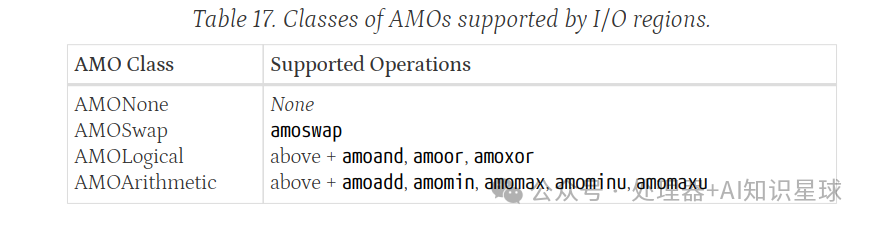
<span>AMOCASW</span> indicates that, in addition to the instructions supported at the <span>AMOArithmetic</span> level, the <span>AMOCAS.W</span> instruction is also supported.<span>AMOCASD</span> indicates that, in addition to the instructions supported at the <span>AMOCASW</span> level, the <span>AMOCAS.D</span> instruction is also supported.<span>AMOCASQ</span> indicates that, in addition to the instructions supported at the <span>AMOCASD</span> level, the <span>AMOCAS.Q</span> instruction is also supported.<span><span>AMOCASW/D/Q</span></span> requires <span><span>AMOArithmetic</span></span><span><span> level support, as </span></span><span><span>AMOCAS.W/D/Q</span></span><span><span> instructions require the ability to perform arithmetic compare and swap operations.</span></span>
Related Reading:
How RISC-V ISA Instruction Length is Encoded
Introduction to RISC-V and the Base Instruction Set
RISC-V Atomic Instruction Set – A Extension
CAS (Compare-And-Swap) Operation and the ABA Problem
RISC-V Wait Reserved Set Instruction Extension – Zawrs
Follow our public account to stay updated with the latest news.