
Click the blue text above to follow us



1 Overview
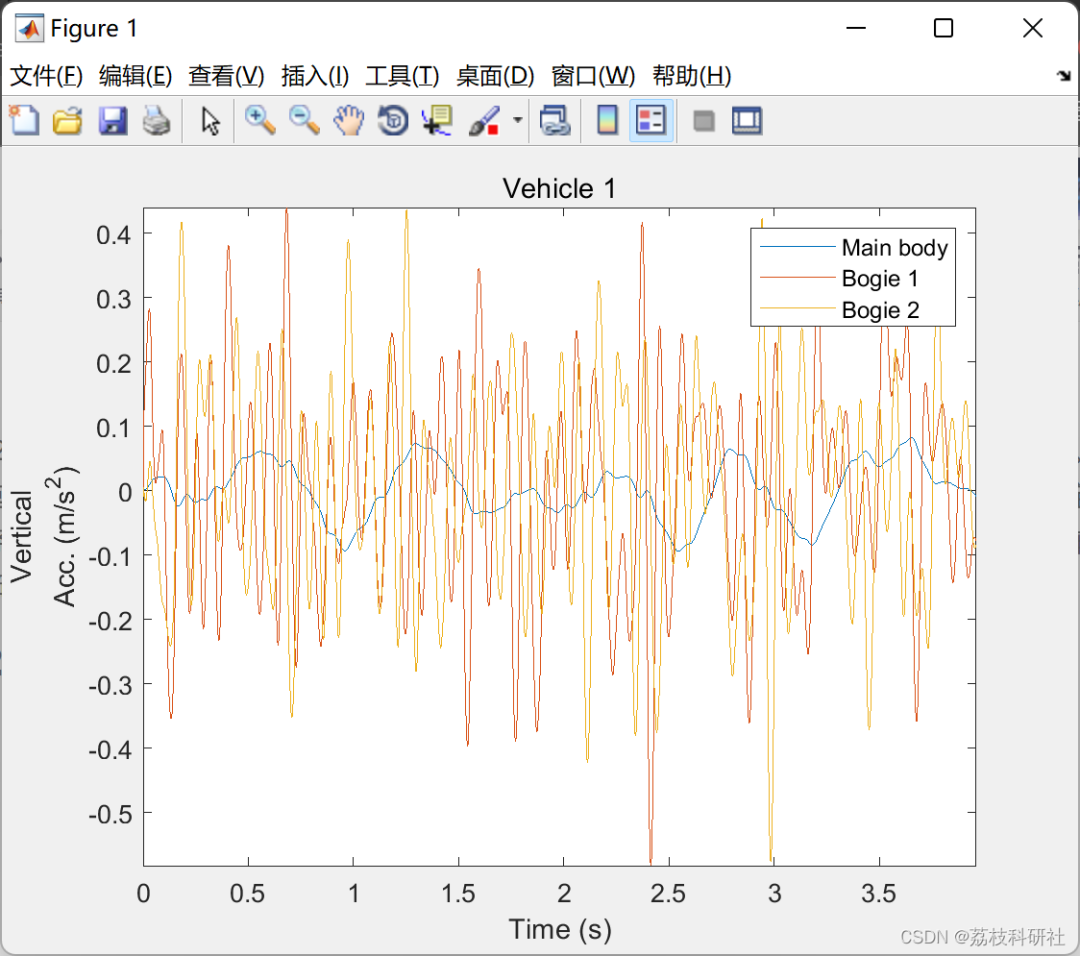
The TTB-2D software simulates the dynamic response of the train-track-bridge system in a 2D representation. The train is represented as a continuous series of multiple vehicles. The track includes track irregularities and models the track, pads, sleepers, ballast, and sub-ballast. The bridge is modeled as a beam with finite element formulations that have customizable support conditions, effectively representing various structural configurations. This validated numerical model considers the vehicle-infrastructure interaction.
Reference 1:
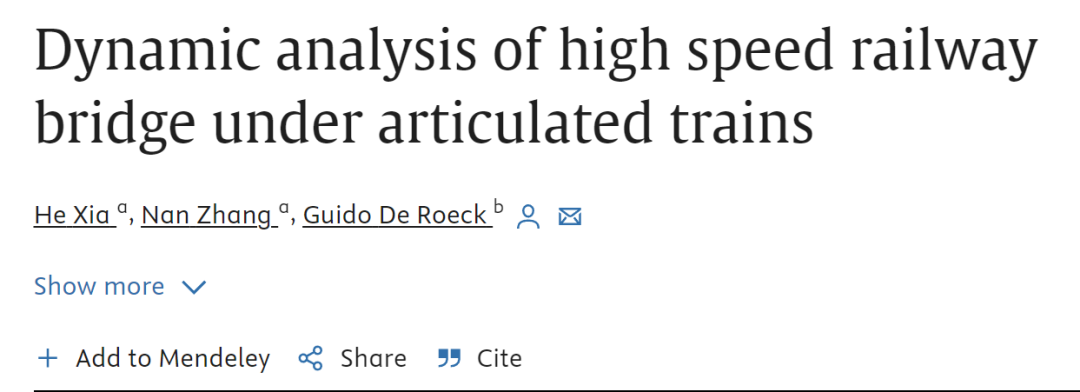
Abstract: This paper studies the dynamic interaction system of articulated high-speed trains on bridges. A dynamic interaction model of the bridge-articulated train system is established, consisting of an articulated vehicle element model and a finite element bridge model. The vehicle model is developed based on the structure and suspension characteristics of the articulated vehicle, and a computer simulation program is compiled. Using the Talys articulated train passing over the Antoing bridge on the Paris-Brussels high-speed rail line as an example, the dynamic responses of the bridge and vehicle are calculated and analyzed. The proposed analytical model and solution method are validated by comparing the calculated results with field measurement data. The vibration behavior of the articulated train is discussed.
Reference 2:
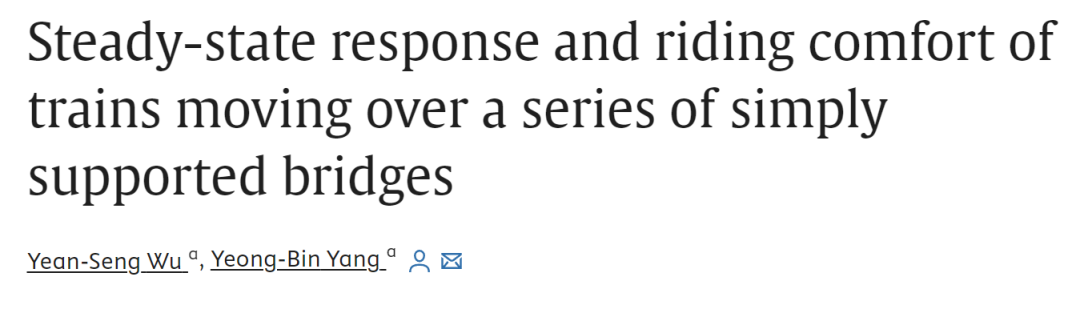
Abstract: This paper discusses the two-dimensional steady-state response and riding comfort of trains traveling over a series of simply supported railway bridges, as well as the impact response of the track and bridge. The dynamic response of the vehicle-track-bridge interaction system is addressed using previously developed condensation techniques. To achieve steady-state response for the traveling train, bridge segments composed of a minimal number of elements should be considered. The power spectral density (PSD) function is used to account for the random nature of track irregularities. The steady-state responses of the train, track, and bridge are calculated and discussed, along with the fast Fourier transform (FFT) of the responses. The impact response of the track and bridge at different train speeds is studied using impact coefficients. The maximum response of the train due to train-track-bridge resonance is determined. Finally, the Spurling riding index is used to assess the riding comfort of trains traveling on tracks with different irregularity levels.
Reference 3:
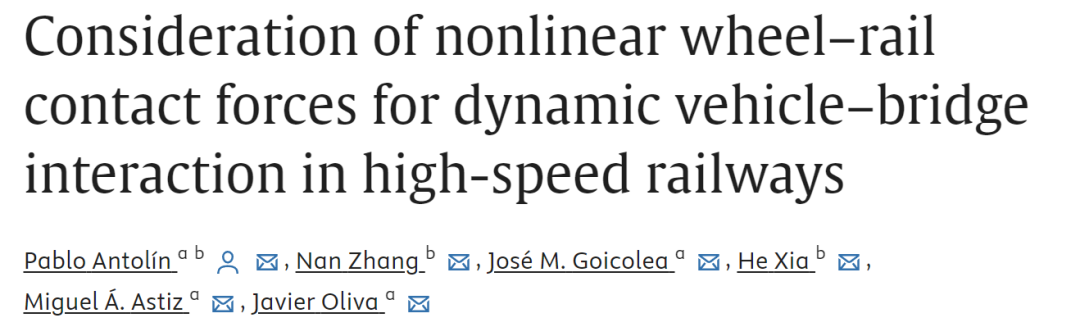
Abstract: This paper considers a model with nonlinear wheel-rail contact forces for analyzing the dynamic interaction between high-speed trains and bridges, to study the dynamic effects in bridges and vehicles caused by coupling. Nonlinear contact models may be required to assess driving stability and safety in situations such as trains crossing bridges under strong winds or vehicles overturning during earthquakes. To study the coupled dynamic response of trains and bridges, a multibody dynamics model is used for the vehicles, and finite element methods are applied for the structures. This paper particularly emphasizes the consideration of contact interaction forces between railway vehicles and tracks. Four different interaction models are compared: (1) a model where the vehicle wheelset is considered rigidly coupled to the track; (2) a staggered decoupling method, where vehicles and structures are analyzed separately; (3) a linear contact model that allows lateral relative displacement between the track and train wheels, assuming double-cone wheels and track profiles, and the linear theory of normal contact from Kalker; (4) a nonlinear model that uses actual wheel and track profiles, with Hertz’s nonlinear theory for normal contact and Kalker’s nonlinear theory for tangential contact. Different models are applied and compared with experimental measurements from a Chinese high-speed train.
2 Results
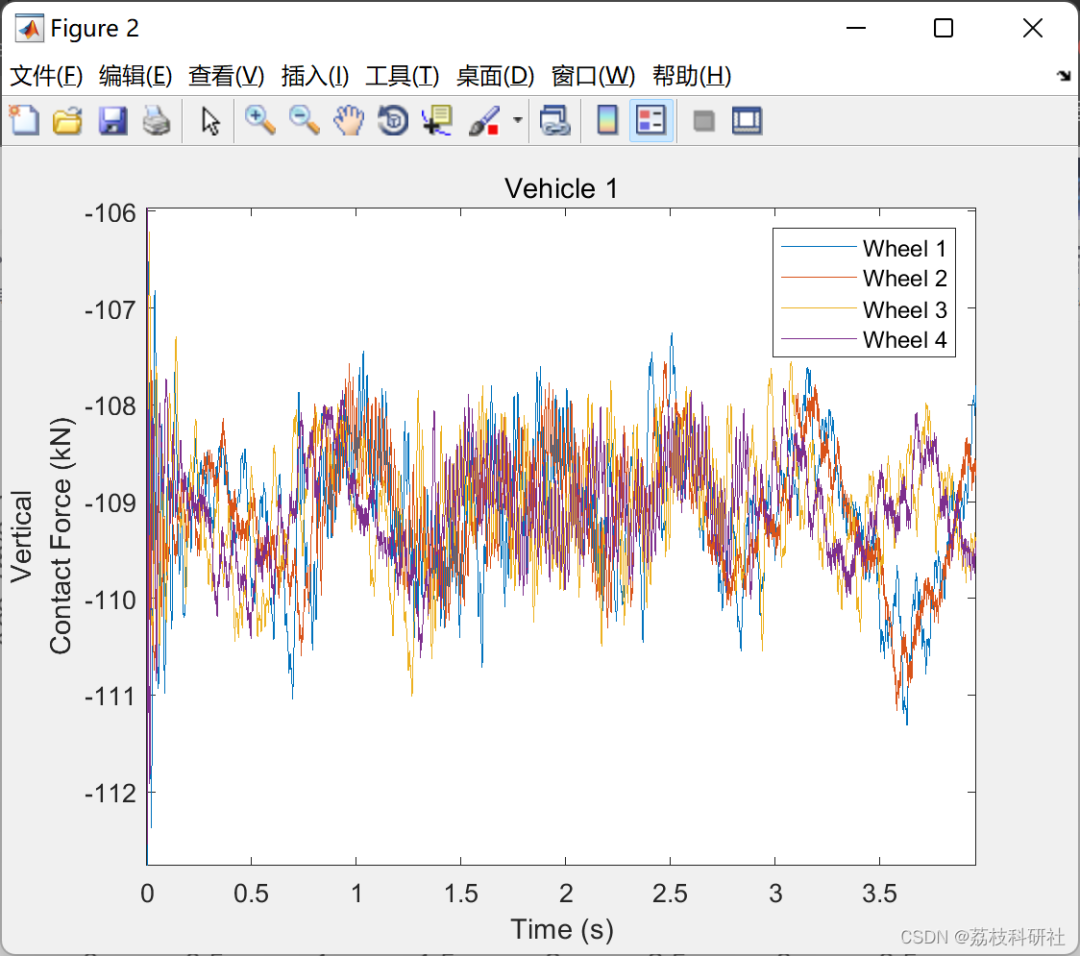
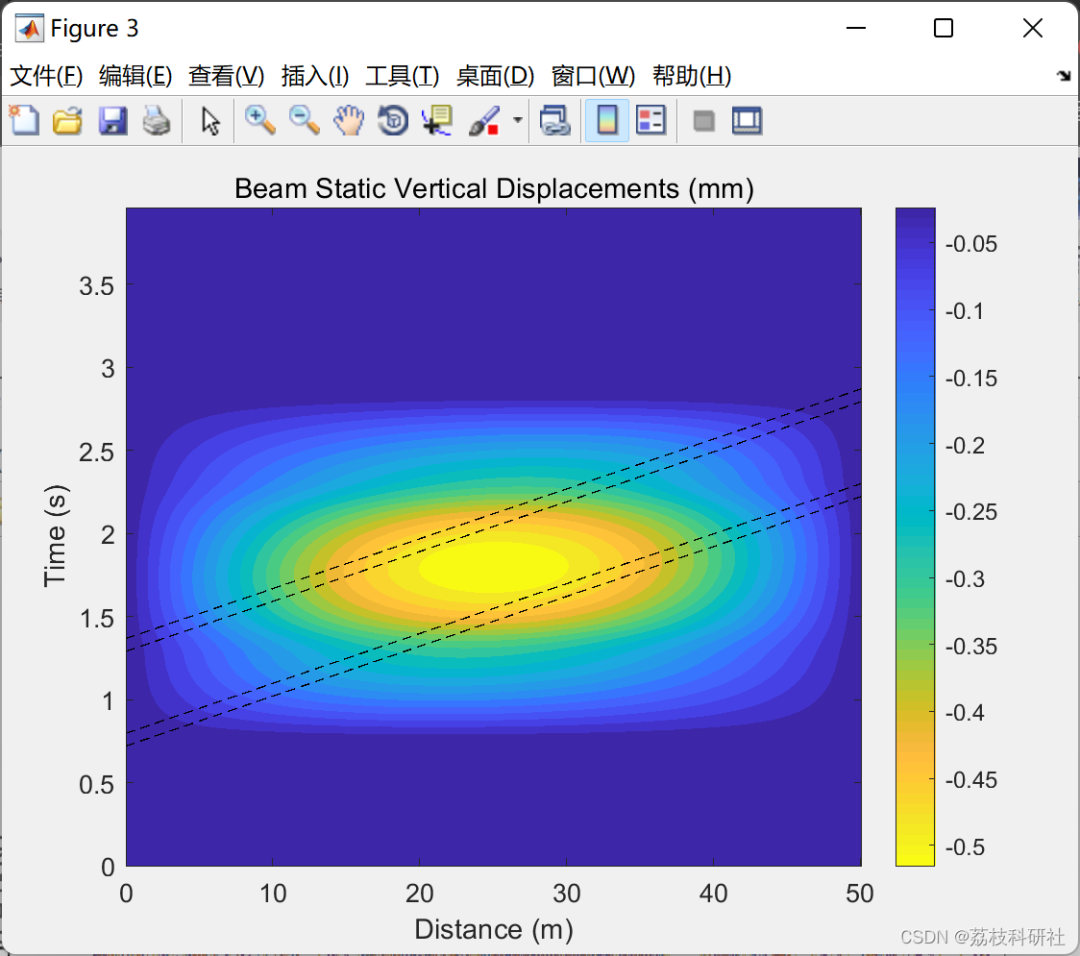
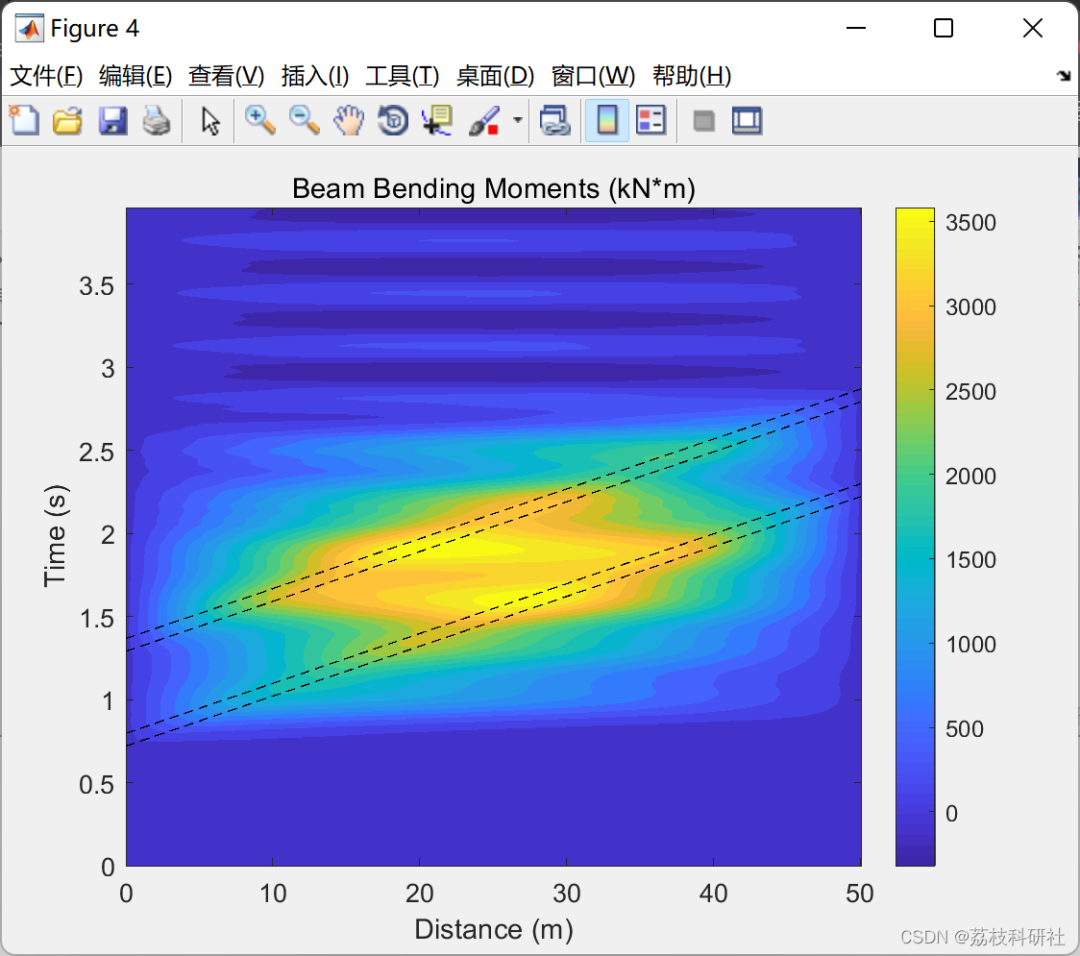
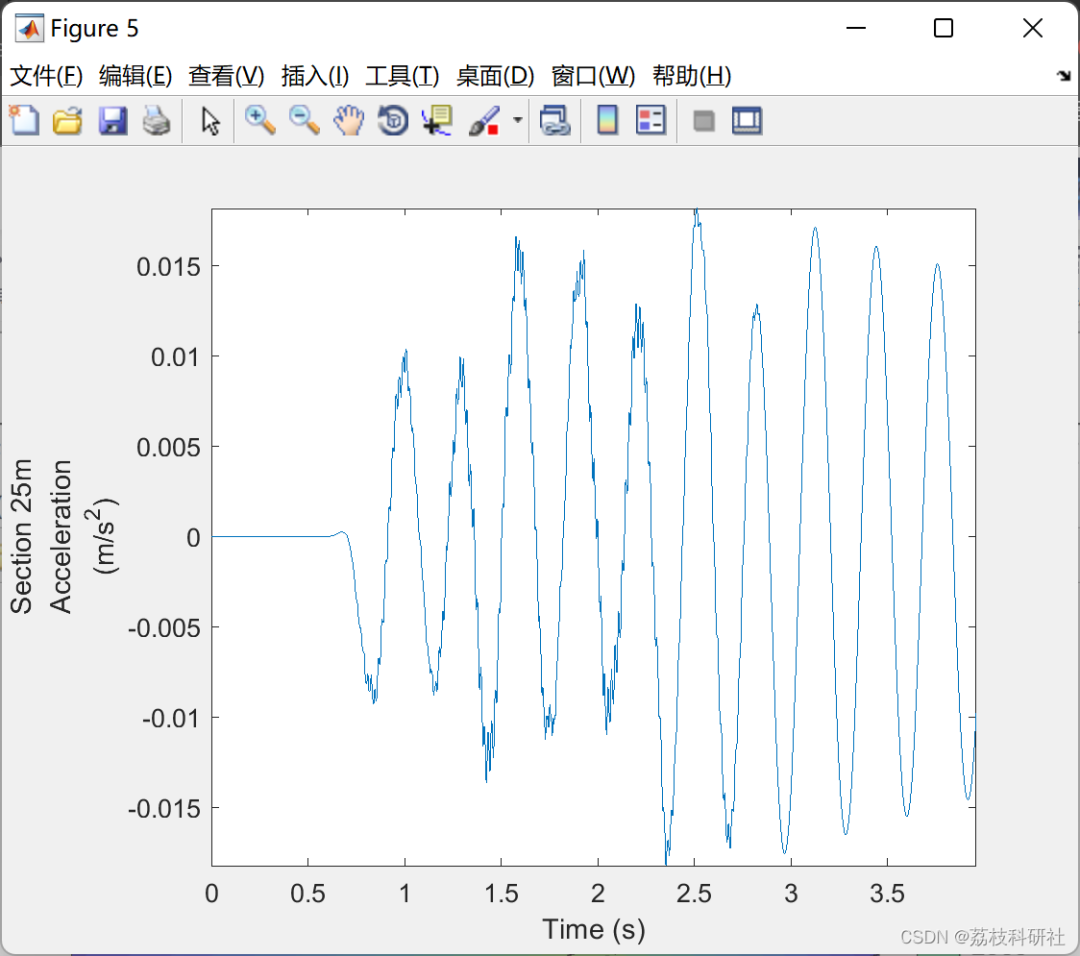
% Input processing
if calc_type ==0
    out_field ='StaticShear';
    in_field ='StaticU';
elseif calc_type ==1
    out_field ='Shear';
    in_field ='U';
end

% if calc_type ==0
% Initialize variables
Sol.Beam.(out_field).xt = zeros(Beam.Mesh.Nodes.Tnum,Calc.Solver.num_t);

%In-line functions (more efficient alternative to subfunctions)
B32_Beam_ele_HS = ...
    @(L,E,I) double(E*I*[[12/L^3,6/L^2,-12/L^3,6/L^2];[12/L^3,6/L^2,-12/L^3,6/L^2]]);

%---- NO average nodal values ----
if Calc.Options.Shear_calc_mode ==0
for ele =1:Beam.Mesh.Ele.Tnum
        aux1 = B32_Beam_ele_HS(Beam.Mesh.Ele.a(ele),Beam.Prop.E_n(ele),Beam.Prop.I_n(ele));
        Sol.Beam.(out_field).xt(ele,:) = aux1(1,:) * ...
            Sol.Model.Nodal.U(Model.Mesh.DOF.beam(Beam.Mesh.Ele.DOF(ele,:)),:);
end
%for ele
    ele = Beam.Mesh.Nodes.Tnum;
    aux1 = B32_Beam_ele_HS(Beam.Mesh.Ele.a(ele-1),Beam.Prop.E_n(ele-1),Beam.Prop.I_n(ele-1));
    Sol.Beam.(out_field).xt(ele,:) = aux1(2,:) * ...
        Sol.Model.Nodal.(in_field)(Model.Mesh.DOF.beam(Beam.Mesh.Ele.DOF(ele-1,:)),:);

%---- AVERAGE nodal values ----
elseif Calc.Options.Shear_calc_mode ==1
for ele =1:Beam.Mesh.Ele.Tnum
        Sol.Beam.(out_field).xt([1,2]+(ele-1),:) = Sol.Beam.(out_field).xt([1,2]+(ele-1),:) + ...
            B32_Beam_ele_HS(Beam.Mesh.Ele.a(ele),Beam.Prop.E_n(ele),Beam.Prop.I_n(ele)) * ...
             Sol.Model.Nodal.(in_field)(Model.Mesh.DOF.beam(Beam.Mesh.Ele.DOF(ele,:)),:);
end
%for ele
% Average of nodes with multiple calculations
    Sol.Beam.(out_field).xt(2:end-1,:) = Sol.Beam.(out_field).xt(2:end-1,:)/2;
end
% Calc.Options.Shear_calc_mode
%---- Additional Outputs ----
% Maximum Shear Force
[Sol.Beam.(out_field).max,aux1] =max(Sol.Beam.(out_field).xt);
[Sol.Beam.(out_field).max,aux2] =max(Sol.Beam.(out_field).max);
Sol.Beam.(out_field).max_node = aux1(aux2);
Sol.Beam.(out_field).max_COP = Beam.Mesh.Nodes.acum(Sol.Beam.(out_field).max_node);
Sol.Beam.(out_field).max_pCOP = Sol.Beam.(out_field).max_COP/Beam.Prop.L*100;
Sol.Beam.(out_field).max_t_crit = Calc.Solver.t(aux2);
if Sol.Beam.(out_field).max_pCOP <50
    Sol.Beam.(out_field).max_supp =max(Sol.Beam.(out_field).xt(1,:));
else
    Sol.Beam.(out_field).max_supp =max(Sol.Beam.(out_field).xt(end,:));
end
% if Sol.Beam.(out_field).max_pCOP <50
% Minimum Shear Force
[Sol.Beam.(out_field).min,aux1] =min(Sol.Beam.(out_field).xt);
[Sol.Beam.(out_field).min,aux2] =min(Sol.Beam.(out_field).min);
Sol.Beam.(out_field).min_node = aux1(aux2);
Sol.Beam.(out_field).min_COP = Beam.Mesh.Nodes.acum(Sol.Beam.(out_field).min_node);
Sol.Beam.(out_field).min_pCOP = Sol.Beam.(out_field).min_COP/Beam.Prop.L*100;
Sol.Beam.(out_field).min_t_crit = Calc.Solver.t(aux2);
if Sol.Beam.(out_field).min_pCOP <50
    Sol.Beam.(out_field).min_supp =min(Sol.Beam.(out_field).xt(1,:));
else
    Sol.Beam.(out_field).min_supp =min(Sol.Beam.(out_field).xt(end,:));
end
% if Sol.Beam.(out_field).min_pCOP <50
%---- End of function ----
3References
Some theoretical sources are from the internet; please contact us for removal if there is any infringement.

[1] He Xia, Nan Zhang, Guido De Roeck, Dynamic analysis of high speed railway bridge under articulated trains, Computers & Structures, Volume 81, Issues 26–27, 2003, Pages 2467-2478, ISSN 0045-7949.
[2] Yean-Seng Wu, Yeong-Bin Yang, Steady-state response and riding comfort of trains moving over a series of simply supported bridges, Engineering Structures, Volume 25, Issue 2, 2003, Pages 251-265, ISSN 0141-0296.
[3] Pablo Antolín, Nan Zhang, José M. Goicolea, He Xia, Miguel Á. Astiz, Javier Oliva, Consideration of nonlinear wheel–rail contact forces for dynamic vehicle–bridge interaction in high-speed railways, Journal of Sound and Vibration, Volume 332, Issue 5, 2013, Pages 1231-1251, ISSN 0022-460X.

4 MATLAB Code and Article Download