Click the blue text above to follow us

📋📋📋 The table of contents is as follows: 🎁🎁🎁
Contents
💥1 Overview
📚2 Results
🎉3 References
🌈4 Matlab Code, Data, Literature


 1 Overview

Efficient data investigation and rapid, accurate prediction of the remaining useful life (RUL) of aircraft engines can be considered a very important task in maintenance operations. In this case, the key issue is how to conduct appropriate research to extract important information from high-dimensional data-driven sequences to ensure reliable conclusions. This paper proposes a data-driven learning scheme based on the online sequential extreme learning machine (OS-ELM) algorithm for RUL prediction. First, a feature mapping technique based on stacked autoencoders is proposed to enhance feature representation through precise reconstruction; additionally, to address the dynamic programming problem based on environmental feedback, a new dynamic forgetting function based on recursive learning time difference is introduced to enhance the ability to dynamically track new incoming data. Furthermore, a new update selection strategy is developed to discard unnecessary data sequences and ensure that the training model parameters converge to appropriate values. The method is validated on the C-MAPSS dataset, and experimental results show that the predictive model has satisfactory accuracy and efficiency compared to other existing methods. Predicting the health status in complex equipment or subsystems based on traditional methods (such as physical modeling methods) has become a very daunting task. Due to the need for in-depth understanding of system components and their internal interactions, the complexity of the modeling process increases, making it nearly impossible. Even if the final model can be prepared under limited conditions, the results may mislead predictions or be insufficiently accurate due to poor generalization. Nowadays, due to the availability of heterogeneous data, machine learning applications for RUL estimation have become increasingly important, which in turn drives researchers to push traditional RUL prediction paradigms through various predictive methods. Continuous improvements in machine learning models make their application in prognostics and health management (PHM) more relevant [1]. It allows modeling system behavior by extracting important patterns solely from retrieved data, even without prior knowledge of its internal features. Unlike traditional paradigms, machine learning techniques aim to reduce modeling complexity with less human intervention and lower computational costs. For example, Xiong Li et al. [2] used hidden semi-Markov models (HSMM) to train SVM for RUL prediction. García et al. [3] designed a hybrid swarm intelligence technique based on SVM to find the optimal training coefficients in the RUL prediction process of aircraft engines. Saidi et al. [4] combined spectral kurtosis (SK) with SVM to construct RUL predictors with more meaningful feature mappings for health prediction of wind turbine high-speed shaft bearings. Zheng et al. [5] constructed a training template for the ELM model based on a hybrid model. They adopted time window feature scaling as a preprocessing and appropriate feature selection step to ensure accurate RUL predictions. Ordóñez et al. [6] proposed a hybrid autoregressive model and constructed several estimation algorithms for early RUL prediction using genetic algorithms combined with improved SVM. Chen et al. [7] used the same C-MAPPS dataset to perform RUL prediction using SVM-based similarity methods. It is worth mentioning that all cited works can be classified as hybrid models aimed at accurately predicting RUL by preprocessing training data through unsupervised training or before “single-batch” supervised training. However, in these cases, time-varying data and parameter updates are not considered, which is incompatible with data-driven predictive models capable of addressing dynamic health deterioration of equipment based on internal or environmental conditions. Neural networks with mini-batch training can interact with flowing data sequences and update predictive models to meet changes in newly arrived data sequences. In [8], Ben Ali et al. introduced a new data-driven method that trains a simplified fuzzy adaptive resonance theory map (SFAM) neural network using Weibull distribution (WD) to avoid time-domain fluctuations in the RUL prediction process. Al-Dulaimi et al. [9] developed a mini-batch hybrid deep neural network that employs two paths for RUL estimation; multidimensional feature extraction based on long short-term memory (LSTM) and convolutional neural networks, as well as a prediction path based on fusion algorithms. Wen et al. [10] constructed a feature mapping and training scheme based on ensemble residual CNN, and after building multiple learners to accurately predict RUL, they validated their training model using K-fold cross-validation methods. Xiang et al. [11] simplified the RUL prediction process of aircraft engines by directly using raw sensor measurements without requiring prior expertise in signal processing using novel deep convolutional neural networks and time window feature extractors. The predictive methods used in these works are based on mini-batch training that interacts with data-driven sequences. Many training models have been developed using different paradigms, such as hybrid, ensemble, and deep learning, attempting to access more meaningful data representations through accurate predictions. However, in this case, there is no discussion of the impact of dynamic changes at the mini-batch data level on training models, which may allow weights and biases to diverge in certain mini-batches, leading to gradual underfitting of the neural network (NN). In other cases, using old mini-batch training algorithms (such as backpropagation (BP) algorithms) for NNs increases computational costs and time consumption. Through this analysis, the main challenges of the RUL prediction task are: 1. Updating training models based on changes in data over time (adaptive learning). 2. Determining whether newly arrived data is important for training models (new). 3. Making training models conform to the actual health status of the equipment by focusing more on newly acquired data and gradually discarding old data. 4. Reducing time consumption during training. Over the past decade, ELM has been widely used for prediction purposes due to its fast training based on linear function approximation and fewer parameter adjustments [12]. Zhou et al. [13] proposed stacked elm trees (S-ELM), where a stack of small elm trees is specifically designed to address large complex data problems. Ben Ali et al. [14] proposed a new unsupervised learning classification tool based on adaptive resonance theory 2 (ART2) to extract data for health prognosis of high-speed shaft bearings. Li et al. [15] proposed an improved OS-ELM, which is one of the ELM variants with adaptive forgetting factors and update selection strategies to predict gas utilization using time-varying data. Yang et al. [16] developed a new method for recursive learning regularization of OS-ELM to reduce overfitting of predictive models as well as empirical and structural risks. Lu et al. [17] enhanced the recursive learning of OS-ELM by introducing ensemble Kalman filter propagation for adjusting the output weights of NNs for aircraft engine RUL prediction. Yin et al. [18] proposed a time-decaying recursive least squares (TD-RLS(λ)) that enhances RLS’s adaptation to linear function approximation by updating its parameters based on environmental feedback. OS-ELM can solve online learning problems in real-time, such as our RUL prediction problem, without iterative tuning, which greatly helps reduce computational costs. The training rules of OS-ELM allow recursive learning for any driven data block, even if the sizes are different or fixed. Generally, one of the limitations of OS-ELM or ELM algorithms is the interpolation caused by the pseudo-inverse of the matrix [19], which makes ELM variants suffer from structural risks. This paper proposes an improved data-driven RUL estimation method based on OS-ELM to enhance the novelty of the predictive algorithm and its adaptability to time-varying data. In fact, the main contributions of this work to address the issues of adaptive learning and inadaptability are: 1. The modified OS-ELM based on SAE achieves optimal feature extraction and selection through unsupervised learning. 2. The introduction of OS-ELM. 3. The involvement of Tikhonov regularization to reduce structural risk and overfitting by minimizing the norm of training weights. 4. Dynamic forgetting of old data, integrating USS and TD error target functions into SAE and OS-ELM for better accuracy and adaptability to newly arrived data. The proposed method is applied to a public dataset of turbofan engines [20], and the results obtained show higher performance compared to other methods recently used in the literature.


 2 Results
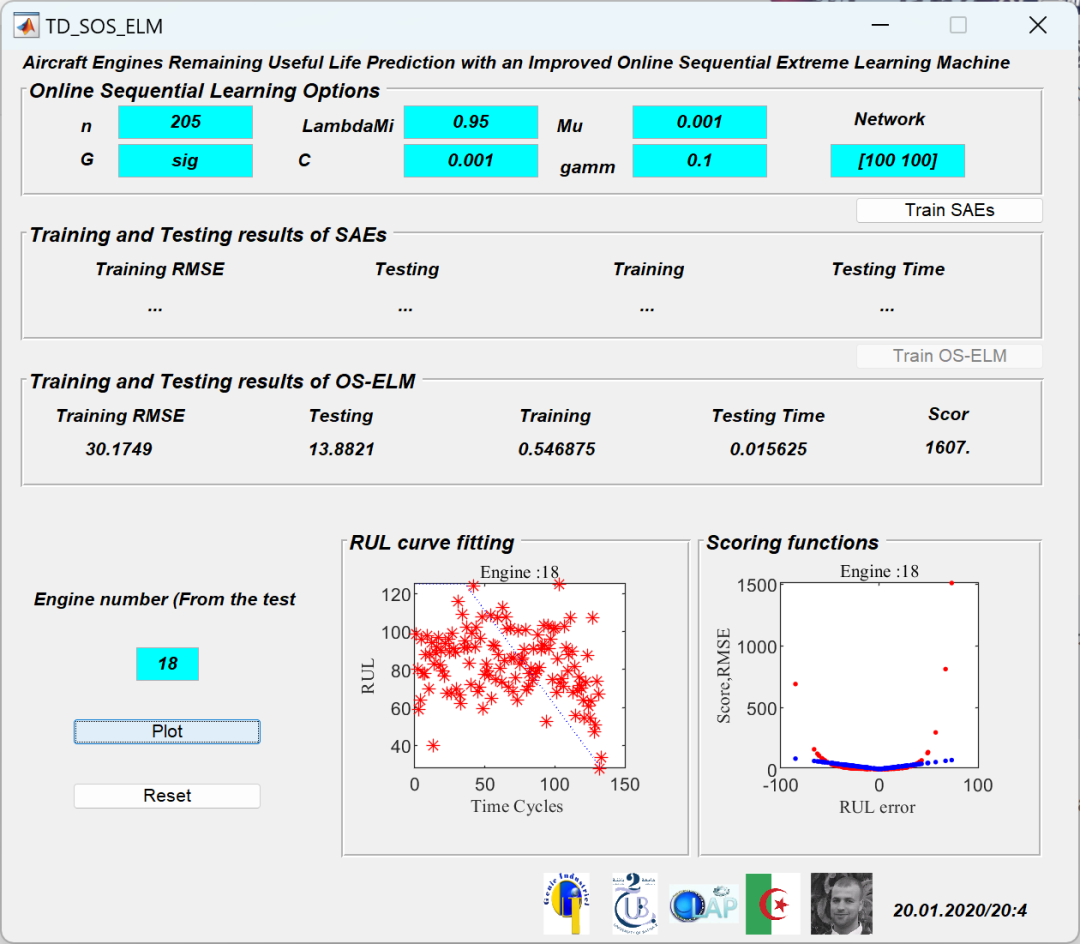
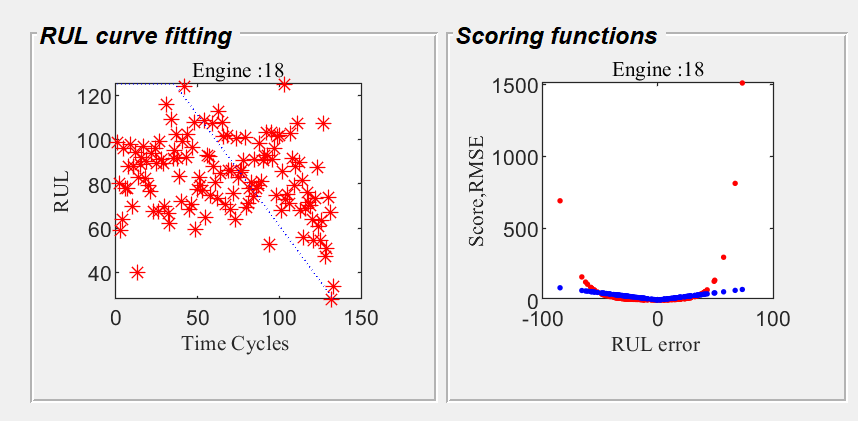
% Part of the code:

%% plot(RUL) of a set of engines from the test set
% the user has the ability to choose any engine ,
% i: is the desired number of engine
axes(handles.axes2);
i=str2double(get(handles.UniteN,'string'));
plot(1:length(net.Yts_hat{i}),net.Yts_hat{i},'r*',1:length(net.Yts_hat{i}),net.Yts{i},'b:');
xlabel('Time Cycles ','FontName','Times New Roman','FontSize',8);
ylabel('RUL','FontName','Times New Roman','FontSize',8);
%legend('Predicted RUL','desired RUL');
title(['Engine :' num2str(i)],'FontName','Times New Roman','FontSize',8);
%% plot Score
axes(handles.axes3);
[~,S,d,er]=Score(net.Yts_hat{i}',net.Yts{i});
i=str2double(get(handles.UniteN,'string'));
plot(d,S,'r.',d,er,'b.');
xlabel('RUL error ','FontName','Times New Roman','FontSize',8);
ylabel('Score,RMSE','FontName','Times New Roman','FontSize',8);
%legend('Predicted RUL','desired RUL');
title(['Engine :' num2str(i)],'FontName','Times New Roman','FontSize',8);

% --- Executes on button press in pushbutton4.
function pushbutton4_Callback(hObject, eventdata, handles)
% hObject    handle to pushbutton4 (see GCBO)
% eventdata  reserved - to be defined in a future version of MATLAB
% handles    structure with handles and user data (see GUIDATA)
%% variables & buttons management
% buttons
set(handles.pushbutton1,'Enable','on');
set(handles.pushbutton3,'Enable','off');
% variables
set(handles.UniteN,'Enable','off');
% parameters
set(handles.Arch,'Enable','on');
set(handles.G,'Enable','on');
set(handles.LambdaMin,'Enable','on');
set(handles.Mu,'Enable','on');
set(handles.gamma,'Enable','on');
set(handles.C,'Enable','on');
set(handles.n,'Enable','on');
%
axes(handles.axes2)
cla
axes(handles.axes3)
cla
%% initialize results
set(handles.trr,'string','...');
set(handles.tsr,'string','...');
set(handles.trt,'string','...');
set(handles.tst,'string','...');
set(handles.Score,'string','...');
set(handles.S_trr,'string','...');
set(handles.S_tsr,'string','...');
set(handles.S_trt,'string','...');
set(handles.S_tst,'string','...');

 3 References
Some content in this article is sourced from the internet, and references will be noted. If there are any omissions, please feel free to contact us for removal.

[1] Berghout, T.; Mouss, L.-H.; Kadri, O.; Saïdi, L.; Benbouzid, M. Aircraft Engines Remaining Useful Life Prediction with an Improved Online Sequential Extreme Learning Machine. Appl. Sci. 2020, 10, 1062.


 4 Matlab Code, Data, Literature
Lychee Research Society