✅ Author’s Introduction: A Matlab simulation developer passionate about research, skilled in data processing, modeling simulation, program design, obtaining complete code, reproducing papers, and scientific simulation.
🍎 Previous Review: Follow my personal homepage:Matlab Research Studio
🍊 Personal Motto: Investigate things to gain knowledge, complete Matlab code and simulation consultation available via private message.
🔥 Content Introduction
In complex engineering and scientific decision-making scenarios, Interval-Valued Multi-Objective Optimization Problems (IVMOPs) are widely present. These problems differ from traditional deterministic multi-objective optimization as their objective function values or constraints exhibit interval uncertainty. For example, in power system scheduling, load demand is influenced by various random factors, making precise predictions difficult, and can only be expressed in interval form; in supply chain management, the procurement costs of raw materials often reflect interval values due to market fluctuations. Traditional multi-objective optimization algorithms (such as NSGA-II, MOEA/D, etc.) have limitations when facing such uncertainties, failing to fully exploit the potential information in the solution space and struggling to provide comprehensive and robust decision-making solutions. The Interval-based Multi-Objective Evolutionary Algorithm (IP-MOEA) has emerged to address these uncertainty issues, aiming to find a set of balanced Pareto optimal solutions in an interval environment through effective strategies, providing decision-makers with more resilient and adaptive decision support.
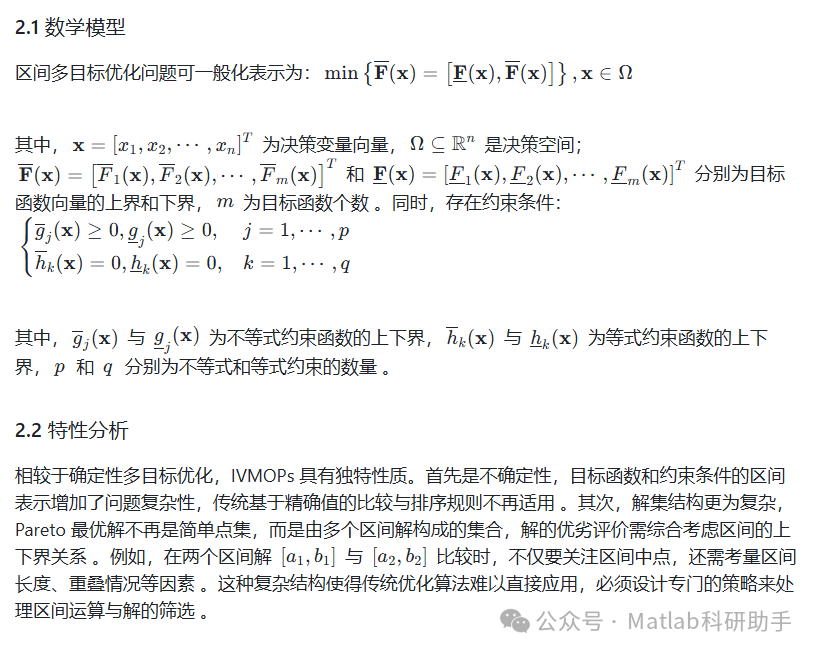
II. Mathematical Description and Characteristics of Interval Multi-Objective Optimization Problems
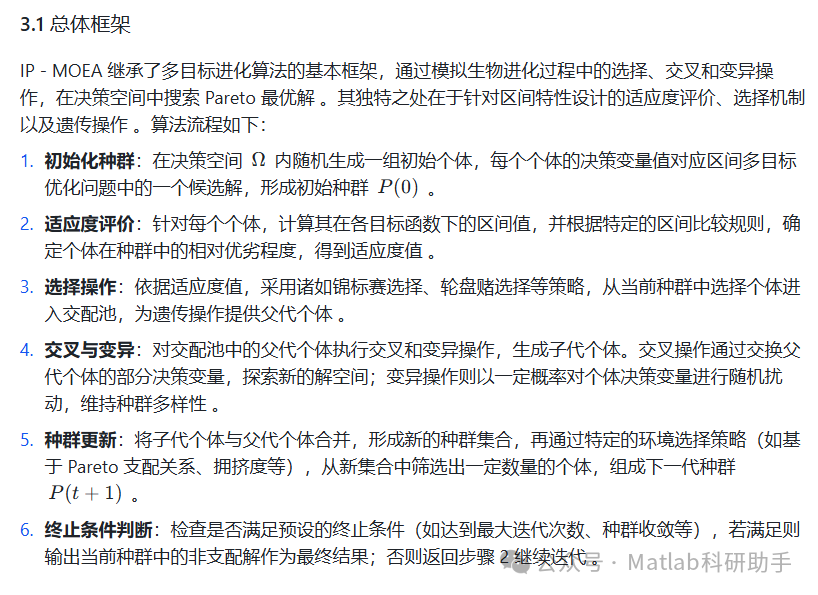
III. Principles and Core Mechanisms of IP-MOEA Algorithm
IV. Performance Advantages and Application Scenarios of IP-MOEA
4.1 Performance Advantages
- Ability to Handle Uncertainty: Compared to traditional multi-objective optimization algorithms, IP-MOEA can directly handle interval uncertainty in objective functions and constraints without needing to convert interval values into deterministic values for approximate solutions, thus more accurately reflecting the characteristics of real-world problems and providing solutions that better meet actual needs. For instance, in mechanical design optimization with uncertain parameters, traditional algorithms may lead to deviations in design schemes during actual operation due to approximate handling of parameters, while IP-MOEA can conduct a comprehensive search based on interval information, resulting in more robust design solutions.
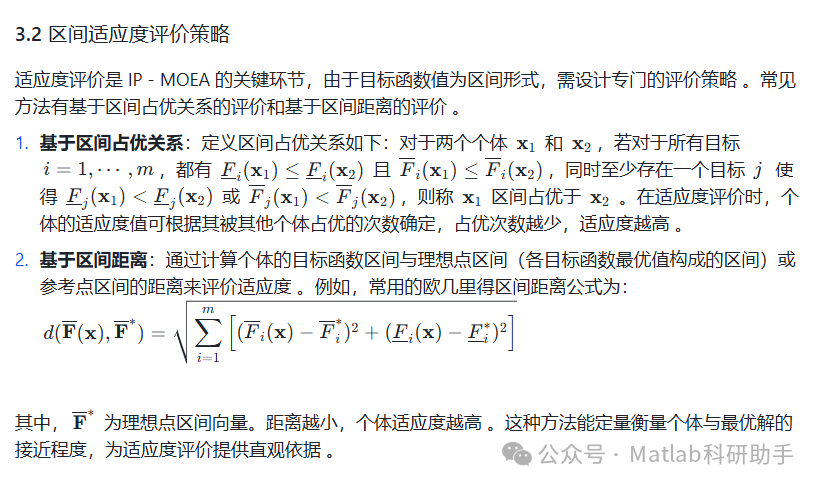
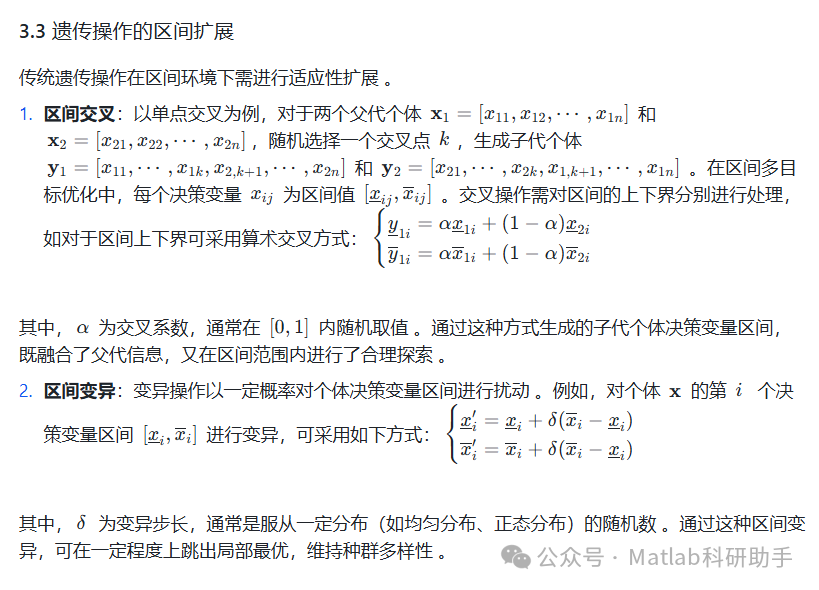
- Diversity and Balance of Solution Sets: Through specially designed interval fitness evaluation and genetic operations, IP-MOEA can better balance convergence and diversity during the search process. In fitness evaluation, strategies based on interval dominance and distance encourage the algorithm to converge towards the Pareto front while maintaining solution diversity; interval genetic operations, through reasonable perturbations and crossover of interval bounds, further expand the solution space, preventing the algorithm from prematurely converging to local optima, resulting in a Pareto optimal solution set that performs better in terms of diversity and balance. For example, in multi-objective portfolio optimization, IP-MOEA can provide various investment portfolio schemes that balance risk and return, catering to different investors’ risk preferences.
4.2 Application Scenarios
- Energy System Optimization: In the power system unit commitment problem, load demand and new energy generation power exhibit uncertainty and are often represented in interval form. IP-MOEA can be used to optimize the startup and shutdown plans and generation output of units, effectively handling the interval uncertainty of load and new energy generation while considering multiple objectives such as generation costs and system reliability, thus formulating more reliable power dispatch plans. Additionally, in energy distribution network planning, uncertainties exist in energy demand, transmission losses, etc., and IP-MOEA can comprehensively consider construction costs, operational efficiency, reliability, and other objectives to provide energy distribution network optimization schemes that adapt to uncertainties.
- Supply Chain Management: In supply chain inventory management, market demand fluctuations lead to interval characteristics in inventory demand. IP-MOEA can be used to optimize inventory levels and replenishment strategies, balancing multiple objectives such as inventory holding costs, stockout costs, and replenishment costs to cope with market demand uncertainty and improve overall supply chain efficiency. In supply chain network design, uncertainties exist in supplier delivery capabilities, transportation times, etc., and IP-MOEA can design supply chain network structures that adapt to uncertainties while considering construction costs, operational costs, service levels, and other objectives.
V. Current Research Status and Challenges of IP-MOEA
5.1 Current Research Status
In recent years, significant progress has been made in research related to IP-MOEA. In terms of algorithm improvement, scholars have optimized the basic IP-MOEA from multiple perspectives. For example, introducing an elite retention strategy that directly retains outstanding individuals from each generation into the next generation to accelerate algorithm convergence; adopting an adaptive parameter adjustment mechanism that dynamically adjusts crossover, mutation probabilities, and other parameters based on the population state during the algorithm’s operation to improve search efficiency. In theoretical analysis, in-depth studies have been conducted on the convergence, complexity, and other theoretical properties of IP-MOEA, providing a theoretical basis for algorithm performance evaluation. Furthermore, research on the application of IP-MOEA in more practical fields continues to emerge, such as multi-objective optimization for pollution control in environmental engineering and multi-objective path optimization in traffic planning.
5.2 Challenges Faced
- Computational Complexity: Due to the complexity of interval operations, the computational load of IP-MOEA increases dramatically when handling large-scale problems. For instance, in cases with high-dimensional decision variables and multiple objective functions, interval fitness evaluation and genetic operations require a large number of interval operations, leading to long algorithm run times and low efficiency. Reducing computational complexity and improving the algorithm’s solution efficiency for large-scale problems is an urgent issue to be addressed.
- Insufficient Utilization of Interval Information: Currently, IP-MOEA still has shortcomings in processing interval information, with some algorithms only utilizing the upper and lower bounds of intervals without fully exploring the potential information contained in the uncertainty degree and probability distribution of intervals. This may lead to the loss of important information in the selection and evaluation of solutions, affecting solution quality. How to more comprehensively and effectively utilize interval information to enhance algorithm performance is an important direction for future research.
- Visualization of Solutions and Decision Support: The solutions obtained by IP-MOEA are a set of Pareto optimal solutions in interval form. How to present these complex interval solutions to decision-makers in an intuitive and understandable way to assist in decision-making is a challenge in practical applications. Currently, there is a lack of effective solution visualization methods and decision support tools, limiting the promotion and application of IP-MOEA in actual decision-making.
VI. Future Research Directions
6.1 Efficient Algorithm Design
Explore new algorithm frameworks and strategies to reduce the computational complexity of IP-MOEA. For example, by combining parallel computing technology, distributing interval operation tasks across multiple computing nodes for parallel processing to accelerate algorithm execution; researching proxy model-based IP-MOEA, which constructs proxy models for objective functions and constraints to reduce the number of complex interval operations and improve the algorithm’s solution efficiency for large-scale problems.
6.2 Enhanced Interval Information Mining
Design more advanced interval information processing methods to fully utilize the uncertainty characteristics contained in intervals. For example, introducing fuzzy theory, evidence theory, etc., to quantify the uncertainty degree of intervals and incorporate it into fitness evaluation and genetic operations, enabling the algorithm to handle uncertainty more accurately and improve solution quality.
6.3 Development of Solution Visualization and Decision Support Systems
Develop specialized solution visualization tools to present the interval solutions obtained by IP-MOEA in intuitive graphics (such as interval graphs, radar charts, etc.) to decision-makers, while providing decision support functions, such as sorting and filtering interval solutions based on decision-maker preferences, assisting them in making reasonable decisions quickly. By improving solution visualization and decision support systems, the widespread application of IP-MOEA in practical engineering and scientific decision-making can be promoted.
VII. Conclusion
The Interval Multi-Objective Optimization Algorithm IP-MOEA, as an effective tool for addressing uncertain multi-objective optimization problems, demonstrates significant value in both theoretical research and practical applications. Through unique interval fitness evaluation, genetic operations, and other mechanisms, IP-MOEA can efficiently search for Pareto optimal solutions in an interval environment, providing comprehensive and robust solutions for complex decision-making problems. Despite currently facing challenges such as high computational complexity, insufficient utilization of interval information, and lack of solution visualization and decision support, with the in-depth development of efficient algorithm design, interval information mining technologies, and solution visualization and decision support systems, IP-MOEA is expected to play a greater role in various fields such as energy systems, supply chain management, and environmental engineering, providing stronger technical support for solving complex uncertain multi-objective optimization problems in the real world.
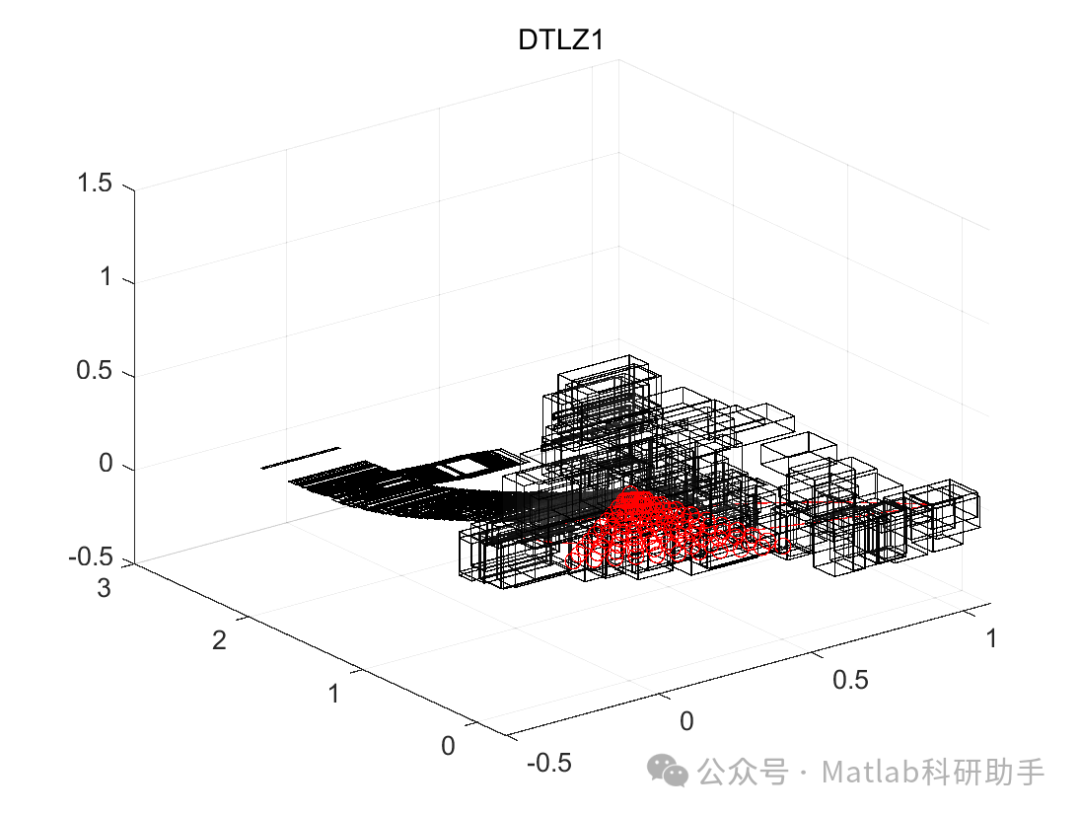
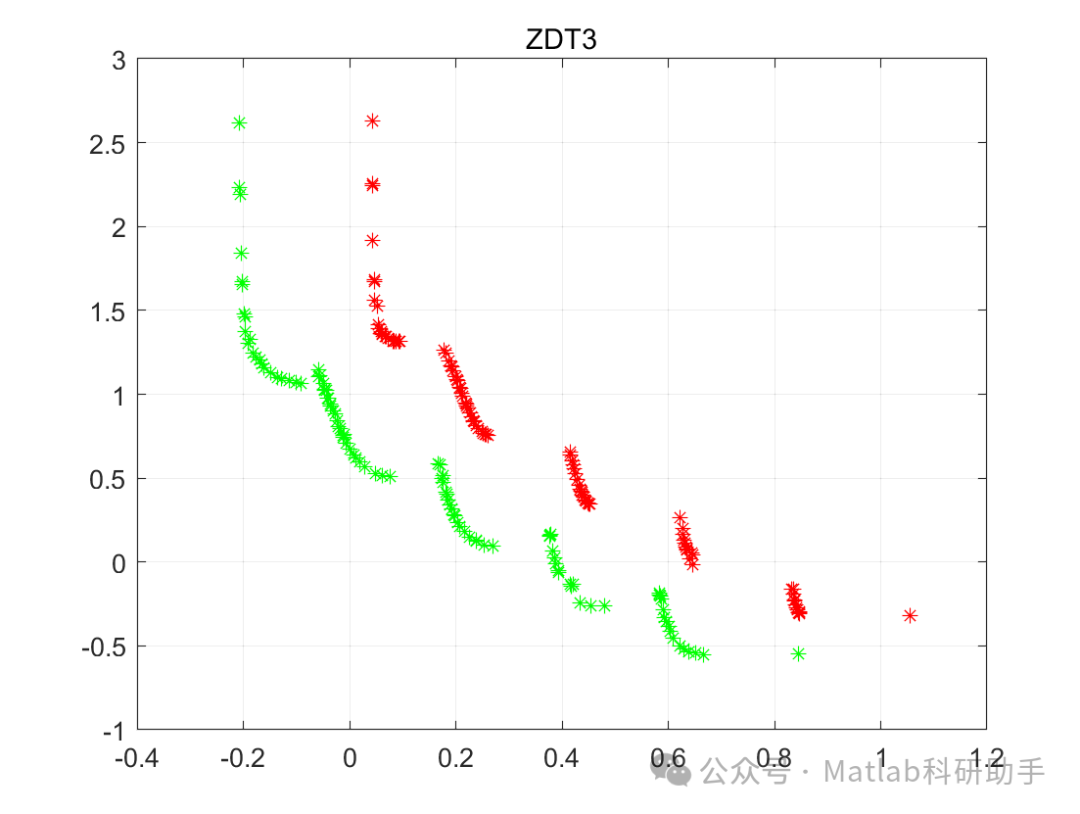
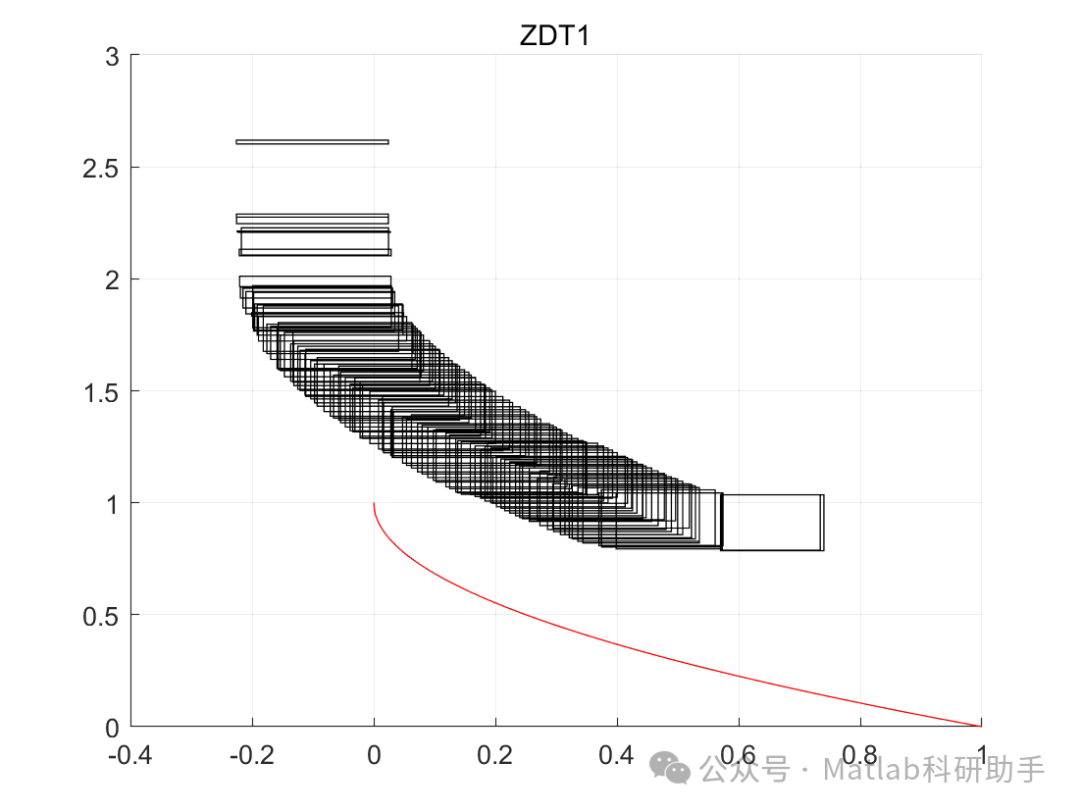
⛳️ Operation Results
🔗 References
[1] Zheng Xiangwei, Liu Hong. Research Progress on Multi-Objective Evolutionary Algorithms [J]. Computer Science, 2007, 034(007):187-192. DOI:10.3969/j.issn.1002-137X.2007.07.050.
[2] Yan Hong. Research and Application of Multi-Objective Optimization Algorithm Based on Interval Credibility Lower Bound [J]. Computer Science, 2017, 44(B11):577-579.
[3] Yan Hong. Research and Application of Multi-Objective Optimization Algorithm Based on Interval Credibility Lower Bound [J]. Computer Science, 2017, 44(B11):4. DOI:CNKI:SUN:JSJA.0.2017-S2-124.
📣 Partial Code
🎈 Some theoretical references are from online literature; if there is any infringement, please contact the author for deletion.
👇 Follow me to receive a wealth of Matlab e-books and mathematical modeling materials.
🏆 Our team specializes in guiding customized MATLAB simulations in various research fields, helping to realize research dreams:
🌈 Various intelligent optimization algorithm improvements and applications
Production scheduling, economic scheduling, assembly line scheduling, charging optimization, workshop scheduling, departure optimization, reservoir scheduling, three-dimensional packing, logistics site selection, cargo position optimization, bus scheduling optimization, charging pile layout optimization, workshop layout optimization, container ship loading optimization, pump combination optimization, medical resource allocation optimization, facility layout optimization, visual field base station and drone site selection optimization, knapsack problem, wind farm layout, time slot allocation optimization, optimal distributed generation unit allocation, multi-stage pipeline maintenance, factory-center-demand point three-level site selection problem, emergency supply material distribution center site selection, base station site selection, road lamp post arrangement, hub node deployment, transmission line typhoon monitoring devices, container scheduling, unit optimization, investment portfolio optimization, cloud server combination optimization, antenna linear array distribution optimization, CVRP problem, VRPPD problem, multi-center VRP problem, multi-layer network VRP problem, multi-center multi-vehicle VRP problem, dynamic VRP problem, two-layer vehicle routing planning (2E-VRP), electric vehicle routing planning (EVRP), hybrid vehicle routing planning, mixed flow shop problem, order splitting scheduling problem, bus scheduling optimization problem, flight shuttle vehicle scheduling problem, site selection path planning problem, port scheduling, port bridge scheduling, parking space allocation, airport flight scheduling, leak source localization.
🌈 Machine learning and deep learning time series, regression, classification, clustering, and dimensionality reduction
2.1 BP time series, regression prediction, and classification
2.2 ENS voice neural network time series, regression prediction, and classification
2.3 SVM/CNN-SVM/LSSVM/RVM support vector machine series time series, regression prediction, and classification
2.4 CNN|TCN|GCN convolutional neural network series time series, regression prediction, and classification
2.5 ELM/KELM/RELM/DELM extreme learning machine series time series, regression prediction, and classification
2.6 GRU/Bi-GRU/CNN-GRU/CNN-BiGRU gated neural network time series, regression prediction, and classification
2.7 Elman recurrent neural network time series, regression prediction, and classification
2.8 LSTM/BiLSTM/CNN-LSTM/CNN-BiLSTM long short-term memory neural network series time series, regression prediction, and classification
2.9 RBF radial basis function neural network time series, regression prediction, and classification
2.10 DBN deep belief network time series, regression prediction, and classification
2.11 FNN fuzzy neural network time series, regression prediction
2.12 RF random forest time series, regression prediction, and classification
2.13 BLS broad learning time series, regression prediction, and classification
2.14 PNN pulse neural network classification
2.15 Fuzzy wavelet neural network prediction and classification
2.16 Time series, regression prediction, and classification
2.17 Time series, regression prediction, and classification
2.18 XGBOOST ensemble learning time series, regression prediction, and classification
2.19 Transform various combinations time series, regression prediction, and classification
Directions cover wind power prediction, photovoltaic prediction, battery life prediction, radiation source identification, traffic flow prediction, load prediction, stock price prediction, PM2.5 concentration prediction, battery health status prediction, electricity consumption prediction, water body optical parameter inversion, NLOS signal identification, precise prediction of subway stops, transformer fault diagnosis.
🌈 Image processing aspects
Image recognition, image segmentation, image detection, image hiding, image registration, image stitching, image fusion, image enhancement, image compressed sensing.
🌈 Path planning aspects
Traveling salesman problem (TSP), vehicle routing problem (VRP, MVRP, CVRP, VRPTW, etc.), three-dimensional path planning for drones, drone collaboration, drone formation, robot path planning, grid map path planning, multimodal transport problems, electric vehicle routing planning (EVRP), two-layer vehicle routing planning (2E-VRP), hybrid vehicle routing planning, ship trajectory planning, full path planning, warehouse patrol.
🌈 Drone application aspects
Drone path planning, drone control, drone formation, drone collaboration, drone task allocation, online optimization of safe communication trajectories for drones, vehicle collaborative drone path planning.
🌈 Communication aspects
Sensor deployment optimization, communication protocol optimization, routing optimization, target localization optimization, Dv-Hop localization optimization, Leach protocol optimization, WSN coverage optimization, multicast optimization, RSSI localization optimization, underwater communication, communication upload and download allocation.
🌈 Signal processing aspects
Signal recognition, signal encryption, signal denoising, signal enhancement, radar signal processing, signal watermark embedding and extraction, electromyography signals, electroencephalography signals, signal timing optimization, electrocardiogram signals, DOA estimation, encoding and decoding, variational mode decomposition, pipeline leakage, filters, digital signal processing + transmission + analysis + denoising, digital signal modulation, bit error rate, signal estimation, DTMF, signal detection.
🌈 Power system aspects
Microgrid optimization, reactive power optimization, distribution network reconstruction, energy storage configuration, orderly charging, MPPT optimization, household electricity.
🌈 Cellular automata aspects
Traffic flow, crowd evacuation, virus spread, crystal growth, metal corrosion.
🌈 Radar aspects
Kalman filter tracking, trajectory association, trajectory fusion, SOC estimation, array optimization, NLOS identification.
🌈 Workshop scheduling
Zero-wait flow shop scheduling problem (NWFSP), Permutation flow shop scheduling problem (PFSP), Hybrid flow shop scheduling problem (HFSP), zero idle flow shop scheduling problem (NIFSP), distributed permutation flow shop scheduling problem (DPFSP), blocking flow shop scheduling problem (BFSP).
👇