0 Introduction
Engineering education practical teaching is an important part of professional course teaching and cultivating engineering talent. Strengthening experimental practical education is beneficial to enhancing students’ innovation ability and overall quality. During the “14th Five-Year Plan” period, the Ministry of Education vigorously promotes the deep integration of modern information technology and practical experimental teaching in higher education institutions. With the rapid development of technologies such as the Internet and big data, traditional teaching models in universities are gradually shifting towards online or blended teaching modes, achieving fruitful research results. However, current blended teaching is mostly applied in theoretical teaching, with relatively less application in practical experimental teaching. How to construct a blended teaching model suitable for practical experimental teaching and achieve deep integration of online and offline practical experimental teaching is a crucial issue that every experimental teacher in higher education should pay attention to.
Small Private Online Courses (SPOC) combine traditional face-to-face teaching with online learning, compensating for the shortcomings of traditional courses and integrating the advantages of Massive Open Online Courses (MOOC), making it more suitable for personalized teaching and the development of new teaching modes. The BOPPPS (Bridge-in Objective/Outcome Pre-assessment Participatory-learning Post-assessment Summary) model, known for effective teaching, emphasizes comprehensive student participation in learning, forming a continuous improvement teaching loop. To facilitate the implementation of online and offline blended experimental teaching, the BSPOPS (Bridge-in Simulation Pre-assessment Operation Post-assessment Summary) model is generated by optimizing and improving individual teaching links based on the BOPPPS model, integrating six components: introduction, simulation, pre-assessment, operation, post-assessment, and summary and evaluation.
1 Current Status of Experimental Teaching Modes in Higher Education
The continuous reform of experimental teaching methods and means is a key factor in cultivating practical abilities and innovative talents. Looking at the evolution of experimental teaching modes in higher education, they are mainly divided into traditional experimental teaching modes and online virtual experimental teaching modes[1].
The traditional experimental teaching mode focuses on completing functional verification experiments and has the characteristics of “four fixed”—requiring students to complete fixed experimental content using fixed experimental equipment within a fixed time and following fixed experimental steps. The advantage of this teaching method is that students can perceive and operate instruments, which is conducive to understanding theoretical knowledge and cultivating practical skills. However, the downside is that students’ thinking becomes rigid, which is not conducive to cultivating their innovative abilities.
The online virtual experimental teaching mode refers to the experimental teaching mode conducted under the “Internet+” background, which involves remotely operating virtual laboratory systems or real devices via the internet. It can be divided into three categories: software-shared virtual experiments[2-4], instrument-shared virtual experiments[5], and remotely controlled virtual experiments[6]. Online virtual experimental teaching effectively overcomes the limitations of traditional experimental teaching, allowing flexible adjustments to experimental content while enhancing students’ innovative abilities and stimulating their interest and enthusiasm in experiments. However, this teaching mode requires a certain amount of funding to design and establish the corresponding virtual experimental systems, and it needs careful management and operation of shared equipment. How to carry out online and offline blended experimental teaching in a short time with zero cost and low configuration is crucial.
2 Design of Blended Experimental Teaching Objectives
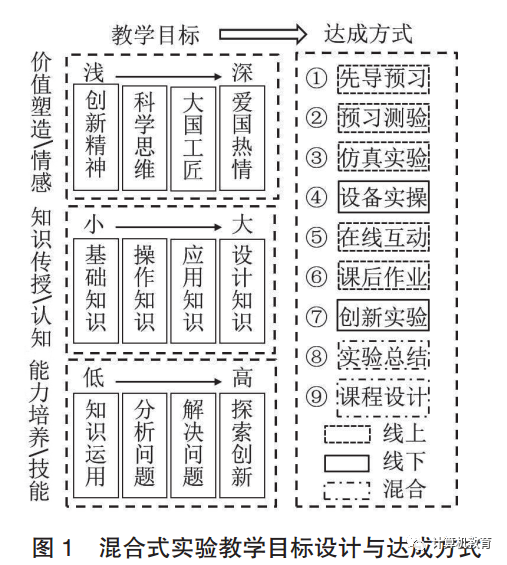
Teaching objectives are the starting and ending points of the teaching mode. To establish a blended experimental teaching model, it is essential to clarify the teaching objectives of the course[7]. When designing teaching objectives, it is necessary to integrate the requirements of the “Guidelines for Ideological and Political Construction of Higher Education Courses” and the BOPPPS model requirements from multiple dimensions, setting teaching objectives from the three dimensions of “value shaping/emotion,” “knowledge transmission/cognition,” and “ability cultivation/skills.”
The teaching objectives of the value shaping/emotion dimension refer to the goals in blended experimental teaching that utilize guidance, motivation, and emotional resonance to cultivate students’ targets in “emotion, attitude, and values” while mastering course knowledge and skills, stimulating learning interest and innovative spirit, and fostering students’ scientific thinking methods for problem-solving and analysis. The knowledge transmission/cognition dimension teaching objectives are mainly divided into two categories: basic knowledge and extended knowledge. Basic knowledge objectives refer to the experimental knowledge, working principles, and independent operational knowledge that students need to understand and master; extended knowledge objectives refer to the integration and flexible application of basic knowledge objectives, including high-level knowledge related to application and design. The ability cultivation/skills dimension teaching objectives are important goals of practical teaching, referring to the ability to apply practical knowledge and the ability to conduct relevant research in the future. The cultivation of the three-dimensional teaching objectives runs through the entire experimental teaching process, as shown in Figure 1.
3 Construction of Blended Teaching Mode
Both traditional experimental teaching and online virtual experimental teaching play a significant role in talent cultivation. Based on the principle of combining virtual and real, the blended experimental teaching mode based on the combination of SPOC and BSPOPS is constructed to achieve mutual integration and complementarity of these two experimental methods.
3.1 Blended Teaching Mode Based on the Combination of SPOC and BSPOPS
The blended experimental teaching mode based on the combination of SPOC and BSPOPS introduces wisdom introduction, online self-study, offline flipping, and process assessment into blended teaching, as shown in Figure 2. The interactive platform and resource support for blended teaching mainly include online and offline parts, with the online SPOC platform selecting Rain Classroom as the interactive platform and the offline course using the laboratory experiment box for teaching. This mode integrates the six components of BSPOPS into the three stages of traditional teaching: before class, during class, and after class.
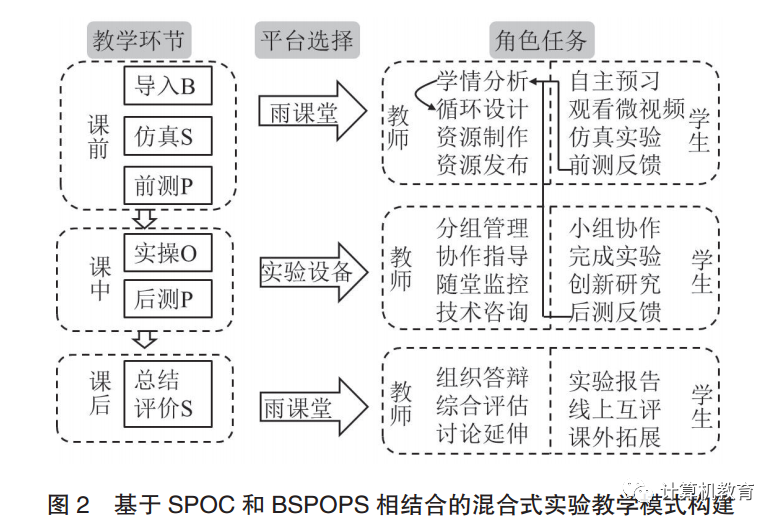
The pre-class stage is mainly used to complete the introduction, simulation, and pre-assessment work. A teaching system of “learning situation prediction + immediate feedback” is constructed, allowing teachers to adjust the difficulty of experiments based on pre-assessment results. Teachers design experimental teaching based on learning situation analysis and introduce teaching resources such as PPT, operational process micro-videos, and preparatory tests, which are released in Rain Classroom a week in advance by class. Students independently prepare online, completing simulation experiments and pre-assessments based on operational process micro-videos, and are allowed to enter the offline experimental stage after meeting the standards.
The in-class stage is mainly used to complete practical operations and post-assessments. Teachers organize students for discussions, formulate experimental plans, and conduct experimental operations. After completing the basic experiment, students conduct group checks and complete the post-assessment. Personalized tutoring is provided for students with strong abilities to further explore their potential. Teachers compile post-assessment results and include existing issues in the course summary to form secondary feedback.
The post-class stage is mainly used for summarization and evaluation, solidifying and enhancing previous experiments. In this stage, teachers conduct comprehensive evaluations and extend the curriculum. Students complete experimental reports and submit them through the online platform.
The blended experimental teaching mode forms a closed-loop experimental teaching based on pre-assessment feedback and post-assessment feedback, which is conducive to cultivating students’ independent learning habits and allows teachers to comprehensively consider teaching objectives, refine and improve experimental course design, thereby improving the quality of experimental teaching.
3.2 Design and Development of Online Teaching Resources
Online teaching resources are the foundation for conducting blended teaching. Common issues reported by students during online learning play a key role in learning situation analysis and the formulation of teaching objectives. Experimental teaching resources are categorized into three types based on functionality: guiding resources, content resources, and generative resources[8]. Guiding resources mainly include syllabi and teaching calendars formulated by the teaching team according to course characteristics and student levels. Content resources are the focus of course resource design and development, subdivided by experimental projects, using a top-down knowledge map to organize and present experimental content and requirements reasonably; content resources are generally designed in the form of multimedia teaching materials, experimental operation micro-videos (around 10 minutes), objective test questions, and extended resources. Generative resources mainly refer to resources dynamically generated during the interactive process of blended teaching, including students’ experimental reports, homework, interactive discussions, and adjusted learning situation analysis reports.
3.3 Integration of Ideological and Political Education into Blended Experimental Teaching
Teaching methods and means in experimental courses differ significantly from those in theoretical courses, leading to different methods for integrating ideological and political education. Therefore, how to organically integrate ideological and political education into experimental teaching and improve the effectiveness of experimental courses and the quality of talent cultivation poses a significant challenge.
In the online and offline blended teaching mode, information technology can be fully utilized to flexibly and reasonably integrate and present ideological and political education using various teaching methods, effectively conducting ideological and political education in experimental courses. During the production of online teaching resources, it is essential to deeply explore the ideological and political elements involved in experiments and use intuitive expressions of life philosophies and insights, enhancing the moral education effect of ideological and political education while achieving knowledge transmission. In the pre-assessment and post-assessment stages, select subjective assignments related to ideological and political education that resonate with students’ age, psychology, and life, closely linking them to practical and social hot topics. In offline experimental teaching, focus on cultivating students’ rigorous scientific attitudes, professional ethics, and engineering literacy through teaching by example, real-life stories, and cultural integration.
Combining online and offline promotes the clever integration of ideological and political education, but it is also essential to avoid falling into the pitfalls of ideological and political education. For example, avoid blindly imitating and simply inserting political theory content into experimental teaching, excessively explaining ideological and political elements, and forcing connections between ideological and political elements and the course content. In summary, ideological and political education should not be rushed; further exploration and accumulation are needed in future experimental teaching.
3.4 Construction of Evaluation System for Blended Experimental Teaching
The grading evaluation system for experimental courses directly affects students’ enthusiasm and initiative in participating in experiments. Therefore, it is crucial to establish a personalized, comprehensive, and quantifiable diversified evaluation system for experimental courses based on the blended experimental teaching mode.
Blended experimental teaching adopts a formative evaluation system for achieving course objectives, unfolding evaluations from multiple dimensions and angles through student self-assessment, peer assessment, and teacher evaluation, forming clear, scientific, and data-supported fine-grained formative assessment rules. The assessment rules focus mainly on offline practical operations, experimental results, and post-assessment situations (accounting for 50%), supplemented by online preparatory work, pre-assessment situations (accounting for 20%), post-class reports (accounting for 20%), and the duration of online video viewing (accounting for 10%). This comprehensive evaluation of students’ learning situations promotes students’ in-depth thinking about experimental details and reflection on experimental results, stimulating students’ enthusiasm for experimental research and cultivating autonomous exploration and deep thinking in experimental classes.
4 Practice and Application of Blended Teaching Based on the Combination of SPOC and BSPOPS
The course on Computer Organization Principles is one of the core courses in the School of Information Science and Technology at our university and serves as a prerequisite for other computer major courses. The course is theory-heavy and abstract, requiring practical operation for understanding and verification[9], making the experimental component crucial for helping students gain a deeper understanding of computer working principles and improving their design and analysis capabilities for computer systems.
In terms of experimental platform selection, based on the course characteristics, we choose to combine Rain Classroom, Quartus II software simulation, and offline hardware experiment boxes, allowing students to truly understand the operation mechanism of the entire system after clarifying the system structure, thus enhancing the effectiveness of experimental teaching.
In organizing experimental content, experiments are arranged with the guiding principle of better understanding theoretical knowledge. In the early independent component experiments, focus on decomposing the experimental process to lay a solid foundation for subsequent autonomous experimental designs and comprehensive experimental designs.
In online resource production, we meticulously create dynamic multimedia teaching materials to help students intuitively understand the working principles of various modules and the operation mechanism of the entire machine, etc. Each experiment’s steps are explained, and the Quartus II software simulation operation process is recorded into short videos of around 10 minutes, with the relevant teaching resources released in Rain Classroom by class to improve the efficiency of offline experimental classes. Through Rain Classroom, we assign, correct, and provide feedback on homework, allowing students to receive timely feedback on their homework status, facilitating the digestion of experimental content.
In organizing experiments, we reasonably arrange students for offline group experiments, including offline experiment box testing and autonomous experimental design. After online preparation, for imitative validation experiments, we have thoroughly resolved issues where some students with weaker foundations cannot replicate complex operational steps, allowing 100% of students to complete the experiment. Compared to traditional experimental teaching, the entire class can complete the same experimental content at least one hour earlier, significantly enhancing the efficiency of experimental classes. Students with extra capacity can continue to engage in autonomous experimental design, further improving their innovative abilities.
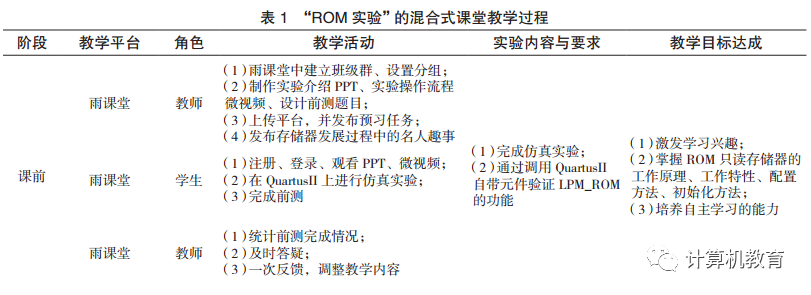
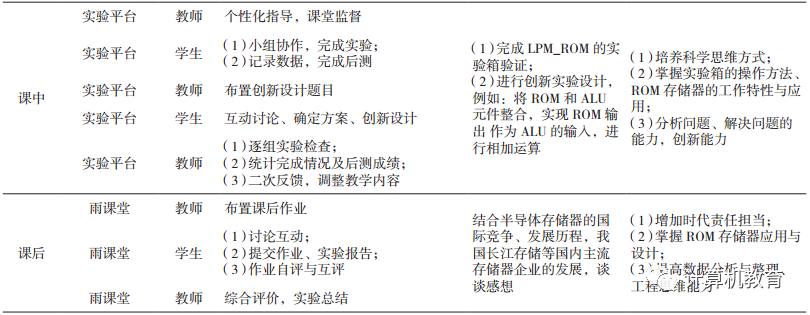
The specific blended experimental teaching process for the ROM experiment in the Computer Organization Principles course is shown in Table 1.
5 Analysis of Experimental Teaching Effectiveness and Limitations
5.1 Comparative Analysis of Traditional Teaching and Blended Experimental Teaching Effectiveness
In the 2020 Computer Organization Principles experimental teaching, two classes were selected to adopt blended experimental teaching. Data from the teaching practice of that semester was collected and compared with the class from the 2019 cohort that used traditional experimental teaching. With comparable student levels and overall quality, and using the same experimental teaching syllabus and courseware, the comparison of final scores is shown in Table 2.
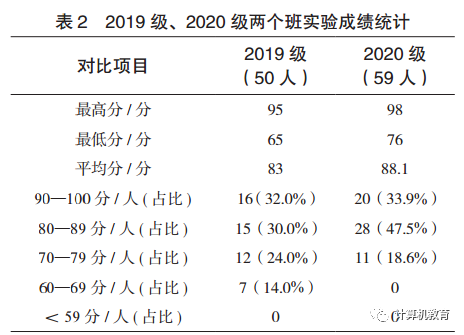
The excellent rate for the 2020 cohort was 33.9%, slightly higher than the 32.0% of the 2019 cohort, with an average score of 88.1 points, which is 5.1 points higher than the 83 points of the 2019 cohort. From the score distribution, 47.5% of the 2020 cohort scored between 80-89, with most students concentrated in this score range, and there were no low scores. In contrast, 14% of the 2019 cohort scored between 60-69. These results reflect the significant improvement in the effectiveness of the blended teaching using SPOC and BSPOPS compared to traditional experimental teaching.
5.2 Summary and Limitations of Experimental Teaching
With the popularization of blended teaching models in higher education, more and more courses are adopting online and offline blended teaching, leading to conflicts in students’ online learning time. How to scientifically and reasonably arrange students’ extracurricular time for online learning needs careful consideration. Secondly, different courses using different online platforms and teaching processes pose challenges for students who need to familiarize themselves with various platforms and teaching processes. Achieving a unified, high-quality online teaching platform requires in-depth research in future teaching. Lastly, teachers need to monitor students’ online learning situations manually for learning situation analysis and teaching organization design, which requires a significant amount of time and effort and can easily lead to information omissions that affect teaching effectiveness. The research team plans to develop corresponding intelligent software to dynamically adjust knowledge maps based on real-time student testing and Q&A situations, conducting word cloud analysis on students’ feedback to reduce teachers’ workload while completing precise teaching design.
6 Conclusion
The blended teaching based on SPOC and the improved BOPPPS (BSPOPS) effectively utilizes the advantages of the SPOC platform and BSPOPS teaching mode, deeply integrates and applies traditional experimental teaching with online teaching, and provides a successful reference case for conducting online and offline blended experimental teaching with zero cost and low configuration in a short time. Practice has proven that the combination of traditional experiments, new media technology, and online teaching effectively enhances the teaching effectiveness and quality of experimental courses, well fulfilling the educational, moral, and talent cultivation functions of experimental courses, providing valuable reference for blended teaching in other experimental courses in higher education.
References:
[1] Ma Handai, Zhang Jianming. Research on the Application of Blended Experimental Teaching in Higher Education [J]. Experimental Technology and Management, 2015(9): 170-172, 175.
[2] Zeng Haiyan, Zheng Xin. Research on Teaching Reform of Mobile Communication Principles Course Based on e-Labsim Simulation Platform [J]. Intelligent Computer and Applications, 2019(3): 306-308.
[3] Zhou Xiuying. Exploration of Accounting Experimental Teaching Practice Based on VR Technology [J]. Journal of Xichang University (Natural Science Edition), 2019(1): 113-116.
[4] Ma Ying, Zhang Heng, Song Qisheng, et al. Virtual Simulation Experimental Projects Assist Online Teaching of Experimental Courses [J]. University Chemistry, 2020(5): 223-228.
[5] Liu Yuehua, He Jing. Exploration of the Application of Virtual Reality in the Teaching of Computer Organization Principles Course [J]. Science and Technology Vision, 2020(4): 49-52.
[6] Tang Haifeng, Liu Yan, Yan Guodong, et al. Online and Offline Blended Teaching Promotes the Opening of Large Instruments to Undergraduates [J]. Experimental Technology and Management, 2020(11): 174-177.
[7] Yu Tai, Li Li, Li Tongming. A Brief Analysis of the Application of SPOC in Higher Education Experimental Teaching [J]. Experimental Technology and Management, 2018(9): 179-181, 185.
[8] Liu Bin. Research on Design and Practice of Blended Teaching Based on Online Courses [J]. China Education Informatization, 2016(11): 81-84.
[9] Zhao Yanan, Zhang Junxia, Lu Jianliang, et al. Exploration of a Graded Teaching Model for Computer Organization Principles Experiment Guided by Competitions [J]. Computer Education, 2022(5): 11-14.
Funding Project: Reform Project of the School of Information Science and Technology, Beijing University of Chemical Technology, “Online and Offline Blended Teaching for Practical Experimental Courses” (XXJG2021004); National Natural Science Foundation Project “Research on Integrated Convection CPCR Microfluidic Nucleic Acid Diagnosis Method with Nucleic Acid Extraction” (81871505).
First Author Introduction: Miao Guijun, Female, Engineer at Beijing University of Chemical Technology, research direction includes computer technology and applications, intelligent control, signal analysis and processing, [email protected].
Citation Format:Miao Guijun, You Feng, Qiu Xianbo. Research and Application of Blended Experimental Teaching Combining SPOC and BSPOPS [J]. Computer Education, 2023(1): 16-20, 27.
(End)
More Exciting:
Call for Papers
Yan Shi│Reflections and Suggestions on the “Predicament” of Young Teachers in Higher Education
Xu Xiaofei et al.|Metaverse Education and Its Service Ecosystem
【Directory】 Computer Education, Issue 12, 2022
【Directory】 Computer Education, Issue 11, 2022
【Directory】 Computer Education, Issue 10, 2022
【Editorial Board Message】 Professor Li Xiaoming from Peking University: Reflections on the “Year of Classroom Teaching Improvement”…
Professor Chen Daoxu from Nanjing University: Teaching students to ask questions and teaching students to answer questions, which is more important?
【Yan Shi Series】: Trends in Computer Discipline Development and Their Impact on Computer Education
Professor Li Xiaoming from Peking University: From Interesting Mathematics to Interesting Algorithms to Interesting Programming—A Path for Non-Majors to Experience Computational Thinking?
Reflections on Several Issues in First-Class Computer Discipline Construction
New Engineering and Big Data Professional Construction
Lessons from Others Can Be Used to Improve Ourselves—Compilation of Research Articles on Computer Education at Home and Abroad