PCB Network News

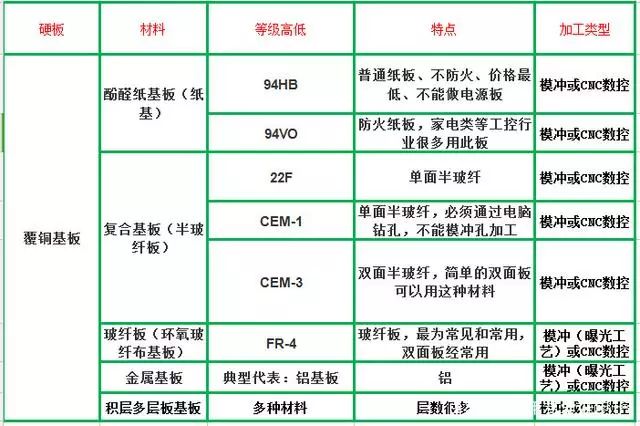
According to the reinforcing materials, PCB boards can generally be divided into the following types:
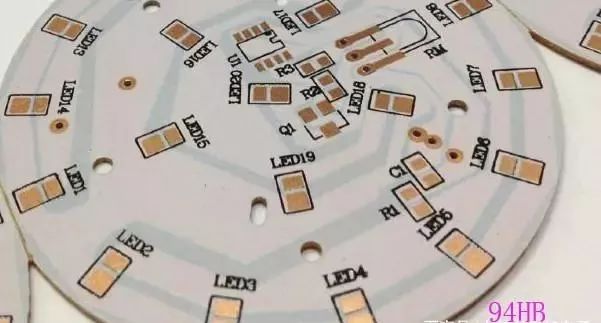
Phenolic PCB Paper Substrate
This type of PCB board is composed of paper pulp and wood pulp, and is sometimes also called paper board, V0 board, flame-retardant board, and 94HB, etc. Its main material is wood pulp fiber paper, which is synthesized under pressure with phenolic resin.
The characteristics of this paper substrate include being non-fireproof, suitable for punching processing, low cost, and relatively low density. Commonly seen phenolic paper substrates include XPC, FR-1, FR-2, FE-3, etc. The 94V0 is a flame-retardant paper board that is fireproof.
Composite PCB Substrate
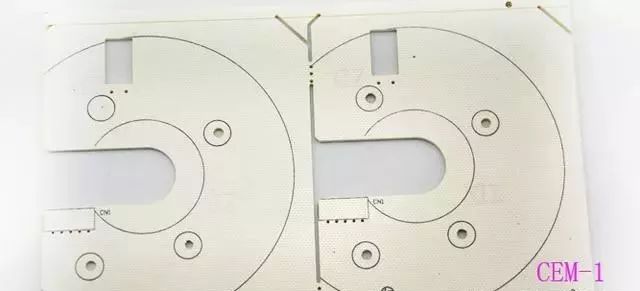
This is also known as powder board, using wood pulp fiber paper or cotton pulp fiber paper as the reinforcing material, while glass fiber cloth is used as the surface reinforcing material. Both materials are made with flame-retardant epoxy resin.
Common types include single-sided semi-glass fiber 22F, CEM-1, and double-sided semi-glass fiber board CEM-3, among which CEM-1 and CEM-3 are currently the most common composite copper-clad boards.
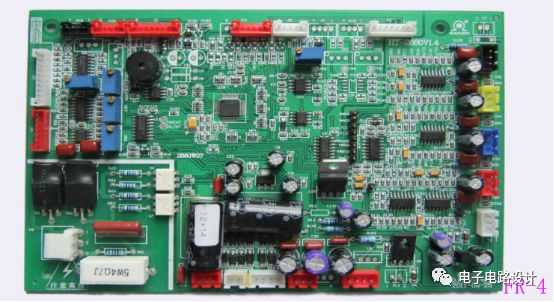
Sometimes also referred to as epoxy board, glass fiber board, FR4, fiber board, etc., it uses epoxy resin as the adhesive and glass fiber cloth as the reinforcing material.
Characteristics: high working temperature, minimal environmental impact, commonly used in double-sided PCBs.
Other Substrates
In addition to the three commonly seen types mentioned above, there are also metal substrates and laminated multilayer boards (BUM).
1. Classified by glass cloth weaving, for example:
106, 1067, 1080, 1078, 2116, 2113, 3313, 7628, etc.
These are common types of glass cloth; of course, there are others, and each type of glass cloth is defined in the IPC specifications. Therefore, the same type of glass cloth model used by different manufacturers is generally not significantly different, as there are many manufacturers of glass cloth, but the same type of glass cloth provided by different manufacturers must meet the requirements of the IPC specifications.
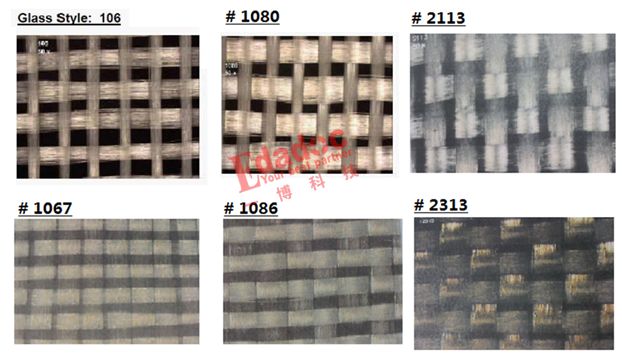
2. Classified by glass type
E-glass: E stands for electrical, meaning electrical insulating glass, which is a calcium-aluminosilicate glass with very little alkali metal oxide content (generally less than 1%), thus also known as low-alkali glass, with high resistivity. E-glass has become the most commonly used component in fiberglass, and most materials are generally made of E-glass unless otherwise specified.
NE-glass: Also known as low-Dk glass, it was developed by Nitto Denko Corporation, a low dielectric fiber glass with a dielectric constant ε (1MHz) of 4.6 (E-glass is 6.6) and a loss factor tanδ (1MHz) of 0.0007 (E-glass is 0.0012). Common materials using NE-glass include M7NE, IT968SE, and IT988GSE, etc.
3. Classified by resin system and performance used by suppliers:
-
Jiangtong KB:
KB-6168/KB-6167GMD/KB-6167GLD/KB-6167F, etc.
-
Lianmao Iteq: IT180A/IT170GRA1/IT958G/IT968/IT968SE/IT988GSE -
Taiyao Tuc: Tu862HF/Tu872LK/Tu872SLK/Tu872SLK-SP/Tu883/Tu933+ -
Panasonic: Megtron4/M4S/Megtron6/M6G/M7E/M7NE -
Park Meteorwave Series: MW1000/2000/3000/4000/8000 -
Shengyi:S1000-2(M)/ S7439/S6, etc. -
Rogers: RO4003/RO3003/RO4350B (RF materials), etc.
4. Classified by loss level
Can be divided into regular loss materials (Df≥0.02), medium loss materials (0.01<Df<0.02), low loss materials (0.005<Df<0.01), and ultra-low loss materials (Df<0.005). These are classified based on the Df value of the materials; this classification is relatively broad and is just a general classification; different people may have different classification ranges.
5. Classified by flame retardancy
Flame-retardant type (UL94-VO, UL94-V1) and non-flame-retardant type (UL94-HB level)
Finally, to emphasize, based on different loss and different manufacturers’ material names, it is primarily based on loss ratios smaller than ordinary FR4 for commonly used medium-speed boards. Ordinary FR4, such as IT180A, S1000-2/M, Tu752/768, etc., generally has little difference in Df, and these are currently the most commonly used Hi-Tg boards.
Source: PCB Network City organized from Mr. Gao’s High Speed, if there is any infringement, please contact the background, and we will handle it as soon as possible.
Recommended Hot Articles
GPCA Second Session Third Member Conference / SPCA Third Session Third Member Conference Grandly Held
[Innovation, Sharing, Towards the Future] Many Industry Experts Gather at PCB Technology and Management Forum
[Industry Model] PCB Industry Lifetime Achievement Award Ceremony Successfully Held
[Enterprise Dynamics] Shantou City CPPCC Chairman Xie Zesheng and other leaders visited Hongli Electronics Technology Park for research
[Enterprise Honor] Chongda Technology Awarded Bosch (Zhuhai) “Supplier Performance Commendation” Award
[Review] Jiangmen PCB Enterprise Directory
[Project Construction] Shenzhen Nantong Phase II Expected to Be Put into Production in Mid-2020, Mainly for 5G Communication Products
[Research Report] Super Hua Technology 5G Layout: Industry-Academia-Research Collaboration Achieves Stage Results
[Law Enforcement] Meizhou City Ecological Environment Bureau Organized Special Cross-Inspection Action for Circuit Board (Electroplating) Enterprises
28 PCB Industry Enterprises Listed in Guangdong Manufacturing 500 Strong