A new passive Wi-Fi sniffing attack technique called U-Print has emerged. It can identify specific smartphone users with an astonishing 98.4% accuracy by analyzing the wireless layer metadata of encrypted Wi-Fi traffic (such as packet size, time intervals, and transmission direction) without decrypting the traffic or breaking MAC address randomization defenses. This technology, proposed by Chinese researchers, poses a serious challenge to current mainstream Wi-Fi security assumptions.
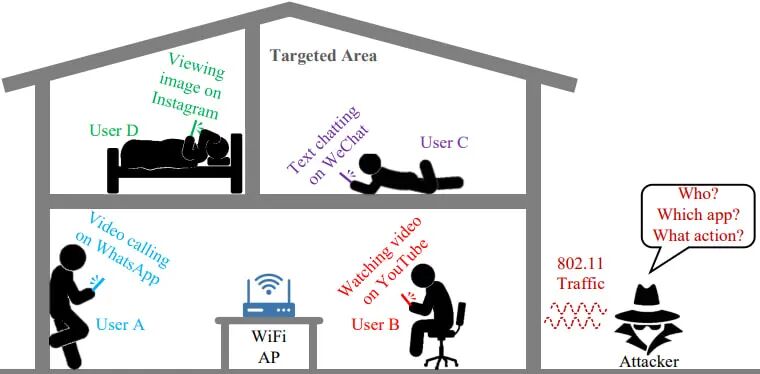
U-Print Threat Model
01
Threat Model:
No network access required, sniffing can profile
The attack scenario for U-Print is highly realistic: an attacker only needs to place a passive Wi-Fi sniffer (such as a laptop equipped with a specific network card) within the wireless signal coverage area of the target environment (such as an office, café, or home). The attacker does not need to know the Wi-Fi password or connect to the target network; they only need to be physically close to the target area to start capturing 802.11 data frames transmitted over the air.
● Beyond Application Identification: Unlike previous attacks that focused on identifying which applications were running on devices or required IP layer access, U-Print operates entirely at the wireless MAC layer.
● Penetrating Dual Defenses: It bypasses the two core security barriers widely adopted by modern smartphones: WPA2/WPA3 encryption and MAC address randomization. Even with data encryption and constantly changing device MAC addresses, the attack remains effective.
● Deep Behavioral Profiling: The core of U-Print is based on the belief that users’ unique application preferences and usage habits (behavioral fingerprints) leave identifiable patterns in seemingly random MAC layer metadata. For example:
User A prefers to send text messages via WhatsApp.
User B tends to send voice messages.
Although both use the same application, the differences in their interaction methods result in subtle but distinguishable variations in packet size sequences, packet arrival time intervals, and uplink/downlink traffic ratios.
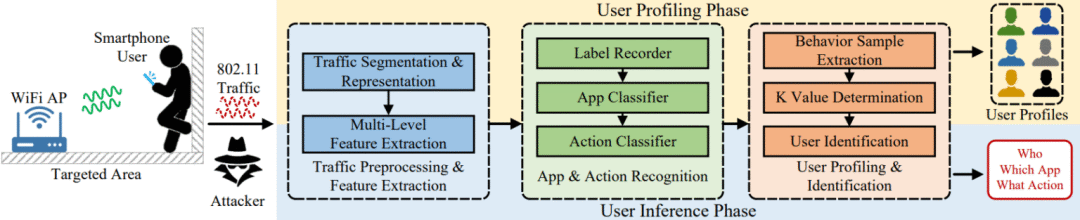
User Analysis
02
U-Print Technology Unveiled:
Three Steps to Identify Users
The researchers designed a sophisticated process to capture and utilize these “behavioral fingerprints”:
● Traffic Preprocessing: The sniffer captures 802.11 frames in the air, filtering out management and control frames, retaining only the data frames that carry user data. Key metadata is extracted: frame arrival timestamps, frame sizes (in bytes), and transmission directions (uplink Tx / downlink Rx).
● Application and Action Classification: An advanced temporal convolutional network is used as the core classifier. Its uniqueness lies in the integration of OpenMax technology, which provides open-world classification capabilities—allowing effective identification and categorization even when faced with new applications or actions that were never seen during training (whereas traditional methods typically perform better in closed-world settings).
●User Profiling and Identification: The processed metadata stream is converted into sequences that represent user behavior. Clustering algorithms (such as K-Means) are used to analyze the behavioral sequences, generating a “behavioral profile” for each unique user. When a new traffic session is captured, the system compares it with the existing profile database to identify the specific user, all without relying on static or pseudo-random MAC addresses.
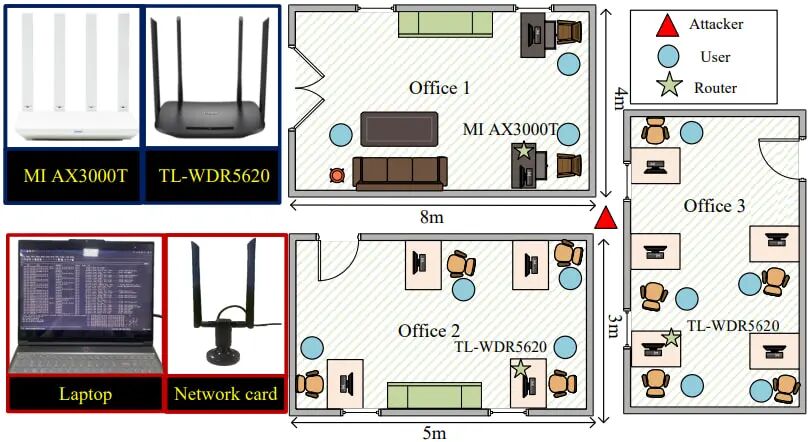
Experimental Setup
03
Experimental Results:
High-Precision Strikes in Real Environments
The research team conducted rigorous testing in a real office environment:
● Experimental Setup: A Lenovo laptop equipped with a network card supporting Monitor mode (running Kali Linux) was used to passively capture Wi-Fi traffic generated by 12 volunteer smartphones, involving 40 commonly used mobile applications.
● Amazing Accuracy:
Application Identification: The accuracy in a closed world (known applications) reached 98.7%; in an open world (including unknown applications), the accuracy was still 87.6%.
Action Identification: The accuracy for closed world (known actions such as sending text/voice) was 96.8%; in the open world, it was 86.1%.
User Identification: With MAC address randomization enabled, the identification accuracy for 12 users reached 98.4%, with an F1 score (a comprehensive measure of precision and recall) as high as 0.983.
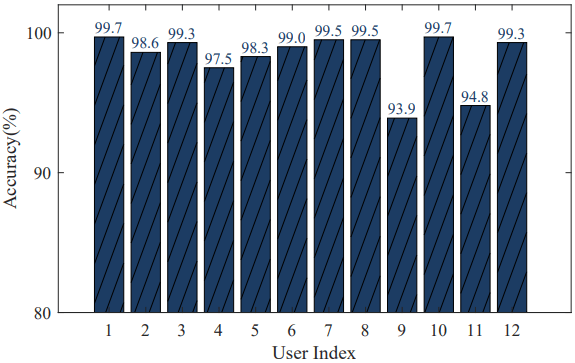
Identification Accuracy for 12 Volunteers
Despite common real-world challenges, the system’s performance remains robust, for example:
Tolerance to Packet Loss: It can tolerate up to 15% packet loss with only a slight decrease in performance.
Resistance to Background Noise: Even when the target device runs multiple applications generating mixed traffic, it can still accurately identify the target user and their primary behavior.
Environmental Universality: Testing in three different office locations showed highly consistent identification performance.
04
Security Implications:
Encryption and Randomization Are Not Panaceas
The findings of U-Print reveal a severely underestimated threat dimension in the current wireless security landscape:
● The Lethality of Metadata Leakage: Even if data content is strongly encrypted (such as WPA3), and even if device MAC addresses are effectively randomized, the information carried by the communication patterns themselves is sufficient to create powerful behavioral fingerprints for precise user tracking and profiling.
● Escalation of Privacy Leakage: Attackers can not only know “who” is using the device but also “what applications are being used” and “what actions are being taken within the applications.” Long-term monitoring combined with data analysis may further infer extremely sensitive personal attributes such as the user’s age, gender, occupational habits, and even mental health status.
● Defense Strategies Urgently Need Innovation: Traditional protective strategies relying on encryption and MAC randomization are no longer sufficient to counter such passive sniffing attacks based on behavioral patterns.
05
Countermeasures:
Exploring Possible Defense Paths
Although U-Print is currently mainly in the research demonstration stage, the risks it reveals require the industry to actively seek countermeasures:
● Traffic Obfuscation/Shaping: Introduce technologies that actively modify the timing characteristics and packet size distribution of traffic, such as adding padding bytes, introducing random delays, and standardizing packet sizes, to disrupt the uniqueness of behavioral fingerprints.
● Strengthening MAC Randomization Strategies: Although U-Print is effective under randomization conditions, more frequent and thorough randomization (such as randomizing per packet or per connection) remains a fundamental and necessary defense layer that can increase the difficulty for attackers to correlate traffic.
● Mixed Behavioral Signals: Encourage users to consciously mix different types of applications and interaction methods, or run applications that generate “harmless noise” in the background, to homogenize behavioral patterns and reduce the distinctiveness of fingerprints.
● Protocol Layer Improvements: In the long run, it may be necessary to design new wireless communication protocols or modify existing standards to fundamentally reduce or obscure the information in metadata that can be used for behavioral analysis.
The findings of U-Print serve as a wake-up call, reminding us that wireless network security remains a dynamic battlefield of offense and defense. The researchers’ exploration at the forefront of passive wireless sniffing not only demonstrates the astonishing potential of attack techniques but also forces the industry to re-examine the inherent notion that “encryption equals security.”
In the era of the Internet of Things, protecting user privacy requires a more in-depth and intelligent defense system, from protocol design to terminal behavior management, to effectively counter increasingly sophisticated “metadata profiling” attacks. This research will undoubtedly provide crucial impetus for the evolution of next-generation wireless security standards.
Source: arxiv.org
Source: Security Guest
The technologies, ideas, and tools mentioned in the articles published or reprinted by Heibai Zhidao are for learning and communication purposes only, and no one may use them for illegal purposes or for profit; otherwise, they will bear the consequences themselves!
If there is any infringement, please contact us to delete the article
END