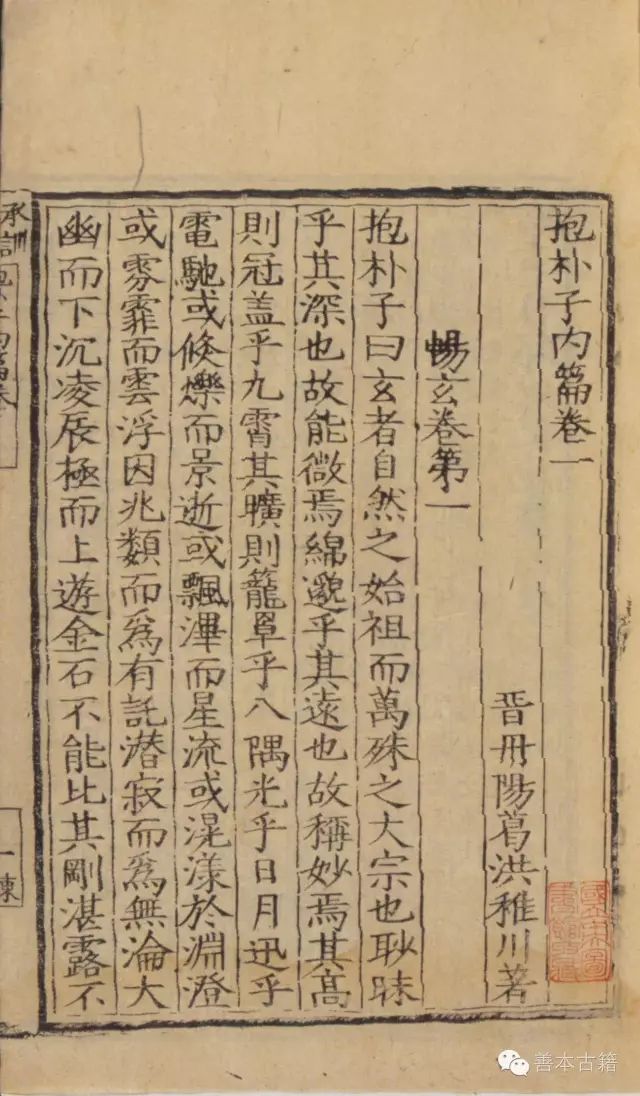
 After the emergence of Baopuzi, it was recorded in historical texts, passed down through official channels, stored in various levels of academies and schools, as well as specialized libraries at both central and local levels, and widely circulated among bibliophiles and scholars in society. Therefore, since the “Sui Shu • Jing Ji Zhi”, various historical texts, official records, and private bibliographies have extensively documented this book. Many copies of Han texts have been transmitted overseas, and Baopuzi is no exception, with the majority found in Japan; bibliographies from Japan, the United States, and other foreign countries also record Baopuzi. In this section, we will examine the documentation of Baopuzi editions throughout history based on historical texts and public and private bibliographies, as this serves as a foundational basis for further in-depth research into the relationships between various versions of Baopuzi and the exploration of its version system. Based on what we have observed, we will investigate the documentation of Baopuzi from the following five aspects in historical texts, official records, private collections, and overseas bibliographies, using this as supplementary and reference material for studying the versions of Baopuzi.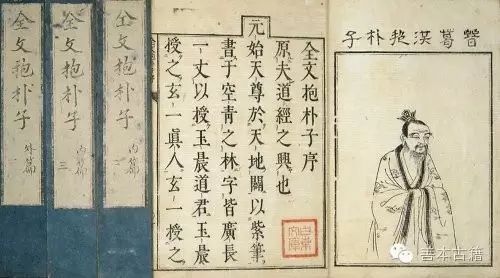
1. Investigation of Versions of Baopuzi That Have Been Lost in Historical Records
From the documentation of Baopuzi in various historical bibliographies, we find that some records do not match the currently existing mainstream edition system, which consists of twenty volumes of “Inner Chapters” and fifty volumes of “Outer Chapters”. The number of volumes recorded differs, either more or less than the current editions. The reasons for this situation are complex; it may be due to the loss of certain parts of the ancient mainstream editions during transmission, or it may relate to a different version system distinct from the current mainstream editions, or it could even result from recording errors, among other possibilities. However, overall, we have extracted these records from historical bibliographies, and this is very beneficial for verifying the status of lost editions of Baopuzi and exploring the original appearance of the text.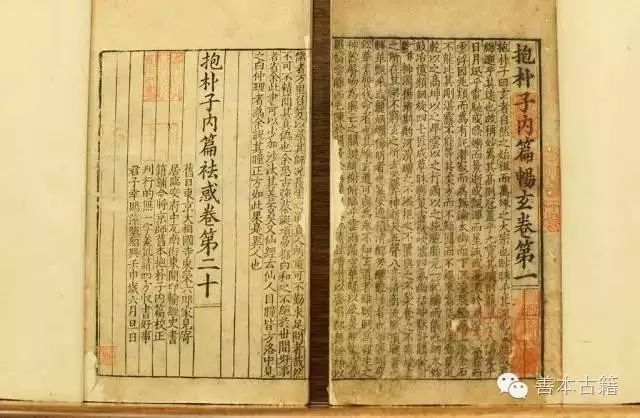
(1) Song Edition
Regarding the Song edition, both the Qing scholar Ji Zhenyi’s “Ji Cangwei Collection Catalog” and Xu Qianxue’s “Chuan Shi Lou Song Yuan Ben Catalog” have documented it. The Ji’s bibliography records: Baopuzi twenty volumes, five copies, Weng Ba; Song edition of Baopuzi twenty volumes. The Xu’s bibliography records: Song edition of “Baopuzi Inner Chapters” twenty volumes, five copies; Song edition of “Baopuzi Inner Chapters” twenty volumes, Ge Hong, ten copies. It can be seen that two Song versions of Baopuzi existed in the Qing dynasty, one being a five-volume set stored in the Liaoning Library, dating back to the Southern Song Dynasty, Shaoxing year 22 (1152), the Rong Liulang edition, while the other ten-volume Song edition of “Baopuzi Inner Chapters” has been lost.
(2) Yuan Edition
As for the Yuan edition, the modern scholar Luo Zhenchang compiled the “Zi Yi Yue Zhai Collection Catalog” (one volume), which includes a record. Its record states: “Baopuzi Outer Chapters” two volumes, two copies, authored by Jin Ge Hong, Yuan edition. Mr. Luo Zhenchang mentioned in the preface of the “Zi Yi Yue Zhai Collection Catalog”: “More than ten years ago, I obtained a copy of the collection catalog from the Yi family in Gusu, which contained a manuscript of the ‘Zi Yi Yue Zhai Catalog’. I do not know who the owner was; the collection was small but contained many rare books, and the records and verifications are indicative of knowledge, not something that a person of ignorance could achieve. The book had a red sticker, indicating that it was likely for sale by the Yi family… or perhaps the owner did not want to reveal their identity and falsely attributed it to a zhai name, which cannot be ruled out.” Luo’s view that “the name was falsely attributed for sale” is one perspective regarding the origins of this bibliography; another view suggests that it was authored by Zhang Dayong from Changshu. In other words, the Yuan edition of Baopuzi Outer Chapters once belonged to Zhang. If the record is accurate, then this Yuan edition has been lost.
(3) Inner Chapters
Regarding the Inner Chapters, there are also two versions: one with thirty volumes and another with ten volumes. The thirty-volume Inner Chapters are recorded in the Qing scholar Zhu Xueqin’s “Jie Yi Lu Catalog” (four volumes) as a manuscript. Its record states: “Baopuzi Inner Chapters” thirty volumes, “Outer Chapters” fifty volumes, totaling four books, authored by Jin Ge Hong, Ming manuscript.
The “New Tang Records” records the ten-volume Inner Chapters, stating: “Daoist ‘Baopuzi Inner Chapters’ ten volumes, Ge Hong; miscellaneous ‘Baopuzi Outer Chapters’ twenty volumes, Ge Hong.” Judging by the number of volumes, this Inner Chapters and Outer Chapters may not be complete. In the Qing dynasty, Qian Qianyi’s “Jiangyun Lou Catalog” (four volumes) also records the ten-volume Inner Chapters, stating: “Baopuzi” ten volumes, “Baopuzi Outer Chapters” twenty volumes. This record completely matches that of the “New Tang Records”; it is unknown whether it is the same version. Unfortunately, it is no longer extant.
(4) Outer Chapters
Regarding the Outer Chapters, there are five versions: fifty-one volumes, forty-five volumes, thirty volumes, twenty volumes, and ten volumes. The fifty-one volume Outer Chapters are recorded in the “Sui Records”, stating: “Baopuzi Outer Chapters” thirty volumes, authored by Ge Hong, Liang has fifty-one volumes.” Thus, it can be seen that there were still fifty-one volumes of Outer Chapters during the Liang dynasty.
Compiled in 1936, the “Jiangsu Provincial Library Catalog Supplement” records the forty-five volume Outer Chapters, stating: “Baopuzi Inner Chapters” twenty volumes, “Outer Chapters” forty-five volumes, and two volumes of lost texts, authored by Jin Dan Yang Ge Hong.”
The thirty-volume Outer Chapters first appeared in the “Sui Records”, stating: “Daoist ‘Baopuzi Inner Chapters’ twenty-one volumes, Yin one volume, authored by Ge Hong; miscellaneous ‘Baopuzi Outer Chapters’ thirty volumes, authored by Ge Hong, Liang has fifty-one volumes”; it also appears in Ming scholar Jiao Hong’s “National History • Jing Ji Zhi”, stating: “Daoist ‘Baopuzi Inner Chapters’ twenty volumes, Ge Hong, and ‘Outer Chapters’ thirty volumes.”
The twenty-volume Outer Chapters have been recorded from the Tang and Song dynasties to the Qing dynasty. The “New Tang Records” records: “Daoist ‘Baopuzi Inner Chapters’ ten volumes, Ge Hong; miscellaneous ‘Baopuzi Outer Chapters’ twenty volumes, Ge Hong.” The Song dynasty official catalog “Chongwen Zongmu” also has the twenty-volume Outer Chapters recorded, stating: “Daoist ‘Baopuzi Inner and Outer Chapters’ twenty volumes, authored by Ge Hong; miscellaneous ‘Baopuzi Outer Chapters’ twenty volumes, authored by Ge Hong.” Qing scholar Qian Qianyi’s “Jiangyun Lou Catalog” and Zhu Xueqin’s “Separate Edition of Jie Yi Lu Catalog” also recorded the twenty-volume Outer Chapters, among which the Jie Yi Lu contains a Ming manuscript of the Outer Chapters, which consists of two volumes.
From the Song to the Ming dynasty, there were also ten volumes of Outer Chapters. Song scholar Chao Gongwu’s “Junzai Reading Records” states: “Hong, whose name is Zhi Chuan, was from Danyang, Jurong. During the Yuan dynasty, he was repeatedly summoned but did not respond. He only refined alchemy on Mount Luofu, authored books promoting the path of ascension, guiding and nourishing principles, and matters of Huang and Bai. The twenty-volume is named ‘Inner Chapters’, and the ten-volume is named ‘Outer Chapters’. He called himself Baopuzi, hence the name of the book.” Yuan scholar Ma Duanlin’s “Wenxian Tongkao • Jing Ji Kao” also records ten volumes of “Baopuzi Outer Chapters”.
In the Ming dynasty, Chen Di’s “Shishan Tang Collection Catalog” (one volume) recorded ten volumes of “Baopuzi Outer Chapters” in the category of various schools and families.
In addition, Qing scholar Chen Kui’s “Ji Rui Lou Catalog” (one volume) recorded Xu Liangfu’s edited version of “Baopuzi” (eight volumes) in four volumes, which is a combined edition of the Inner and Outer Chapters, suggesting that this book has been lost. Moreover, there are extant copies, but some content has been lost. For example, the Song edition of “Baopuzi Inner Chapters”, Rong Liulang’s edition, exists in eighteen volumes, with two lost volumes being supplemented. Additionally, Ming scholar Ye Sheng’s Luzhutang has a three-volume “Baopuzi”, and the Shanghai Library holds a Ming manuscript of “Baopuzi Outer Chapters”, which consists of one volume, possibly representing a surviving part of this book.
2. Analysis of Errors in the Documentation of Baopuzi Throughout History
Ancient bibliographies are one of the important mediums through which we can gain a general understanding of the transmission and preservation status of ancient texts today. However, while we utilize ancient bibliographies for academic research, we also discover their own omissions and even errors. Here are a few examples for brief analysis:
(1) Examples of Incorrect Characters
1. Zhang Yuanji’s compilation of the “Hanfen Lou Collection Catalog” records: Daoist “Baopuzi Inner and Outer Chapters” authored by Jin Ge Hong, the Pingjin Pavilion edition, eight copies, and the Baishi Tang published edition, four volumes. The character “Shi” in “Baishi Tang” is an incorrect character for “Jun”. In the “Supplement” of this bibliography, it was changed to “Baijun Tang Collection Edition”.
2. Qing scholar Xu Bingyi’s collection and compilation of the “Peilin Tang Catalog” records: Daoist “Baopuzi” (eight volumes), two copies, and the “Pu” chapter five volumes. Here, “Pu” is suspected to be an error for “Bu”.
3. Qing scholar Mo Youzhi’s compilation of the “Xuting Zhi Jian Zhuan Bibliography” (sixteen volumes) records: Daoist “Baopuzi Inner and Outer Chapters” eight volumes, authored by Ge Hong, Jia Jing Ding Chou Lu Zao edition. Here, “Ding Chou” should be “Yi Chou”, and “Lu Zao” should be “Lu Fan”.
4. Song scholar Chao Gongwu’s “Junzai Reading Records” records: “Baopuzi Inner Chapters” twenty volumes, “Outer Chapters” ten volumes. It is suspected that “ten volumes” of the Outer Chapters should be an error for “twenty volumes”, because the explanation states: “The current transmission consists of only forty chapters”, which should total forty chapters, with the Inner Chapters being twenty volumes, thus the Outer Chapters should also be twenty volumes.
(2) Examples of Added Text
In the compilation of the “Chongwen Zongmu” (seven volumes, appendix and supplements) by Song scholars Wang Yaochen and Ouyang Xiu, it records: Daoist “Baopuzi Inner and Outer Chapters” twenty volumes, authored by Ge Hong, and miscellaneous “Baopuzi Outer Chapters” twenty volumes, authored by Ge Hong. Among them, the “Inner and Outer Chapters” of “Baopuzi” is suspected to have “Outer” as an added character, because there are later miscellaneous versions of the “Outer Chapters” with another twenty volumes. It is confirmed in You Mao’s “Suichu Tang Bibliography” that there indeed exists a “Baopuzi Inner and Outer Chapters”, which is a combined edition of the Inner and Outer Chapters. However, the records in the historical texts such as the “Sui Records”, “Old Tang Records”, and “Song Records” all match this volume count. Moreover, from a content perspective, the “Inner Chapters” discuss matters of immortality, belonging to Daoism; while the “Outer Chapters” refute and interpret, belonging to miscellaneous schools. In summary, this should be the “Baopuzi Inner Chapters” twenty volumes, and “Outer” is an added character.
3. Overview of the Extant Forms of Baopuzi in Historical Documentation
Since the composition of Baopuzi, different historical periods have seen the emergence of various extant forms, including single editions of the Inner Chapters, single editions of the Outer Chapters, and combined editions of Inner and Outer Chapters. Based on the differences in published content, these can be divided into single editions of the Inner Chapters, single editions of the Outer Chapters, and combined editions of Inner and Outer Chapters. Before the Ming dynasty, bibliographical works mostly recorded single editions of the Inner and Outer Chapters. For example, the “New Tang Records”, “Song Records”, “Junzai Reading Records”, “Chongwen Zongmu”, and “Wenxian Tongkao • Jing Ji Kao”. However, there are also records of combined editions of Inner and Outer Chapters. For instance, the Song scholar You Mao’s “Suichu Tang Bibliography”.
During the Ming and Qing dynasties, bibliographical works predominantly recorded combined editions of Inner and Outer Chapters. For example, the Ming “Zhao Dingyu Catalog”, “Mai Wang Guan Catalog”, and others; Qing works like “Siku Quanshu Zongmu”, “Peilin Tang Catalog”, and “Chijing Zhai Catalog” also recorded this. However, there are also records of single editions; both the Qing “Ji Cangwei Collection Catalog” and “Chuan Shi Lou Song Yuan Ben Catalog” have documented single editions of the Inner Chapters; the “Separate Edition of Jie Yi Lu Catalog”, “Qun Bi Lou Good Edition Catalog”, “Zi Yi Yue Zhai Collection Catalog”, and “Beijing Library Good Edition Catalog Supplement” have all recorded single editions of the Outer Chapters.
This phenomenon can be attributed mainly to a fundamental change in the publication of Baopuzi starting from the Ming dynasty, where earlier separate publications of Inner and Outer Chapters were transformed into combined editions of Inner, Outer, and other chapters published in one book. This change in publication format is directly reflected in bibliographical works, and the content recorded in bibliographies has also changed accordingly.
Thus, in the bibliographies documenting the version status of Baopuzi, we should particularly note two types of versions: one is the combined editions of Inner and Outer Chapters before the Ming dynasty; the other is the single editions of Inner and Outer Chapters during the Ming and Qing dynasties. Both of these version forms differ from the mainstream version forms of their respective periods.
Before the Ming dynasty, bibliographies recording combined editions of Inner and Outer Chapters are relatively rare. The Song scholar You Mao’s “Suichu Tang Bibliography” records: Daoist “Baopuzi Inner and Outer Chapters”. This record is simple, making it difficult to determine which version it is. However, it should be a combined edition of Inner and Outer Chapters, which is a typical record of a combined edition. If the record is accurate, this may indicate that a combined edition was already circulating in the Song dynasty, but unfortunately, this version is no longer extant.
In the Ming and Qing dynasties, there are more records of single editions of Inner and Outer Chapters compared to the previous ones, and there are extant copies of this type. These versions may be ancient copies from the Song and Yuan dynasties circulating in the Ming and Qing periods, or they may belong to different version systems from the majority of versions in the Ming and Qing. From these versions, we can glimpse certain version forms and conditions that differ from the current mainstream editions. Below, we briefly analyze two examples.
The Qing “Ji Cangwei Collection Catalog” and “Chuan Shi Lou Song Yuan Ben Catalog” both record single editions of the Inner Chapters, which are ancient copies from the Song dynasty. Among them, the five-volume set—the Southern Song Rong Liulang edition—exists today. Its version form differs from the combined editions of Inner and Outer Chapters commonly used in the Ming and Qing. The Rong Liulang edition’s format features fifteen lines per half page, with twenty-eight characters per line, which is a typical small-character edition. In contrast, the Ming and Qing versions typically have ten lines per half page, with about twenty characters per line being the mainstream format. Baopuzi is no exception; the Ming Lu Fan edition, Ming Lu Shun Zhi’s edited edition, and Qing Sun Xingyan’s collection edition are all combined editions of Inner and Outer Chapters; among them, the Lu Fan edition has nine lines per half page, with twenty characters; the Lu Shun Zhi’s edited edition also has nine lines per half page, with twenty characters; and Sun Xingyan’s collection edition has eleven lines per half page, with twenty characters. In terms of content, there are also significant differences. Taking the widely circulated Lu Shun Zhi’s edited edition from the Ming dynasty as an example, there are 157 instances of text in the Rong Liulang edition that are not present in Lu Shun Zhi’s edited edition, and these can be found throughout each volume; not only are there characters and words, but there are also large passages of text. Conversely, there are 323 instances of text found in the Rong Liulang edition that are absent in Lu Shun Zhi’s edition, including not only characters and words but also complete sentences, with as many as 39 complete sentences, along with two lines of editorial comments. The number of cases where the word order changes within sentences, as well as completely different sentences, is even more numerous and cannot be counted. From this, it is evident that in terms of the internal textual content of the versions, there are significant differences between single editions and combined editions.
Another single edition from the Ming dynasty—the Ming Ji Fan edition—exhibits similar differences. The Ji Fan edition is a single edition of the Outer Chapters, and it differs significantly from the combined editions of Inner and Outer Chapters in the Ming and Qing. This edition is divided into two volumes, with twenty-four chapters in the upper volume and twenty-five chapters in the lower volume. In contrast, the combined editions of Inner and Outer Chapters in the Ming and Qing often have one chapter per volume, totaling fifty volumes, as seen in the Ming Lu Fan edition and Qing Sun Xingyan’s collection edition; or several chapters combined into one volume, totaling four volumes, as seen in the Ming Shen Mao Guan edition, Ming Lu Shun Zhi’s edited edition, and the edition published in 1912 by the Hubei Government Printing Office. Specifically, taking Lu Shun Zhi’s edited edition as an example, this edition is divided into four volumes, with the first volume including: “Jia Dun”, “Yi Min”, “Qu Xue”, “Chong Jiao”, “Jun Dao”, “Chen Jie”, “Liang Gui”, “Shi Nan”, “Guan Li”, “Wu Zheng”, “Gui Xian”, “Ren Neng”, “Qin Shi”, and “Yong Xing”, totaling fourteen chapters; the second volume includes: “Shen Ju”, “Jiao Ji”, “Bei Que”, “Zhuo Cai”, “Ren Ming”, “Ming Shi”, “Qing Jian”, “Xing Pin”, “Mi Song”, “Jiu Jie”, and “Zhi Miu”, totaling eleven chapters; the third volume includes: “Ji Huo”, “Ci Jiao”, “Bai Li”, “Jie Shu”, “Jun Shi”, “Sheng Fan”, “Shang Bo”, “Han Guo”, “Wu Shi”, “Shou Tian”, “An Pin”, “Ren Ming”, and “Bo Yu”, totaling thirteen chapters; the fourth volume includes: “Guang Pi”, “Ci Yi”, “Xun Ben”, “Ying Chao”, “Yu Bi”, “Bai Jia”, “Wen Xing”, “Zheng Guo”, “Dan Ni”, “Zhi Bao”, “Zhi Zhi”, “Qiong Da”, “Chong Yan”, and “Zi Xu”, totaling fourteen chapters. In addition, the Ji Fan edition’s version form also differs from the combined editions of Inner and Outer Chapters in the Ming and Qing. A prominent feature of the Ji Fan edition’s format is that punctuation often appears between words, such as commas or periods; the chapters “Bo Yu”, “Guang Pi”, and “Ci Yi” contain spacing symbols “O”, with the first two chapters using spacing symbols quite frequently; the “Ci Yi” chapter contains two occurrences of “O”; the formatting is inconsistent, with double black fish tails appearing on pages seventy-five, seventy-seven, and seventy-nine. These features are absent in the combined editions of Inner and Outer Chapters in the Ming and Qing. More importantly, the textual content of the Ji Fan edition also exhibits significant differences from the combined editions of Inner and Outer Chapters in the Ming and Qing. The most notable characteristic of the Ji Fan edition’s text is that the twenty-third chapter “Mi Song” explicitly states, “The text is not elegant and is edited”; it lacks the chapters “Bai Jia” and “Wen Xing”. In contrast, the combined editions of Inner and Outer Chapters in the Ming and Qing consist of fifty chapters, with “Mi Song”, “Bai Jia”, and “Wen Xing” all present.
In summary, in terms of the extant forms of Baopuzi, the single editions and combined editions recorded in historical bibliographical works exhibit significant differences in both external version forms and internal textual content. These differences are important documentary materials for studying the relationships between various versions of Baopuzi and organizing the version system.
4. Brief Examination of Versions of Baopuzi Not Noted in Historical Documentation
In historical bibliographical works, especially modern bibliographies, many records of Baopuzi include version notes. However, there are also records that do not specify the version. We will examine these based on visual inspection or related information.
(1) Determining Versions Based on Visual Inspection
The Qing scholar Ji Zhenyi’s “Ji Cangwei Collection Catalog” does not note the version. This is the Southern Song Rong Liulang edition currently housed in the Liaoning Provincial Library, which has the bookplate “Ji Zhenyi Collection” and “Yushi Zhenyi’s Seal” as evidence.
The “Shanghai Cultural Relics Management Committee Good Edition Catalog” records: “Newly Printed Baopuzi Inner Chapters” four volumes, “Outer Chapters” four volumes. The version situation is not noted. This copy has a missing text in the preface of “Baopuzi”. The next page’s volume end title reads “Newly Printed Baopuzi Inner Chapters Volume One”, titled “Edited by Zhang Keda, Reviewed by Shen Mao Guan”. It bears seals “Li Xuan Kou Seal”, “Hezhong Library Collection Seal”, and “Shanghai Library Collection Seal”. This copy is currently stored in the Shanghai Library and is verified to be the Ming Shen Mao Guan edited edition.
The “East China Normal University Ancient Books Catalog” records: Daoist “Ge Zhi Chuan Inner Chapters” four volumes, “Outer Chapters” four volumes, authored by Jin Ge Hong, Ming published edition. It only notes “Ming published edition” without specifying the specific version situation. This copy consists of eight volumes, with nine lines per half page and twenty characters per line. The left and right sides are double margins, with white edges and single fish tails, the title on top reads “Baopuzi”, and the volume page number is inscribed with “Inner” or “Outer”. It has Zhu, blue, and black hand-written annotations; the author’s preface is not annotated, and it is signed “Lingjia Mountain People”. Seals include “Gu Zengshou”, “Yu Zhai Library Collection”, and “East China Normal University Library”. This copy has no specific printing date, estimated to be from the Ming Jiajing or Wanli periods.
(2) Inferring Versions Based on Clue Words or Related Information in the Records
The Ming “Xingren Si Heavy Printing Catalog” records: “Baopuzi” ten copies. The record is simple, and no version is noted. In the thirty-year reign of the Ming Shenzong Wanli (1602), the Xingren Si published the Lu Fan edition, which consists of ten volumes. Kong Jihuan’s Weibo Pavilion once housed the Lu Fan edition, and this edition later entered Fu Zengxiang’s Shuangjian Pavilion. Fu Zengxiang described in the “Shuangjian Pavilion Good Edition Catalog”: “Ming Jiajing Yi Chou Lu Fan Chengxun Academy published edition, nine lines and twenty characters, the Kong family’s Weibo Pavilion collection has a red seal indicating the Xingren Si’s publication, confirmed by the Wanli Wu Shen Spring inspection, and verified by the Wanli Xin Hai Autumn inspection by the Xingren Si’s chief inspector Fan Yu.” Based on this, it can be inferred that the version recorded in the “Xingren Si Heavy Printing Catalog” is the Ming Lu Fan edition.
In 1919, the “Beijing Library Good Edition Catalog Supplement” recorded: “Baopuzi Outer Chapters” two volumes, purchased by the museum, authored by Jin Ge Hong, Ming Chongde Academy edition, two copies, Ming published edition. The Ming Chongde Academy published edition is the Ji Fan edition published in the sixth year of Wanli (1578).
In 1913, the “National Beiping Library Good Edition Catalog” recorded: “Twenty Families of Scholars, Twenty-nine Volumes”, edited by Ming Xie Qisheng, Ming Wanli published edition, “Baopuzi” two volumes. This copy is the Ji Fan edition published in the sixth year of Wanli (1578).
The Qing scholar Ni Mo’s “Jiang Shang Yun Lin Ge Catalog” records: “Inner Chapters” twenty volumes, two copies, Sun’s edited edition. The Qing Gu Guangqi’s “Si Shi Zhai Ji Wai Shu Ba Lu Mu” records: “Baopuzi Outer Chapters” fifty volumes, Sun’s published edition. The former is Sun Xingyan’s Pingjin Pavilion published single edition of the Inner Chapters, while the latter is the Pingjin Pavilion’s single edition of the Outer Chapters.
(3) Photocopies of Baopuzi in Collections
In modern times, the “Kong De School Library Chinese Books Catalog” records: “Baopuzi Inner Chapters”, “Outer Chapters” authored by Jin Ge Hong, six volumes, Ming published edition (four-part series photocopy). The “National Beiping Library Good Edition Catalog B” published in 1935 records: “Baopuzi Inner Chapters” twenty volumes, “Outer Chapters” fifty volumes, authored by Jin Ge Hong, four-part series edition (Wang Guowei edited). The “Huazhong Normal University Library Ancient Books Catalog” published in 1959 records: “Baopuzi” (Jin) Ge Hong, Hanfen Lou photocopy, 1920; “Baopuzi” (Jin) Ge Hong, four-part series edition, 1922. The three bibliographies recording the “Four-part series” and the Hanfen Lou photocopy of “Baopuzi” are all based on the Lu Fan edition published in the forty-fourth year of Jiajing (1565).
The “1911-1984 Photocopy Good Edition Catalog” records: “Baoyan Tang Secret Manuscript”, edited by Ming Chen Jiru, stone print edition from 1922 Shanghai Civilization Bookstore. This includes “Ge Zhi Chuan Inner Chapters” four volumes, “Outer Chapters” four volumes, which is the Ming Lu Shun Zhi edited edition.
The “National Cultural Palace Library Ancient Books Catalog” records: “Baopuzi Inner Chapters” twenty volumes, “Outer Chapters” fifty volumes, along with eight other sections, authored by Jin Ge Hong, 1924 Shanghai Saoye Mountain House stone print edition, eight volumes. This base text is the Hubei Bureau published edition from the first year of Guangxu (1875).
5. Brief Commentary on the Documentation of Baopuzi
Historical texts, public and private catalogs, and various modern bibliographic institutions have extensively documented Baopuzi, with numerous records. According to incomplete surveys, I have reviewed over three hundred bibliographies, and more than one hundred of them contain records of Baopuzi, indicating its wide circulation throughout history.
In general, the documentation of Baopuzi before the Ming dynasty was relatively brief. For instance, the “Suichu Tang Bibliography” only records the book title; the “Wenyan Pavilion Bibliography” merely notes “one volume, three copies”, etc. However, there are also more detailed records, such as the “Junzai Reading Records”, which separately records the number of volumes, authors, and content descriptions under the book title. In the Qing dynasty, alongside the rise of textual research, the level of bibliographic version studies reached unprecedented heights. The number of bibliographic works documenting Baopuzi increased significantly, and the content became more detailed, with the “Siku Quanshu Zongmu” being a prominent representative. The “Siku Quanshu Zongmu” records the Ming Wucheng Lu Shun Zhi edited edition, providing a brief introduction to the publication process and content of the Lu Shun Zhi edition, and it briefly comments on the merits and demerits of the version. Furthermore, it discusses the reasons for both the Inner and Outer Chapters being classified under Daoism, stating, “Ultimately, its main idea is also based on Huang and Lao.”
Additionally, the introduction selectively examines the documentation of Baopuzi in various historical bibliographies, clarifying its source evolution and changes. The level of private cataloging in the Qing dynasty was also superior to that of previous generations. Mo Youzhi’s “Xuting Zhi Jian Zhuan Bibliography” recorded a total of eight versions of Baopuzi from the Ming and Qing eras. In the “Cangyuan Dingbu Xuting Zhi Jian Zhuan Bibliography”, it not only introduced the Dunhuang unearthed fragments of Baopuzi but also provided detailed descriptions of the version forms of the Lu Fan edition, Shen Mao Guan edition, Lu Shun Zhi edited edition, and others, preserving valuable bibliographic materials. Qing scholars Ji Zhenyi and Xu Qianxue also documented Song editions in their bibliographies, which are extremely precious. In modern times, the bibliographies of large bibliophiles, such as Fu Zengxiang’s records, are the most comprehensive, documenting a total of five versions of Baopuzi in his “Cangyuan Qunshu Title Records”, “Shuangjian Pavilion Good Edition Catalog”, and “Cangyuan Qunshu Jingyan Records”: Ming Lu Fan edition, Ming Lu Shun Zhi edited edition, two Ming manuscripts, and the Ming Huiji Niushi Shixue Lou manuscript. Detailed descriptions of the version forms of each edition are provided. In modern library bibliographies such as “Peking University Library Collection of Ancient Books Good Edition Catalog”, “Beijing Library Ancient Books Good Edition Directory”, and “National Library Good Edition Catalog”, the documentation of various versions of Baopuzi is comprehensive and detailed, and there is no need to elaborate further.
If you wish to participate in discussions related to ancient texts, please reply to the 【Good Ancient Books】 public account message: Group Chat
Welcome to join the Good Ancient Books Learning Exchange Circle