Overview of 108 Core High-Frequency Python Vocabulary
1. Common Built-in Functions
- print: Implements printing or output functionality
- len: Used to get length
- type: Determines data type
- input: Implements input functionality
- range: Generates a range of numbers
- str: Handles string types
- int: Handles integer types
- float: Handles floating-point types
- list: Operates on list types
- dict: Operates on dictionary types
- set: Operates on set types
- tuple: Operates on tuple types
- open: Used to open files
- sorted: Sorts elements
- sum: Calculates the total of elements
- max: Gets the maximum value
- min: Gets the minimum value
- enumerate: Enumerates elements
- zip: Merges or compresses elements
- isinstance: Determines type
- abs: Calculates absolute value
- round: Implements rounding
- help: Gets help information
- dir: Views attributes and methods
2. Keywords
- False: Represents boolean false
- True: Represents boolean true
- None: Represents null value
- and: Logical AND operation
- or: Logical OR operation
- not: Logical NOT operation
- if: Used for conditional judgment
- elif: Used for multi-condition judgment “else if”
- else: Used for conditional judgment “else”
- for: Used for iteration
- while: Used for conditional loops
- break: Exits the loop
- continue: Continues the loop
- def: Used to define functions
- return: Function return value
- class: Used to define classes
- try: Used for exception handling
- except: Used to catch exceptions
- finally: Code block executed at the end of exception handling
- import: Imports modules
- from: Imports from modules
- as: Sets alias
- with: Manages context
- lambda: Defines anonymous functions
- yield: Generator return value
- global: Declares global variables
- nonlocal: Declares non-local variables
- assert: Used for assertion debugging
- pass: Placeholder for no operation
3. String Operations
- split: Splits strings
- join: Merges strings
- strip: Removes leading and trailing spaces from strings
- format: Formats strings
- lower: Converts string to lowercase
- upper: Converts string to uppercase
4. List Operations
- append: Adds elements to the list
- pop: Pops elements from the list
- remove: Removes elements from the list
- insert: Inserts elements into the list
- index: Gets the index of list elements
5. Dictionary Operations
- keys: Gets the keys of the dictionary
- values: Gets the values of the dictionary
- items: Gets the key-value pairs of the dictionary
- get: Gets the value of the dictionary
- update: Updates the dictionary
6. File Operations
- open: Opens files
- read: Reads files
- write: Writes to files
- close: Closes files
- with: Manages file context
7. Four Basic Data Types
- int: Integer type
- float: Floating-point type
- str: String type
- bool: Boolean type
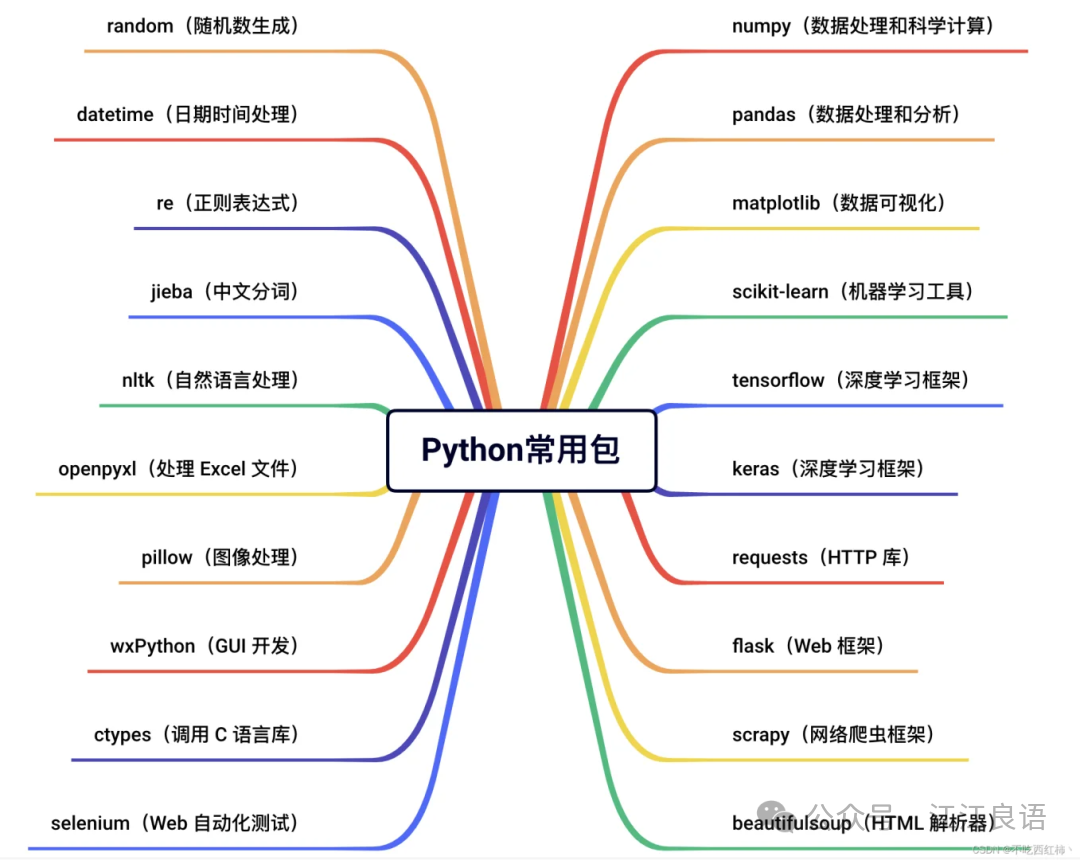
Exception Handling Unit
- try: Attempts to execute code
- except: Catches and handles exceptions
- finally: Final code block executed
- raise: Actively raises exceptions
Object-Oriented Programming (Module 1)
- class: Defines classes
- def: Defines class methods
- self: Reference to the instance itself
- __init__: Constructor of the class
- inheritance: Inheritance
- super(): Calls parent class methods
- @staticmethod: Static method decorator
- @classmethod: Class method decorator
Common High-Frequency Terms
- data: Data
- value: Value
- key: Key of the dictionary
- item: Element / Item
- index: Index
- result: Result
- output: Output
- temp: Temporary variable
- flag: Flag variable
Object-Oriented Programming (Module 2)
- arg: Argument
- kwargs: Keyword arguments
- iter: Iteration
- ctx: Context
- regex: Regular expression
- util: Utility
- config: Configuration
- init: Initialization
#Python#Python Beginner Learning#Python Learning#Python#Programming Language#Programmer